Skip to contentSkip to navigation
Guide&Travel
Favorites (0)
Sign InSign up
Guide&Travel

In-depth city guides — compare destinations, plan your budget, and discover what's nearby. In 12 languages.

support@guideandtravel.com
Bulgaria

Explore

  • Cities
  • Places
  • Events & Key Dates

General Information

  • About Flights
  • About Car Rental
  • About Travel Insurance
  • About SIM Cards
  • About Visas

Tools

  • City Comparison
  • Packing List

Support

  • Help Center
  • Contact Us
  • FAQ

Company

  • About Us
  • Blog
  • Sponsorship

Subscribe to our Newsletter

Get travel tips, exclusive deals, and inspiration delivered to your inbox.

© 2026 GuideAndTravel. All rights reserved.

Privacy PolicyTerms of ServiceCookie PolicyImage Credits
Food & Drink — Paris
CitiesParisFood & Drink

Food & Drink in Paris

Local cuisine, must-try dishes, signature restaurants, and the food culture you should know.

Paris is not a city with a big local larder of its own. Its genius is that it gathers everything: Breton oysters, Normandy butter, Auvergne cheese and Bordeaux wine all land within the same few streets. Understanding how to eat here means understanding how the city curates the rest of France.

The city also invented the restaurant as we know it. When the Revolution emptied aristocratic kitchens, their cooks opened dining rooms of their own, and haute cuisine became something anyone could buy. Two centuries later the same instinct drives the bistronomy movement: serious cooking in a thirty-seat room.

Almost every mistake visitors make here is a timing or a greeting mistake, not a taste one. Kitchens close between services, many good rooms shut on Sunday evening and Monday, and every exchange starts with bonjour. Get those right and the city opens up quickly.

Typical food & drink prices in Paris

Last updated: November 19, 2026.Prices are reviewed and refreshed at least once a month.

Average meal cost (per person)

Breakfast
€5
Lunch
€15
Dinner
€24

Common items

Breakfast

  • Croissant — flaky, buttery crescent pastry€2.50
  • Pain au Chocolat — flaky pastry with two chocolate sticks inside€2.60
  • Buttered Baguette with Jam (Tartine Beurre-Confiture) — classic café breakfast of sliced baguette with butter and jam€6
  • Apple Turnover (Chausson aux Pommes) — puff pastry turnover filled with apple compote€2.80

Lunch

  • Croque Monsieur — toasted ham and cheese sandwich topped with béchamel€11
  • Quiche Lorraine — savoury tart filled with egg custard, cream and bacon€9.50
  • Niçoise Salad (Salade Niçoise) — Nice-style salad with tuna, egg, olives and anchovies€15
  • French Onion Soup (Soupe à l'Oignon Gratinée) — caramelised onion soup topped with bread and melted cheese€10

Dinner

  • Steak Frites (Steak & Fries) — bistro classic of grilled steak served with French fries€22
  • Coq au Vin — chicken slow-braised in red wine with mushrooms and bacon€21
  • Beef Bourguignon (Bœuf Bourguignon) — Burgundy-style beef stew braised in red wine€22.50
  • Duck Confit (Confit de Canard) — duck leg slow-cooked in its own fat, then crisped€23.50

Snacks

  • Ham & Butter Baguette (Jambon-Beurre) — Paris's everyday sandwich: baguette, butter and ham€5.50
  • Sugar Crêpe (Crêpe au Sucre) — thin pancake sprinkled with sugar, a street-stand favourite€4.50
  • Parisian Macaron (Macaron Parisien) — almond-meringue sandwich biscuit with a creamy filling€2.50
  • Waffle (Gaufre) — crisp waffle from street stands, topped with sugar or chocolate€5.50
  • Chouquettes (Sugar Puff Pastries) — small choux puffs topped with pearl sugar, a bakery favourite€3.50

Desserts

  • Paris-Brest — ring of choux pastry filled with praline cream€7.50
  • Opera Cake (Gâteau Opéra) — layered almond sponge with coffee syrup, buttercream and chocolate€7.50
  • Crème Brûlée — vanilla custard under a crackly caramelised sugar crust€8.50

Other

  • Coffee (Café) — an espresso, the default "café" order in Paris(drink)€3.50
  • Hot Chocolate (Chocolat Chaud) — thick, rich hot chocolate served in Parisian cafés(drink)€5.50
  • Glass of Red Wine (Verre de Vin Rouge) — a glass of house red, standard in bistros(drink)€7
  • Kir Royal — Champagne aperitif with a dash of blackcurrant liqueur(drink)€11
  • Fresh-Squeezed Lemonade (Citron Pressé) — fresh lemon juice served with water and sugar to mix yourself(drink)€5.50

Approximate prices, updated periodically. Actual costs may vary.

Restaurants and food addresses

Selected places across every price level

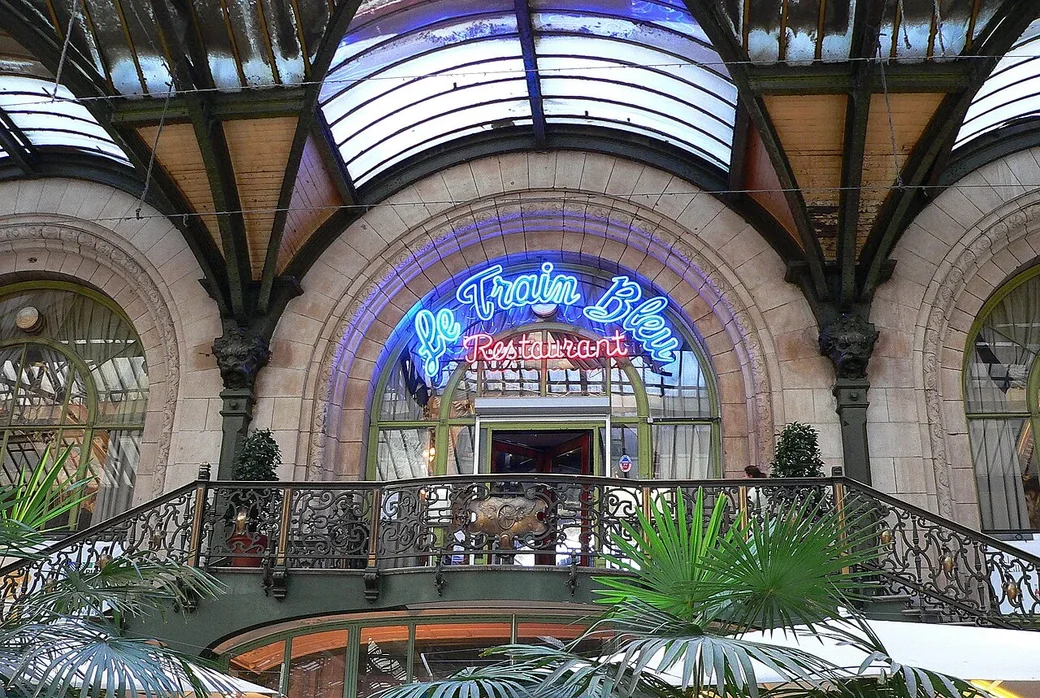
Opened in 1901 in Paris's Gare de Lyon, Le Train Bleu is a listed restaurant known for its Belle Epoque dining room with murals of towns along the railway line.

Bistro & Brasserie

Le Train Bleu

4.5€€€
Directions

Le Train Bleu sits inside Gare de Lyon and was created for the 1900 Exposition Universelle. It opened in 1901 as the station's buffet, was inaugurated by President Émile Loubet, and took its current name in 1963 in homage to the luxury Paris–Ventimiglia "Train Bleu". The great hall, the Golden Hall and several salons have been listed as historic monuments since 1972, with gilded ceilings, chandeliers and painted scenes evoking Mediterranean destinations. The restaurant was renovated in 2014; the lamb is a local favourite, and Colette, Coco Chanel and Brigitte Bardot are among its past guests. Booking is recommended. The walls and ceilings carry 41 paintings by artists of the period, depicting the cities and landscapes once served by the PLM railway on the line from Paris to the Mediterranean. The restaurant has appeared in films such as Nikita and Mr. Bean's Holiday, and its bar is a pleasant place to wait for a train.

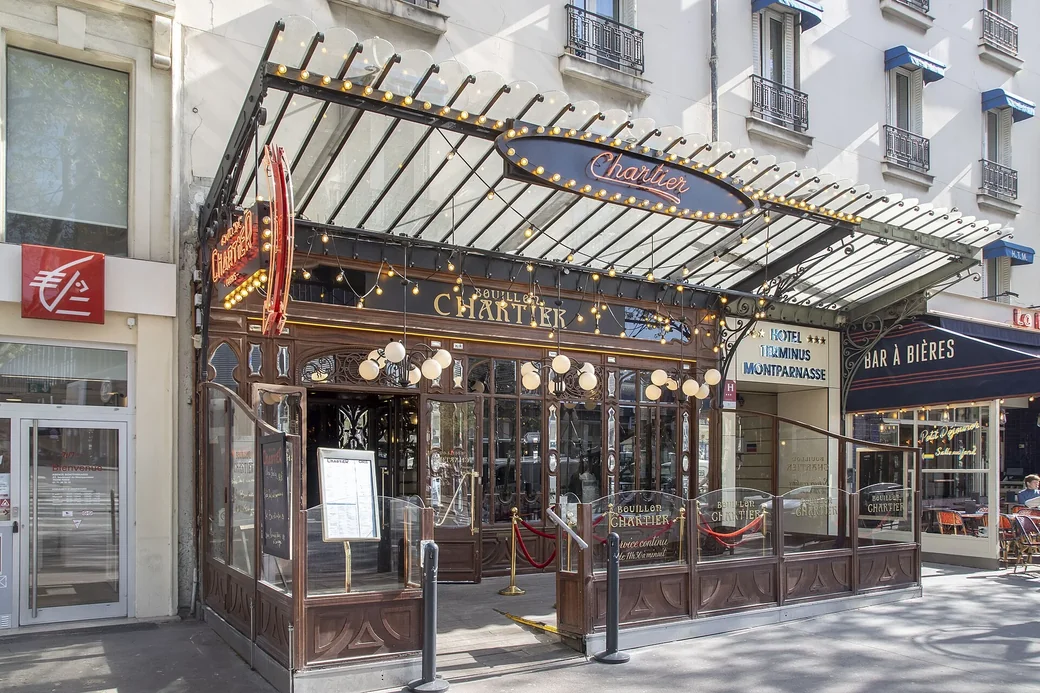
Founded in 1896 on rue du Faubourg Montmartre, Le Bouillon Chartier is a bouillon (traditional budget restaurant) with a listed Belle Epoque dining room.

Bouillon

Bouillon Chartier

4.3€
Directions

Bouillon Chartier, on Rue du Faubourg Montmartre in the 9th arrondissement, opened in 1896, founded by the Chartier brothers with a simple promise: a proper meal at a modest price. Its Belle Époque dining hall has been a listed historic monument since 1989. Under the high ceiling, globe lamps and mirrors, waiters in black waistcoats and white aprons tally the bill on the paper tablecloth. The huge menu of classics — leeks vinaigrette, egg mayonnaise, snails, beef bourguignon — is kept deliberately affordable, true to the founders' promise. There are no reservations, so expect a queue and shared tables at peak hours. The small numbered wooden drawers along the walls once held the napkins of regular diners, a reminder of its working-class canteen origins, and more than a century later the hall still serves well over a thousand meals a day.

Plénitude – Cheval Blanc Paris

French

Plénitude – Cheval Blanc Paris

4.9€€€€
Directions

Plénitude is the gastronomic restaurant of Cheval Blanc Paris, the LVMH hotel on Quai du Louvre. Led by Chef Arnaud Donckele, it opened in 2021 and earned three Michelin stars in the 2022 guide, within months of opening. Its cooking is built around sauces, broths, vinaigrettes, veloutés and juices inspired by the traditions of preserving and maturing, and pastry chef Maxime Frédéric is celebrated for his desserts. The dining room looks out toward the Seine and Pont Neuf. Tables are booked many months ahead. Donckele also holds three stars at La Vague d'Or in Saint-Tropez, which places him among the few chefs with two three-star restaurants in France. Cheval Blanc Paris occupies the restored Art Deco building of the former Samaritaine department store, and the small dining room keeps the number of guests deliberately limited.

Épicure

French

Épicure

4.8€€€€
Directions

Épicure is the three-Michelin-star restaurant of Le Bristol Paris on Rue du Faubourg Saint-Honoré, a stone's throw from the Élysée Palace. Since May 2024 the kitchen has been led by Chef Arnaud Faye, a Meilleur Ouvrier de France, who succeeded Éric Frechon — the chef who ran Le Bristol's kitchens for 25 years and earned the restaurant its third star in 2009. Faye's cooking is contemporary French, precise and product-focused, with vegetables playing a starring role. What sets Épicure apart is its dining room opening onto the hotel garden, with Louis XVI-style furnishings, ornate mirrors and tall French windows. Reserve well in advance. Le Bristol has welcomed guests on the Faubourg Saint-Honoré since 1925, and the restaurant took the name Épicure, after the Greek philosopher of pleasure, in 2011, when it moved into its garden-facing room. During the Frechon years, macaroni stuffed with black truffle, artichoke and duck foie gras became the emblem of the house.

Alliance

French

Alliance

4.8€€€€
Directions

Alliance is an intimate restaurant in Paris's 5th arrondissement, between the Left Bank and Boulevard Saint-Germain, named for the partnership of chef Toshitaka Omiya in the kitchen and Shawn Joyeux in the dining room. It rose to two Michelin stars in the 2026 guide. With just eight tables, it serves surprise set menus practically tailored to each table, built on premium seasonal ingredients such as green asparagus, scallops from the Bay of Mont-Saint-Michel or Racan pigeon. The pared-back room has discreet nods to Japan and a view into the kitchen. Authenticity over gimmicks. Book early. Omiya's cooking pairs French technique with a Japanese sense of restraint, letting one main ingredient lead each plate, while Joyeux's attentive service and wine pairings complete the experience. The restaurant stands on a quiet street a few minutes from the Seine and Notre-Dame, which makes it an easy choice before or after a walk on the islands.

Kei

French

Kei

4.8€€€€
Directions

Kei is Chef Kei Kobayashi's restaurant on Rue Coq-Héron, just north of Les Halles. In 2020 it became Paris's newest three-star restaurant, making Kobayashi the first Japanese chef to earn three Michelin stars in France. Its creative French cuisine is served in a small, stylish, restrained modern dining room that contrasts with the chef's renowned inventiveness. Book well ahead. Born in Nagano, Kobayashi came to France at 21 and trained with Gilles Goujon in the Corbières and at Alain Ducasse au Plaza Athénée under Jean-François Piège before opening Kei in 2011, in the former premises of Gérard Besson's restaurant. The restaurant gained its first star in 2012 and its second in 2017. His signature 'garden of crunchy vegetables', a colourful composition of dozens of vegetables, herbs and flowers, sums up a cuisine that pairs French produce with Japanese precision.

Le Cinq

French

Le Cinq

4.8€€€€
Directions

Le Cinq is the gastronomic restaurant of the Four Seasons Hotel George V in Paris's 8th arrondissement. Under Chef Christian Le Squer it has held three Michelin stars since 2016. What sets it apart is the palace-hotel setting and a menu that balances classical French haute cuisine with modern creativity — expect a formal, impeccably paced tasting-menu experience. Reserve well in advance. Le Squer, who grew up in Brittany, had already earned three stars at Ledoyen before taking over the kitchen here in 2014 and winning back the third star two years later. The dining room is a grand space of high ceilings, mouldings and soft grey-and-gold tones, and the wine list draws on one of the most celebrated hotel cellars in Paris.

Hakuba

Sushi & Japanese

Hakuba

4.7€€€€
Directions

Hakuba is the Japanese restaurant at Cheval Blanc Paris, on Quai du Louvre, and rose to two Michelin stars in the 2026 guide. It brings together sushi master Takuya Watanabe, sauce specialist Arnaud Donckele and pastry chef Maxime Frédéric, who is also head pastry chef at Plénitude. Sushi is prepared to order in full view of diners, while Donckele contributes creations such as shellfish dashi, sweet garlic purée with green shiso coulis, and the clear, intensely flavoured ramen broth. Unusually for a Japanese restaurant, dessert takes center stage. Reserve ahead. Watanabe made his name at Jin, an intimate sushi counter near the Louvre where he earned a Michelin star, before joining Cheval Blanc to open Hakuba. Seats are arranged around a light-wood counter, so each meal unfolds like an omakase (a chef's-choice menu), with fish selected daily and rice seasoned in the traditional Edomae style.

Showing 8 of 34

Practical food guide

From bakeries and markets to etiquette and menu words

From Royal Kitchens to Bistronomy: A Short History of Eating in Paris

Some of the city's oldest addresses predate the word restaurant itself: Le Procope (1686) is Paris's oldest café and its first literary one, and Stohrer on Rue Montorgueil (1730) is the oldest pâtisserie and the birthplace of baba au rhum. According to a widely told story, the word itself arrived in 1765, when a vendor named Boulanger sold restorative meat broths he called bouillons restaurants (restoring broths). The format exploded after the Revolution, when cooks who had left aristocratic households opened public dining rooms of their own — among them Debauve & Gallais (1800), which began as a royal pharmacist's chocolate shop, while Grimod de La Reynière started publishing the first restaurant reviews in the same period. The cuisine's grammar was being written in parallel: royal cook Taillevent had already codified medieval French cooking in Le Viandier, and La Varenne's Le Cuisinier François later dropped heavy spicing for butter, stocks and sauces — the real birth of the modern kitchen. At Versailles, the king's vegetable garden turned seasonality into a matter of court prestige (the popular story that Italian cooks in Catherine de Médicis's retinue founded French cuisine is largely a myth). In the 19th century, Antonin Carême turned pastry into architecture and organised the mother sauces, while Auguste Escoffier built the kitchen brigade system, wrote Le Guide Culinaire, and standardised serving courses one after another rather than all at once — a grammar nearly every professional kitchen in the world still runs on. One historic address still keeps an older kind of ritual alive: La Tour d'Argent numbers every duck it has ever served. The most recent chapter opened in the 1990s, when chefs trained in grand hotels began opening small rooms with short, market-driven menus — the bistronomy movement. Septime became its defining address, followed by a generation of chef-owned counters, and Paris today is also one of the world's great centers for Japanese-French cooking.

Paris's Culinary Identity: France's Showcase, Not Its Farm

Unlike Lyon or Marseille, Paris has almost no cuisine of its own soil. What it has is selection: the best oysters, butter, cheese, charcuterie and wine from every region arrive here first, most of it passing before dawn through the enormous wholesale market at Rungis, just south of the city — judge a restaurant by its suppliers, not by whether the dish is local. Yet the city has genuinely invented dishes of its own: jambon-beurre (baguette, butter and ham) remains France's best-selling sandwich; croque-monsieur is a ham-and-cheese toastie gratinated under béchamel, which becomes a croque-madame with a fried egg on top; gratinéed onion soup, according to popular tradition, was the porters' dish of the old central market; and Paris-Brest, a praline-cream choux ring, was shaped after a bicycle wheel. Several products carry the city's own name: champignon de Paris, the common cultivated mushroom, was first grown commercially in the city's underground quarries; jambon de Paris is the pale, brined, cooked ham found in every sandwich; and there is also boudin noir de Paris (Paris-style black pudding), the cervelas (a short, garlicky cooked sausage) and Fontainebleau, a whipped fresh cheese eaten as dessert. Beyond the city walls, 19th-century Paris was ringed by market gardens whose names still appear on menus today — asparagus from Argenteuil, peas from Clamart, beans from Arpajon, carrots from Croissy, cherries from Montmorency, peaches from Montreuil, and chasselas grapes from Thomery. Some of that heritage is still alive: watercress from Méréville still grows in spring-fed beds, peppermint from Milly and the beers of Brie and the Vexin continue, and the Clos Montmartre vineyard is still harvested every autumn.

French Quality Labels and the Region's Protected Products

On food, the label to look for is AOP, protected origin; AOC now survives only on wine, while IGP is a looser geographical link. Only two cheeses around Paris hold protected origin status: Brie de Meaux, a wide raw-milk wheel moulded by hand with a special shovel, and the smaller, tangier, more creamy Brie de Melun. The region also protects Houdan and Gâtinais poultry and Gâtinais rabbit under geographical indication. Because Paris sells the whole country, a single cheese counter can carry Comté, Roquefort, Normandy camembert, Bresse poultry, Guérande salt and Bayonne ham all at once.

Bistrot to Brasserie: A Field Guide to Where You're Eating

A bistrot is small, with a short handwritten or blackboard menu that changes daily. A brasserie is large, open late and serves continuously — oysters, choucroute, steak. A bouillon keeps the nineteenth-century workers' canteen format: classic dishes, very fast service, usually no reservations. A café is for coffee and simple plates. Beyond these four, a bar à vin or cave à manger pours grower wines with charcuterie and cheese (Paris is arguably the world capital of natural wine), a salon de thé serves tea and pastry, a crêperie pairs savoury buckwheat galettes with cider, and a traiteur sells food to take away — the cheapest good lunch in the city. Some rooms are worth visiting for the room itself: Le Train Bleu, above the platforms of the Gare de Lyon, is a painted Belle Époque hall; La Coupole and its Montparnasse neighbours preserve the artists' brasserie of the 1920s; Bouillon Chartier still writes the bill on the paper tablecloth; and Le Grand Véfour sits under the arcades of the Palais-Royal. The literary cafés — Café de Flore, Les Deux Magots and La Closerie des Lilas — were once the offices of writers and philosophers, and today they trade largely on that memory: treat them as a monument rather than a meal, sit on the terrace, order one coffee, watch the boulevard, then eat somewhere less famous nearby.

How Parisians Really Eat: Neighborhoods, Hours and Late Nights

The 11th arrondissement around Rue Paul Bert, Charonne and Oberkampf is the heart of the modern bistro scene; Belleville and Ménilmontant are cheaper and more multicultural, Batignolles quieter and family-run, Butte-aux-Cailles village-like, and Rue des Martyrs one of the densest streets of independent food shops. The day itself has a fixed rhythm: bakeries open early and breakfast belongs to the morning, and the Parisian breakfast itself is light and sweet with no savoury tradition at all — no eggs, cheese board or olives, the sharpest difference for visitors used to a full morning table. The standard is a croissant or pain au chocolat with coffee, or a tartine, a baguette split lengthwise with butter and jam (a straight-ended croissant traditionally signalled all-butter and a curved one margarine, though the labelling on the price list is now the safer guide). Lunch is served around midday, with kitchens taking last orders in the early afternoon; the apéritif hour fills terraces in the early evening, dinner service starts later in the evening and most Parisians sit down to dinner later than in many other places, while children have their sweet snack, the goûter, in the middle of the afternoon. Weekend brunch has become a firm habit in the eastern districts and popular tables need booking; otherwise the corner bakery plus a café counter beats the hotel buffet on both price and character. Closing days matter more than visitors expect: many of the best kitchens close on Sunday evening and all day Monday, and small family businesses shut for several weeks in August, while between services — roughly mid-afternoon to early evening — most kitchens stop entirely (a sign reading service continu means the place serves without a break). Paris is not a true all-night city, but it has reliable late options: one brasserie by the old market halls never closes and serves onion soup around the clock, others run past midnight, and the kebab counters of Faubourg Saint-Denis and Belleville plus Chinatown carry on into the small hours. Plan the way back — the metro closes in the small hours, a little later on Fridays and Saturdays, after which Noctilien night buses take over — and note that some bakeries also keep a vending machine that dispenses baguettes at any hour.

Vegetarian, Halal and Gluten-Free Paris: Where to Eat and What to Watch For

Paris now has a solid network of vegan bakeries, cafés and restaurants, especially in the 3rd, 10th and 11th arrondissements, and at the top end L'Arpège has built a three-star kitchen around vegetables since its chef removed red meat from the menu, with vegetable-led tasting menus now common in ambitious kitchens. Even so, classic dishes hide meat in unexpected places: a green salad may arrive with bacon lardons, onion soup is usually built on beef stock, and many sauces start with meat jus, so never assume a dish is meat-free because it sounds like it — saying clearly that you eat no meat, no fish and no meat stock avoids most misunderstandings. For halal food, Paris has one of Europe's deepest scenes: Barbès, Château Rouge and La Chapelle in the north, Belleville and Ménilmontant in the east, and the Faubourg Saint-Denis all offer North African, Turkish, West African, Lebanese and South Asian kitchens, and the Grande Mosquée de Paris runs a tea room and restaurant open to all. France has no single state halal standard, though; several independent bodies certify, the best known linked to the mosques of Paris and Lyon and to the AVS association, so the sign on the window may refer to different systems and it is fair to ask which — some halal-labelled restaurants also serve alcohol, and in fine dining halal meat is effectively unavailable, so the practical route is to request a seafood or vegetable menu when booking. Gluten-free travelers are also well served: dedicated gluten-free bakeries and restaurants exist, and organic chains carry wide gluten-free ranges. The classic trap is the Breton galette — buckwheat is naturally gluten-free, but the same griddle and batter cloth serve wheat crêpes, so cross-contamination is likely unless the crêperie is dedicated — and flour-thickened sauces are the other risk. Say you are cœliaque, coeliac, rather than simply avoiding gluten; the national coeliac association AFDIAG publishes lists of tested addresses.

Paris in a Glass: Coffee, Tea, Wine and the Apéritif Ritual

Paris spent most of the twentieth century pairing a magnificent café culture with mediocre, dark-roasted, fast-poured coffee; since the mid-2000s a wave of independent roasters and specialty bars, concentrated around the Canal Saint-Martin, Belleville, the 11th and the Marais, has changed that — look for places that name their roaster. Ordering it correctly avoids a slip: un café means a single espresso, a noisette adds a drop of milk, an allongé is a longer pull, and a café crème is the large milky one; crème and cappuccino belong to breakfast, since after a meal locals drink plain espresso, and the same cup costs more at the table and more again on the terrace, which is normal and posted by law. France is not a tea country, yet Paris holds some of Europe's great tea merchants and a long salon de thé tradition where tea comes with pastry rather than as a drink on its own: Japanese tea houses serve matcha with wagashi, the Grande Mosquée pours sweet mint tea in its courtyard, and palace hotels turn afternoon tea into a full sitting that needs booking. On the table, classic pairings hold: oysters and shellfish go with dry white from the Loire or Chablis, or with brut champagne; blue cheese is famously served with sweet Sauternes, brie with cider or a light red; steak takes Bordeaux or Rhône, charcuterie takes gamay, and savoury buckwheat galettes are drunk with cider from a bowl rather than a glass. Reading a French wine list means reading places, not grapes: Muscadet and Sancerre from the Loire and Chablis from Burgundy are the dry whites poured with shellfish, Beaujolais means the gamay grape and suits charcuterie, and Bordeaux and Rhône carry red meat. The apéritif is a social hour rather than just a drink — a kir of white wine and blackcurrant liqueur, pastis in summer, or a glass of natural wine with olives, and among aromatised drinks Lillet and Suze are further apéritif choices, the first fruity and the second bitter with gentian. At the other end of the meal come the digestifs: calvados, armagnac, or a herbal liqueur such as Chartreuse. Non-drinkers order a citron pressé, where lemon juice, water and sugar arrive separately to mix yourself.

Bread and Pastry in Paris: From the Legal Baguette to Master Pâtissiers

The baguette de tradition is legally defined — flour, water, salt and yeast only, no additives, never frozen at any stage, and kneaded and shaped in the shop that sells it, while the plain baguette allows industrial shortcuts; the craft itself is inscribed on the UNESCO intangible heritage list, the city holds an annual competition whose winning baker supplies the presidential palace for a year, and you can ask for yours bien cuite, well baked, or barely coloured. At the table, bread comes free and is placed directly on the tablecloth rather than on a plate, which is correct rather than careless: it is meant for the sauce, and wiping the plate with a piece is accepted in relaxed rooms. Bakeries bake twice a day, so a late-afternoon loaf is as fresh as a morning one, and neighbourhood bakers take holidays in rotation, posting the nearest open address. Pastry, though, is a separate profession from bread, with its own diplomas, and the highest recognition is the Meilleur Ouvrier de France title, awarded by national competition and worn on a tricolour collar; the names that define modern Paris pastry include Pierre Hermé, Cédric Grolet, Yann Couvreur, Philippe Conticini, Nina Métayer, Christophe Michalak and Sadaharu Aoki, whose signature pieces change with the season. The core repertoire runs from éclair, mille-feuille, lemon meringue tart, religieuse, Saint-Honoré and Paris-Brest to the thick vanilla custard tart called flan parisien, which has become the city's current obsession, while a wave of artisan bakers has revived long-fermented sourdough, pistachio escargot rolls and butter-heavy pastry alongside them. For something cold, glace means dairy ice cream and sorbet means fruit and water, so sorbets are often suitable for vegans, though it is worth asking; the classic address sits on the island behind Notre-Dame, where the fruit sorbets are more celebrated than the creams, and for a non-alcoholic drink the standard order is a fruit syrup with water, such as mint or grenadine.

Where Parisians Shop for Food: Supermarkets, Markets and Souvenirs to Bring Home

In the centre you will mostly meet small city-format supermarket chains, convenient but limited, while larger branches in outer districts carry far more, and organic chains are the best bet for gluten-free, vegan and specialist products; at the top end, the department-store food halls and the great grocery attached to a Left Bank store are destinations in their own right. The real food calendar, though, is the market day: open-air markets run on fixed weekday and weekend mornings and pack up by early afternoon, and most neighbourhoods have one. The Aligre market and its covered hall are the liveliest and least expensive, the oldest covered market in the Marais is now full of cooked-food stalls, and dedicated organic markets appear on specific mornings on the left and right banks. For edible souvenirs to bring home, sea salt, mustard bought fresh from the barrel, chocolate, tea, chestnut cream and salted-butter caramel all survive a suitcase, while cheese and charcuterie do not travel as easily and are restricted when entering many countries outside the European Union, so check your destination's rules before buying anything dairy or meat-based.

Paris Street by Street: A Walking Map of the City's World Cuisines

Rue des Rosiers in the Marais is the falafel and Eastern European Jewish bakery street, Rue Montorgueil is a market street of cheesemongers, oyster stands and historic pâtisseries, Rue Mouffetard is the student version, cheaper and busier, and Rue du Montparnasse is lined with Breton crêperies; for everyday neighbourhood shopping streets rather than tourist ones, walk Rue Cler or Rue Daguerre. For Asian food, Rue Sainte-Anne is the Japanese street, packed with ramen, udon and grilled skewers, where queues at lunch are normal; the Chinatown of the 13th, along the avenues south of Place d'Italie, is Vietnamese, Chinese and Cambodian, with pho, banh mi and a huge Asian supermarket, while Belleville holds a second, younger Chinese quarter that grew from the late 1970s. Around Barbès and Château Rouge you find Moroccan, Algerian and Tunisian cooking, West African stews and a loud street market; Passage Brady, a covered arcade, is the Indian, Pakistani and Bangladeshi row; and the Faubourg Saint-Denis mixes Turkish, Kurdish and Sri Lankan Tamil kitchens, the last concentrated further north around La Chapelle.

Paris on the Calendar: Feast Days, Seasons and Festivals on the Plate

The Christmas table means oysters, foie gras, smoked salmon, roast capon with chestnuts and a rolled log cake, and in the Provençal tradition it ends with a spread of thirteen small desserts. Through January bakeries sell galette des rois, an almond-cream puff pastry hiding a charm, and whoever finds it wears the paper crown; early February is crêpe day, and Easter brings lamb and chocolate bells. The Jewish bakeries of the Marais mark their own calendar with honey cake in autumn and fried doughnuts at Hanukkah. From October the game season fills menus with venison, wild boar and pheasant, and the year's first Beaujolais arrives in November to be drunk with charcuterie. In late winter the national agricultural show brings producers from every region to the city for a week of tasting. Ramadan transforms the northern and eastern quarters with soups, semolina pancakes and honeyed pastries, and Lunar New Year brings special menus to Chinatown and Belleville.

French Table Manners: Greetings, Ordering, the Menu and the Cheese Course

Opening with a bonjour before any request is not politeness theatre here; skipping it reads as rudeness and changes how you are served. Call a waiter with eye contact and s'il vous plaît rather than by shouting, and don't expect the bill to arrive on its own — you have to ask for it, and no one will hurry you before you do. Certain ordering habits mark you out as unfamiliar: milky coffee after dinner, butter requested for the baguette outside breakfast, and cheese ordered after dessert. Steak doneness also shifts, since the local rare is bloodier than most visitors expect, so if you want it properly cooked through, say so plainly. On the language of the menu itself, menu means a fixed set of courses in French, while the full list you choose from is la carte; tap water is safe and a carafe d'eau is free on request, though saying only water may bring a paid bottle, and lunch sets are almost always the same kitchen at a lower commitment. Taking leftovers home is a legal right and restaurants must provide a container if you ask, though in formal rooms the request is still unusual. Cheese has its own etiquette throughout: at a cheese shop, say when you plan to eat it and the seller will choose pieces at the right ripeness, a question that is expected rather than fussy, and it is always cut in wedges, never sliced off the pointed nose. On a menu, cheese comes after the main course and before dessert, meant to finish the red wine still in the glass; three or four contrasting pieces beat a large assortment, and soft raw-milk cheeses are advised against for pregnant women and small children.

Reading a Paris Restaurant: Tipping, Traps, Good Signs and Eating Out with Kids

Service is included in the listed price by law, so tipping is a gesture rather than an obligation: rounding up or leaving a small amount when you are happy is entirely enough, and leaving nothing is not an insult. Where you eat matters more than what you order, since the same dish costs far more within sight of a monument than ten minutes' walk away, and the quality usually moves in the opposite direction; portions follow the starter-main-dessert structure and are modest by American standards, most people take two courses, and lunch formulas offer the best value across every level, from a corner bistro to a starred dining room. Warning signs of a tourist trap cluster together: photographs of every dish on a laminated card translated into six languages, someone stationed outside inviting passers-by in, a menu covering French classics alongside pizza and sushi, and no house-made logo on the card; the densest concentration sits along the Champs-Élysées, around Place du Tertre in Montmartre, on Rue de la Huchette near the Latin Quarter riverbank and immediately below the Eiffel Tower, and an empty dining room at the height of dinner service is another clear signal in a city that eats late. The signs of a good room point the other way: look for a short list of five to eight main courses, a blackboard that changes, a wine list naming growers rather than only regions, and staff who greet you in the local language first; a room that fills with people speaking French at lunchtime, and a kitchen that firmly closes between services, are the strongest signals of all. For families, bistros and brasseries almost always offer a children's set, usually chopped steak with fries or ham with small pasta, plus a dessert; high chairs are common but space is tight in small rooms, and there is no separate children's dinner hour, since French children eat the same late meal at the same table and are expected to sit through it, though ambitious tasting-menu restaurants may set an age limit, so ask when booking.

Going Deeper Into Paris Food: Guides, Rankings, Classes, Museums and the Chefs Who Shaped It

Paris has one of the densest concentrations of Michelin-starred restaurants in the world, including several three-star houses, and the selection is revised every year. Beyond stars, the Bib Gourmand marks serious cooking at moderate cost and the green star rewards sustainability. Separately, an international peer-voted ranking places several Paris kitchens near the top — the self-taught Bruno Verjus and bistronomy's Bertrand Grébaut recur — while the critic-aggregating La Liste has repeatedly crowned a Paris house. Small rooms release bookings on a fixed schedule and fill within minutes, so set a reminder for the release day and treat lunch as the accessible door. For a hands-on introduction, cooking classes are widely available, from famous professional schools to short workshops aimed at visitors, usually in English; the most common formats are croissant or macaron sessions and a market walk followed by cooking. Among museums, the chocolate museum traces cocoa across four millennia with tastings, and a wine museum occupies medieval cellars on the right bank of the river's west side. Behind it all stand the books and the chefs: Brillat-Savarin's Physiology of Taste turned eating into philosophy, Escoffier's Guide Culinaire became the profession's manual, and the Larousse Gastronomique remains the reference encyclopaedia. Today's kitchens are led by a mixed generation — Alain Ducasse and Guy Savoy on the classical side, Alain Passard who built a three-star kitchen on vegetables, Hélène Darroze, David Toutain, Yves Camdeborde who launched bistronomy, and Bertrand Grébaut who carried it forward.

The Paris Menu Decoded: Classic Dishes, Seafood, Desserts and Regional Specialties

Some dishes turn up on menus again and again. Bœuf bourguignon is beef braised slowly in red wine with mushrooms and small onions, and coq au vin is the poultry version of the same idea. Blanquette de veau is a pale, creamy veal stew cooked without browning. Confit de canard is duck leg cooked and preserved in its own fat, crisp outside and falling apart within. And steak tartare is raw beef chopped by hand with capers, shallot, mustard and egg yolk. For seafood and charcuterie, a plateau de fruits de mer is a cold tiered platter of oysters, clams, whelks, prawns and crab, eaten with lemon and a shallot vinegar. Moules marinière are mussels steamed in white wine, shallots and parsley. Escargots arrive baked in garlic-parsley butter with tongs and a narrow fork. And rillettes are meat slowly cooked and shredded into a spreadable paste, served cold with bread. On the dessert trolley, mille-feuille layers puff pastry with vanilla cream, and tarte Tatin is an upside-down caramelised apple tart. Crème brûlée is baked custard under a sheet of burnt sugar you crack with a spoon. Île flottante floats poached meringue on thin custard. Profiteroles are choux buns filled with ice cream under hot chocolate, and a religieuse stacks two glazed choux like a small robed figure. Beyond the classics, regional dishes turn up on Paris menus too. Cassoulet, from the southwest, is a slow-baked casserole of white beans, sausage and preserved meat, while choucroute garnie, from Alsace, piles cured pork and sausages on fermented cabbage. Among pastries, kouign-amann is a Breton cake of butter and caramelised sugar folded into dough, canelé is a small ridged Bordeaux custard cake with a dark crust, and the Opéra layers coffee-soaked almond sponge with chocolate ganache.

Tours & Experiences in Paris

Skip-the-line tickets, small-group walks, and curated experiences.

All Tours in Paris

More about Paris

  • Sports & Recreation
  • Arts & Culture
  • Fashion & Design
  • Entertainment & Activities