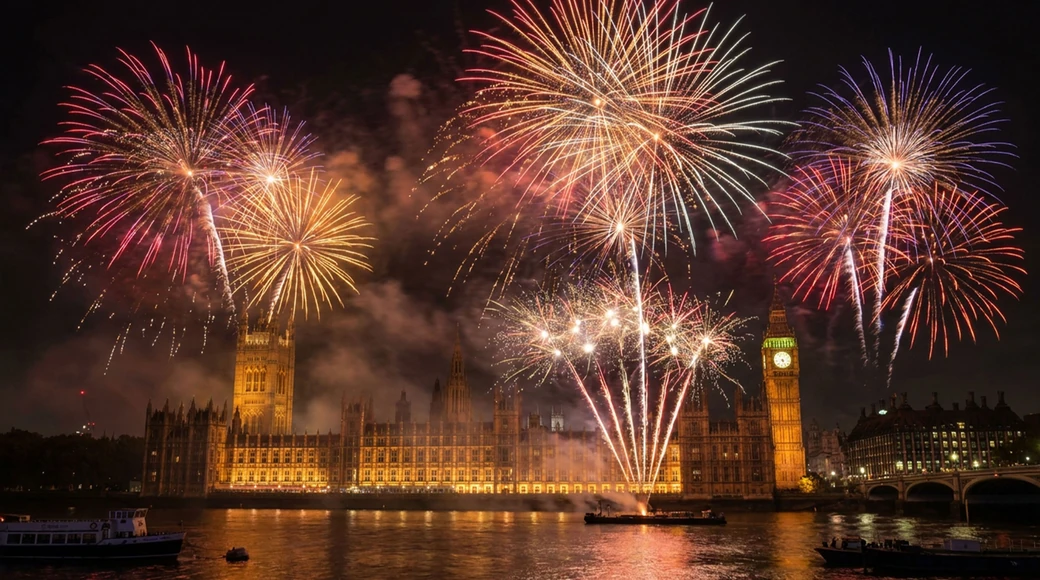
London's great night of fire, marking the foiling of the 1605 Gunpowder Plot. Bonfires, drone shows and ticketed displays at Alexandra Palace, Battersea Park and Blackheath, with toffee apples and jacket potatoes eaten in the cold.
About This Festival
Why London Lights Bonfires on the Fifth of November
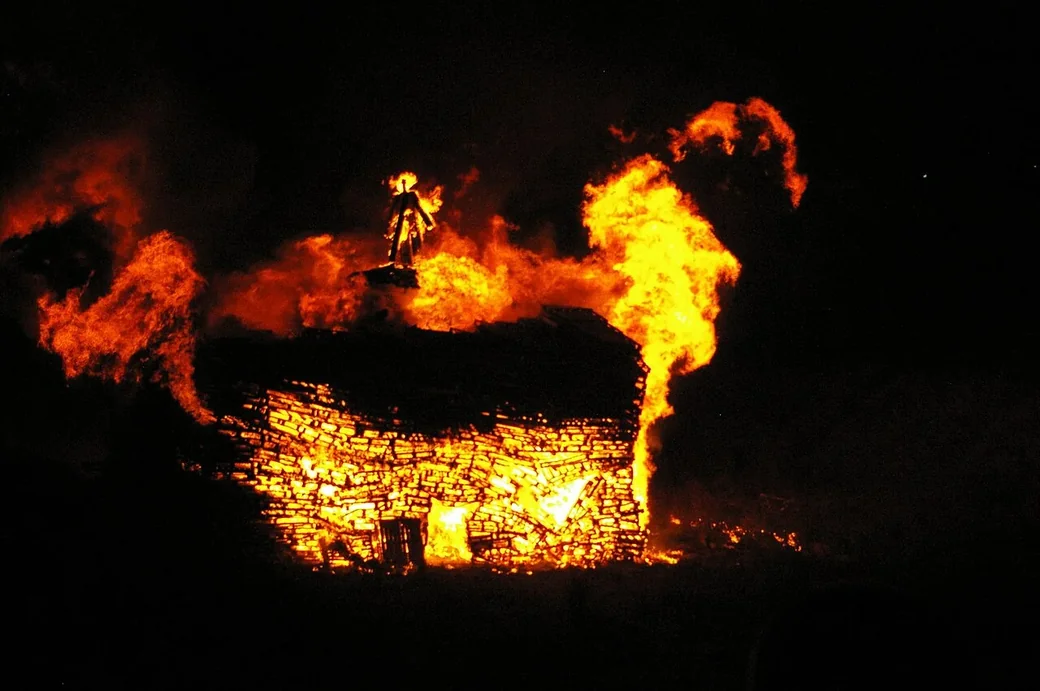
London’s bonfires trace back to the Gunpowder Plot (a failed conspiracy of 1605 to blow up Parliament during the State Opening, the ceremony that begins each parliamentary session). The conspirators, led by Robert Catesby, stored gunpowder in a cellar beneath the House of Lords, and Guy Fawkes was found guarding it during a midnight search; the exact number of barrels is still disputed. In January 1606 Parliament declared an annual day of thanksgiving with church services, bonfires and fireworks. The law was repealed in 1859, yet the fires never stopped. Even today the Yeomen of the Guard (the sovereign’s ceremonial bodyguard) search the cellars before each State Opening, as a picturesque custom rather than a security measure.
The Date Most Visitors Get Wrong: the Night Versus the Fireworks Weekend
Bonfire Night (the evening of 5 November, marked with bonfires and fireworks) always falls on the fifth, but London does not light up that evening. Only a handful of displays run on the night itself; most of the big ones move to the nearest Saturday, with a second, earlier family round on the Sunday. If you climb a hill on the fifth hoping for a sky full of rockets, you will mostly hear neighbours’ back gardens. Decide first which evening you really want, then build the rest of the plan around it.
Where the Big London Fireworks Displays Actually Happen
There is no single city-wide display. In the north, Alexandra Palace stands on a ridge with one of London’s best skyline views; in the south, Battersea Park sits beside the Thames; in the south-east, Blackheath Common hosts the biggest night in that corner of the city. Borough parks such as Wimbledon Park and Morden Park run two shows each, an earlier one for small children and a main one later. Coram’s Fields in Bloomsbury has traditionally offered a free (and very popular) show, but this is a children’s park and adults are admitted only with a child. Cricket clubs, rugby clubs, schools and Scout groups fill in the rest of the map.
How Booking Works for London Bonfire Night Tickets
Nearly every London display is ticketed and sells out, often weeks ahead, and sales usually open in early autumn. Some sites, Battersea Park for example, sell in advance only: no gate sales, no official resale and no waiting list for sold-out nights. Buy from the organiser’s own website or the sellers it names, never from strangers online. Check the age rules too: children normally need their own ticket and an accompanying adult, and a few venues insist on printed tickets rather than phone screens. Early-bird releases are cheaper, so join the organiser’s mailing list.
The Free Viewpoints That Stay Open After Dark
Parliament Hill on Hampstead Heath is the best free choice: the viewpoint is open round the clock and the sightlines over the city are protected. Alexandra Park also stays open all hours, so you can stand outside the fenced arena and still see the sky above the Palace. Primrose Hill is famous but unreliable: it is not an official viewing area, fireworks and paper lanterns are banned, it closes at 10pm during the bonfire season, and in some years it has been shut entirely for crowd safety, so check the Royal Parks notice before you go. Greenwich Park is the classic trap, because its gates close at about six in the evening in winter, long before any display. Prefer the water? A Thames cruise from Festival Pier holds position opposite Battersea’s show.
What a London Fireworks Evening Looks Like, Hour by Hour
Gates usually open in the late afternoon, hours before the first rocket; sunset falls around half past four in early November, so it is dark long before the main show. The bonfire is lit early in the evening while funfair rides, street-food stalls and bars run alongside, and the headline display goes up somewhere between about seven and half past eight, depending on the venue. Some venues open the night with a choreographed drone show. Last entry is often earlier than visitors expect and at a few sites it coincides with the start of the display, so arrive with a comfortable margin. Big venues also run an earlier, gentler family session.
Bonfire Night Food: Parkin, Toffee Apples and Jacket Potatoes
The food is deliberately hearty and hot: sausages, soup and the classic jacket potato (a potato baked whole in its skin), which street vendors sold by the ton in Victorian London. The sweet side belongs to toffee apples (apples dipped in hard toffee on a stick), treacle toffee (hard, dark, molasses-flavoured toffee) and parkin (a sticky oatmeal-and-treacle ginger cake). Parkin is a northern speciality and not traditional in southern England, so in London it is a seasonal bakery item rather than street food. You may also meet black peas (a northern dish of dark dried peas), hog roast and mulled wine, and marshmallows are toasted over the embers. Big venues have street-food villages with vegetarian choices, though some do not allow outside food. According to a story told by food writers, the York school Fawkes attended is said to refuse to serve parkin.
What to Wear and Pack for a Night Standing Still in the Cold
Dress for standing still, not for walking. London averages roughly 11°C by day and 5°C overnight in November, and the clearest, calmest evenings are the coldest. A hat, gloves, thick socks, a waterproof outer layer and a flask do more good than enthusiasm, and in a crowd a rain jacket beats an umbrella. Add a power bank, because cold drains phone batteries, ear defenders (ear protection against loud noise) for small children, and a torch if you are climbing an unlit hill. Pack light: Alexandra Palace, for instance, encourages visitors to come without bags and inspects those they bring.
Getting to the Displays and Getting Home Again
Parking is scarce or unavailable at most large venues and the surrounding streets fill early, so take the train or the Underground. Alexandra Palace has its own station on a line from central London and no public car park, Battersea Park is served by Battersea Park and Queenstown Road stations, and Blackheath is a short walk from its own station. Leaving is the slow part, because tens of thousands move at once: walk on to the next station out, or wait ten minutes for the crush to thin.
Fireworks Rules and Etiquette Every Visitor Should Know
Setting off your own fireworks is banned in the Royal Parks and on Hampstead Heath, and the rules are enforced by the police. Elsewhere, consumer fireworks may be used until midnight on 5 November and until 11pm on most other nights (1am on New Year’s Eve, Diwali and Chinese New Year), but never in the street or other public places. Fireworks are sold only to over-18s, and under-18s may not carry them in public. Buy only from licensed sellers, look for UKCA or CE marks and keep to the safety distance printed on the label. Sparklers (handheld fireworks that burn with a shower of sparks) count as fireworks and follow the same curfew. At organised displays, leave your own fireworks at home: some venues ban even sparklers. Photography is welcome.
Staying Safe and Comfortable in a Bonfire Night Crowd
Crowds, darkness and phones in hands make these evenings good weather for pickpockets, so wear bags in front of you and keep valuables out of back pockets. The squeeze is greatest at the exits rather than during the show; wait ten minutes or walk on to the next station. Agree a meeting point before you go in, because mobile networks slow down when everyone messages at once. Entrances have security checks and marshals, so stay on the marked routes. Hold sparklers at arm’s length, one per person, away from drinks and coats, and keep alcohol and fireworks apart. Fire-brigade call-outs in London nearly triple on the night, so keep any home bonfire small, supervised and well away from buildings.
Bonfire Night With Children and Accessible Viewing
Several London parks stage two shows on the same evening: an earlier, gentler one for small children and the main one later. Expect every child to need a ticket of their own (babies too at some venues) and an accompanying adult to be compulsory. Ear defenders (ear protection against loud noise) are worth the space in the bag. Blackheath, for example, offers free personal-assistant tickets for disabled visitors, booked directly with the organiser rather than through the ticket agent, with proof of disability sent in advance; other venues publish their own accessibility pages, so read them before you buy. Coram’s Fields, being a children’s park, admits adults only when they bring a child.
Pets, Noise and Being a Good Neighbour
Fireworks are hard on animals. Vets and welfare charities advise keeping cats and dogs indoors with the windows closed, curtains drawn and music or television on to soften the bangs, and giving nervous pets a den they can retreat into. Never take an animal to a display. If you are setting anything off at home, tell the neighbours first so households with small children, elderly residents or anxious pets can prepare. It is courtesy rather than law, and it works.
Guys, Masks and Old Customs: the Folklore Behind the Night
Children once built a guy (a stuffed rag-and-newspaper figure of Fawkes), wheeled it round the streets calling “penny for the Guy” (a request for coins) and burned it on the bonfire; the custom had mostly faded by the end of the twentieth century, and London Museum holds photographs from its last decades. The Fawkes mask outlived it, becoming a worldwide protest symbol through the graphic novel and film V for Vendetta, while an 1841 novel by William Harrison Ainsworth had already turned Fawkes into a romantic figure. Some details stay fuzzy: the number of barrels is disputed, and the author of the anonymous warning letter that exposed the plot has never been identified; according to one long-debated theory, it came from someone close to the conspirators. Fawkes’s lantern is kept at the Ashmolean Museum in Oxford, and the cellar he guarded was damaged in the fire of 1834.
What Else Is On Around Bonfire Night in London
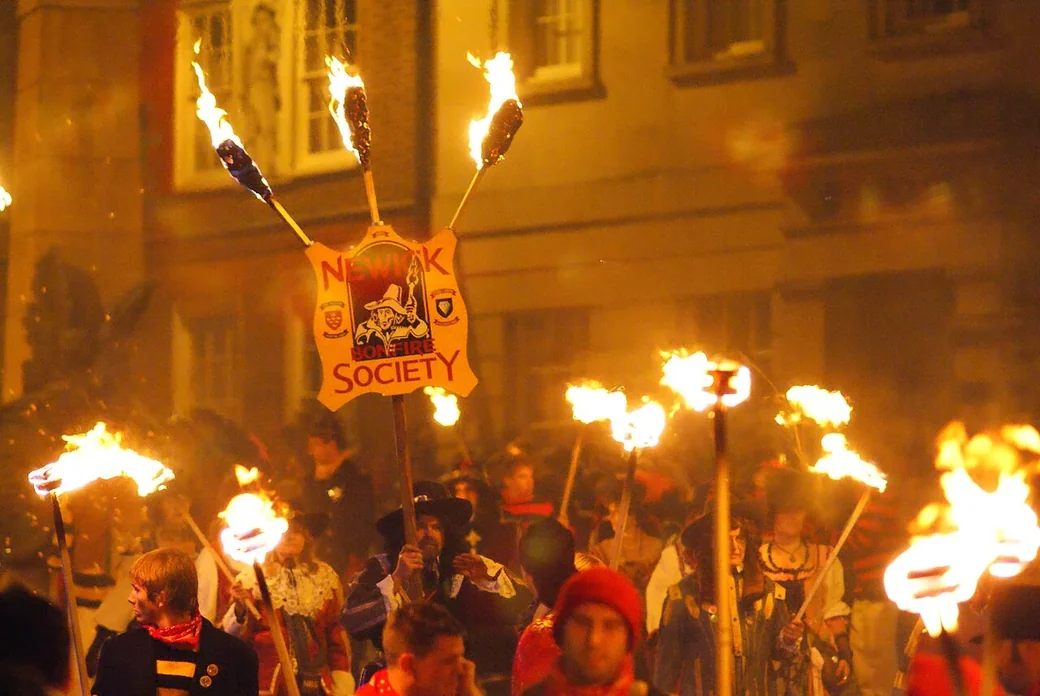
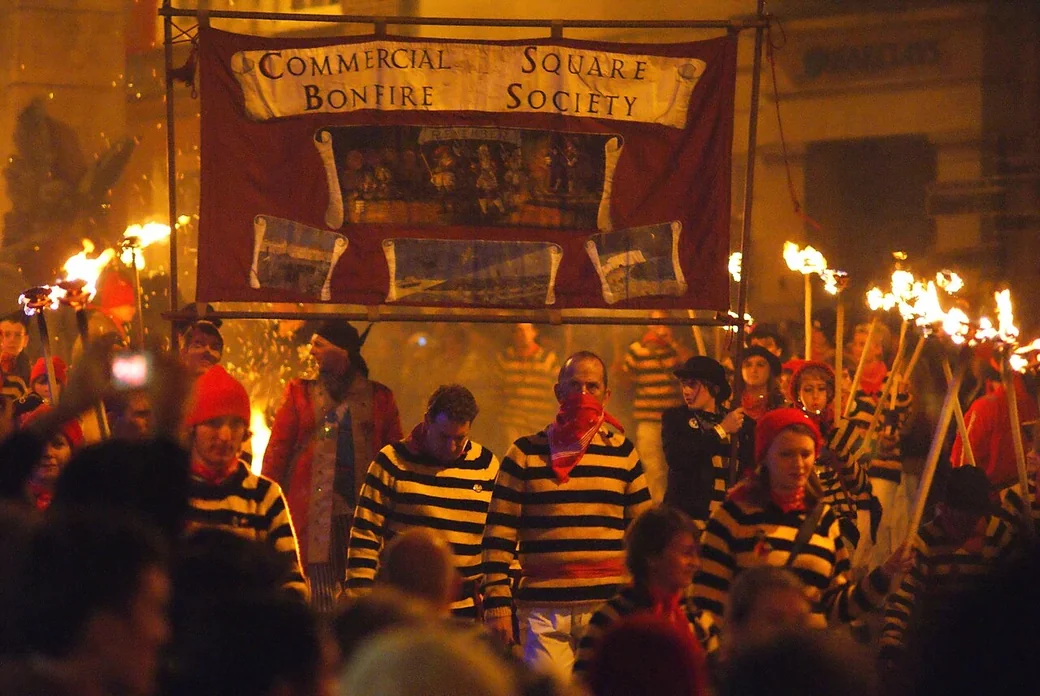
The fire reaches well beyond the capital: Lewes in Sussex is famous for torchlit processions (marches by costumed societies carrying flaming torches), and other towns keep their own bonfire customs. In London the same fortnight is crowded. Diwali (the Hindu festival of lights) often falls within days, and some borough displays merge the two into one evening of fireworks, Bollywood stages and street food. Remembrance Sunday (the national day honouring those who died in war) and the Lord Mayor’s Show (the City of London’s annual civic procession) follow soon after. For a calmer alternative to a park, take a Thames cruise or look for a free gallery viewing level that stays open late.
Bonfire Night Vocabulary: Words and Phrases You Will Hear in London
A few words you will hear, with what they mean: Bonfire Night (the evening of 5 November, a night of bonfires and fireworks), also called Guy Fawkes Night, Fireworks Night or Plot Night; the Guy (the stuffed figure once burned on the fire); penny for the Guy (the old street call for coins); display (an organised fireworks show); gates open and last entry (when doors open and the final moment you can be admitted); sold out (no tickets left); sparkler (a handheld firework that burns with sparks); toffee apple, parkin and jacket potato (the classic night-time foods). Children also recite the old rhyme that begins “Remember, remember, the fifth of November”, which is the quickest way to tell a Londoner you know what the night is for.
Who Runs London’s Fireworks: Councils, Clubs, Charities and Greener Shows
Most displays are ticketed because staging a licensed, safe show is expensive. Organisers range from borough councils, such as Wandsworth for Battersea Park and Merton for Wimbledon Park and Morden Park, to cricket and rugby clubs, schools, Rotary groups and Scout troops, and several donate part of their income to charity; the Beckenham display, run by a Scout group, has raised money for local causes since 1946. Battersea’s pyrotechnics team also runs tree-planting schemes and avoids single-use plastic, and drone shows are increasingly paired with fireworks. Smoke, noise and litter remain part of the conversation, so take rubbish home or use the bins provided.
Practical Information
When
Bonfire Night (the evening of 5 November) is the same date every year, but London’s big displays gather on the nearest weekend, with only a few on the night itself. This season’s main timings: Alexandra Palace opens its gates at 4pm, with the Saturday party-night display at 8pm and an earlier family-day display at 6pm on Sunday. Battersea Park: Saturday gates at 6pm, last entry 8pm, fireworks about 8:30pm; Sunday gates 4:30pm, last entry 6:30pm, fireworks about 7pm. Blackheath Common: gates at 5pm, last entry and display both at 8pm, finishing around 10pm. Merton’s parks: gates at 5:15pm, a first show for young children at 6:45pm and the main one at 8:30pm. Sunset is around 4:30pm, so every show happens in full darkness.
Where
Across Greater London. The biggest displays are Alexandra Palace (Alexandra Palace Way, N22 7AY, in the north), Battersea Park (Battersea Park Road, SW11 4NJ, on the south bank of the Thames) and Blackheath Common (SE3, in the south-east), plus Wimbledon Park, Morden Park, Coram’s Fields (93 Guilford Street, WC1N 1DN, Bloomsbury) and dozens of club, school and Scout grounds. Nearest stations: Alexandra Palace station, Battersea Park and Queenstown Road, and Blackheath. Free viewpoints: Parliament Hill on Hampstead Heath and Alexandra Park.
Cost
Almost every display is paid and sold in advance (prices are shown in the price fields of this page), and early-bird tickets are cheaper. One show in Bloomsbury, at Coram’s Fields, has traditionally been free, but adults are admitted only with a child. All the high viewpoints, such as Parliament Hill, are free. Extras such as ice skating, a beer festival or premium viewing areas are sold as add-ons.
Tips
Book as soon as tickets appear, arrive well before last entry, travel by train or Underground (parking is scarce or unavailable at the big venues), dress for standing still in roughly 5°C, carry a power bank and a torch, agree a meeting point, and pack light, because some venues inspect bags. Long exposures suit fireworks (check each venue’s rules on tripods); the hills on the northern edge of the city give you skyline and rockets in one shot, while inside a ticketed arena you are usually too close for both. If you cannot get in, an unlit hill, Alexandra Park or a river cruise are the fallbacks.
Specific to this festival
The Gunpowder Plot of 1605 happened in London, beneath the Palace of Westminster, and the Yeomen of the Guard (the sovereign’s ceremonial bodyguard) still search its cellars before each State Opening. The date is fixed, but the displays spread over the weeks and weekends around it, from late October to the Sunday after. This season’s headline acts: at Alexandra Palace, a DJ set by Eats Everything, a German beer festival with a Queen tribute band, a drone show by Celestial and, on the family day, a kids’ rave and karaoke with Shaun Williamson; at Battersea Park, a DJ set by Rudimental and the Latin band Conjunto Sabroso with a Disco Ceilidh (a party mixing disco with traditional Gaelic ceilidh dancing) on Saturday, and Arcadia’s Lords of Lightning, Fearlessly Taylor and a pop-anthems afterparty with DJ Josh Lovatt on Sunday; at Blackheath, DJ Luck & MC Neat, Brandon Block, Massaoke (mass karaoke), Lords of Lightning and the Big Belly Comedy Club. Line-ups change every year, so check the organiser’s page.
Accommodation and hotel options during Bonfire Night (Guy Fawkes Night)
Accommodation and hotel options around the event venue, with their prices, are shown by Stay22 as a map and a list. Cookies are used. Your consent is remembered on every page; you can turn it off at any time in the cookie settings.