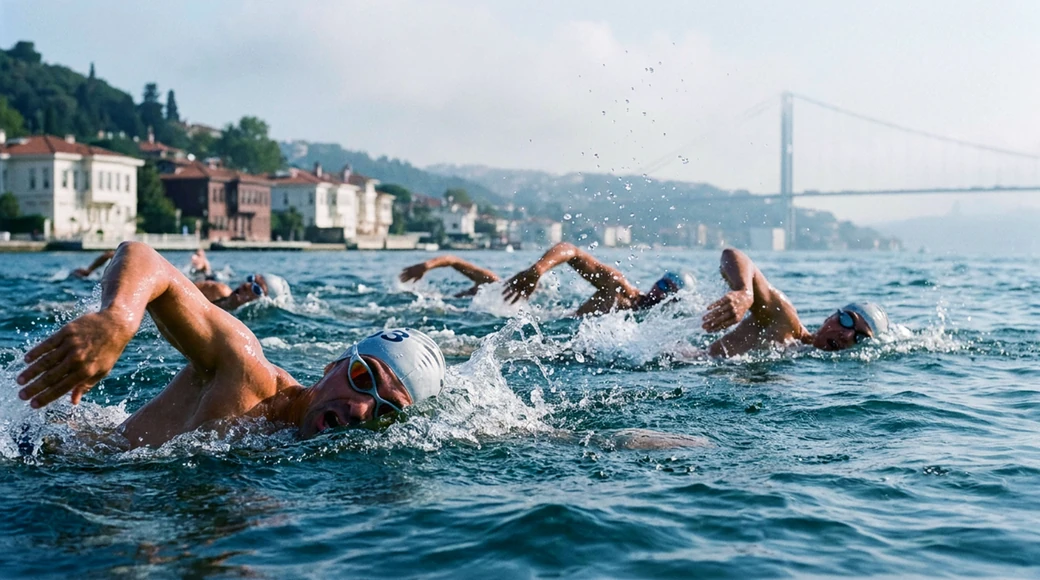
Bosphorus Intercontinental Swimming Race in Istanbul, hundreds of swimmers in colorful caps crossing the strait from Asia to Europe beneath a suspension bridge

Bosphorus Intercontinental Swimming Race

IstanbulAug 22, 2027↻ Annual
Duration:1 daysType:
Sports & Outdoor Events
Admission:FreeLocationAnnual event — exact dates may vary each year

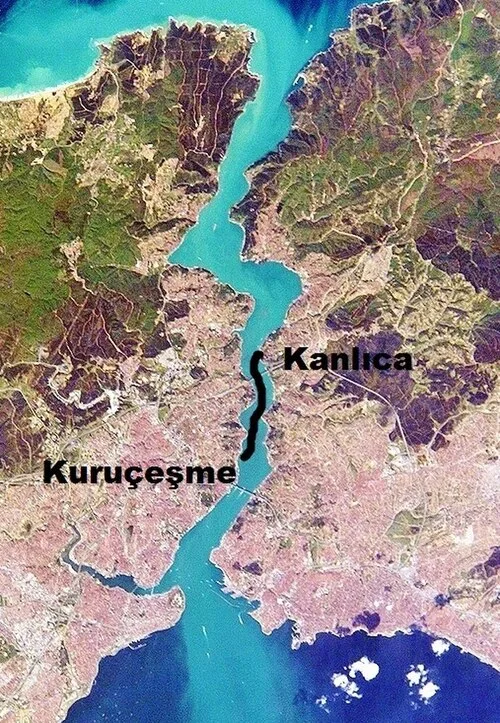
Istanbul's annual open-water swim crosses the Bosphorus from Kanlıca in Asia to Kuruçeşme in Europe over about 6.5 km, with thousands of swimmers and a lively finish area at Cemil Topuzlu Park.

About This Festival

Bosphorus Intercontinental Swimming Race: Swim from Asia to Europe in Istanbul

Every summer, Istanbul turns its famous strait into a racecourse. The Bosphorus Intercontinental Swimming Race, known in Turkish as the Boğaziçi Kıtalararası Yüzme Yarışı, sends thousands of swimmers from the Asian shore at Kanlıca to the European shore at Kuruçeşme, a distance of roughly 6.5 kilometres. Because Istanbul straddles two continents, finishing the course really does mean crossing from Asia to Europe under your own power. The Turkish Olympic Committee has organised the event since 1989, and it has grown into one of the largest open-water swims anywhere, with entrants from dozens of countries and of every age. Everyone who finishes earns the title of Intercontinental Swimmer, while spectators enjoy a lively waterfront festival with views of the strait, the bridges and the city skyline. The race also goes by the slogan "2 Continents, 1 Race" (in Turkish, "2 Kıta 1 Yarış"), and the official hashtag #2kita1yaris and account @2kita1yaris gather photos and news from swimmers and fans.
History of the Bosphorus Cross-Continental Swim: From 1989 to a World-Class Open Water Event

The race began on 23 July 1989 with 68 swimmers, four of them women, and the backing of the International Olympic Committee. The following year the start moved from Çubuklu to Kanlıca, which stretched the course to today's 6.5 kilometres. In 1992 the swim went international when 22 swimmers from Czechoslovakia and two from the United States joined in. Since 2010 every finisher has received an Intercontinental Swimmer certificate. Recognition followed: in 2016 the World Open Water Swimming Association named it the best open-water swimming organisation of the year, and in 2019 it topped the vote for the world's best 100 open-water races. For many years the event carried the Samsung name, and for a period rowing and canoe races were part of the same programme on the strait. In 2010, with Turkcell as main sponsor, about 750 swimmers took part; the field has since passed two thousand, with 2,836 entrants in 2024 and around 2,500 swimmers from 64 countries in the most recent edition, half of the places going to international entrants.

When Is the Bosphorus Swimming Race? Typical Date, Start Time and Race-Day Timeline

The race is held on a Sunday in summer. The first editions took place in July, while recent years have settled on the last weekends of August, so always confirm the current date on the official website before booking travel. Race morning is tightly choreographed: swimmers gather at Cemil Topuzlu Park in Kuruçeşme, board city ferries early in the morning and cross to Kanlıca. The start horn sounds in the late morning, and the awards ceremony follows at the finish. The Bosphorus is closed to ship traffic in both directions for the morning, so the strait belongs to the swimmers. Once the last swimmer has entered the water, a two-hour time limit applies to the whole field.

The 6.5 km Course: Kanlıca to Kuruçeşme Across the Bosphorus

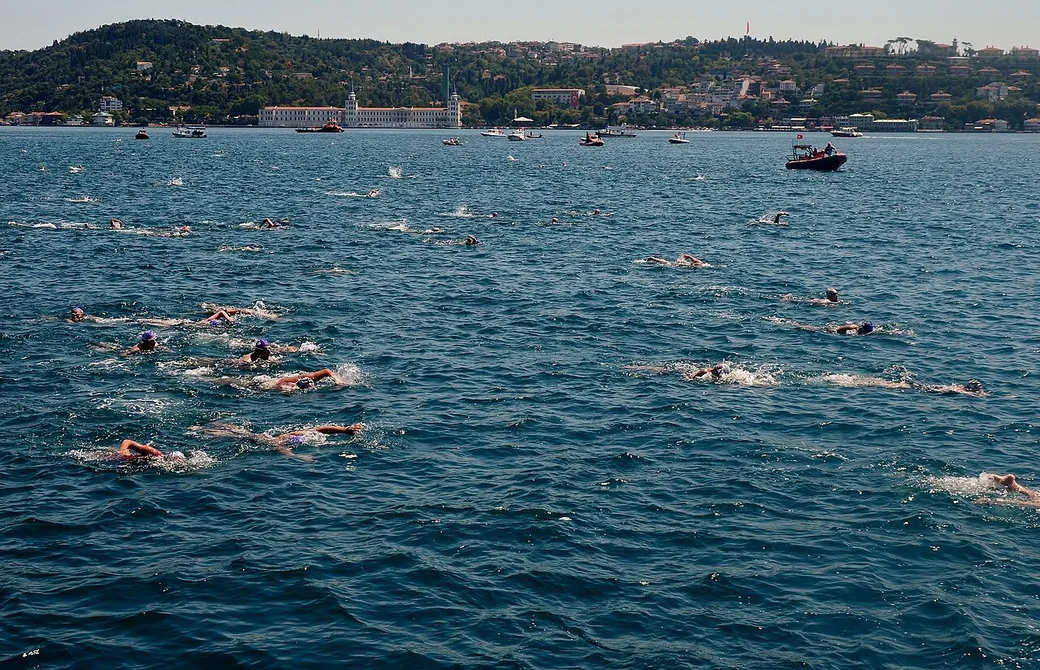
The course runs about 6.5 kilometres downstream. It starts at the Kanlıca ferry pier on the Asian side, just north of the Fatih Sultan Mehmet Bridge, and ends at Cemil Topuzlu Park in Kuruçeşme on the European side, north of the Bosphorus Bridge. Along the way swimmers pass beneath the first bridge and glide past Rumelihisarı and Anadoluhisarı, the twin medieval fortresses, then Bebek and Arnavutköy. Near the end the Galatasaray Islet becomes the landmark for turning toward the European shore. Guide boats at the front, flags on the referee boats and distance checkpoints help swimmers hold their line, and a tall sign with flashing lights marks the finish pontoon. Spectators who know the geography can enjoy the same landmarks from the shore.

Where to Watch the Bosphorus Swim: Cemil Topuzlu Park and the Kuruçeşme Finish

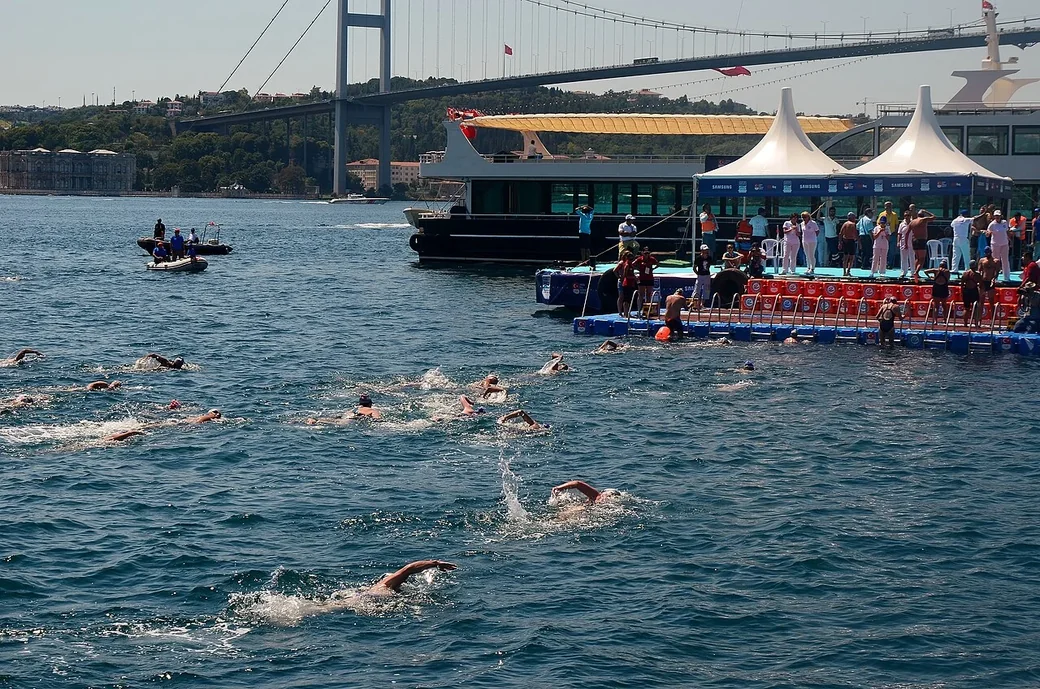
The best place for spectators is Cemil Topuzlu Park in Kuruçeşme, where the swimmers finish. The waterfront park hosts a spectator grandstand, a sponsor zone, a festival and food area, a children's play area and the awards stage, plus a shop selling official race merchandise. Swimmers' areas such as the cloakroom and warm-up zone are fenced off, but you can watch finishers climb the pontoon ladders and follow results on screens. If you cannot be there, the race is usually broadcast live on Turkish television and results appear online through the organisers' live results page. Arrive early, bring sun protection and water, and expect the park to fill around the time the first swimmers appear, roughly an hour after the start. Recent editions were broadcast live on TRT Spor Yıldız, and the official website links to a photo gallery of the race, so even those who cannot attend can follow the action and find their own pictures later.

Kanlıca, the Start of the Race: Famous Yogurt, Mihrabat Grove and Bosphorus Mansions

To see the start, head to Kanlıca on the Asian shore. This old Bosphorus village is famous for its thick yogurt, traditionally served with powdered sugar, although honey or jam are popular alternatives. Cafés beside the ferry pier have served it for generations, which makes it the perfect snack before the swimmers jump from the floating platform. Stroll through Mihrabat Grove, one of the greenest corners of the Asian side, and admire the wooden waterfront mansions known as yalı that line the shore. Kanlıca is a stop for the city ferries on the Bosphorus line, and a small boat shuttles across to Emirgan on the European side, which is a pleasant way to return once the swimmers have disappeared downstream. The Kanlıca ferry pier is at Barış Manço Caddesi 4 in Beykoz, right next to the pier square where the cafés stand.

How to Enter the Bosphorus Swim: Qualification, Age Groups and Registration

Entering is competitive. Participants must be licensed swimmers aged at least 14, and every entrant is expected to be medically fit. Turkish applicants usually take part in selection swims at 50-metre pools in several cities, such as Istanbul, Ankara and İzmir, while foreign swimmers apply through the official website, where about half of all places are reserved for them and the quota has in past years filled within minutes of opening. Applications normally open in spring, and past participants report needing a medical note and confirmation of swimming ability from a coach. There are twelve age groups for men and women, from 14 to 18 up to 70 and over, so everyone races against their peers. Always check the official site for the latest requirements. There is no upper age limit, and swimmers well into their eighties have taken part. Swimmers with disabilities are also welcome to enter.

Bosphorus Swim Rules and Equipment: Neoprene Ban, Safety Buoy and What to Leave Behind

The rules are strict, and breaking them can mean disqualification and a ban from the following year's race. Ordinary textile swimsuits are fine, but rubber or neoprene suits are forbidden. Watches, cameras, jewellery and long or artificial nails are prohibited because jumping from the pontoon can cause injuries. Goggles, nose clips and earplugs are allowed, but anything that helps speed or endurance is not. Every swimmer must tow the supplied safety buoy, tied around the waist with the cord trailing behind, never carried in the hand or on the back and never loaded with belongings. Swimmers without a correctly fitted buoy are not allowed on the ferries, and arriving at the finish without it leads to disqualification.

Accreditation and Race Kit: Cap, Timing Chip, Safety Buoy and Ferry Boarding

Registration takes place before race day at Cemil Topuzlu Park, normally over the three days before the race from mid-morning until evening, with a short extra window early on race morning. Swimmers receive a personal bag with a numbered cap, an ankle band holding the timing chip, the safety buoy, a lanyard ID card, an information leaflet, a souvenir T-shirt and a pair of slippers. None of these items can be replaced if lost. The swimmers' area offers a cloakroom, changing cabins, showers, toilets, water points and a warm-up zone. Wear your swimsuit under your clothes, use the toilets before boarding because the facilities on the ferries stay closed, and board by cap number; anyone who misses the boarding deadline is out of the race. Before race day, limited-capacity boat tours let swimmers and their companions see the whole course from the water. Places are booked through the swimmer's account on the official website, so reserve early.

Start and Finish Explained: Pontoon Jump, Timing Mats and the Intercontinental Swimmer Certificate

The start is dramatic. Ferries pull up beside a pontoon at Kanlıca, the horn sounds and swimmers jump from the platform or slip in from a floating pier. Magnetic mats read your ankle chip, so each swimmer's time begins individually and jumping early gives no advantage. At the finish you climb a ladder onto a pontoon covered with another mat, which stops your clock. After returning the chip you receive a finish kit, an energy snack and water. Finishers can download a certificate online. Overall winners among women and men receive medals and cups, age-group podium finishers get medals, and swimmers aged 70 and over who complete the course receive a finisher's medal.

Bosphorus Currents and Water Temperature: How to Swim Fast and Stay on Course

The Bosphorus joins two seas, and swimmers describe two very different bodies of water: a colder, saltier flow running south from the Black Sea and slower, warmer water with eddies near the shores. Experienced swimmers aim for the cold, fast water in the middle of the strait and avoid the coves, where counter-currents can stall you. Participants usually describe temperatures between about 17 and 22 degrees Celsius. Winning times swing from around 38 minutes to nearly an hour depending on the day's flow. Earlier organisers' handbooks have warned that swimmers swept beneath the Bosphorus Bridge are disqualified, so keep an eye on the finish landmarks, sight often and follow the guide boat and the referee flags. Swimmers report current speeds of roughly 2 to 7 kilometres per hour, strongest near the finish, which can make you swim 30 to 50 percent faster than your usual pool pace. That is why many compare the crossing to flying.

Safety at the Bosphorus Swim: Rescue Boats, Chip Tracking and a Closed Strait

Safety at the Bosphorus Swim: Rescue Boats, Chip Tracking and a Closed Strait

Safety is organised on a national scale. On race morning the strait is closed to shipping and dozens of inflatable rescue boats, jet skis, referee boats and canoe teams escort the swimmers, supported by coast guard and police vessels, drones, and sea and land ambulances. Every swimmer wears a chip and a brightly coloured buoy so that staff can see and track them. If you feel unwell, raise your hand or wave your cap and wait calmly for the nearest boat, because panic puts you and others at risk. Swimmers who cannot finish within the official two hours are lifted from the water by the crew. At the park, medical tents and first-aid teams are on site for swimmers and visitors.

Race-Day Nutrition and Packing List for the Bosphorus Swim

The official guidance is simple. Eat carbohydrate-rich meals the day before, drink plenty of water, avoid trying new foods and skip alcohol. On race morning the organisers suggest oats, a banana, wholegrain bread, yogurt and water, while very fatty, very spicy or high-fibre foods and untested supplements are best avoided. Pack spare goggles, wear your swimsuit under your clothes and bring a change of clothes for the cloakroom, but leave valuables at the hotel. Spectators should bring sunscreen, a hat and a water bottle because the park is exposed to the sun, and a light layer helps in the cool early morning. Allow extra travel time, since the event area opens at dawn.

Records, Champions and Famous Guests: Spitz, Thorpe and the Swimming Dog

A few names define the race. Hakan Eskioğlu holds the record for most overall victories with ten wins. The men's course record of around 38 minutes was set in 2021 by Polat Uzer Turnalı, and Beren Kayrak holds the women's record of 40 minutes 50 seconds from 2006, although times depend heavily on the current. Famous guests have raised the profile: American Olympic legend Mark Spitz put on a swimming show in 2012, and Australia's Ian Thorpe swam in 2013. In the 1990s a record-setting dog named Umbra, who belonged to American swimmer Ted Erikson, also took part. The oldest swimmer so far is Levent Aksüt, who crossed at the age of 87, proof that anyone fit enough can try. Kuzey Tunçelli, who made history by swimming in an Olympic final at Paris 2024, joined the swimmers at the 2024 race.

Zero Waste, Organisers and Related Swims: Çanakkale Strait and Challenge Istanbul

Organisers treat the shore as carefully as the strait. Swimmers are asked to put caps, slippers and bottles into the recycling bins at the park, and in 2018 the race became the first event in Turkey to join the Plastic Disclosure Project Sport programme backed by the United Nations Environment Programme and the World Bank. The event is run by the Turkish Olympic Committee together with the governorate, the municipality, the swimming federation, dozens of public bodies and many volunteers. Fans of strait crossings can also look into the Çanakkale Strait swimming race, another Asia-to-Europe swim, or the Istanbul Bosphorus Triathlon, which also crosses between two continents. Combine your visit with a Bosphorus cruise to see the entire course from the deck.

Practical Information

When

Held once a year on a Sunday in summer (recent editions fell in late August). The swimmers' ferries leave Kuruçeşme in the early morning, the start is in the late morning and the awards ceremony follows at the finish. The Bosphorus is closed to ship traffic during the race.

Where

The start is at Kanlıca Ferry Pier (Beykoz, Asian side); the finish and the whole event area are at Cemil Topuzlu Park in Kuruçeşme (Beşiktaş, European side). The course is about 6.5 km long.

Cost

Free for spectators; there is no entry fee to watch the race. Swimmers register through the official website.

Tips

Arrive at Kuruçeşme early, bring sunscreen, a hat and water, and follow the live results online. To see the start, go to Kanlıca and try its famous yogurt. Check the official website for the current date before you travel.

Specific to this festival

It is a mass-participation swim that crosses two continents with the Bosphorus current. Every finisher earns the Intercontinental Swimmer title, the strait is closed to shipping for the morning, and each swimmer's time is recorded by an ankle chip on magnetic mats.

Accommodation and hotel options during Bosphorus Intercontinental Swimming Race

Accommodation and hotel options around the event venue, with their prices, are shown by Stay22 as a map and a list. Cookies are used. Your consent is remembered on every page; you can turn it off at any time in the cookie settings.

Keep Exploring

Travel essentials for Istanbul

Flights, transfers, car rental, eSIM and insurance — compare your options

Flights

Find the best route

Transfers

Airport & city ground transport

Car Rental

Drive at your own pace

eSIM

Stay connected on arrival

Insurance

Cover your trip