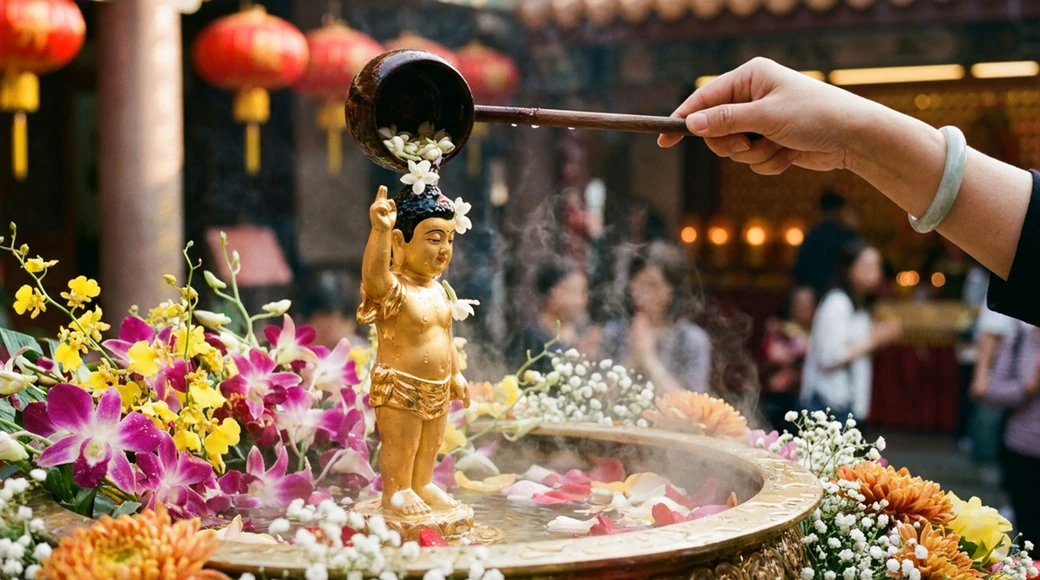
Buddha's Birthday in Hong Kong, where devotees gently pour scented water over a statue of the baby Buddha in a small basin during the quiet Washing the Buddha ceremony at the temple

Buddha’s Birthday & Bathing the Buddha Festival in Hong Kong

Hong KongMay 13, 2027Public holiday↻ Annual
Duration:1 daysType:
Religious & Spiritual Days
Admission:FreeLocationAnnual event — exact dates may vary each year

Hong Kong marks the Buddha’s birth with scented-water bathing ceremonies at Po Lin Monastery, a three-day celebration at Hong Kong Coliseum and a family carnival in Victoria Park. It is a general holiday in the city.

About This Festival

Buddha’s Birthday in Hong Kong: What the Buddha Bathing Festival Is and When It Happens

The Birthday of the Buddha (Fat Daan, “the Buddha’s birth”) is celebrated in Hong Kong on the eighth day of the fourth lunar month, which usually lands between late April and late May. The occasion is also known as the Buddha Bathing Festival (“the festival of bathing the Buddha”), because its central ritual is pouring scented water over a small statue of the infant Buddha. There is no single stage for the festival. Monasteries, temples, a public park and an indoor arena each host their own events, so you can choose between a quiet mountain setting and a lively city carnival. The day is a general holiday, and in 2026, when it fell on a Sunday, the following Monday became the day off.
How Buddha’s Birthday Became a Public Holiday in Hong Kong

Before 1997 few people in Hong Kong knew the date of the Buddha’s birthday. Buddhist organisations kept asking for it to be recognised, and the Hong Kong Buddhist Association, founded in 1945, led the effort. Its leader, Venerable Kok Kwong, is remembered for a petition that gathered hundreds of thousands of signatures, with one official source mentioning more than 800,000. A bill introduced in 1998 added the day, together with Labour Day, to the list of general holidays from 1999 onwards. At that time the government estimated that about 800,000 Buddhists lived in the city. Today it is the only traditional Chinese religious day with holiday status in Hong Kong.

Bathing the Buddha Step by Step: The Ritual and Its Meaning

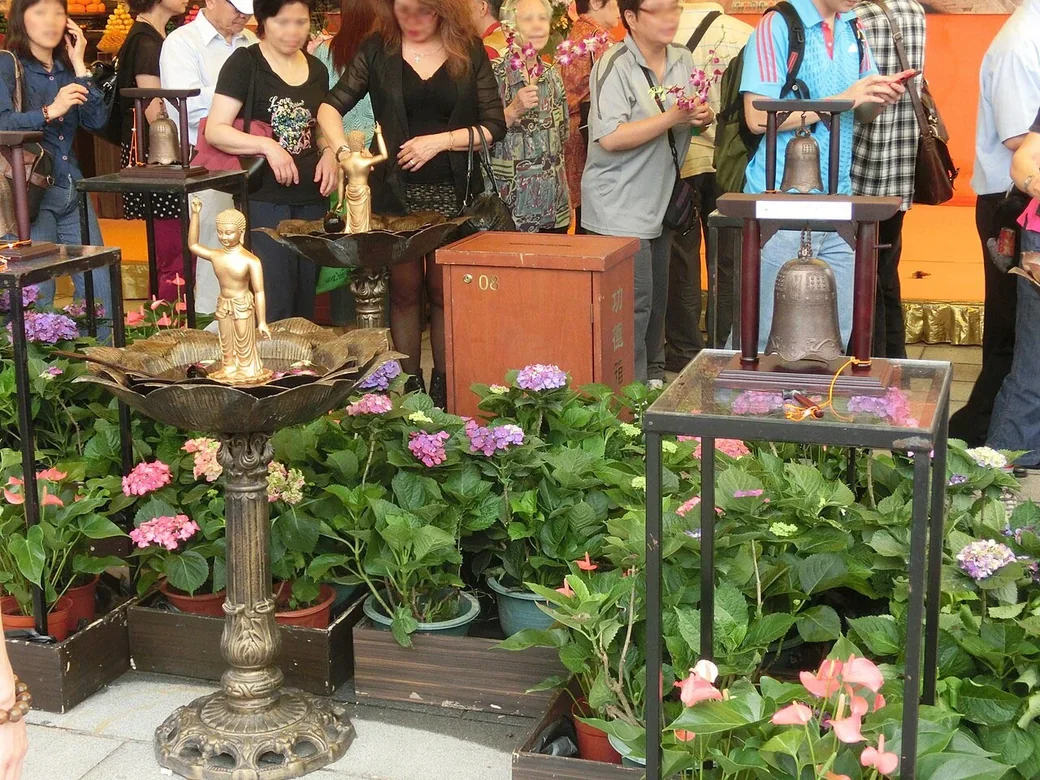
A basin of fragrant water holds a small statue of the newborn prince, one hand pointing to the sky and the other to the earth. Visitors bow, say a short prayer and pour water over the statue with a long-handled ladle. One widely taught form uses three ladles: the first touches the right shoulder for a pure intention to do good, the second the left shoulder for letting go of greed and anger, and the third the right shoulder again with wishes for the safety of family. Practices differ from temple to temple, so follow the volunteers beside the basin. The water is traditionally scented with herbs such as sandalwood and agarwood. The idea is that the washing cleanses the heart of greed, anger and confusion, not the statue itself. Temples also light lanterns on the day, a symbol of the Buddha’s attainment of nirvana (final liberation).

Legends of the Baby Buddha: Nine Dragons, Seven Lotus Steps and the Bathing Tradition

According to a legend told in Buddhist scriptures, when Prince Siddhartha was born in Lumbini, nine dragons sprayed purifying water from the sky to bathe him. That story gave rise to the bathing ritual you see in Hong Kong today. Another account says that the newborn took seven steps in each of the four directions, with a lotus blossoming at every step, and that he raised one hand to the heavens while the other touched the ground. This is why statues of the infant Buddha stand in exactly that pose. Both tales are part of religious tradition rather than documented history, and many devotees read them as symbols of purity, awakening and compassion.

Why Buddha’s Birthday Falls on Different Dates Across Asia: Lunar Calendar, Vesak and Buddhist Era

Chinese Buddhism, followed in Hong Kong, Taiwan and Macau and also in Korea, marks the birth on the eighth day of the fourth lunar month, so the Gregorian date moves every year. Many communities in South and Southeast Asia instead observe Vesak (the Buddhist day of remembrance of the Buddha) on the full moon of the Vesakha month (usually in May) and celebrate the birth, enlightenment and passing of the Buddha together. In 1950 the founding conference of the World Fellowship of Buddhists in Colombo recommended marking the full moon of May as the Buddha’s day, and the traditional dates (birth in 623 BCE, enlightenment in 588 BCE and passing in 543 BCE) come from Theravada tradition. The Hong Kong Buddhist Association counts years in the Buddhist era, a number you will see printed on its banners and programmes.

Hong Kong Coliseum Buddha’s Birthday Celebration: Three Days of Bathing, Chanting and Lamp Ceremonies

The Hong Kong Buddhist Association stages its large public celebration at Hong Kong Coliseum in Hung Hom, which you can reach by MTR (Hong Kong’s metro) to Hung Hom Station. The three-day programme includes the bathing ceremony, Buddhist chanting, a lamp-passing ceremony (symbolising the handing down of the teachings), a refuge ceremony (in which people formally declare their Buddhist commitment) and talks by monks. Several sessions run each day: in 2026 the first day had afternoon and evening sessions and the last day had morning, afternoon and evening ones. Entry is by ticket with advance registration, so watch the association’s announcements. Senior city officials have joined the ceremony and rung a bell three times as a blessing for Hong Kong.

Po Lin Monastery and the Tian Tan Big Buddha: Bathing the Buddha on Lantau Island

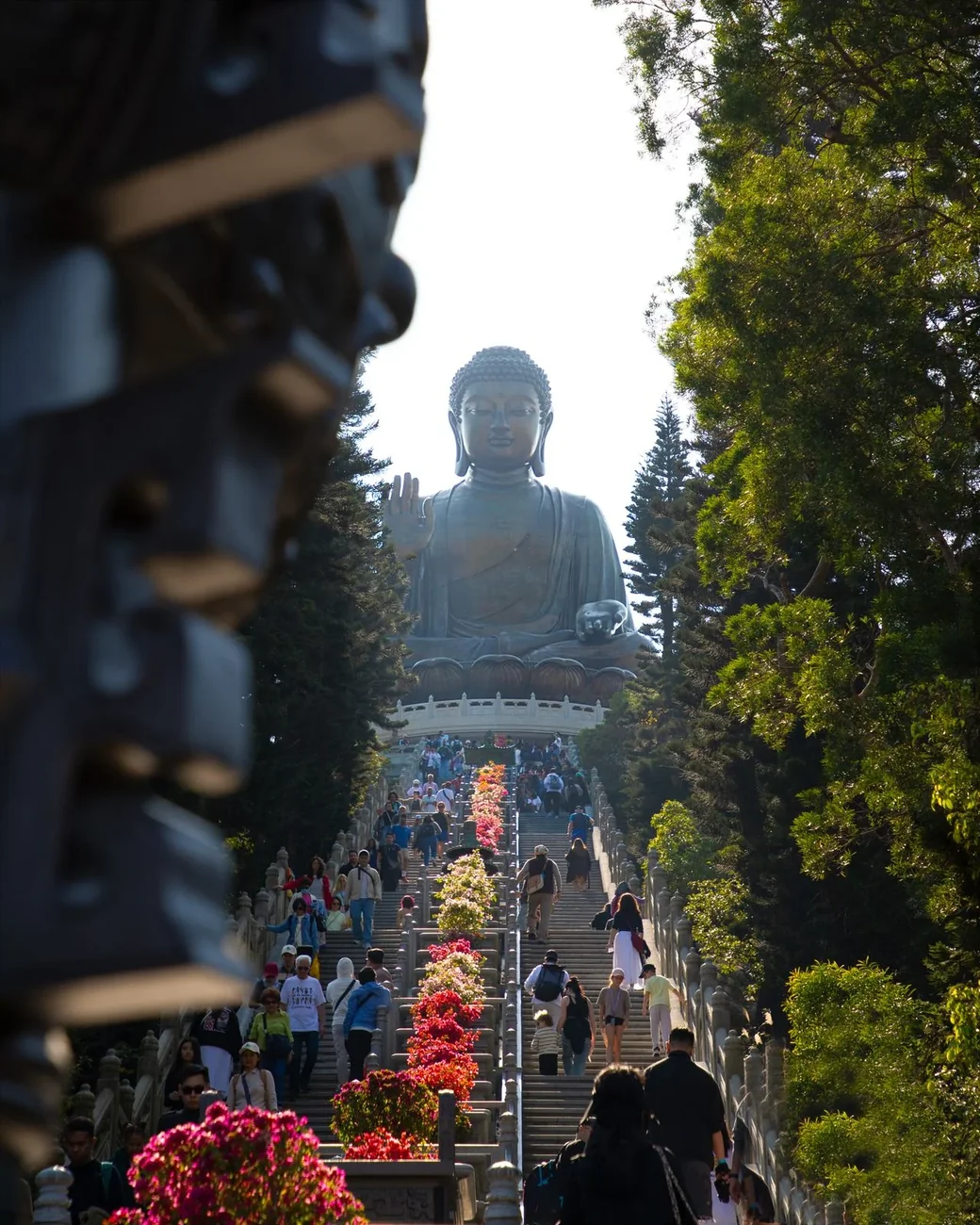
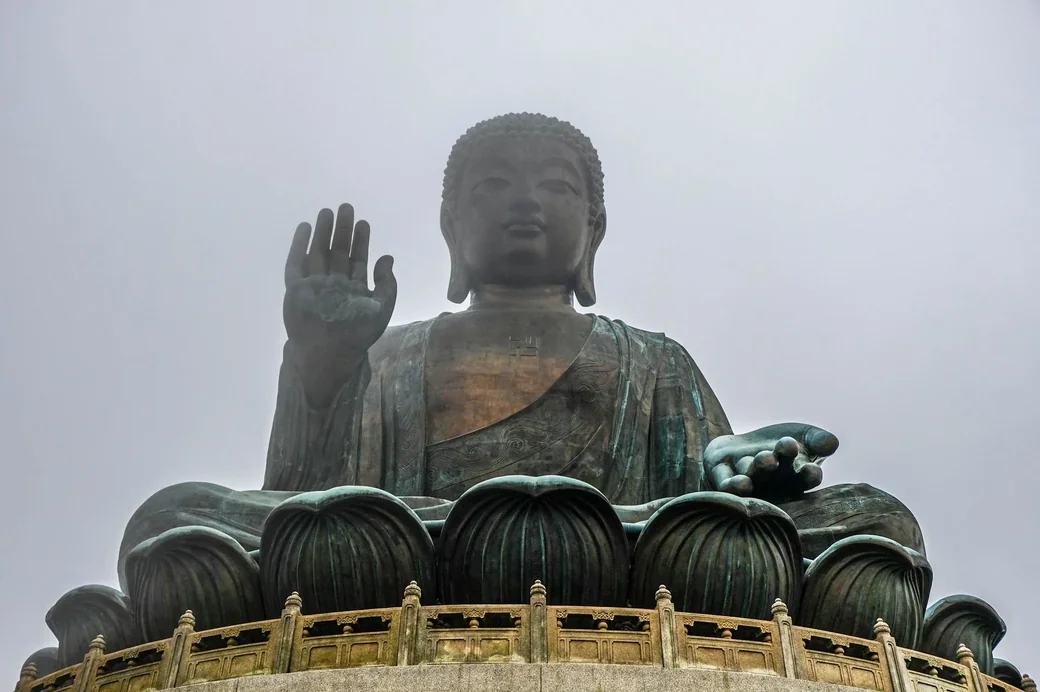
Po Lin Monastery (“Precious Lotus”) on the Ngong Ping plateau holds a public bathing ritual every day from the 2nd to the 8th of the fourth lunar month, with the basin placed in front of the Hall of the Great Hero. Three monks founded the monastery in 1906 as a simple hut, and it took its present name in 1924. The Tian Tan Buddha beside it was completed in 1993; it is 34 metres tall, weighs about 250 tonnes and is reached by 268 steps. It faces north, and its base was inspired by the Altar of Heaven in Beijing. From Tung Chung you can take bus 23 or the Ngong Ping 360 cable car, and the monastery restaurant serves vegetarian meals.

Buddha’s Birthday Carnival at Victoria Park: Family Activities, Scripture Copying and Vegetarian Snacks

The Buddha’s Light International Association, through its Hong Kong Fo Guang Vihara, organises a one-day carnival at Victoria Park in Causeway Bay, on football pitches 4 to 6. In 2026 it featured more than 100 booths. Visitors can bathe the Buddha, copy Buddhist scriptures by hand, make a wish by striking a bell, read at the mobile Cloud and Water library, join a tea-and-meditation ceremony and see an exhibition on the Buddha’s life. Collecting stamps at the booths earns a small souvenir, and a parade of floats and statues honours the Shakya clan of the Buddha’s family. Take the MTR to Tin Hau or Causeway Bay.

Chi Lin Nunnery, Ten Thousand Buddhas Monastery and Tsz Shan: More Places to Bathe the Buddha

Chi Lin Nunnery at Diamond Hill is a large timber-built complex that began as a retreat for Buddhist nuns and is popular on the holiday. Ten Thousand Buddhas Monastery in Sha Tin is reached by about 430 steps lined with golden statues, and many devotees see the climb itself as a gesture of respect. It offers vegetarian noodles to visitors on the day. Tsz Shan Monastery in Tai Po has made water offerings in place of incense, and it has welcomed visitors for bathing sessions through an online registration system. The Hong Kong Buddhist Association also holds public bathing ceremonies in school playgrounds and community centres. Wong Tai Sin Temple and Man Mo Temple in Sheung Wan also draw extra worshippers on the day.

Vegetarian Food on Buddha’s Birthday in Hong Kong: Monastery Meals, Noodles and Carnival Snacks

Many Hong Kong families eat vegetarian on Buddha’s Birthday as a way of practising compassion. Vegetarian dishes are called zaai1 coi3, “vegetarian dishes” in Cantonese. The restaurant at Po Lin Monastery is the best-known place to enjoy them after the ceremony, and the Victoria Park carnival offers vegetarian snacks and information sessions on Buddhist vegetarian culture. Ten Thousand Buddhas Monastery serves noodles, and traditionally its volunteers hand out red packets containing rice and peanuts, known as “rice of well-being” (a symbol of good health and long life). Tsz Shan has provided vegetarian food during its open days. If you follow a particular diet, ask the volunteers about ingredients.

Tam Kung’s Birthday in Shau Kei Wan: The Same-Day Festival with Lion and Dragon Dances

On the same day as Buddha’s Birthday, the fishing district of Shau Kei Wan celebrates Tam Kung, a sea deity revered by seafaring communities. In the morning, lion dance and dragon dance teams march towards Tam Kung Temple, which was built in 1905 beside the harbour, accompanied by gongs and drums. The festival was revived in the 1990s, and the public holiday has since let more residents join in. According to a popular account, Tam Kung was born in Huizhou during the Yuan dynasty and could forecast the weather and heal the sick even as a child. Take the MTR Island Line to Shau Kei Wan, or ride the tram to its terminus.

Cheung Chau Bun Festival on Buddha’s Birthday: Piu Sik Parade and Midnight Bun Scrambling

The carless island of Cheung Chau holds its Bun Festival from the fifth to the ninth day of the fourth lunar month, so the grand parade coincides with Buddha’s Birthday. In the Piu Sik (“floating colours”) parade, children in costume seem to float above the streets. The finale is a bun-scrambling contest at midnight beside Pak Tai Temple, and the festival buns are stamped with ping on, “peace and safety”. The festival has been on China’s national list of intangible cultural heritage since 2011. According to a local legend, islanders once paraded a statue of the god Pak Tai to drive away plague and pirates. Ferries leave from Central Pier 5, so go early and consider staying overnight.

Temple Etiquette on Buddha’s Birthday in Hong Kong: How to Join Respectfully and Five Cantonese Phrases

Visitors are welcome to take part in the bathing ritual. Queue calmly, bow lightly before pouring, and follow the volunteers’ directions at the basin. Dress modestly, keep your voice low in the halls, and look for signs about photography before you raise your camera. If you are unsure what to do, watch the local worshippers and copy them. Five Cantonese expressions are handy: fat6 daan3 faai3 lok6, “happy Buddha’s Birthday”, juk6 fat6, “bathing the Buddha”, zaai1 coi3, “vegetarian dishes”, o1 mei4 to4 fat6, a common Buddhist greeting and blessing and ping4 on1, “peace and safety”.

Getting Around Hong Kong on Buddha’s Birthday: Transport, Timing and What to Bring

Because the day is a general holiday, attractions, restaurants, public transport and shops stay open. For Po Lin, take the MTR to Tung Chung and continue by bus 23 or by cable car. For Victoria Park, use Tin Hau or Causeway Bay station. For the Coliseum, use Hung Hom station, and for Shau Kei Wan the Island Line. Ferries to Cheung Chau fill early. Late spring in Hong Kong is warm and humid, so bring water, sun protection, light clothing and a compact umbrella. Po Lin’s bathing ritual lasts a whole week, so a visit on a day before the main date is often quieter. Check registration notices for the Coliseum and Tsz Shan.

Little-Known Facts and Souvenirs: Buddha’s Birthday in Hong Kong Beyond the Bathing Ceremony

Hong Kong’s Theravada Buddhists (followers of the school of Buddhism found mainly in Sri Lanka and Southeast Asia), many of them from the Thai community, traditionally celebrate Vesak (the Buddhist day of remembrance of the Buddha) on the full moon of the Vesakha month (usually in May) and visit the Thai Buddhist monastery in Tai Po on the nearest Sunday. Labour Day and Buddha’s Birthday became general holidays in the same 1998 bill. Three celebrations share one date: Buddha’s Birthday, Tam Kung’s Birthday and the Cheung Chau Bun Festival, so you can sample all three in one day if you plan well. For keepsakes, look for the wooden bracelets sold near the Tian Tan Buddha, the buns stamped with “peace” on Cheung Chau and the stamp-rally souvenirs at the Victoria Park carnival.

Practical Information

When

The eighth day of the fourth lunar month, usually between late April and late May. It is a general holiday, and in 2026 (when it fell on a Sunday) the following Monday was the day off. Po Lin Monastery’s public bathing runs for a week, from the 2nd to the 8th day of the lunar month.

Where

Across Hong Kong. The main stages are Hong Kong Coliseum in Hung Hom, Po Lin Monastery on Lantau Island, the Victoria Park carnival in Causeway Bay, Chi Lin Nunnery, Ten Thousand Buddhas Monastery and Tsz Shan Monastery. Tam Kung’s Birthday in Shau Kei Wan and the Bun Festival on Cheung Chau take place on the same day.

Cost

Free. The bathing ceremonies and the carnival have no entry charge. The Coliseum programme is entered with a ticket obtained at no charge, and some monasteries ask for advance registration.

Tips

Arrive early at the popular sites, bring water and sun protection, wear modest clothing and follow the volunteers’ guidance at the basin. Check the Hong Kong Buddhist Association and each monastery’s notices for registration and session times.

Specific to this festival

This is the only traditional Chinese religious day that is a general holiday in Hong Kong, and it falls on the same day as two other celebrations: Tam Kung’s Birthday and the Cheung Chau Bun Festival. The key ritual is gentle and open to visitors: you pour scented water over a statue of the infant Buddha, and the washing is meant to cleanse the heart rather than the statue.

Accommodation and hotel options during Buddha’s Birthday & Bathing the Buddha Festival in Hong Kong

Accommodation and hotel options around the event venue, with their prices, are shown by Stay22 as a map and a list. Cookies are used. Your consent is remembered on every page; you can turn it off at any time in the cookie settings.

Keep Exploring

Travel essentials for Hong Kong

Flights, transfers, car rental, eSIM and insurance — compare your options

Flights

Find the best route

Transfers

Airport & city ground transport

Car Rental

Drive at your own pace

eSIM

Stay connected on arrival

Insurance

Cover your trip