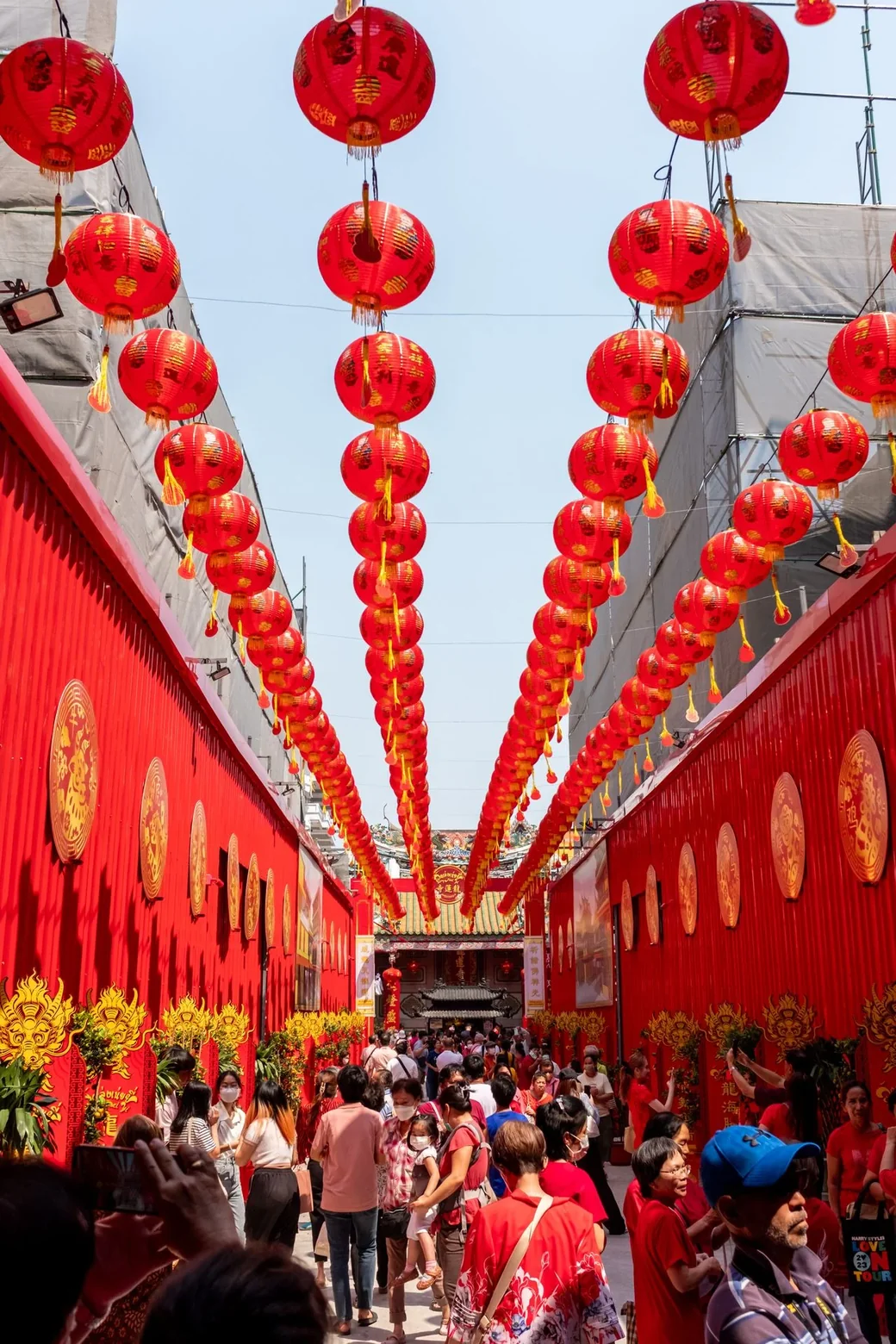
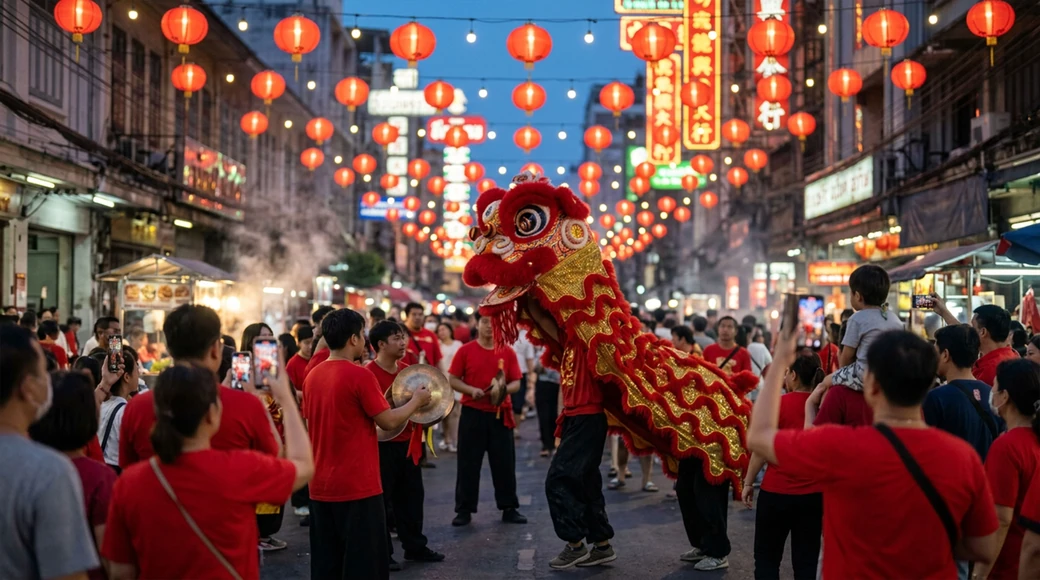
Chinese New Year in Bangkok's Chinatown, with red lanterns strung above Yaowarat Road and lion dancers performing amid festive crowds

Chinese New Year in Bangkok (Trut Chin, Yaowarat)

BangkokFeb 5, 2027 – Feb 7, 2027↻ Annual
Duration:3 daysType:
Cultural & Traditional Festivals
Admission:FreeLocationAnnual event — exact dates may vary each year

Bangkok's Chinatown turns red for Trut Chin: Yaowarat Road closes to traffic, lion dances thread through the crowd, and Wat Mangkon fills with incense. The city's biggest Lunar New Year celebration, free to join.

About This Festival

Trut Chin: What Chinese New Year Means in Bangkok

Thais call it Trut Chin, and it belongs as much to Bangkok as it does to China. Descendants of Teochew, Hokkien and Hakka migrants who settled here from the eighteenth century onward have folded the lunar new year into Thai life so thoroughly that it now feels like a local season rather than an imported one. Families make merit at Buddhist temples alongside Chinese rituals, and charitable giving in the spirit of nam jai (generosity of the heart) runs through the whole period. It is not an official public holiday, so offices, banks and transport operate normally — which is exactly what makes the transformation of one neighbourhood so striking. Step off the MRT and the ordinary city ends at the top of the stairs.
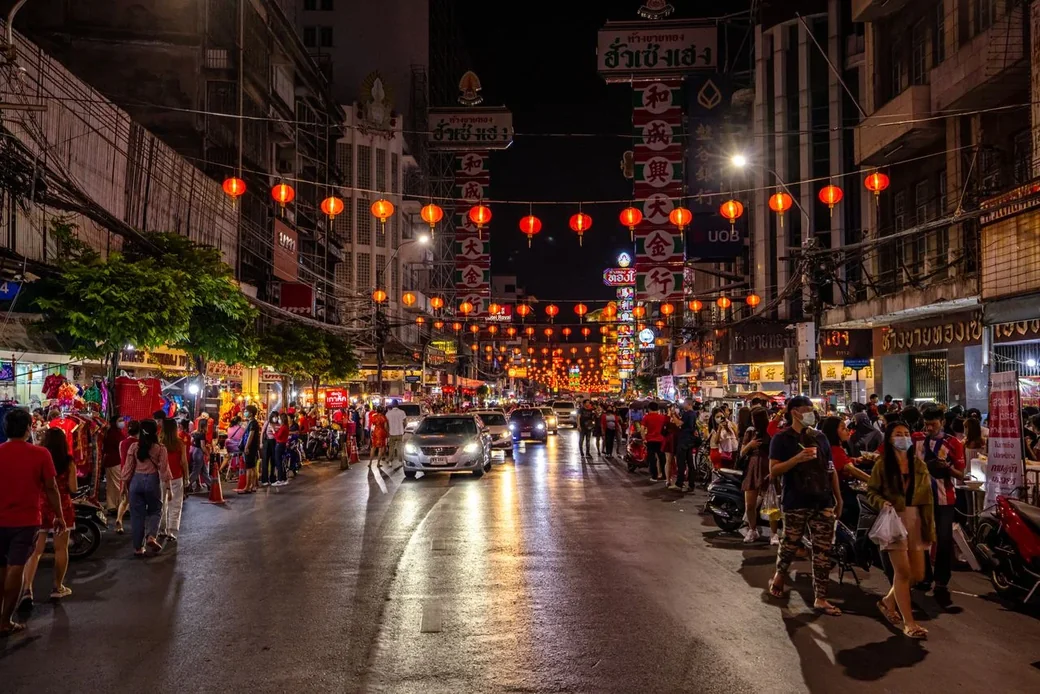
Yaowarat, the Dragon Road: Why Chinatown Looks the Way It Does

Bangkok's Chinese community was moved to this stretch of riverbank when the capital was founded, and for a century the narrow Sampheng lane was its main street. Late in the nineteenth century King Chulalongkorn ordered a proper road cut through the district. To avoid expropriating land, the surveyors followed existing oxcart tracks, which is why Yaowarat curves like a dragon's body — a shape merchants have always read as auspicious for trade. The road runs roughly a kilometre and a half and is lined with gold shops, dozens on the main street and many more in the lanes behind it, earning it the nickname Thailand's Golden Road. Understanding that curve explains why the celebration has the shape it does.

The Three Ritual Days: Wan Chai, Wan Wai and Wan Tiew

The festival has a private architecture that visitors rarely see. On Wan Chai, the shopping day, markets fill with people buying whole chickens and ducks, fruit, Chinese cakes, incense and folded paper offerings. On Wan Wai, the worship day, households make offerings in a set order — to guardian deities at dawn, to ancestors in the late morning, to wandering spirits in the afternoon — and paper money is burned in the street. Wan Tiew is the day for visiting: new clothes, preferably red, rounds of relatives, and red envelopes handed from elders to the young. Houses are cleaned thoroughly the day before, then brooms are put away, because sweeping on the new year is said to sweep out the luck.

The Opening Ceremony at the Odeon Arch

The street celebration begins under the commemorative Chinatown arch at Odeon Circle, built in honour of a royal birthday and now the symbolic gateway to the festival. The opening has long carried royal patronage — a senior member of the royal family has regularly presided — and it is organised jointly by the tourism ministry, the Bangkok Metropolitan Administration, the Tourism Authority of Thailand, the Samphanthawong cultural council, the gold traders' association and local businesses. Yaowarat is closed to vehicles and becomes a single enormous pedestrian street, with exhibition areas on the district's history. The exact programme is confirmed each year and can change, so check official announcements before you plan your evening around a specific hour.

Lion Dances, Drums and Chinese Opera on the Street

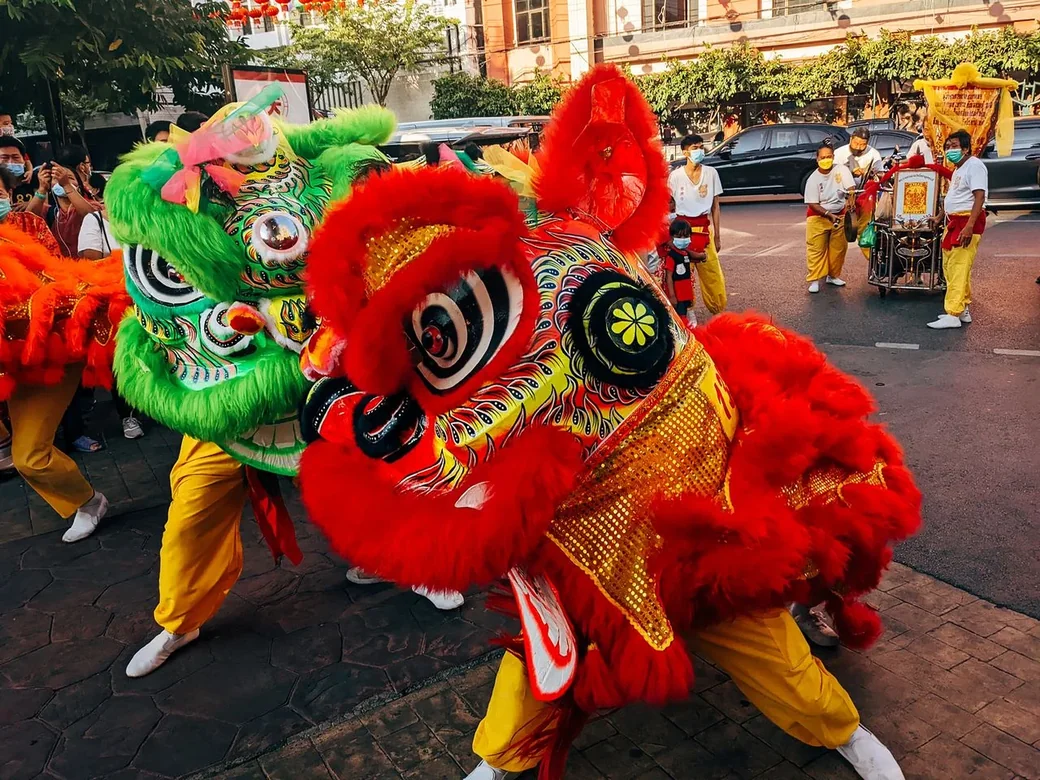
The sound reaches you before the sight does: cymbals, a deep drum, then a lion pushing through the crowd on two pairs of legs. Lion and dragon dances are blessings rather than performances, and shopkeepers hand the troupes red envelopes so the blessing settles on their business for the year. Acrobatic and dance companies are often invited from Chinese provinces, while traditional Chinese opera is staged on small platforms beside the shrines, drawing an older audience that watches for hours. There is no large central fireworks display in the middle of the city; what you get instead are small pyrotechnic bursts around the lion dances and, above your head, tunnels of lanterns and illuminated arches.

Wat Mangkon Kamalawat: The Spiritual Centre of the Festival

Bangkok's largest and most important Chinese Buddhist temple was founded in the early 1870s as Wat Leng Noei Yi and renamed by King Chulalongkorn as the Dragon Lotus Temple. Its founder built it to hold the community's Buddhist, Taoist and Confucian devotions under one roof, and that mixture is still visible in the altars. Four guardian figures, each about four metres tall, stand inside the entrance; behind the courtyard are pavilions to Guanyin, to the founder and to a Chinese saint. At new year the courtyard fills with worshippers seeking blessings for the year ahead, including rituals for those whose zodiac sign clashes with the incoming animal. Go early in the morning if you want to breathe.

Wat Traimit and the Golden Buddha at the Gateway

At the Odeon end of Yaowarat stands Wat Traimit, home to a Sukhothai-style Buddha cast in solid gold and weighing several tonnes. For centuries it sat under a plain plaster shell, unremarkable and unremarked, until the covering cracked during a move and the gold beneath was revealed — plaster fragments are still displayed on site. Upstairs, the Yaowarat Chinatown Heritage Centre tells the story of the Chinese migrants who built the district, which makes it the most useful first stop of the day; the museum floors close one day a week. Visiting in the morning and walking up Yaowarat afterwards gives the festival a context that the evening crowd cannot.

The Shrines and Back Lanes Locals Visit First

Beyond the main road, small shrines do much of the spiritual work. Opposite the Chinatown arch, the Thian Fa Foundation shelters a revered carved Guanyin where people pray specifically for health, and Chinese opera is often staged in its courtyard during the festival. Leng Buai Ia, tucked into the lanes and said to be among the oldest Chinese shrines in Bangkok, and the Tai Hong Kong shrine draw steady queues of incense-bearers. The narrow market alley of Trok Itsaranuphap is where offerings are actually bought. Talat Noi, Song Wat and the older residential blocks hold quieter, family-scale celebrations — this is where Thai-Chinese Bangkok celebrates when it is not performing.

Red, Gold and Incense: Reading the Festival's Atmosphere

The palette is absolute: red for luck and gold for prosperity, on banners, lanterns, envelopes and clothing. The soundtrack is percussive — drum, gong and cymbal — layered over vendors calling and opera singers competing with both. The smell is the thing you remember: sandalwood incense drifting out of temple gates, roast duck fat, caramelising sugar. Temples now encourage shorter incense sticks and electronic firecrackers to keep the air breathable, a small modern compromise inside an old ritual. Dress in red if you want to belong; black and white are the colours of mourning in Chinese custom and are best left in the wardrobe. The best photographs come from the arch looking up the road, and from the side lanes looking out.

What to Eat: Symbolic Dishes and Yaowarat Street Food

Every dish on a new year table carries an argument. Noodles are served long and never cut, because their length is your life; fish suggests surplus; a whole chicken, head and feet intact, stands for wholeness and family unity. Around it all, Chinatown does what it does best. Roast duck and char siu hang in shophouse windows, dim sum steams in back alleys from early morning, oyster omelettes spit on flat griddles, and mango sticky rice appears from carts that have stood on the same corner for decades. The strategy is small portions at many stalls rather than one seated meal. Vegetarian jay food is easy to find around the Chinese temples, and the side sois offer tables when your legs give out.

Getting There and Timing Your Visit

Take the MRT Blue Line to Wat Mangkon or Hua Lamphong and walk in. Once the road closures go up, taxis and ride-hailing cars cannot reach Chinatown and will strand you in traffic several blocks away, so the train is not merely convenient but necessary. A river boat to Ratchawong pier is a pleasant alternative approach. Locals go early: temple visits happen in the morning, when the courtyards are calm and the light is good. The street fills from late afternoon and peaks after dark, so arriving before sunset gets you a position rather than a scrum. If the main day falls on a weekend, expect the crowd to roughly double.

Visitors moving through the dense evening crowd in Bangkok's Chinatown

Crowds, Safety and Staying Comfortable

Hundreds of thousands of people pass through a road built for oxcarts, so plan for density. Keep phones and wallets in front pockets or zipped bags, agree a meeting point with your group because phone signal struggles in the crush, and carry a power bank. Cash in small notes is essential; most stalls take nothing else, and ATMs on the main road develop queues. Bangkok is warm even in the cool season, so drink more water than you think you need. Wear closed, comfortable shoes — pavements are uneven and alleys are slick with kitchen runoff. Police presence is heavy during the official event and first-aid points are set up along the route. Wheelchair users will find the main road flat and easy to roll along; the narrow side lanes are best explored on foot.

Etiquette and a Few Words That Open Doors

Temples remain working places of worship during the festival. Cover shoulders and knees, remove your shoes where signs indicate, keep your head lower than the Buddha images when seated, and never point your feet towards an altar. Ask before photographing someone mid-prayer, and stay out of the path of a lion dance rather than stepping in for a better frame. Avoid giving clocks or shoes as gifts, both of which carry unlucky homophones. The greeting you will hear most is the Teochew "Sin jia yu ee, sin nee huat chai" — may your wishes come true and your year be prosperous — alongside the Mandarin "Gong xi fa cai" (wishing prosperity) and the Thai "Suk san wan Trut Chin" (happy Chinese New Year).

Where to Stay and How to Get Home Afterwards

Staying in Chinatown puts you inside the festival, with lively nights outside your window; the historic shophouse hotels here are charming and intimate in size. Silom, Sathorn and the old royal quarter around Rattanakosin all sit within a short MRT ride and stay calmer, while the riverside hotels offer a genuine retreat with boat access to Ratchawong pier. This falls in Bangkok's cool, dry high season, so rooms are scarce and expensive unless you book months ahead. Plan your return before you go out: the metro does not run all night, road closures distort taxi routes for hours afterwards, and walking out to a main road is often quicker than waiting.

Beyond Yaowarat: Malls, Lanterns and Other Cities

If the crush is not for you, the festival has gentler versions. Major shopping centres including ICONSIAM, CentralWorld and Siam Paragon mount large lantern installations and stage cultural programmes with performers invited from China — air-conditioned, family-friendly and free to walk through. The celebration does not end with the main day either: shrine activity carries on until the Lantern Festival on the fifteenth day of the lunar month, and the Yaowarat illuminations stay lit for weeks. Elsewhere in Thailand, Phuket's old town celebrates with a distinct Peranakan (a locally born community of Chinese descent with a blended Malay–Chinese heritage) accent, while Nakhon Sawan is famous for pole-acrobatic golden dragon parades. The morning after, Chinatown is quiet, swept and unexpectedly photogenic.

Practical Information

When

Trut Chin follows the lunar calendar, so it moves between late January and mid-February. Thai-Chinese families keep three consecutive days — a shopping day, a worship day and a visiting day — while the street celebration in Chinatown is usually concentrated into two evenings around the new year itself. Decorative lighting along Yaowarat is switched on for several weeks, typically from early evening until late at night, and shrine activity continues until the Lantern Festival on the fifteenth day.

Where

Yaowarat Road in Samphanthawong district, between the Chinatown arch at Odeon Circle and the Chaloem Buri intersection. Wat Mangkon Kamalawat on Charoen Krung Road, Wat Traimit at the Odeon end, and the shrines and lanes around Talat Noi and Sampheng carry the same atmosphere at a quieter volume.

Cost

Free. There is no ticket, no fence and no paid seating anywhere along Yaowarat, and temple courtyards are open to everyone. You only pay for what you eat, for optional museum entry and for offerings if you choose to make them.

Tips

Come by MRT — Wat Mangkon and Hua Lamphong stations both sit a short walk from the action, and once road closures begin no taxi or ride-hailing car can reach you. Arrive in the late afternoon rather than after dark, carry cash in small notes, wear closed shoes for uneven pavements, and cover shoulders and knees if you plan to enter temples. Red clothing is welcome; black and white are traditionally avoided.

Special to this festival

This is a Chinese New Year shaped by Thailand. The day is not a national public holiday, so the rest of Bangkok works as usual while one district transforms completely. The opening ceremony at the Odeon arch has long carried royal patronage, which is unique among the world's Chinatown celebrations, and the ritual core — offerings of whole chicken and duck, paper money burned for ancestors, merit made at a Mahayana temple that honours Buddha, Guanyin and Confucius under one roof — belongs to a community that has been in this city since it was founded.

Accommodation and hotel options during Chinese New Year in Bangkok (Trut Chin, Yaowarat)

Accommodation and hotel options around the event venue, with their prices, are shown by Stay22 as a map and a list. Cookies are used. Your consent is remembered on every page; you can turn it off at any time in the cookie settings.

Keep Exploring

Travel essentials for Bangkok

Flights, transfers, car rental, eSIM and insurance — compare your options

Flights

Find the best route

Transfers

Airport & city ground transport

Car Rental

Drive at your own pace

eSIM

Stay connected on arrival

Insurance

Cover your trip