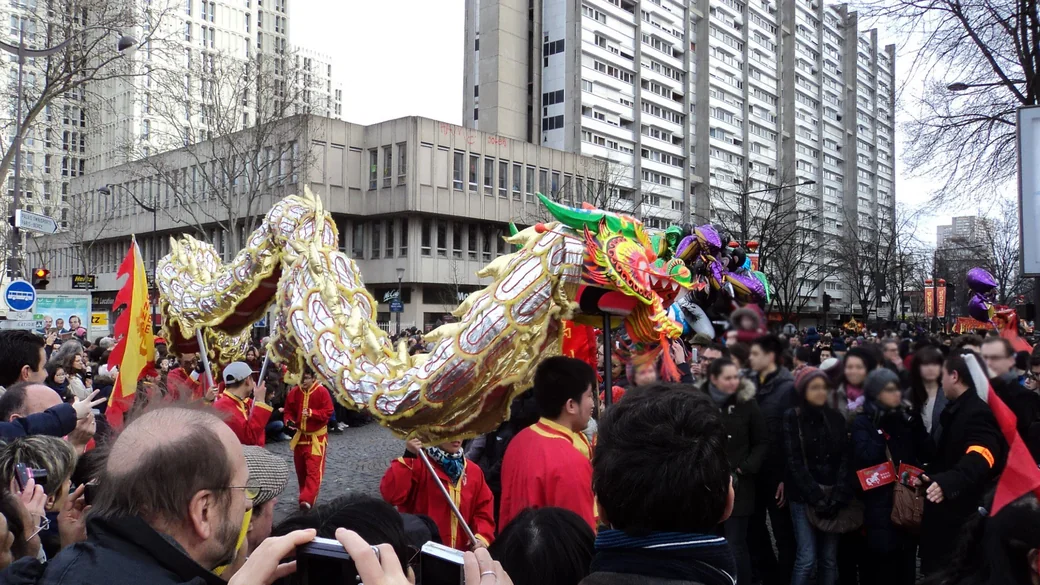
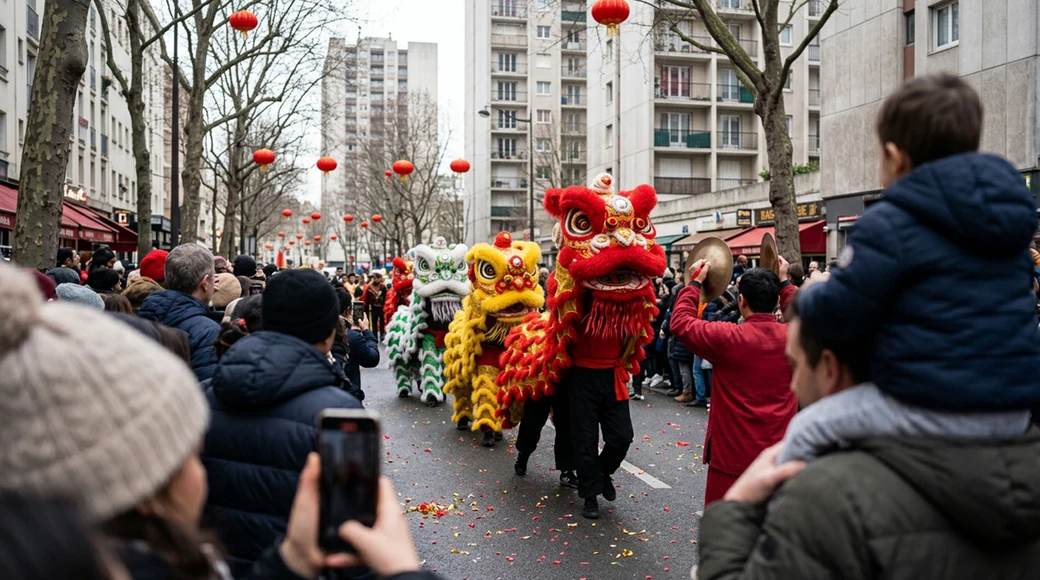
Chinese New Year parade in Paris, dragon and lion dancers moving through streets lined with red lanterns and spectators

Paris Chinese New Year Parade

ParisFeb 21, 2027↻ Annual
Duration:1 daysType:
Cultural & Traditional Festivals
Admission:FreeLocationAnnual event — exact dates may vary each year

Paris's biggest Lunar New Year celebration fills the 13th arrondissement's Chinatown with dragon and lion dances, costumed processions and decorated floats. Free to attend, it's been organized by ARFOI since 1986 and follows the lunar calendar, so its date shifts every year.

About This Festival

What Is the Paris Chinese New Year Parade?

The Paris Chinese New Year Parade is an annual procession through the 13th arrondissement's Chinatown, organized by ARFOI (Association of Residents in France of Indochinese Origin — Association des Résidents en France d'Origine Indochinoise) since 1986. It has grown into the largest Lunar New Year celebration in Paris, drawing dragon and lion dancers, costumed performers and decorated floats through the streets. Attendance is completely free, with no ticket needed, making it an easy addition to any Paris itinerary. More than 2,000 participants take part each year, from dance troupes to community associations marching behind their own floats and banners.
The History Behind the Parade

ARFOI first organized the parade in 1986 to give Paris's Chinese and Indochinese community, centered in the Triangle de Choisy, a public celebration of the Lunar New Year. Over the decades it has grown into the city's largest such event, and its spirit has broadened well beyond its original community: today dancers and performers from the neighborhood's Antillean-Guyanese community march alongside Asian participants, sharing their own traditions in the same joyful procession.

When and Where the Parade Takes Place

Because it follows the Chinese lunar calendar, the parade's date shifts every year, typically falling some weeks after Lunar New Year itself; organizers confirm the exact date only a few months ahead, so it's worth checking before you travel. The event runs in the afternoon. The route sits entirely within the 13th arrondissement near Place d'Italie: it sets off from Avenue d'Ivry, continues along Avenue de Choisy and Boulevard Masséna, and loops back to Avenue d'Ivry.

Dragons, Lions and Floats: What to Expect

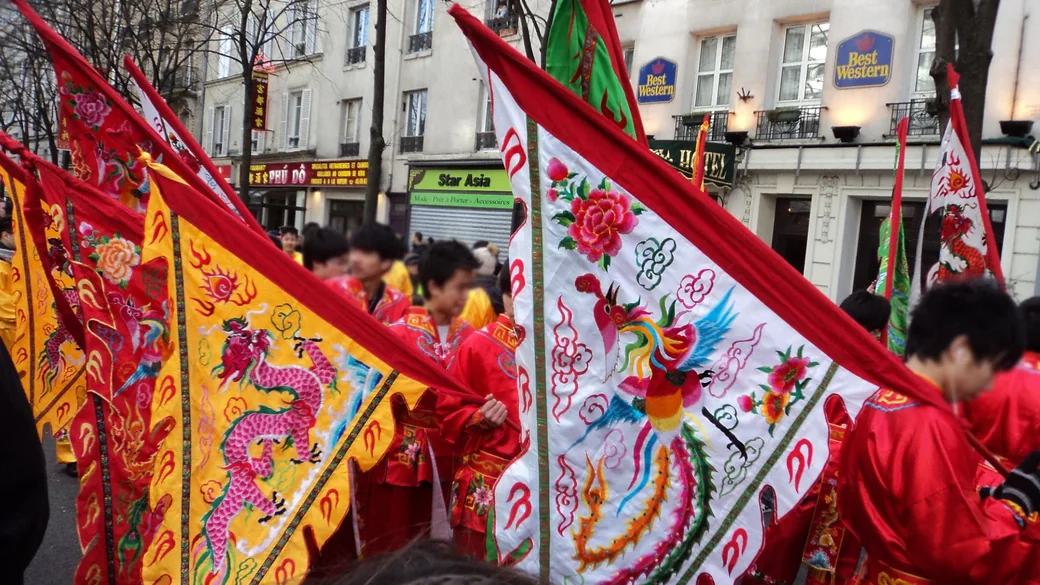
The procession's centerpiece is its dragon and lion dance troupes, whose acrobatic performances wind through the crowds to the sound of drums and cymbals. Alongside them march performers in elaborate costumes portraying fantastical characters, plus decorated floats and banners representing community associations. It's a lively, colorful spectacle that unfolds over several hours as it moves along the route.

The Colors and Symbols of the Celebration

Red dominates the parade, from costumes to banners to decorations, as it's traditionally considered the color of happiness and good luck. The dragon and lion figures, brought to life by teams of dancers underneath, are the visual heart of the event, moving and “blinking” in choreographed routines. Combined with drumming, cymbals and cheering crowds, the result is a full sensory celebration of the new year.

Where to Eat in the 13th Arrondissement's Chinatown

The Triangle de Choisy is home to one of Europe's largest concentrations of Asian restaurants, bakeries and grocery stores, and the neighborhood is especially lively on parade day. It's a great opportunity to grab a bowl of noodles, pick up pastries from a Chinese or Vietnamese bakery, or browse the grocers for ingredients, either before finding a spot along the route or after the procession has passed. The Tang Frères supermarket on Avenue d'Ivry, right by the parade's starting point, is something of a neighborhood institution and a good first stop for browsing.

Practical Tips for Visiting the Parade

Entry is completely free and no ticket is required. The area is well served by metro: Porte de Choisy, Porte d'Ivry, Maison Blanche and Tolbiac, all on line 7, sit close to the route. Because the parade draws crowds in the hundreds of thousands, arrive early to find a good viewing spot, keep a close watch on your belongings and any children with you, and dress warmly, since the event takes place during a cooler part of the year.

More Ways to Celebrate Lunar New Year in Paris

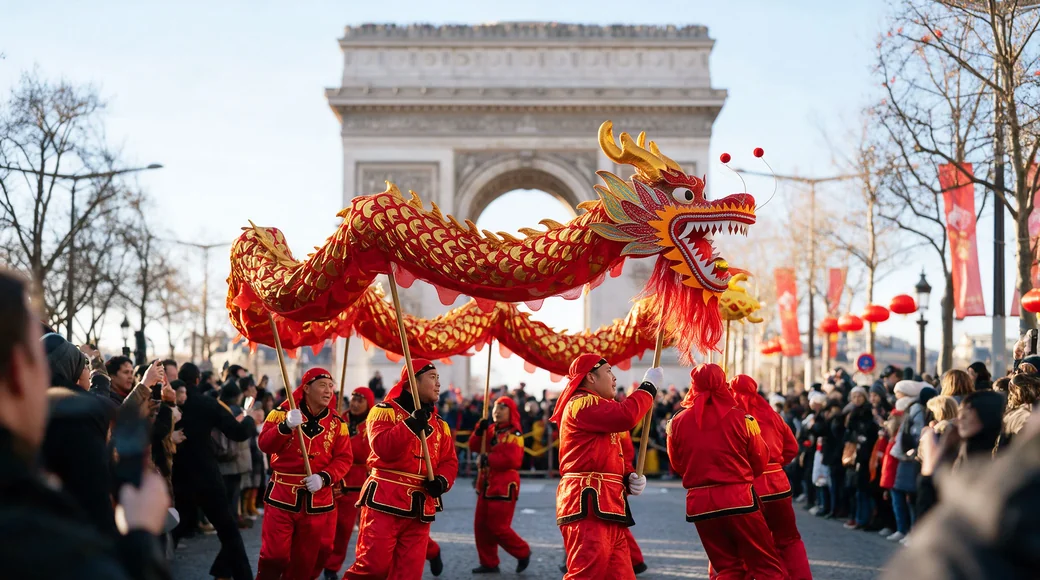
Around the same period, the 13th arrondissement runs a wider free program of performances, exhibitions and community activities beyond the parade itself, so there's more to explore if you're in the area. Paris also hosts separate Lunar New Year celebrations elsewhere in the city, notably in Belleville, which holds its own lantern-festival-style street celebration, so visitors have more than one occasion to join in. In recent years a second, smaller parade has also taken place on the Champs-Élysées earlier in the celebrations, with performers in traditional Hanfu dress marching between the Arc de Triomphe and Fouquet's, giving visitors another chance to join in even if they miss the main event in the 13th.

Local Tips from the 13th Arrondissement

Residents recommend standing near one of the route's bends, such as the corner of Rue de Tolbiac and Avenue de Choisy or where Avenue de Choisy turns onto Boulevard Masséna, for a fuller view as the dragon winds around the corner. It's also worth exploring the neighborhood's restaurants and shops before or after the parade, since many extend their hours for the occasion. And because the date changes every year with the lunar calendar, always check the 13th arrondissement's official announcement before planning your visit.

Not Quite a Chinese Parade: Who Actually Built It

The parade's own organising association tells the story: it was founded in 1986 by a body representing French residents of Indochinese origin, not by a Chinese community group. That reflects how this neighbourhood came to be. Between the mid-1970s and the late 1980s, roughly 145,000 refugees arrived in France from Vietnam, Cambodia and Laos, many of them ethnically Chinese families who had already fled China a generation earlier, and they settled in the newly built tower blocks of the 13th. The result is a Chinatown that is pan-Asian rather than Chinese: the dragons and lion dances are Chinese in form, but the floats, food and languages around them are equally Vietnamese, Cambodian and Laotian. Older residents here often speak four or five languages, among them Cantonese, Teochew, Hokkien and Hainanese, alongside French.

There Are Three Parades, Not One

Almost every guide sends visitors to the 13th arrondissement, and it is indeed the largest lunar new year parade in Europe, with more than two thousand participants, dragons reaching some thirty metres and hundreds of thousands of spectators along avenue d'Ivry, avenue de Choisy and boulevard Masséna. What the guides omit is that Paris holds at least two others. A parade in the 3rd arrondissement, around the Arts-et-Métiers quarter and the streets near the city hall, serves the older Wenzhou-rooted Chinese community and is explicitly regarded by locals as the alternative for those who find the 13th unbearably crowded. A third runs through Belleville, spilling across several arrondissements in the north-east. They fall on different days, so it is entirely possible to see two in one season.

The Date Moves, and the Parade Is Not on New Year's Day

Two scheduling details catch visitors out. The first is that the lunar new year has no fixed Gregorian date: it falls somewhere between late January and late February, and in some years the Paris parade lands in early March. Booking a trip for a guessed date does not work; the parade date has to be checked for the specific year. The second is subtler. The parade almost never takes place on new year's day itself. Organisers schedule it for a Sunday, sometimes a week or two after the actual new year, because closing major avenues is only practical at the weekend. New year's day in the quarter is a quieter, family-centred affair of temple visits and restaurant meals, which many visitors find more interesting than the parade, but it is a different day and needs separate planning.

Feeding the Lion: How Spectators Take Part

Unlike most parades, this one invites the audience in, and visitors often stand watching without realising it. When a lion dance troupe stops in front of a shop, the shopkeeper hangs a red envelope containing money, sometimes with a lettuce, above the doorway. The lion rears up, takes it in its mouth and scatters the leaves, a gesture of exchanged luck between the business and the performers. Spectators can offer an envelope too, and children are often encouraged to hand one over or to pat the lion. If you want to join in, small red envelopes are sold in the quarter's shops in the weeks beforehand. Two courtesies matter: hand the envelope with both hands rather than one, and do not step into the space the troupe is working in, as the dance moves quickly and the drummers set the pace.

Accessibility: Flat Ground, Loud Firecrackers

Physically this is one of the easier Paris events to attend. The 13th arrondissement was built in the 1960s and 1970s, so unlike the historic centre it has wide modern pavements, dropped kerbs at crossings and no cobbles or hills anywhere along the route. Wheelchair users and families with pushchairs generally manage well, provided they arrive early enough to reach the barrier rather than standing behind several rows. The real sensory issue is noise. Firecrackers and percussion are central to the tradition, not incidental: long strings of crackers are set off at close range to drive away bad luck, and the sound is sudden, extremely loud and repeated throughout the afternoon. Anyone sensitive to noise, and most small children, will want ear protection, and it is worth standing a little back from the lion dance troupes rather than directly beside them.

Getting There, and the Sunday Closing Trap

The quarter sits at the southern edge of the city and is served directly by metro line 7, with Porte de Choisy and Porte d'Ivry the two useful stops, plus tram line 3a along the boulevard. On parade day the avenues themselves are closed to traffic and the nearest station exits become extremely congested, so getting off one stop earlier and walking in is the usual advice. Driving is pointless: circulation is restricted across the eastern half of the arrondissement for most of the day. The trap is a different one. Many shops and some restaurants in this Chinatown close on Sundays as a matter of routine, which is precisely when the parade is held, so visitors who plan to combine the procession with supermarket browsing or a long lunch should check opening hours rather than assume an all-day festival economy.

Where to Stay: The Cheapest Week of the Paris Year

This is the one Paris festival that falls squarely in the city's deepest low season. Late January and February are the quietest, coldest and cheapest weeks of the year here, well after the Christmas market crowds have gone and long before spring, and hotel rates across the city drop accordingly. That makes it a rare event where you can stay centrally without paying a premium. Sleeping in the 13th itself is possible and there are modern chain hotels around Place d'Italie, but the quarter is residential and a long way from everything else a visitor wants, so most people base themselves centrally and ride out on the metro in around twenty minutes. Because there is no accommodation squeeze, booking a few weeks ahead is comfortable, and the usual central range of hostels, family hotels, chains and apartments is fully available.

Practical Information

When

Held once a year on a date set by the lunar calendar, typically falling some weeks after Chinese New Year itself. The exact date changes annually and is confirmed by the organizers only a few months ahead, so check current listings before planning your trip. The parade runs in the afternoon, roughly from 2pm to 5pm.

Where

The parade winds through the Triangle de Choisy in the 13th arrondissement, Paris's main Chinatown, near Place d'Italie. It departs from Avenue d'Ivry, continues along Avenue de Choisy and Boulevard Masséna, then loops back to Avenue d'Ivry.

Cost

Completely free, with no ticket or reservation required.

Tips

Arrive well before the start for a good viewing spot, as crowds can number in the hundreds of thousands; keep a close eye on belongings and children, and dress warmly since the event falls in a cooler season.

About this parade

Organized by ARFOI since 1986, this is the largest Lunar New Year celebration in Paris, bringing together dragon and lion dance troupes with participants from both the neighborhood's Chinese and Indochinese community and its Antillean-Guyanese community.

Accommodation and hotel options during Paris Chinese New Year Parade

Accommodation and hotel options around the event venue, with their prices, are shown by Stay22 as a map and a list. Cookies are used. Your consent is remembered on every page; you can turn it off at any time in the cookie settings.

Keep Exploring

Travel essentials for Paris

Flights, transfers, car rental, eSIM and insurance — compare your options

Flights

Find the best route

Transfers

Airport & city ground transport

Car Rental

Drive at your own pace

eSIM

Stay connected on arrival

Insurance

Cover your trip