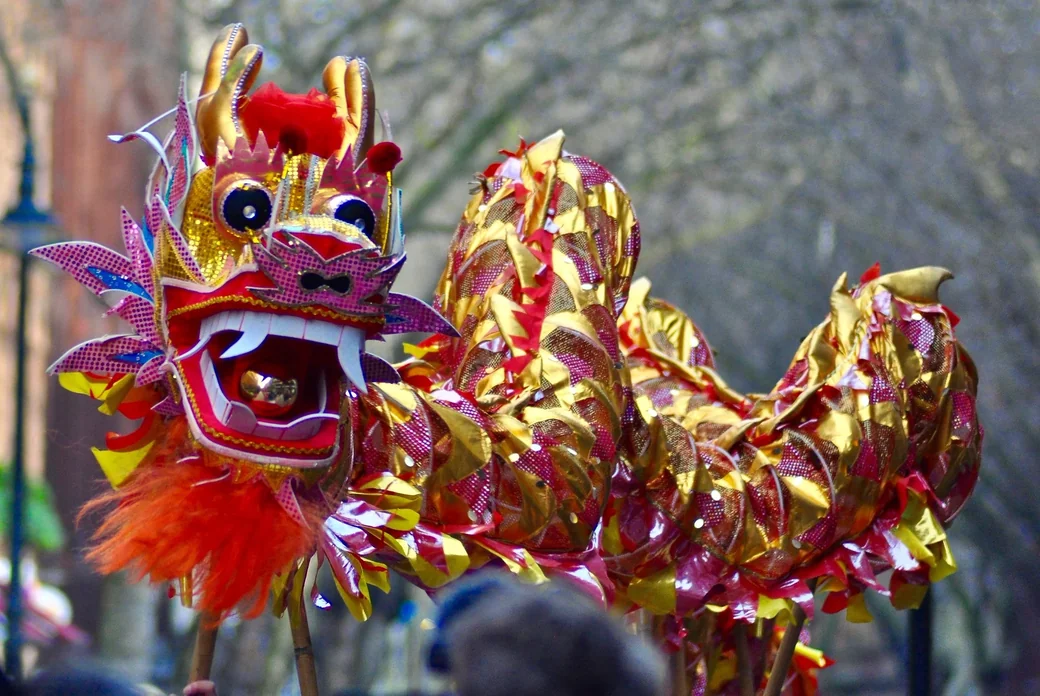
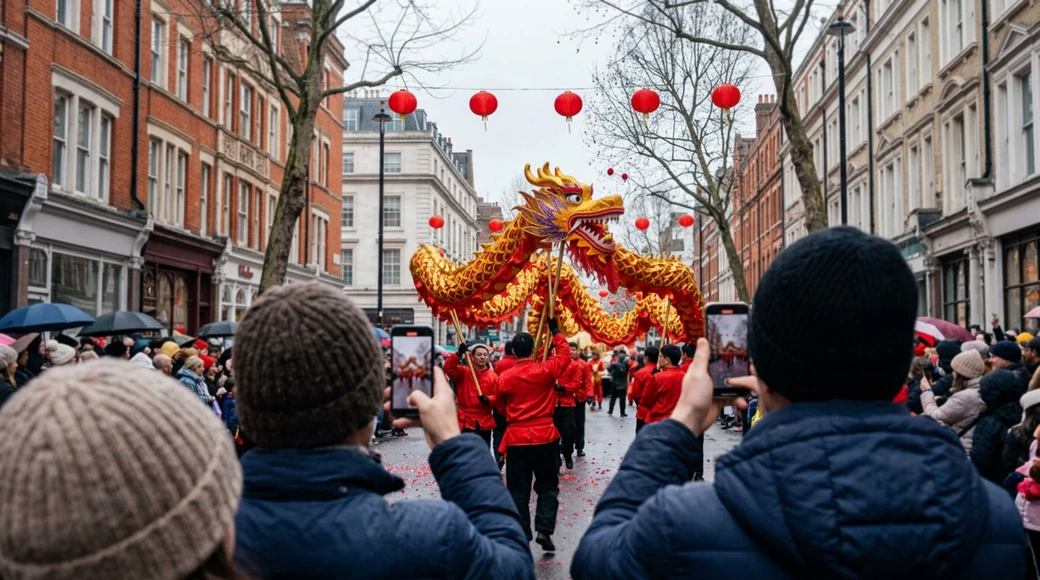
Chinese New Year Parade in London, with lion dancers and a long golden dragon winding through the West End streets beneath red lanterns, watched by cheering crowds

Chinese New Year Parade London

LondonFeb 7, 2027↻ Annual
Duration:1 daysType:
Cultural & Traditional Festivals
Admission:FreeLocationAnnual event — exact dates may vary each year

The largest Lunar New Year celebration outside Asia: a parade of handcrafted floats, lions and dragons from Trafalgar Square to Chinatown, stage shows, cultural workshops and festive food in the heart of London.

About This Festival

Chinese New Year Parade London route: from Trafalgar Square to Chinatown

The parade gathers on the east side of Trafalgar Square, close to Charing Cross station, then climbs Charing Cross Road and turns into Shaftesbury Avenue, where it finishes at the edge of Chinatown near Wardour Street. According to the organisers, the procession features handcrafted floats from China together with Chinese dragon and lion teams, and Visit London describes it as Europe's largest gathering of lions and dragons. Once the parade has passed, the floats stay on display along Shaftesbury Avenue, which makes it an easy place to take photographs without being swept along by the crowd.
Best places to watch the London Chinese New Year parade and how to avoid the biggest crowds

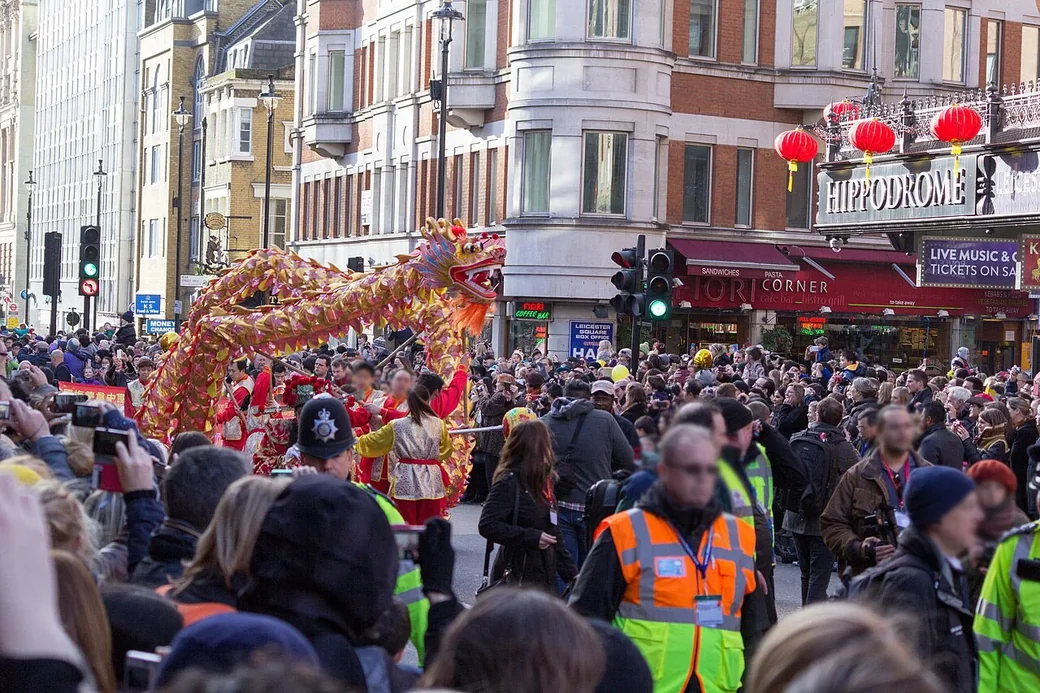
The streets of the West End are narrow and the pavements fill up early, so decide where you will stand before the day. The areas right beside Charing Cross, Leicester Square and Piccadilly Circus stations are the busiest, so move a few streets away from them. Trafalgar Square has more open space and is the easiest choice if you are with children, because the stage, food stalls and stands are all there. Arriving early is the single most useful tip, and it is worth agreeing a meeting point in case your group gets separated.

How to get to the London Chinese New Year celebrations: Tube stations, road closures and the way home

The organisers advise using public transport, because roads are closed, parking is suspended and traffic is diverted during the celebrations. Their list of the nearest Underground stations is Charing Cross, Embankment, Leicester Square, Piccadilly Circus and Tottenham Court Road. The stations right beside the action get extremely busy, so walking in from Tottenham Court Road, Holborn or Westminster is often quicker; check the TfL Journey Planner (Transport for London's route-planning tool) before you leave. The event takes place on a Sunday and the Night Tube (the all-night Underground service) only runs on Friday and Saturday nights, so plan your journey home around the regular last trains or night buses. Covent Garden, Soho, Bloomsbury and Westminster are all within walking distance if you want to stay nearby.

London Chinese New Year programme: parade, Trafalgar Square stage, lion dances and the finale

The day follows a familiar pattern. The parade sets off in the morning from the east side of Trafalgar Square. Around midday the main stage in Trafalgar Square opens with speeches and the lion awakening ceremony, followed by a dragon dance and the acrobatic "flying lions" (lion dancers who perform on high poles), a variety show and, in the early evening, a grand finale with a light show. Chinatown has lion dances and festive stalls through the afternoon, Leicester Square hosts cultural workshops, and a family corner at the junction of Dean Street and Shaftesbury Avenue offers games and activities. The day before the parade, lion dances usually already move through Chinatown.

Lion eye-dotting ceremony (dim jing) at London's Chinese New Year: why the lion is awakened first

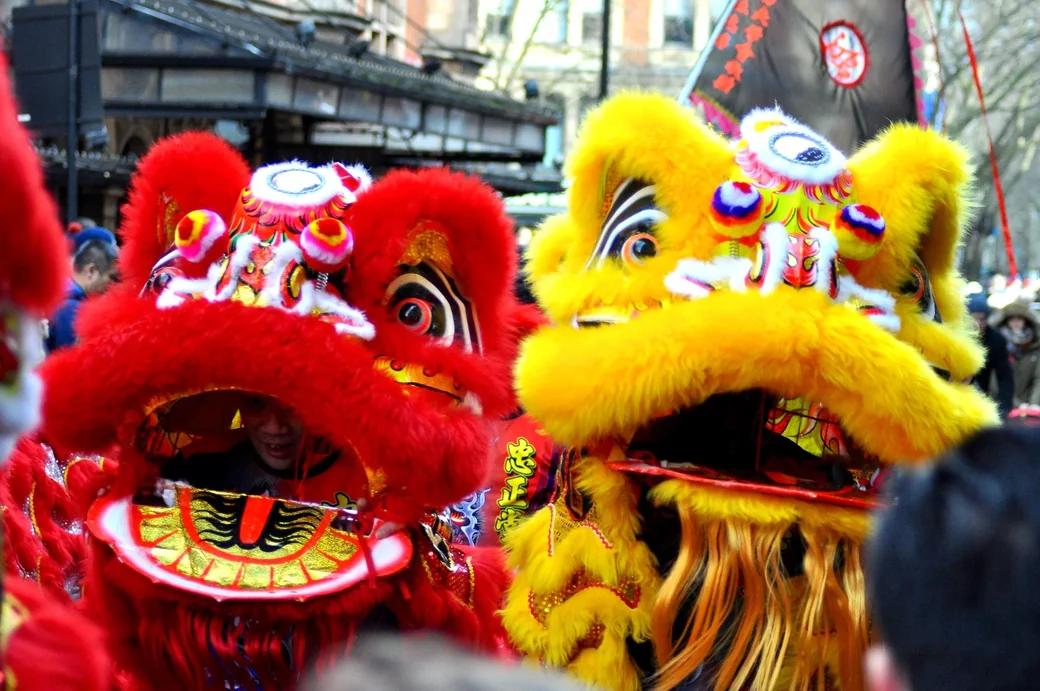
Before the lions dance on the Trafalgar Square stage, the ceremony called dim jing (eye-dotting; in Mandarin kai guang, "opening the light") takes place. According to tradition, a red dot is painted on the lion's eyes to awaken it, and once its eyes are open the lion is considered alive and ready to bring luck, health and protection. Red is the colour of life and good fortune in Chinese culture. Each lion is usually operated by two dancers, one at the head and one at the tail, while the drum, gong and cymbals set the pace. If you watch the ceremony first, the dances that follow read more like a story than a show.

Choi ching (plucking the greens) in London's Chinatown: lettuce and red envelopes above shop doors

Look above the doorways in Chinatown and you may see a head of lettuce tied to a red envelope. This is the setting for choi ching (plucking the greens), in which a lion dance team visits a business, "eats" the lettuce, scatters the leaves and keeps the hongbao (red envelope) as its reward. A popular explanation links lettuce, sheng cai in Mandarin, to a similar-sounding word meaning "to make a fortune", which is why it stands for prosperity. Many restaurants and shops invite a lion to their door to bring luck. Stand near a doorway and wait for the drums, and please leave hanging lettuce and envelopes alone, as they belong to the performance.

What to eat in Chinatown during London's Chinese New Year: festive menus, dumplings and nian gao

Chinatown's streets are full of restaurants, bakeries and stalls, and the official Chinatown guide says that many places offer special new-year menus and limited festive foods and drinks. Classic dishes for the season include dumplings, whole fish, long-life noodles, turnip cake and nian gao (sticky new-year cake), while bao (steamed buns) make a quick snack. Tables fill quickly at lunchtime on festival day, so book ahead or eat later in the afternoon. Menus differ from place to place, so ask staff if you need vegetarian, vegan or other dietary options.

Dressing for a winter street festival in London: what to pack for the day

The celebration lands in the coldest, dampest stretch of the London calendar, and you will be standing still for long periods rather than walking. Layers, a waterproof hooded jacket, gloves and shoes that cope with wet pavement matter more than style. A hood beats an umbrella in a packed crowd, where umbrellas block views and catch on people. Cold also drains phone batteries fast, so carry a power bank. Many visitors wear something red for luck; a scarf is enough to join in without a costume.

London Chinese New Year with children: the family corner, cultural workshops and keeping everyone together

The organisers usually set up a family corner at the junction of Dean Street and Shaftesbury Avenue, with interactive cultural workshops and games for all ages. Leicester Square has cultural stands where visitors can try Chinese brush calligraphy and traditional painting and listen to traditional music, and there are benches to rest on. Drums and loud noises can startle small children, so the front of the stage is not the best place for them. Agree a meeting point everyone can find alone, because phone signal can struggle in a crowd, and put a card with your phone number in a young child's pocket. Pushchairs are hard work on the parade route but manageable around the squares.

What is London's Chinese New Year celebration? Names, organisers and why the parade is on a Sunday

The festival is known as Chinese New Year, Lunar New Year or Spring Festival (Chunjie, 春节), and the name Lunar New Year is increasingly used because many East and Southeast Asian communities celebrate it. In London it is organised by the London Chinatown Chinese Association with the support of the Mayor of London, the Greater London Authority and Westminster City Council. Organisers describe it as the largest community celebration of the festival outside Asia, drawing hundreds of thousands of visitors. The date of Chinese New Year follows the lunar calendar, but London holds its parade on the Sunday that follows, so the main event does not always fall on New Year's Day itself.

History of London's Chinatown and its Chinese New Year celebrations: from Limehouse to Soho

London's first Chinese community took shape across the 18th and 19th centuries around the docks of Limehouse in the East End, among Chinese sailors. After the Second World War, bomb damage there and cheaper leases around Gerrard Street led Chinese residents and businesses to move to Soho in the 1950s, and by the 1970s the area was the heart of London's Chinese community. The London Chinatown Chinese Association was founded in 1978, and the first organised Chinese New Year celebrations took place in 1985, the year Westminster City Council officially named the area Chinatown. In 2002 the celebrations expanded to Leicester Square and Trafalgar Square, and today they fill much of the West End.

Chinatown London gates and landmarks to see at Chinese New Year: paifang, stone lions and the Horse and Dolphin Yard mural

Chinatown is marked by four paifang (ceremonial gateways). Three stand on Gerrard Street and were built in the 1980s, while the newest and largest, on Wardour Street, was completed in 2016 by Chinese craftsmen in the style of the Qing dynasty and assembled in London; it is described as the largest Chinese gate in the UK. A pair of stone lions donated by China stands on Gerrard Street, and the mural in Horse and Dolphin Yard is another popular stop for photographs. Gerrard Street is also where the jazz musician Ronnie Scott started his famous club.

The look and sound of London's Chinese New Year: red lanterns, drums and festive decorations

Red and gold dominate the scene because they stand for luck and prosperity, and hundreds of red lanterns hang over Gerrard Street and the side streets of Chinatown. The soundtrack of the day is the drum, gong and cymbals that accompany every lion and dragon, so you often hear a team before you see it. In the run-up to the celebration, shops stock hongbao (red envelope), lanterns and decorations, and Chinatown stalls offer festive decorations and traditional handicrafts, which makes souvenir shopping easy. Many visitors wear something red for luck; a scarf is enough, because no costume is required.

Etiquette and useful phrases for London's Chinese New Year: greetings in Mandarin and Cantonese

Watching is welcome and photography is normal, but keep pathways clear and give dancers and drummers room to move. A few greetings go a long way. Xin nian kuai le (Mandarin: Happy New Year) and Sun nin faai lok (Cantonese: Happy New Year) are the standard wishes, and Gung hei fat choy (Cantonese: wishing you prosperity) is heard everywhere in Chinatown. Nei hou (Cantonese) or Ni hao (Mandarin) means hello, and do ze (Cantonese) or xie xie (Mandarin) means thank you. Red is the colour of luck, so wearing it is a friendly gesture, while hanging lettuce and red envelopes belong to the ritual and should be left for the lions.

Safety tips for London's Chinese New Year crowds: pickpockets, meeting points and emergency numbers

The streets are narrow and the area is extremely busy all day, so keep children close, avoid pushing and stand where you can step out of the crowd if you need to. As in any crowded part of central London, keep bags closed and in front of you and phones out of back pockets. Mobile signal and batteries can struggle in big crowds, so carry a power bank and agree a meeting point in advance. In the United Kingdom the emergency number is 999, and 101 is for non-urgent police matters. Underground stations are staffed while trains are running, so ask a member of staff if you lose your way.

The legend of Nian: why lions, drums and the colour red belong to Chinese New Year

According to a Chinese legend, a mythical beast called Nian (年, which also means "year") came each year to trouble villagers, until they found that in many versions of the tale it was frightened away by a lion figure, loud noise and the colour red. According to this popular story, the lion dance, the drums and the red decorations are still used to drive away evil spirits and welcome a lucky year. The tale has been passed down for generations and its details vary from region to region, so you may hear different versions in Chinatown. It is a legend rather than a historical fact, but it explains much of what you will see and hear on the day.

Around London's Chinese New Year: related events, quieter alternatives and similar festivals worldwide

Lion dances move through Chinatown around the parade, and the traditional festive period lasts fifteen days, so lanterns and festive menus can be enjoyed beyond the main Sunday. The London Chinatown Chinese Association also organises the Mid-Autumn Festival (Moon Festival), the Chinatown Night Market, the London New Year's Day Parade and the lighting of the London Eye. For a quieter way to join in, museums elsewhere in London, such as the Horniman Museum and Royal Museums Greenwich, have hosted their own Lunar New Year events. Similar large celebrations take place in other cities, for example the Chinese New Year dragon parade in Manchester and the festival and parade in San Francisco. Follow the hashtag #CNYLondon for updates.

Practical Information

When

The main celebration takes place on the Sunday after Lunar New Year, which falls between late January and mid-February. The parade starts around 10 a.m. and reaches Chinatown around midday; the programme on the stages, in Chinatown and at Leicester Square runs through the afternoon and ends with a grand finale and light show in the early evening. Lion dances usually warm up Chinatown on the day before.

Where

The parade starts on the east side of Trafalgar Square near Charing Cross station, follows Charing Cross Road and Shaftesbury Avenue and finishes at the edge of Chinatown near Wardour Street. The main stage and ceremonies are in Trafalgar Square, cultural workshops at Leicester Square, a family corner at the junction of Dean Street and Shaftesbury Avenue, and food stalls and lion dances in Chinatown around Gerrard Street.

Cost

Free. Admission is free and open to the public; you only pay for the food, drinks and souvenirs you choose to buy.

Tips

Arrive early for a good view. Roads are closed, parking is suspended and traffic is diverted, so use public transport. The organisers list Charing Cross, Embankment, Leicester Square, Piccadilly Circus and Tottenham Court Road as the nearest Underground stations, and walking in from a slightly farther station is often quicker. Dress for cold, damp weather, keep bags in front of you, agree a meeting point and book a table if you want to eat in Chinatown at lunchtime.

Unique to this festival

It is described as the largest Lunar New Year celebration outside Asia, and the procession ends in Europe's largest Chinatown rather than in a stadium or park. Look for the lion awakening and eye-dotting ceremony (dim jing) on the Trafalgar Square stage, the handcrafted floats from China that stay on show along Shaftesbury Avenue, and the lettuce and hongbao (red envelope) hung above shop doors for the choi ching (plucking the greens) ritual.

Accommodation and hotel options during Chinese New Year Parade London

Accommodation and hotel options around the event venue, with their prices, are shown by Stay22 as a map and a list. Cookies are used. Your consent is remembered on every page; you can turn it off at any time in the cookie settings.

Keep Exploring

Travel essentials for London

Flights, transfers, car rental, eSIM and insurance — compare your options

Flights

Find the best route

Transfers

Airport & city ground transport

Car Rental

Drive at your own pace

eSIM

Stay connected on arrival

Insurance

Cover your trip