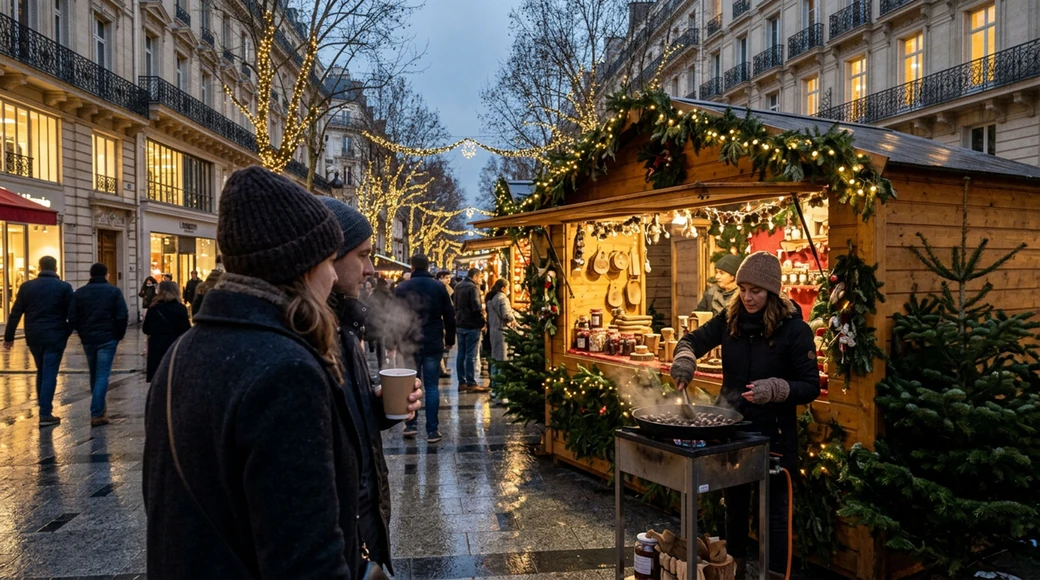
Christmas markets and lights in Paris, wooden chalets and illuminated streets drawing crowds on a winter evening

Paris Christmas Markets and Lights

ParisNov 15, 2026 – Jan 3, 2027↻ Annual
Duration:50 daysType:
Cultural & Traditional Festivals
Admission:FreeLocationAnnual event — exact dates may vary each year

A citywide winter tradition combining the dazzling Champs-Élysées illuminations, festive Christmas markets at the Tuileries Garden and La Défense, and beloved department-store window displays, lighting up Paris from mid-November to early January each year.

About This Festival

What Are the Paris Christmas Markets and Lights?

Paris Christmas Markets and Lights is a citywide winter tradition rather than a single event. It brings together the famous illuminations along the Champs-Élysées, major Christmas markets in the Tuileries Garden and at La Défense, and the elaborately decorated window displays of Paris's grand department stores. Together these transform the whole city into a festive winter destination, with something to see in almost every central neighborhood.
A Nearly Two-Century Tradition of Light

Paris's love of festive illumination dates back to the 1840s, when the Champs-Élysées and Place de la Concorde were first decorated with gas-era lighting for special occasions. The 1881 Exposition internationale d'électricité proved a turning point, establishing electric lighting as a citywide phenomenon, and in 1883 the department store Le Printemps became the first in Paris lit entirely by electricity. Edward H. Johnson, a close associate of Thomas Edison, created the first electric Christmas-tree lights in 1882. Through the 1920s and 1930s, photographer Léon Gimpel documented the glittering department-store windows of the BHV Marais, Galeries Lafayette, La Samaritaine and Le Bon Marché, a golden age whose spirit lives on today.

When and Where to See the Christmas Lights in Paris

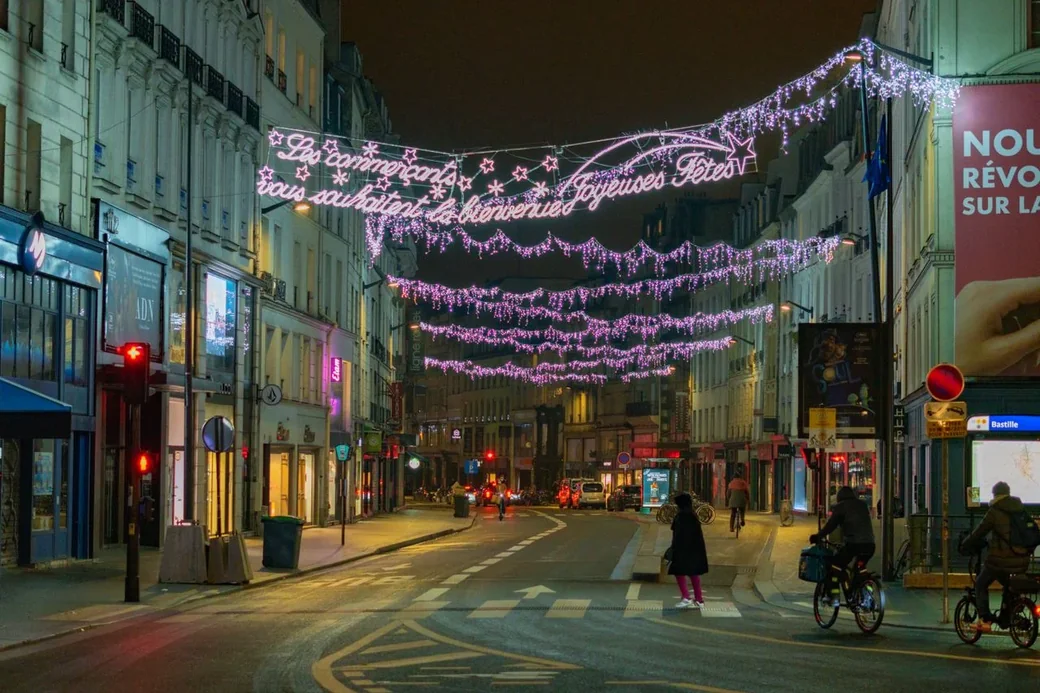
Paris dresses up for the season each year from mid-November to early January, filling the city's darkest weeks with light. The flagship display runs the length of the Champs-Élysées, Paris's grand central avenue, while two of the city's largest Christmas markets set up in the Tuileries Garden, right by the Louvre, and at La Défense, the modern business district west of the city center. Together they give visitors several distinct festive destinations to explore across a single trip.

Lighting Up the Champs-Élysées

Each year the Champs-Élysées illuminations are switched on at a public ceremony hosted by a celebrity godparent, alongside the mayors of Paris and the 8th arrondissement; past hosts have included figures such as Karl Lagerfeld, Lily-Rose Depp and Léa Seydoux. The display itself is impressive in scale, with the avenue's plane trees wrapped in lights all the way from the Arc de Triomphe to Place de la Concorde. The lights shine every evening, and traditionally stay lit all night long on Christmas Eve and New Year's Eve, the season's two biggest celebrations.

Inside the Christmas Markets: Chalets, Rides and More

The Tuileries Garden hosts one of Paris's largest Christmas markets, with around 100 wooden chalets selling handmade crafts such as pottery, jewelry and textiles. Visitors will also find a large ice rink, a Ferris wheel, a Santa's train ride, and a giant slide, plus family entertainment on weekends and school holidays. Just west of the city, the market at La Défense brings the same festive atmosphere to the modern business district, with its own chalets, food stalls and seasonal charm.

Festive Flavors to Try at Paris's Christmas Markets

No visit to a Paris Christmas market is complete without sampling its seasonal treats. Warm up with a cup of mulled wine or hot chocolate, and snack on freshly made crêpes, waffles, gingerbread and roasted chestnuts as you wander between the chalets. Many stalls also serve regional French specialties, making the markets as much a culinary experience as a visual one.

Practical Tips for Visiting the Paris Christmas Markets and Lights

Viewing the Champs-Élysées lights and walking through the Christmas markets is completely free; only individual attractions, such as fairground rides and the ice rink, are paid separately. The markets and illuminations are family-friendly and welcome visitors of all ages. Evenings are especially magical, when the lights along the Champs-Élysées and the glow of the market chalets create the season's most memorable photo opportunities.

Department Store Windows: A Christmas Tradition of Their Own

Beyond the markets and street illuminations, Paris's grand department stores stage some of the city's most beloved holiday displays. Galeries Lafayette, Le Printemps, Le Bon Marché and the BHV Marais all create elaborate, animated Christmas windows every year, a tradition that grew out of the golden age of illuminated shopfronts in the early twentieth century. Strolling past these vitrines de Noël is a cherished ritual in its own right and well worth a dedicated stop on any festive visit.

Where to Stay and How to Get Around

Staying in central Paris puts most of the season's highlights within easy walking distance of one another. The Tuileries Garden market is easily reached by metro at the Concorde or Tuileries stations, right in the heart of the city. La Défense, meanwhile, is served by its own major transit hub, with metro, RER and tram connections making it a simple trip from central Paris even though it sits further west. In terms of hours, La Défense tends to wrap up earlier, while the Tuileries market stays lively later, often open until close to midnight.

Insider Tips for the Best Christmas Market Experience

For smaller crowds, visit on a weekday evening rather than a weekend. Walk the full length of the Champs-Élysées to take in the entire illuminated display rather than just a section of it. Finally, pair your market visit with a stroll past the grand department stores nearby, whose festive window displays make a perfect complement to an evening among the lights.

Smaller Neighborhood Markets Worth a Detour

Tuileries and La Défense are the two flagship markets, but they're not the only ones. Smaller, neighborhood-scale markets pop up each winter in spots such as Saint-Germain-des-Prés, around Notre-Dame, at the foot of Montmartre near Place des Abbesses, on the Champ de Mars beneath the Eiffel Tower, and in the Bois de Vincennes. These tend to be quieter and more intimate than the two main markets, with a handful of chalets rather than dozens, making them a good stop if you're already exploring that part of the city.

The Big Market Was Exiled From the Champs-Élysées

The market that now fills the Tuileries Garden is not a new creation but a relocation. For years the city's flagship Christmas market stood on the Champs-Élysées, where it drew enormous crowds — reportedly some fifteen million visitors across a seven-week season — before the city ended it there and the concession moved east into the gardens between the Louvre and the Concorde. The setting turns out to suit it better: the formal garden absorbs eighty or so chalets, a synthetic ice rink, a Ferris wheel and around thirty fairground rides without the traffic pressure of an avenue. Entry to the market itself is free and always has been; only the rides, the skate hire and the food are paid. If a guidebook still sends you to the Champs-Élysées for the market rather than for the lights, it is out of date.

The Two Days Paris Shuts, and What Stays Open

Visitors who arrive for Christmas are often caught out by how completely Paris closes on 25 December and 1 January. Most shops, many restaurants and a good number of museums shut entirely, public transport runs a reduced service, and streets that were packed the day before empty out. The Tuileries market is one of the few large attractions that deliberately stays open on both of those days, which makes it unusually useful rather than merely festive — it is somewhere to eat, walk and take children when almost nothing else is running. It also closes early on 24 and 31 December, so plan those two evenings around dinner reservations rather than the market. On ordinary days it generally runs from late morning until close to midnight.

The Cup Deposit That Confuses First-Time Visitors

Order a mulled wine and the price you are charged will often be higher than the one on the board. This is not overcharging: most stalls add a deposit for the cup itself, refunded when you bring it back to any stall of the same market. First-time visitors frequently assume they have been overcharged, drink up and walk away, leaving the deposit behind. You can also simply keep the cup, which is usually printed with the year and the market's name and is the cheapest souvenir available on the site. Two related habits are worth knowing: many smaller chalets still prefer cash for low-value orders even where cards are accepted, and the queue for hot drinks grows sharply after dark, so buying one early and carrying it while you walk is the local approach.

Accessibility in Winter: Gravel, Crowds and Early Darkness

The Tuileries is a historic formal garden, and its paths are compacted gravel rather than paving, which is manageable in a wheelchair but noticeably harder work than a pavement, especially after rain when it softens. The market lanes between the chalets are level but narrow and become genuinely congested on December weekends, when moving against the flow is slow. Two winter-specific factors matter as well: darkness falls by around five in the afternoon, so uneven ground is harder to read, and cold combined with standing still is more tiring than most visitors expect. Weekday afternoons early in the season are by far the easiest time to visit. The larger department store windows and the Champs-Élysées lights, by contrast, are viewed from broad city pavements and present no ground-surface problems at all.

Getting Around in the Dark and the Cold

Getting Around in the Dark and the Cold

Winter travel here is less about closures than about timing. Darkness arrives by around five in the afternoon, which is actually convenient: the illuminations are at their best from late afternoon onwards, so a short winter day is not the obstacle it first appears. The metro is the backbone and runs normally through the season, with the Tuileries market reachable from two stations on the same line and the Champs-Élysées lights strung along another. The exceptions are 25 December and 1 January, when public transport runs a reduced timetable and journeys take noticeably longer, and New Year's Eve, when central stations become extremely crowded late at night and some closest to the celebrations may be closed for crowd control. Buses are pleasanter than the metro for seeing the lit streets but are slower in December traffic.

When It Rains: The Indoor Version of the Same Evening

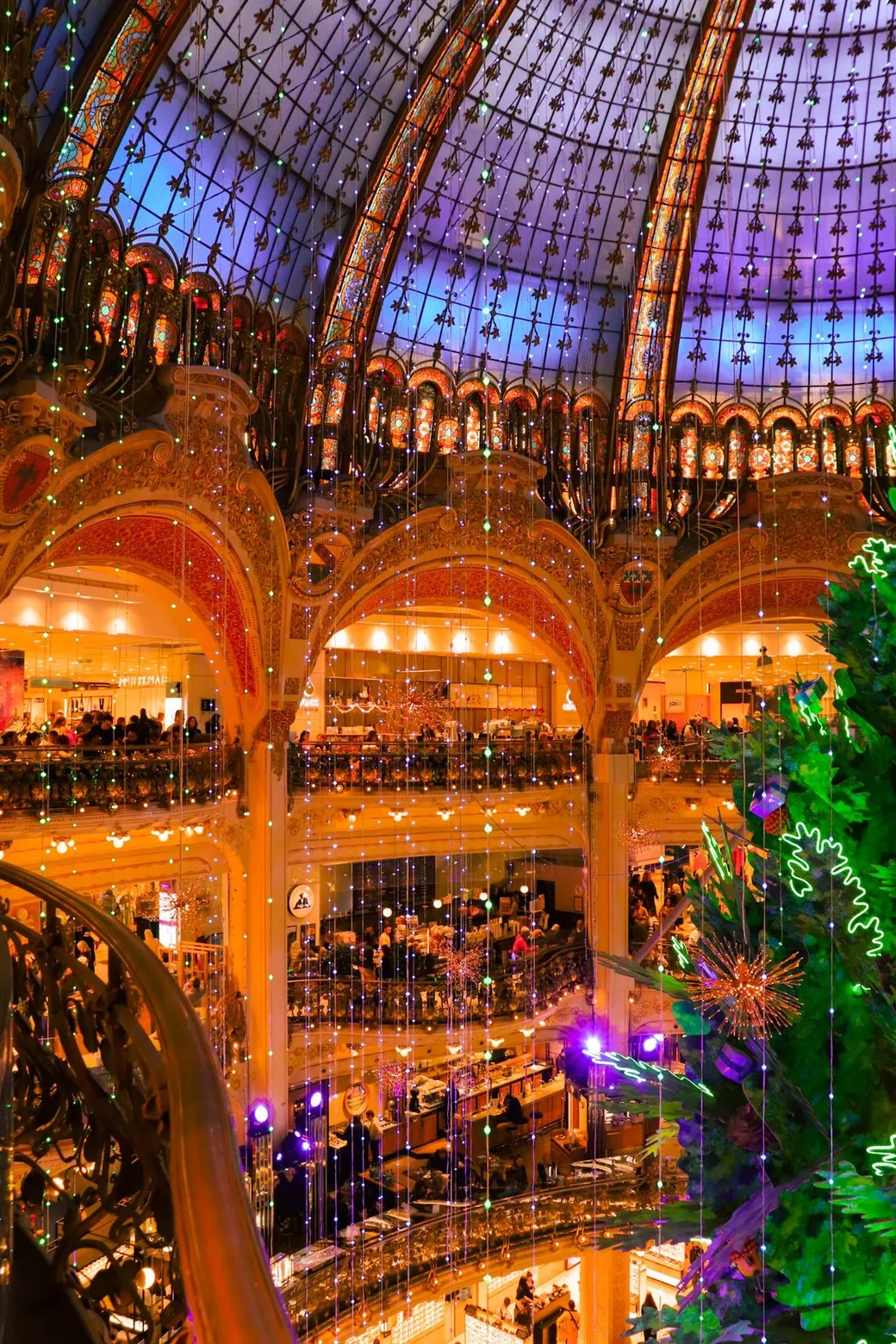
December in Paris is more often grey and wet than crisply cold, and an outdoor market in steady rain is a short experience. The useful thing is that the season's best indoor attraction costs nothing either: the grand department stores near the Opéra decorate their interiors as elaborately as their windows, with enormous suspended trees under glass domes, and you can spend an hour warm and dry inside them. Covered passages such as the nineteenth-century glass-roofed arcades scattered across the central arrondissements offer the same escape on a smaller scale, lit and decorated for the season. Planning the trip as alternating outdoor and indoor stretches rather than one long walk is what separates visitors who enjoy December in Paris from those who remember it mainly as being cold.

Where to Stay: A Season of Two Very Different Halves

The season splits sharply in two, and the difference matters more than the neighbourhood you choose. From mid-November until roughly the third week of December, Paris is in one of its quietest and cheapest periods: the lights are already up, the markets are open, and hotel rates across the whole city sit near their annual low. From Christmas week through to New Year, the same rooms can cost several times as much, and the nights of 24 and 31 December are the most expensive of the year. Central districts along the river suit this trip best, since the markets, the department store windows and the illuminated avenues are close together and the walking is short in cold weather. Every category is available — hostels, family hotels, chains and apartments — and early December in particular offers the best value the Paris calendar has.

Practical Information

When

Each year, Paris's Christmas lights and markets run from mid-November to early January, filling the darkest weeks of winter with light.

Where

The celebration spans the whole city rather than one single site: the illuminated Champs-Élysées, the Christmas market in the Tuileries Garden, another major market at La Défense, smaller neighborhood markets scattered across the city, and festive window displays at department stores across Paris.

Cost

Viewing the lights and strolling through the markets is completely free. Individual attractions such as fairground rides and the ice rink are paid separately.

Tips

Visit in the early evening for the best combination of daylight and lights, and wear warm layers, as market visits mean spending time outdoors.

About this tradition

Paris's festive lighting tradition stretches back to the 1840s, and the city embraced electric illumination early, in the 1880s, giving its winter displays a genuine historic depth.

Accommodation and hotel options during Paris Christmas Markets and Lights

Accommodation and hotel options across Paris, with their prices, are shown by Stay22 as a map and a list. Cookies are used. Your consent is remembered on every page; you can turn it off at any time in the cookie settings.

Keep Exploring

Travel essentials for Paris

Flights, transfers, car rental, eSIM and insurance — compare your options

Flights

Find the best route

Transfers

Airport & city ground transport

Car Rental

Drive at your own pace

eSIM

Stay connected on arrival

Insurance

Cover your trip