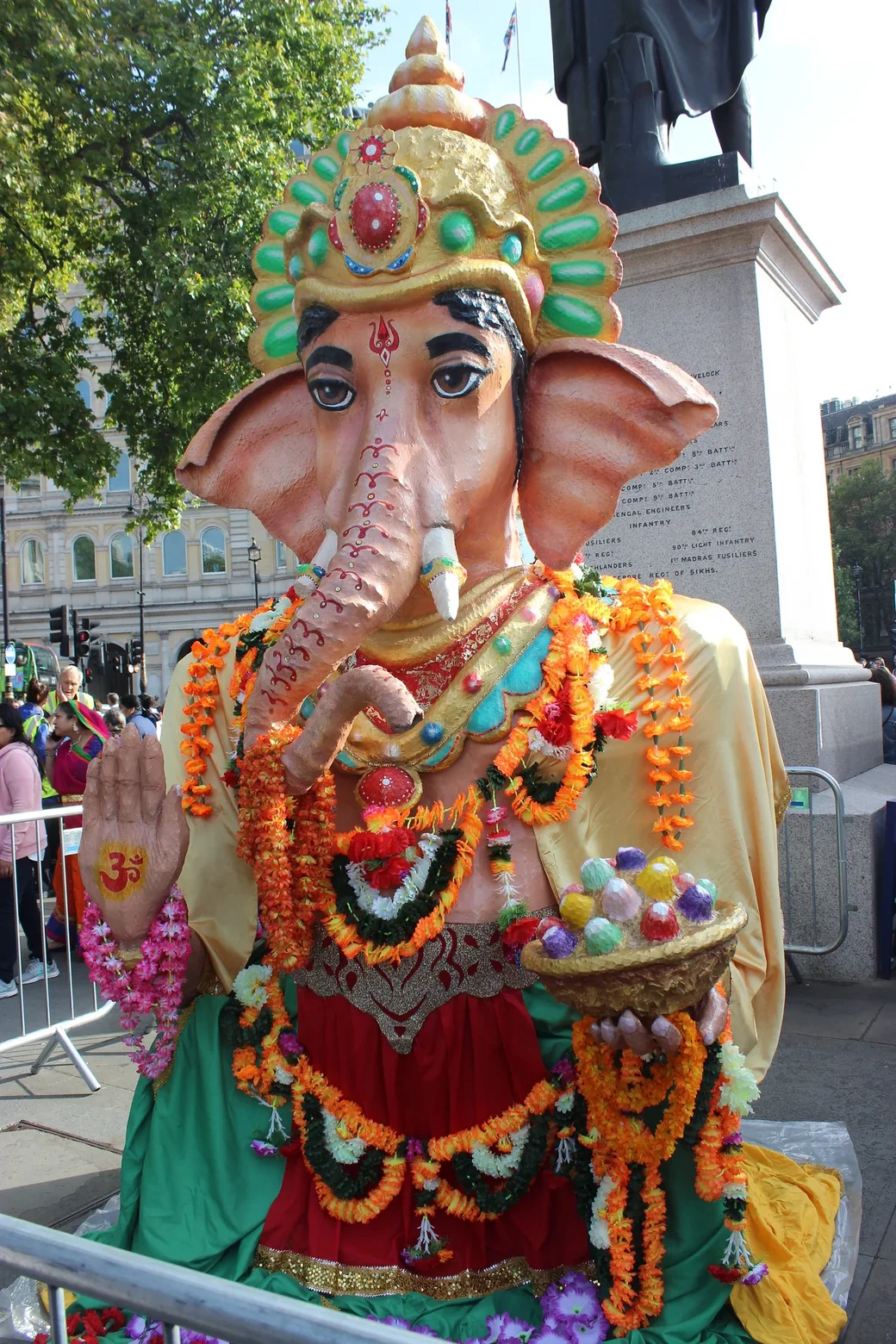
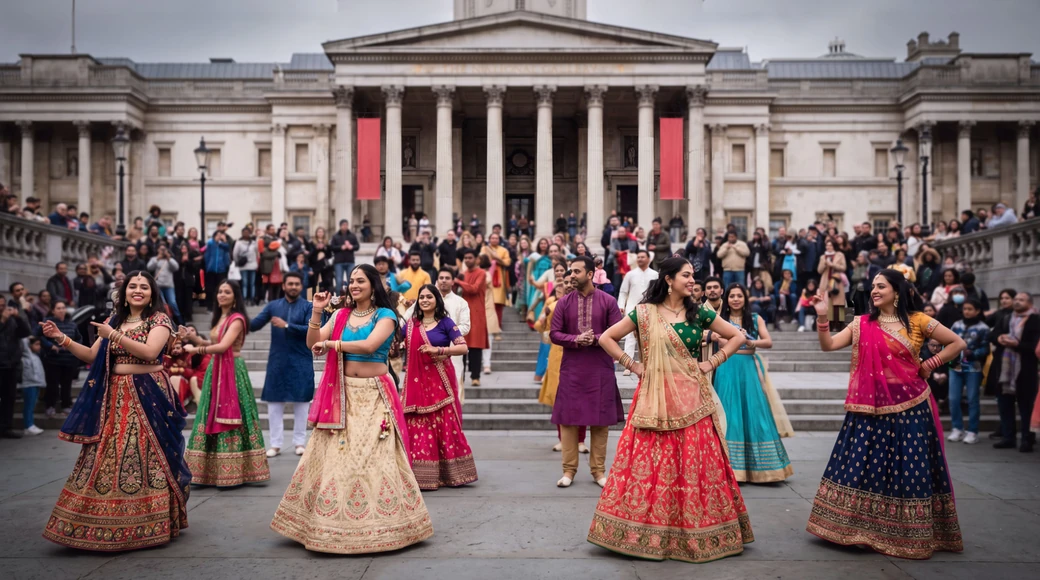
Diwali on the Square in London, the Festival of Lights in Trafalgar Square, with glowing lamps, colorful decorations and dancers performing before happy crowds

Diwali on the Square

LondonOct 25, 2026↻ Annual
Duration:1 daysType:
Cultural & Traditional Festivals
Admission:FreeLocationAnnual event — exact dates may vary each year

London's biggest public Diwali celebration fills Trafalgar Square with 200 costumed dancers, live music, devotional performances, hands-on activity zones and vegetarian and vegan street food. A free, family-friendly day of light shared by the city's Hindu, Sikh and Jain communities.

About This Festival

Diwali on the Square London: the Capital's Biggest Festival of Light

Diwali on the Square, often shortened to DOTS by its organisers, is London's largest public celebration of Diwali (the Hindu, Sikh and Jain Festival of Lights). It takes place every autumn at Trafalgar Square, in the heart of the city. It is the Mayor of London's own event, delivered together with the Diwali in London committee, a volunteer team of community leaders who help choose the programme and who represent Hindu, Sikh, Buddhist and other Asian organisations. The day belongs to London's Hindu, Sikh and Jain communities, yet it is open to everyone, whatever their background or beliefs. Tens of thousands of visitors gather for music, dance, workshops and food, all built around one idea: the triumph of light over darkness and of good over evil. In recent years the official event page has also offered a livestream. If you have never taken part in Diwali, this is an easy and welcoming first introduction.
History of Diwali on the Square: Trafalgar Square's Festival of Lights Since 2002

The festival began in 2002, only a couple of years after London gained its directly elected Mayor, and it has returned to Trafalgar Square almost every year since. In essence it takes a celebration that families usually mark at home and in temples and shares it in the city's most famous public square. Over the years it has grown from a stage show into a full day of activity zones, workshops and street food. Well-known names have taken part too, among them the sitar (a long-necked Indian stringed instrument) virtuoso Anoushka Shankar, but the real stars are community dance schools, temple choirs and drum groups. For many Londoners it is now a fixed date in the autumn calendar, the moment the city officially says Happy Diwali.

What Diwali Means: Hindu, Sikh and Jain Stories Behind the Lights

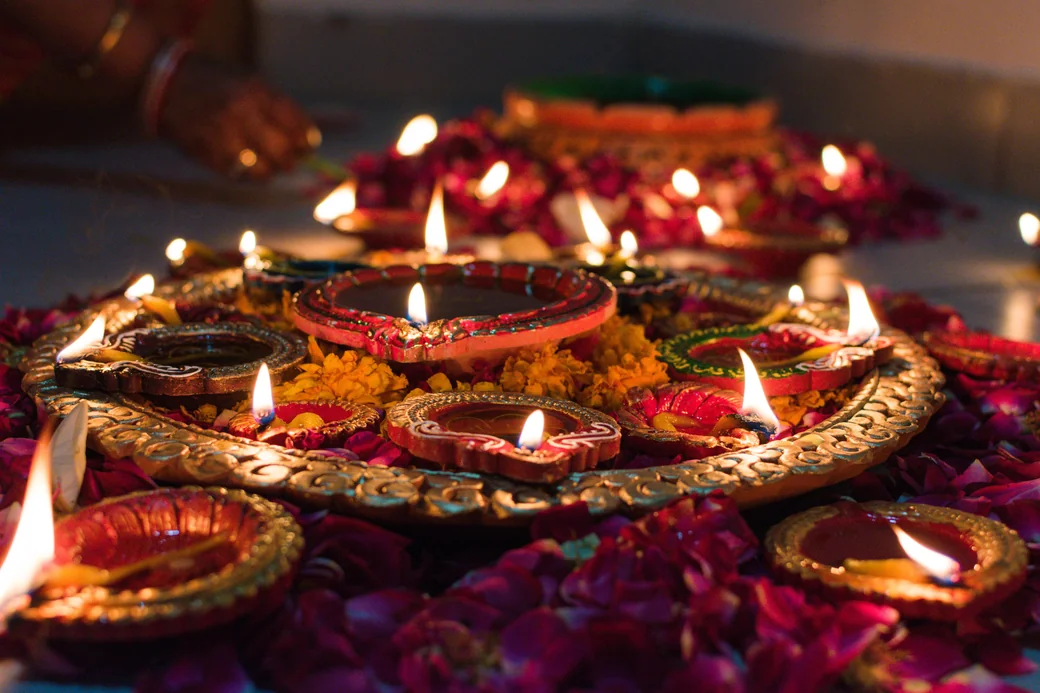
The word Diwali comes from the Sanskrit deepavali, meaning a row of lamps. According to Hindu tradition, the people of Ayodhya lit lamps along the road to welcome Prince Rama home after fourteen years of exile and his victory over the demon king Ravana. Many families also invite Lakshmi (the goddess of prosperity), often worshipped together with Ganesha (the elephant-headed god who removes obstacles), into their homes. Sikhs mark the same days as Bandi Chhor Divas (Day of Prisoner Release): according to the traditional story, the sixth Guru (spiritual teacher), Guru Hargobind, led fifty-two imprisoned princes out of Gwalior Fort by letting each hold a tassel of his cloak. For Jains, Diwali recalls the nirvana (final liberation of the soul) of Lord Mahavira. A popular belief adds that Lakshmi visits the cleanest, brightest homes on Diwali night, so families tidy up and place a lamp by the door. These are traditions and legends, and in London the three communities share one stage.

When to Go: How the Date of Diwali on the Square Is Chosen

Diwali itself follows the Hindu lunar calendar and falls on a new-moon night in autumn, so its date shifts by several weeks from year to year, always landing in October or November. The Trafalgar Square festival is not held on Diwali night. It is placed on a Sunday, usually a few weeks earlier, which suits families and visitors alike. This has a pleasant side effect: you can enjoy the big public celebration in the square and then see Diwali night itself in temples and neighbourhoods across London. The Mayor of London announces the exact date every year, so check the official event page before you book travel or hotels.

Trafalgar Square, London: the Setting, Its Landmarks and a Few Legends

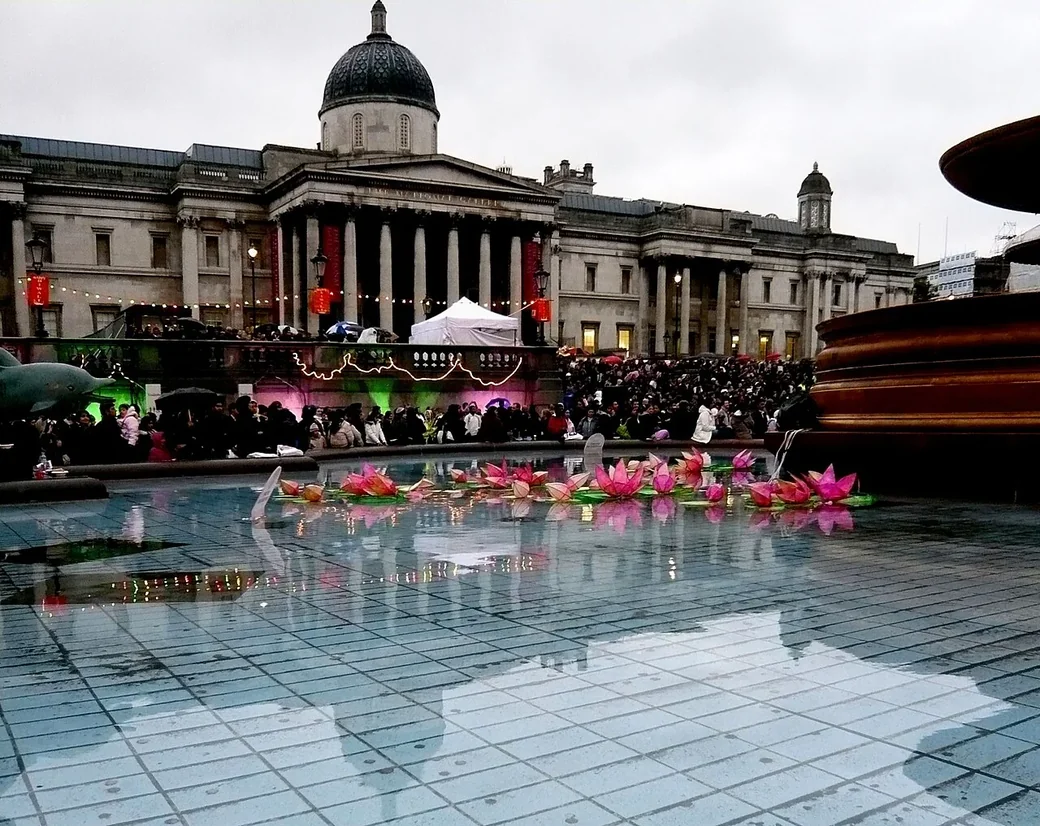
Few festival venues can compete with this one. Trafalgar Square is named after Admiral Nelson's victory at the Battle of Trafalgar in 1805, and Nelson's Column rose in the centre between 1840 and 1843. Four bronze lions by Sir Edwin Landseer guard its base. They were added in 1867, and according to a popular story Landseer, who had never seen a real lion, gave them paws like a dog's. Fountains designed by Sir Edwin Lutyens flank the column, the National Gallery fronts the northern side and St Martin-in-the-Fields church stands at the north-eastern corner. In the north-west corner the Fourth Plinth (an empty pedestal used for changing art) shows contemporary sculpture, so look out for it between performances. The square has long hosted public gatherings, from rallies to New Year's celebrations, and Diwali continues that tradition in colour.

Diwali on the Square Programme: Opening Dance, Lamp Lighting and Finale

The detailed schedule is published by the Mayor of London shortly before the event and may change, but the shape of the day stays familiar. A colourful opening dance by around 200 performers sets the mood in the middle of the square. Through the afternoon the main stage hosts music, devotional songs, classical and folk dance and Bollywood (Indian film-style) numbers from community groups. A lamp-lighting ceremony marks the official opening, and as dusk falls comes the best-loved moment, Light up the Square, when the whole space glows. The final stretch brings an aarti (a prayer offered with lamps, here in honour of Lakshmi), followed by goodbyes and Happy Diwali wishes. Spoken items are interpreted into British Sign Language. Aim to be in the square before sunset.

Activity Zones at Diwali on the Square: Saris, Turbans, Henna and a Kids' Trail

Between stage acts, wander through the activity zones around the square. The children's zone usually offers a walk through the story of Diwali that begins with a quiz. In the Sari (long draped garment) and Turban Zone, helpers show you how to try on and tie these garments, which makes for wonderful photos. Elsewhere you may find henna (plant-dye body art) artists, face painting, a puppet show, dance workshops, a culture area, bhajan (devotional song) singing and yoga or meditation sessions where no mat is needed. A live tableau called Glimpse of Goddesses introduces Lakshmi and Saraswati (goddess of learning and music) through costumed actors. Some activities invite visitors to join in, so sing along or try the dance steps. The zones change a little from year to year, so treat this list as a flavour rather than a fixed map.

Music, Dance and Colour: What Diwali on the Square Looks and Sounds Like

Expect a palette of saffron, orange, magenta, gold and red, with many visitors dressed in saris (long draped garments), kurtas (long loose shirts) and lehengas (long embroidered skirts). The soundtrack is lively: thundering dhol (large double-headed drum), live garba (a Gujarati circle dance) music, bhajans (devotional songs), harmonium (small reed organ), tabla (a pair of hand drums) and sitar (a long-necked stringed instrument). On stage you may see classical forms such as Bharatanatyam (a classical dance from southern India) and Kathak (a North Indian storytelling dance), folk dances, children's musicals and energetic Bollywood fusion. Recent programmes have included Gujarati garba, Telugu and Tamil dance medleys and Pahari folk dance from the Himalayan foothills. The air carries incense, frying samosas (spiced savoury pastries), cardamom and masala chai (spiced milk tea). If a garba circle forms, step in: it is open to all, and beginners are welcome.

Diwali Food in Trafalgar Square: Vegetarian and Vegan Street Food and Sweets

The market and food stalls around the square offer vegetarian and vegan dishes, reflecting the meat-free traditions of many Hindu and Jain families. Typical Diwali favourites include chaat (a tangy savoury snack), samosas (fried spiced pastries), pakoras (vegetable fritters), dosas (thin fermented crêpes), pav bhaji (spiced vegetable mash with soft bread rolls) and chana masala (spiced chickpea curry). Finish with jalebi (syrup-soaked fried swirls), laddu (round sweet balls), barfi (milk fudge) or gulab jamun (syrupy milk dumplings). Sweets, known as mithai (Indian sweets), are the heart of Diwali, and families exchange boxes of them as gifts. Masala chai (spiced milk tea) is popular on a cool autumn afternoon, while coconut water or lassi (a yoghurt drink) calms spicy bites. If you are vegan, ask each stall whether a dish contains milk, ghee (clarified butter) or yoghurt, since many Indian sweets and curries use dairy.

How to Get to Trafalgar Square for Diwali: Tube, Train and Bus Tips

Public transport is the best way to arrive, because the roads around the square are busy and some are closed on the day. Charing Cross, for national rail and for the Northern and Bakerloo Tube lines, is only a few minutes away on foot. The rail station has step-free access, but the Tube station does not. For a step-free Underground route, use Westminster on the Jubilee, District and Circle lines, around ten minutes' walk away. Many bus routes also stop nearby, and Leicester Square and Embankment stations are an easy walk, handy for leaving once the crowd thins. Check Transport for London's journey planner on the day, as road closures and engineering work can change your route. Blue Badge (parking permit for disabled drivers) holders should plan ahead, as accessible parking nearby is limited.

Accessible and Family-Friendly Diwali: Step-Free Access, Quiet Areas and Kids

The organisers put real care into access. The entrance is level, all paths suit wheelchair users and a lift links the North Terrace with the main square. An accessible viewing area on the north terrace has a hearing loop (an assistive-listening system) for the main stage and seating for companions. During spoken items a British Sign Language (BSL) interpreter appears on the screen beside the stage, ear defenders (noise-reducing headphones) are available at the information point if the music feels loud, and a Mobiloo (portable accessible toilet) with a hoist is provided. Assistance dogs are welcome. An easy-read guide and short preview videos are published on the official page. The mood is relaxed, so you can come and go as you like. Under-18s must be accompanied by an adult, with one adult for every four children.

Entry Rules and What to Bring to Diwali on the Square London

Everyone is searched on arrival and bags are checked, so travel light and allow a little queuing time. Items usually not allowed include alcohol, illegal substances, glass bottles and cans, outside food and drink, fireworks and sparklers, candles and other open flames, selfie sticks, large umbrellas, drones, flags and banners, chairs, bicycles and scooters, and loud instruments or air horns (compressed-air noisemakers). Animals other than assistance dogs are not allowed. Small amounts of baby food and medical items are permitted. When the square reaches capacity, a one-in, one-out system (someone must leave before another can enter) applies. Visitors may be filmed or recorded for broadcast or security purposes. Autumn weather in London is mild but changeable, so wear layers, comfortable shoes and a waterproof, and carry a power bank (portable phone charger). Always check the official page for the current list of conditions.

Safety and Comfort at Diwali on the Square: Crowds, Belongings and Solo Visitors

Safety and Comfort at Diwali on the Square: Crowds, Belongings and Solo Visitors

With tens of thousands of visitors, treat the square like any busy part of central London: keep your phone, wallet and passport in zipped inner pockets and carry your bag in front of you. Charge your phone beforehand and agree a meeting point with your group in case the mobile signal struggles in the crowd. Stewards (event staff) and Team London volunteers (city volunteers) wear purple high-visibility jackets, and the information point is the place to ask for help, including with a lost child or lost belongings. The festival is a family event in daylight and early evening, with staff throughout the site, and it is designed to be welcoming to solo travellers, women travelling alone and LGBTQ+ visitors. Anyone involved in hate crime is removed and reported to the police. Dress for a long day outdoors, and buy drinks at the stalls, since bottles cannot be brought in.

Diwali Etiquette and Photography: Do's, Don'ts and Five Words to Learn

Everyone is invited to join in: clap along, step into a garba (circle dance) and wear traditional clothing if you like. During prayers and the aarti (prayer with lamps), keep your voice low and avoid walking between the stage and the people praying. Photography is generally welcome, but ask before taking close portraits, especially during worship, and treat religious symbols with respect rather than as costume props. You do not need to remove your shoes in the square, although you will in temples. Five words will win smiles. Shubh Deepavali means Happy Diwali, namaste is a greeting, dhanyavaad means thank you, diya is the little oil lamp at the heart of the festival, and Sat Sri Akal is a Sikh greeting.

Insider Tips for Diwali on the Square: Timing, Photo Spots and Meeting Points

A good plan is to arrive early in the afternoon, eat while the queues are short, explore the zones with children and then return or stay for the dusk finale. Stalls at the edges of the square are worth trying when the central ones are busy. For photos, try the steps of the National Gallery for a view across the whole square, the north terrace for a bird's-eye look at the opening dance, and Nelson's Column lit up after dark. Please leave the accessible viewing area for those who need it. Save the official event page offline before you set out, because mobile data can slow down in a crowd. If you need help, look for stewards (event staff) in purple high-visibility jackets.

Common Mistakes and Myths About Diwali on the Square (and How to Avoid Them)

The biggest misunderstanding is the date: the festival is not held on Diwali night itself, so do not plan around the lunar festival date alone. Another myth is that it is only for Hindus. It is shared by the Hindu, Sikh and Jain communities and open to all. Visitors sometimes expect fireworks, but fireworks and sparklers are banned inside the event, and the light comes from lamps and the lighting of the square instead. Others arrive by car and lose time in the traffic, bring a glass bottle or a large umbrella that is turned away at the gate, or expect meat dishes and alcohol, which are not part of the event. Finally, the programme is outdoors, so dress for the weather and do not assume there is a covered hall.

After the Festival: Neasden Temple, London's Diwali Neighbourhoods and Nearby Sights

Diwali night itself is celebrated at home and in mandirs (Hindu temples), and visitors of all faiths are welcome at many of them. BAPS Shri Swaminarayan Mandir in Neasden, opened in 1995, was Europe's first traditional Hindu stone temple. Its Bulgarian limestone and Italian marble were carved in India and shipped to London as 26,300 pieces, and visitors remove their shoes and keep silent inside. On the day after Diwali the temple marks Annakut (a mountain of food offered to the deity). Southall, Wembley's Ealing Road and parts of Harrow are well-known neighbourhoods where shops and streets glow with lamps and sweets (mithai) during Diwali. Trafalgar Square also hosts other community celebrations, such as Eid in the Square (the festival after Ramadan) and Chanukah on the Square (the Jewish festival of lights). Right beside the festival you can step into the National Gallery or St Martin-in-the-Fields church, then walk on to Covent Garden, Soho or the Thames.

Practical Information

When

Held once a year on a Sunday in autumn, usually a few weeks before Diwali night itself. The programme runs from the afternoon into the early evening, about six hours in all, and the big finale is timed for dusk.

Where

Trafalgar Square, Westminster, in front of the National Gallery. Charing Cross is a three-minute walk away (national rail and Tube). Westminster station has step-free access and is about ten minutes on foot. Leicester Square and Embankment stations are also close.

Cost

Free. No ticket or booking is needed, you simply turn up, and any website selling entry is not official. Once the square is full, entry works on a one-in, one-out basis.

Tips

Arrive early for a good view of the opening dance and travel by public transport. Expect a bag search at the entrance. Dress in layers and bring a waterproof, because large umbrellas are not allowed. Carry a power bank and eat at the stalls instead of bringing food in.

Specific to this festival

The day opens with a choreographed dance by around 200 performers and peaks when the whole square is lit up at dusk. The food stalls offer vegetarian and vegan dishes, and alcohol is not allowed on site. The Mayor of London and the volunteer Diwali in London committee run it together, and access features such as British Sign Language interpretation, a hearing loop and ear defenders are built in.

Accommodation and hotel options during Diwali on the Square

Accommodation and hotel options around the event venue, with their prices, are shown by Stay22 as a map and a list. Cookies are used. Your consent is remembered on every page; you can turn it off at any time in the cookie settings.

Keep Exploring

Travel essentials for London

Flights, transfers, car rental, eSIM and insurance — compare your options

Flights

Find the best route

Transfers

Airport & city ground transport

Car Rental

Drive at your own pace

eSIM

Stay connected on arrival

Insurance

Cover your trip