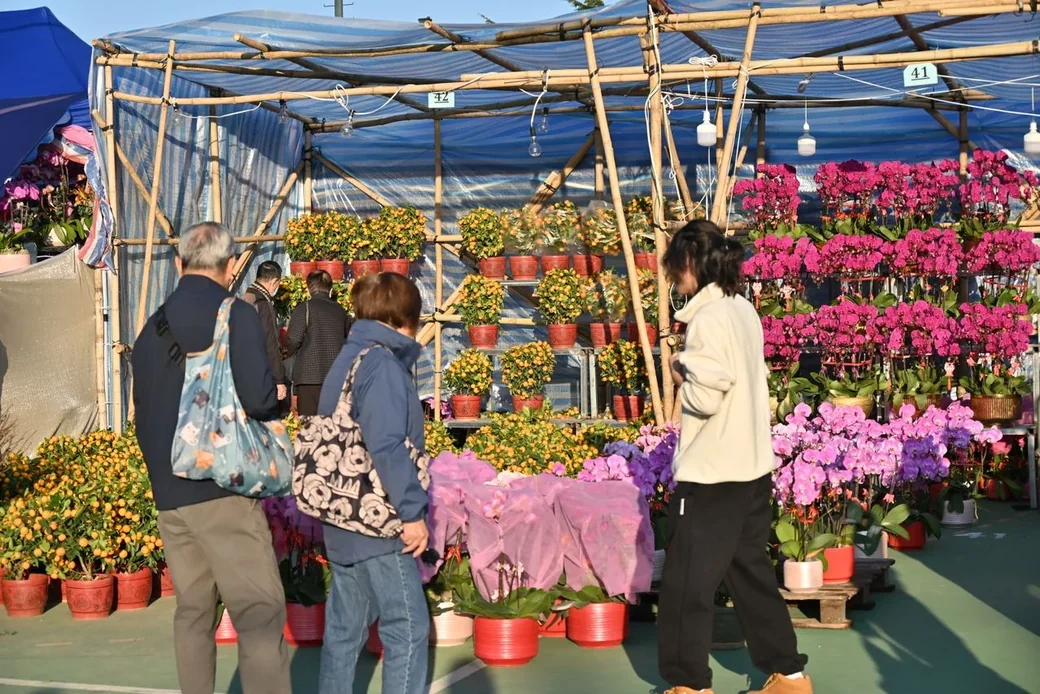
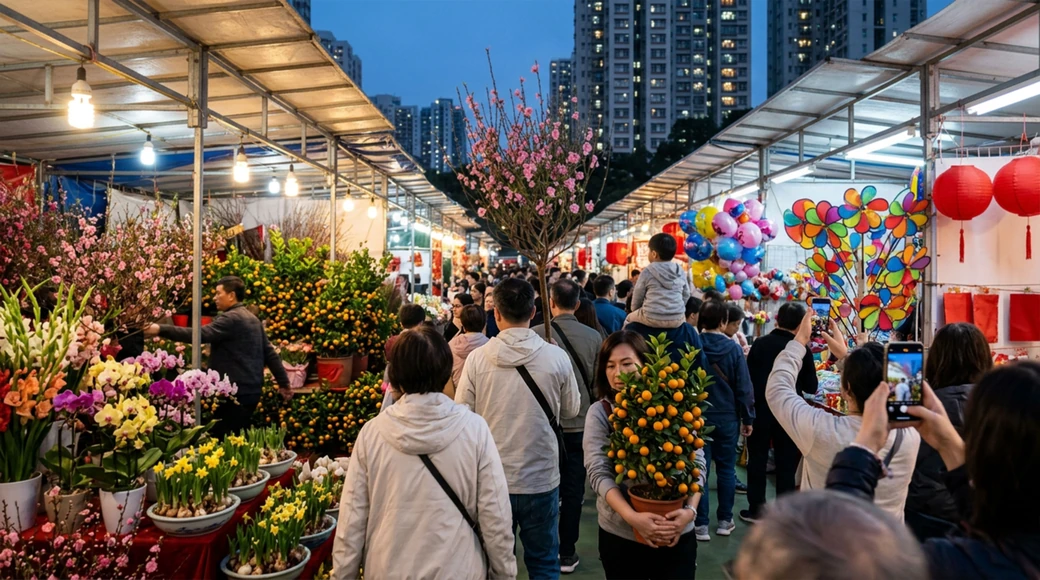
Lunar New Year Market in Hong Kong, with stalls of peach blossom, kumquat trees and red lanterns, where people stroll and pick out lucky decorations for the new year

Hong Kong Lunar New Year Fair – Flower Market

Hong KongJan 31, 2027 – Feb 6, 2027Partial public holiday↻ Annual
Duration:7 daysType:
Cultural & Traditional Festivals
Admission:FreeLocationAnnual event — exact dates may vary each year

Every year, Hong Kong’s parks turn into fragrant flower markets in the days before Lunar New Year. The biggest fair fills Victoria Park in Causeway Bay with blooms, lucky charms and snacks, and stays lively right through the last night.

About This Festival

Hong Kong Lunar New Year Fair: The City’s Great Flower-Market Tradition

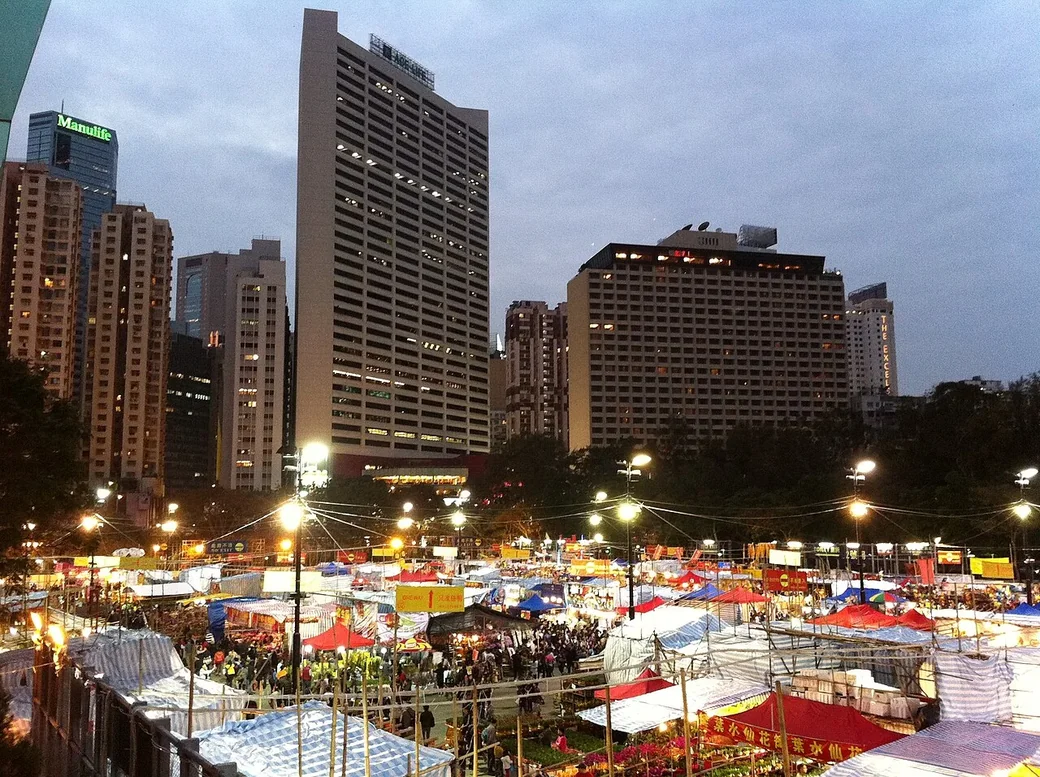
In the days before Lunar New Year, Hong Kong’s parks and playgrounds turn into temporary flower markets known as “nin4 siu1 si5 coeng4” (“the new-year-night market”) or simply “faa1 si5” (“flower market”). Around fourteen official fairs appear across Hong Kong Island, Kowloon, the New Territories and Lantau, and the biggest one, with roughly four hundred stalls, fills Victoria Park in Causeway Bay. Locals call the outing “haang4 faa1 si5” (“walking the flower market”): you wander the aisles, choose blossoms for your home, pick up red decorations and soak up the atmosphere before the new year begins. It is a living city tradition, loved by families, couples and friends, and an easy, friendly way for visitors to experience Hong Kong culture.
History of the Lunar New Year Fair: From Guangzhou to Victoria Park

According to a long-standing tradition, flower markets go back to the Ming dynasty, when farmers south of the Pearl River sold blooms in town. Over the centuries the markets gathered in the days before the new year. Cantonese families who settled in Hong Kong after 1949 brought the custom with them, and a Hong Kong newspaper from 1927 already described fair licences and the goods on sale. From the 1970s, as more households could afford decorative plants, the fairs became a fixture of the calendar. Victoria Park, opened in 1957 on land reclaimed from the Causeway Bay Typhoon Shelter, grew into the flagship site. The city’s leader traditionally visits the fair, a custom that began with the governors. Today Victoria Park is the largest park on Hong Kong Island, covering about nineteen hectares.

Best Time to Visit the Hong Kong Lunar New Year Fair: Day, Evening or Midnight?

The fairs last seven days and finish on the morning of Lunar New Year’s Day. Because the date follows the lunar calendar, it moves every year, and the organiser announces the exact days in autumn. Each moment has its own charm. Daytime is calmer, ideal for choosing plants, chatting with growers and taking photographs in soft light. Evenings bring lanterns, music and a lively crowd. The busiest hours fall a few hours before and after midnight on New Year’s Eve, when the market is at its most festive. In recent years the main fairs have stayed open all night on the last evening, and as dawn approaches vendors often offer friendly bargains. By morning the park returns to normal.

How to Get to Victoria Park’s Lunar New Year Fair: MTR, Tram and Walking

Victoria Park sits between two stations of the MTR (Hong Kong’s metro system). Tin Hau station and Causeway Bay station are each a short walk from the fair entrances, and trams stop at “Victoria Park” on Causeway Road. The MTR is by far the easiest way to arrive, because roads around the park are closed or rerouted during the fair and bus stops are moved. Police regularly ask visitors not to use station halls as meeting points, so choose a landmark inside the park instead. They also remind passengers not to carry metallic balloons on the MTR. During the busiest evenings, follow the directional signs and the officers’ instructions, and be ready for a queuing system that keeps the flow of people smooth and safe.

Wet Goods, Dry Goods and Fast Food: A Guide to the Fair’s Layout

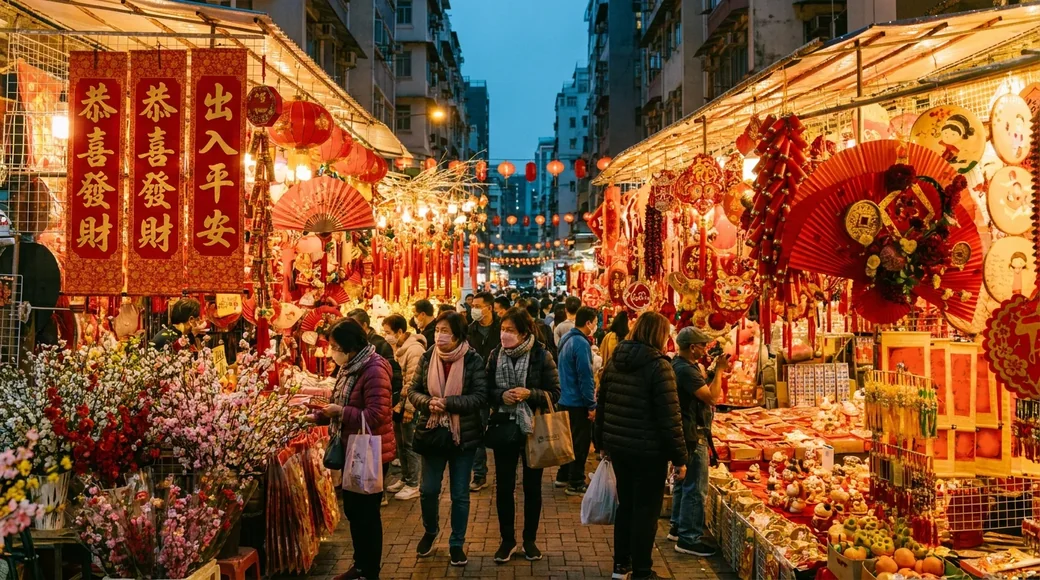
The fair is divided into three kinds of stall. “Wet goods” (fresh flowers and potted plants) fill one half of the grounds, and “dry goods” (soft toys, decorations, lucky charms and festive items themed on the year’s zodiac animal) fill the other. You will also find “fai1 ceon1” (red paper strips with auspicious phrases) that people hang on doors. In Victoria Park more than half of the stalls sell dry goods. Cooked food, snacks and drinks may only be sold at the four fast-food stalls, so look for them when you want a treat. Alcohol and live animals are not sold, games are not allowed at stalls, and goods are handed over on the spot. The Tung Chung fair, near the airport, does not allow gas-filled balloons.

Lucky Flowers of the Lunar New Year: Peach Blossom, Narcissus, Kumquat and Orchids

Every plant at the fair carries a wish. Peach blossom stands for growth and prosperity, narcissus for abundance and good fortune, and mandarins, tangerines and kumquats for luck and wealth. Orchids bring elegance and a sense of plenty, while peonies and chrysanthemums add colour and fragrance. Kumquat trees are shaped so that the fruit looks like a tree covered in gold. Many flowers come from other parts of China, and some come from nurseries in the New Territories. Growers time the blooming carefully, because blossoms should open just as the holiday begins. Warm weather can make them open early, so when you shop, choose branches with plenty of buds and few open flowers to enjoy them through the holiday.

Lunar New Year Legends and Folk Beliefs Behind the Flower Market

A popular tale says that a creature called Nian (“year”) once came down to villages at the turn of the year, until people discovered it feared the colour red, fire and loud noise. This story is often linked to the red decorations and the noisy celebrations of the season. According to an old belief, peach wood protects a household from harm, which is one reason peach blossom is so loved. People say that the name of the kumquat sounds like “gold” and “luck” in Cantonese, so a loaded tree is seen as a promise of wealth. These are stories passed down by word of mouth, not proven facts.

Lucky Pinwheels and Zodiac Souvenirs at the Lunar New Year Fair

Among the most photogenic souvenirs are “fung1 ce1” (“windmill” or pinwheel), bright paper pinwheels that, according to local belief, “turn” your luck for the better as they spin. Families around Wong Tai Sin made pinwheels at home in the 1950s and 1960s as a household craft, and the simple design has hardly changed since. Pinwheels are also popular at Che Kung Temple. Besides them, dry-goods stalls offer plush toys, lanterns and decorations featuring the year’s zodiac animal, and in the 2000s school and youth groups began running their own creative stalls. A pinwheel is light and inexpensive to carry, and it makes a cheerful gift or a charming keepsake from your trip.

What to Eat at the Lunar New Year Fair: Street Snacks and Festive Treats

The fast-food stalls are the place for hot snacks, sweets and drinks, and the lines are part of the fun. Skewers of toffee-glazed strawberries and soft mochi (Japanese-style rice cakes) have been favourites in recent years, and candied kumquat is a traditional new-year sweet. Many local families go to the fair after the “tyun4 jyun4 faan6” (“reunion dinner”), the big family meal on New Year’s Eve, where dishes such as fish stand for abundance and sweet rice balls for togetherness. If you plan to eat at the fair, arrive a little earlier than the midnight peak, carry tissues and napkins, and keep the Causeway Bay restaurants nearby in mind for a proper sit-down meal.

Etiquette at the Flower Market: Photos, Bargaining and Friendly Manners

The fair is a festive occasion for all ages, so a relaxed, polite attitude goes a long way. Photographing the displays is welcome, but it is courteous to ask before taking close portraits of vendors or shoppers. Handle blossoms gently, because every stem is for sale, and choose the plant you want before lifting it out of the crowd. Light, friendly bargaining is common, especially late on the final night when stallholders want to clear their stock, but a smile and a thank-you matter more than the discount. Keep to the flow of people in the aisles, avoid stopping in narrow spots, and keep large bags and backpacks close so that everyone can move comfortably.

Five Cantonese Lunar New Year Greetings to Use at the Fair

A few words of Cantonese will win warm smiles from the stallholders. Say “gung1 hei2 faat3 coi4” (“wishing you prosperity”) as the classic greeting. “San1 nin4 faai3 lok6” (“happy new year”) works for everyone. “San1 tai2 gin6 hong1” (“good health to you”) is a warm wish for older people in particular. “Maan6 si6 jyu4 ji3” (“may everything go as you wish”) suits almost any moment, and “sam1 soeng2 si6 sing4” (“may your wishes come true”) is a lovely farewell. Numbers after the letters show the tone, so listen to how locals say them. Even a simple attempt, offered with a smile, is always appreciated.

Staying Safe and Comfortable in the Lunar New Year Fair Crowds

Crowds are part of the fun, and a little preparation keeps the visit easy. Wear a small bag in front of you, agree on a meeting spot with your group, and hold young children’s hands in the busiest aisles. Police and fair staff direct the flow of visitors and may set up queues, so follow their instructions and the signs. If you lose something, ask the uniformed officers or fair staff. In windy weather stallholders secure their stands and plants, and some structures may be taken down for safety. Bring a thin extra layer for cool evenings, comfortable shoes, and a charged phone or power bank, and rest on the park’s open spaces whenever you need a break.

What to Bring and How to Carry Flowers Home from the Fair

Come with a sturdy reusable bag, comfortable shoes and a mix of cash and a card, since small stalls may prefer cash or mobile payment. In the daytime a hat and sunscreen help, and in the evening a light jacket is welcome. Ask the vendor to wrap a peach branch or orchid in paper so it travels safely on public transport. A large kumquat tree is heavy, so consider a taxi for it. If you are travelling, check whether your hotel room has a vase, and remember that rules for bringing plants into other countries differ. Many visitors simply buy one small potted plant or a pinwheel, which is easy to carry and a pleasure to keep.

How the Fair Supports Local Businesses: Stall Auctions and Young Vendors

Stalls are allocated by a public open auction run by the Food and Environmental Hygiene Department, and bidders must be adult Hong Kong residents who register in their own name, so the people behind the counters are local. That is why the fair feels so personal: growers, florists, craft sellers and snack makers meet their customers face to face. Licences cannot be sublet or transferred, so each stall stays with the person who won it at the auction. Vendors keep their stands tidy, and flowers left unsold may be handed over to the department rather than discarded. The Chief Executive (the head of Hong Kong’s government) and other officials visit the fair every year to encourage shoppers to support the stallholders during the holiday.

Beyond the Flower Market: Lunar New Year Festivities Around Hong Kong

The fair is only one part of the celebration. Other fairs run in Sham Shui Po (Fa Hui Park and Cheung Sha Wan), Kwun Tong, To Kwa Wan, Tsuen Wan, Sha Tin, Tai Po and Tung Chung. At Wong Tai Sin Temple, crowds wait for the “first incense” at midnight, and according to a popular belief this first offering brings protection for the year. Che Kung Temple in Sha Tin is known for its fortune-bringing wheel, and Lam Tsuen’s wishing trees attract wish-makers in Tai Po. In recent years the Tsim Sha Tsui night parade took place on the first evening, the harbour fireworks on the second, and the Chinese New Year Raceday at Sha Tin on the third day. Around the new year, the Che Kung Festival Fair in Sha Tin and the Fong Ma Po New Year Fair in Lam Tsuen carry the festive market mood on for two weeks or more. For questions about the fairs, the organiser’s enquiry line is +852 2868 0000.

Practical Information

When

The fairs run for seven days and end on the morning of Lunar New Year’s Day. Dates follow the lunar calendar and are announced each year by the organiser. On the last night the main fairs stay open through to the early morning.

Where

The largest fair is at Victoria Park, 1 Hing Fat Street, Causeway Bay, a short walk from Causeway Bay and Tin Hau stations on the MTR (Hong Kong’s metro system). Thirteen more fairs are held in other districts, including Sham Shui Po, Kwun Tong, Tsuen Wan, Sha Tin and Tung Chung.

Cost

Entry is free. Flowers, plants and goods are priced by the individual stalls.

Tips

Come by day for a relaxed browse and for the best photos, or in the evening for the full festive buzz. Take the MTR, keep valuables in front of you and agree on a meeting point inside the park. Bring a sturdy bag for your plants and carry both cash and a card.

Specific to this festival

The fair is also known as “haang4 faa1 si5” (“walking the flower market”), and locals treat the stroll itself as part of the new-year ritual. Only the fast-food stalls sell cooked food and drinks. Crowds peak around midnight on New Year’s Eve, and many vendors lower their prices as the night goes on.

Accommodation and hotel options during Hong Kong Lunar New Year Fair – Flower Market

Accommodation and hotel options around the event venue, with their prices, are shown by Stay22 as a map and a list. Cookies are used. Your consent is remembered on every page; you can turn it off at any time in the cookie settings.

Keep Exploring

Travel essentials for Hong Kong

Flights, transfers, car rental, eSIM and insurance — compare your options

Flights

Find the best route

Transfers

Airport & city ground transport

Car Rental

Drive at your own pace

eSIM

Stay connected on arrival

Insurance

Cover your trip