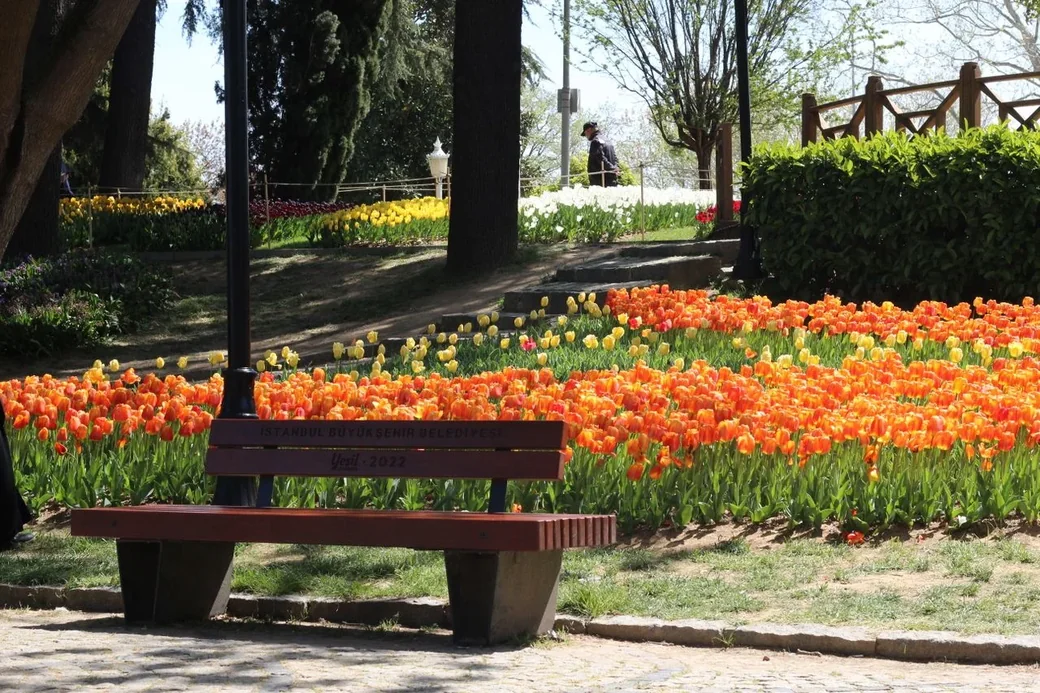
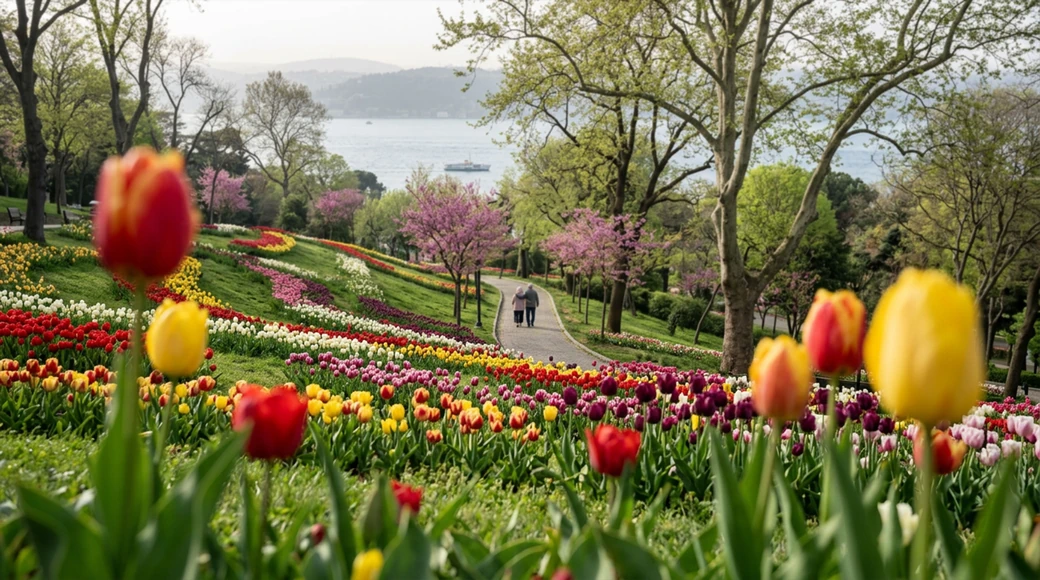
Istanbul Tulip Festival, with beds of red, yellow and purple tulips in full bloom in Emirgan Park as visitors stroll beside ponds and historic pavilions

Istanbul Tulip Festival

IstanbulApr 1, 2027 – Apr 30, 2027↻ Annual
Duration:30 daysType:
Cultural & Traditional Festivals
Admission:FreeLocationAnnual event — exact dates may vary each year

Every April, Istanbul turns into one giant flower garden: tens of millions of tulips bloom in Emirgan Park, Gülhane, Göztepe and the living tulip carpet of Sultanahmet Square, a spring festival rooted in Ottoman tulip history.

About This Festival

Istanbul Tulip Festival: What It Is and Why the City Celebrates It Every April

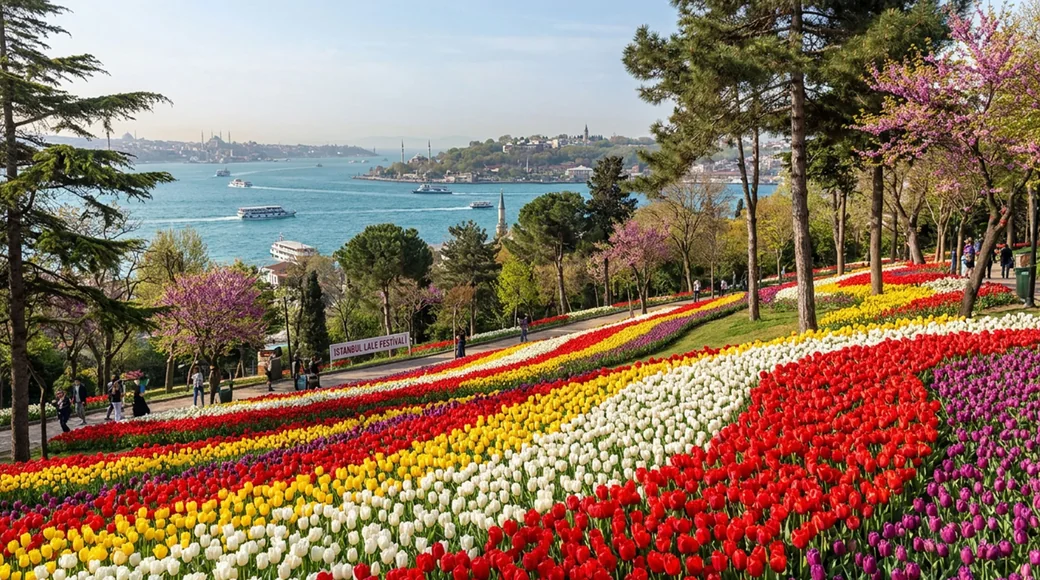
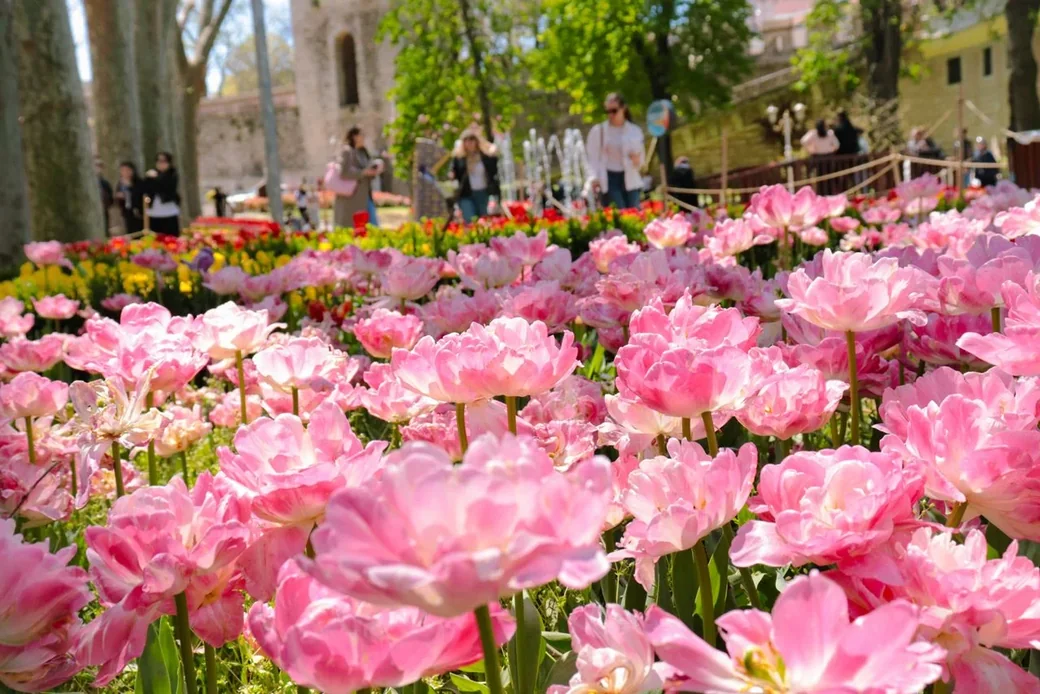
The Istanbul Tulip Festival is a month-long spring celebration organised every April by the Istanbul Metropolitan Municipality. Millions of tulips, and tens of millions across the whole city in recent years, are planted in parks, groves, squares and even roadside beds, so that Istanbul turns into one huge flower garden. The tulip is a symbol of the city, and the festival is the way Istanbul celebrates that bond with its own history. The municipality's replanting effort began in the mid-2000s with the aim of bringing the tulip back to its historic home, and the festival has grown steadily over roughly two decades. Most events take place in open-air green spaces, and the centre of gravity is Emirgan Park on the European shore of the Bosphorus. The first planting round in 2005 used several hundred thousand bulbs, the first festival edition followed in 2006, and the flower became an emblem of the city around the time Istanbul was European Capital of Culture in 2010.
When to See Tulips in Istanbul: Festival Season and Peak Bloom Timing

The festival officially runs from 1 to 30 April every year, but flowers follow the weather rather than the calendar. In most springs the early varieties open in the first days of April, the richest colour is usually found around the second and third weeks, and late-blooming types keep the beds lively until the end of the month. A mild winter can move everything a little earlier and a cold spring a little later, so it is worth checking recent photos or the organiser's website a few days before you go. One weekend in April is also the municipality's "Lale Bayramı" (Tulip Festival Day), when concerts and activities are concentrated in the main parks. If you have only one chance, aim for mid-April and choose a weekday morning.

Emirgan Park: The Heart of the Istanbul Tulip Festival on the Bosphorus

Emirgan Park, often called Emirgan Grove (Emirgan Korusu), sits on a slope above the Bosphorus in the Sarıyer district and is the undisputed star of the festival. Its winding flower beds are arranged in flowing patterns around ornamental ponds, with the strait glimmering in the background. The park has several gates, long shaded paths, picnic lawns, play areas for children and sea-view terraces near the top. Three historic wooden pavilions, the Yellow, the Pink and the White, house cafés and restaurants where you can rest between photo stops. The festival's opening ceremony traditionally takes place in the garden of the White Pavilion. Visitors who arrive early and keep walking uphill are usually rewarded with calmer corners and wider views.

History of Emirgan Grove and Its Yellow, Pink and White Pavilions

Emirgan Grove began as a private estate. In the second half of the nineteenth century the Ottoman sultan Abdülaziz granted it to Khedive İsmail Pasha, a senior viceroy of the empire, and between 1871 and 1878 three pavilions were built inside it. Today they are known by their colours: the Yellow Pavilion in a chalet style, the Pink Pavilion in the manner of a classic two-storey Ottoman house, and the White Pavilion. After passing through the hands of the heirs and a later private owner, the grove was bought by the city and opened to the public in 1943. A major restoration of the Yellow Pavilion in the 1990s gave it its present bird-house charm. Knowing this makes a walk among the tulips feel like a stroll through an imperial garden.

The Living Tulip Carpet in Sultanahmet Square Between Hagia Sophia and the Blue Mosque

Each April the municipality lays out a living carpet of tulips in Sultanahmet Square, on an earth platform between Hagia Sophia and the Sultanahmet (Blue) Mosque. Hundreds of thousands of tulips are arranged to form traditional rug motifs, so the whole design looks like an enormous woven carpet seen from above. The first one appeared in 2015, and the pattern, size and colours change every year; in one edition both the area in square metres and the number of tulips were chosen to echo the conquest year of 1453 and its anniversary. The carpet usually opens in the middle weeks of April and stays until the festival ends. Stand near the corners of the square so that the carpet, the dome of Hagia Sophia and the mosque's minarets fit into one frame.

Best Tulip Parks in Istanbul Beyond Emirgan: Gülhane, Göztepe, Hıdiv and More

Emirgan is not the only place to see tulips. Gülhane Park, right beside Topkapı Palace, fills its historic avenues with colourful beds and combines easily with a day in the old city. Göztepe 60th Year Park on the Asian side, close to Bağdat Avenue, is another large display, while the Hıdiv Kasrı Grove in Çubuklu climbs a hillside of old oaks with a waterfall and a café with a view. Smaller displays appear in the Büyük and Küçük Çamlıca groves, Fethipaşa Grove and Yıldız Park, the last one a quieter alternative between Beşiktaş and Ortaköy. Choosing a park on your own side of the Bosphorus saves time and often gives you the same colours with fewer people.

How to Reach the Istanbul Tulip Festival by Bus, Tram and Ferry

Emirgan Park has no metro station of its own, so most visitors arrive by bus or by boat. From Kabataş, where the tram line meets the funicular from Taksim, buses run along the Bosphorus shore to Emirgan, with journey times that depend on traffic. Passenger ferries on the Bosphorus also call at Emirgan pier, which lets you add a short cruise to the day; from the pier you walk a little uphill to the park. Sultanahmet Square and Gülhane Park are a short walk from the tram line in the old city. The Hıdiv Kasrı Grove can be reached by ferry to Kanlıca followed by a walk of around half an hour. On spring weekends the roads around the grove are busy, so public transport is usually the calmer choice.

Tulip Festival Programme: Concerts, Ebru, Glass Art and the Photo Contest

Alongside the flowers, the festival offers a cultural programme in the main parks. Live music from local bands and municipal orchestras fills the weekends, and the Lale Bayramı weekend concentrates concerts and activities in Emirgan, Gülhane, Göztepe and the Hıdiv grove. Craft demonstrations such as ebru (paper marbling) and glass blowing let you see traditional arts at work, while the municipality's arts-course programme and its women's coordination centre present tulip-themed exhibitions and handmade products. Sculptures shaped like tulips appear in some editions, and the "Most Beautiful Tulip" photo contest invites visitors to share their best pictures. Programme details change from year to year, so check the official website before you go. In some editions the programme has also included symposia on the history of the tulip and a chronological exhibition.

Where Tulips Come From: From Central Asia to the Gardens of Istanbul

The tulip did not originate in Istanbul; it travelled here. Coins, monuments and objects from the Roman and Byzantine periods carry no tulip motifs, which suggests the flower arrived with peoples moving west from Central Asia. It reached Anatolia around the eleventh century, Seljuk palaces used tulip motifs, and the poet Rumi (Mevlâna) wrote about the flower in the thirteenth. In 1554 an envoy of the Habsburg court named Busbecq noticed tulips grown along the road between Edirne and Istanbul and is thought to have carried bulbs westward. His notes record the word "tulipan", which became "tulip" in many languages; one explanation links it to turban cloth. The botanist Carolus Clusius, who received bulbs from Istanbul, later helped make the flower famous across Europe and planted it in the botanical garden of Leiden. As early as 1546 a visiting physician recorded that many foreigners came to Istanbul by ship to buy flower bulbs, and early European writers mistook the tulip for a kind of lily, calling it the “red lily”.

The Tulip Era (Lale Devri) 1718–1730: Istanbul's Golden Age of Tulips

The Tulip Era, or Lale Devri, is the name later given to the years from 1718 to 1730, under Sultan Ahmed III and Grand Vizier Nevşehirli Damat İbrahim Pasha. It was a time of peace, gardens and refined entertainment: the poet Nedim wrote about spring and tulips, the court painter Levnî portrayed palace life, and tulip gatherings were held in pavilions and gardens. The sultan's riverside palace of Sadabad at Kağıthane, raised in about sixty days in 1722, was the stage for many of these parties, although nothing of it survives today. The period also left lasting monuments, including the elegant Fountain of Ahmed III beside the Imperial Gate of Topkapı Palace, and new libraries. The era closed in 1730, yet the festival's tulip imagery still borrows from it.

Ottoman Tulip Culture: Royal Florists, Rare Varieties and a Flower With a Spiritual Meaning

Long before the festival, tulips mattered deeply to the Ottoman court. Mehmed the Conqueror, Süleyman the Magnificent and Ahmed III are remembered among the sultans most fond of the flower, and tulip motifs decorated kaftans, tiles, mosques and gravestones. The palace employed a chief florist, and an expert council examined every new variety: if the bloom was judged flawless it was named and entered in a register with its characteristics and the owner of the bulb. Names ranged from Persian and Arabic terms to everyday words such as Narçiçeği or Pabuççu. A municipal page recalls that the Istanbul tulip was once said to have well over a thousand varieties. In Arabic script the letters of "lale" are the same as those of the word Allah, which, according to tradition, gave the flower a spiritual meaning, and the Ottomans also called it "ferahaver", the bringer of ease. The seventeenth-century traveller Evliya Çelebi described tulips growing in the gardens along the Bosphorus and mentioned a famous variety called Kefe, brought from across the Black Sea.

The Istanbul Tulip Returns: Bulb Farms, the Tulip Foundation and a Gift of Bulbs

The Istanbul tulip, the old local form with dagger-pointed, almond-shaped flowers, faded from the city's gardens during the nineteenth century. Bringing it back has become a long-term project. The Istanbul Tulip Foundation (İLV), established in 2011, grows bulbs and works to return the historic Istanbul tulip to the city's streets. A tulip bulb needs about three years to mature, so the huge quantities planted each autumn are raised well in advance by contracted farmers in places such as the Çumra district of Konya and the Silivri and Çatalca areas of Istanbul. A small and charming chapter began in November 2021, when a consul general based in Istanbul gave the municipality a gift of one thousand bulbs; they were planted in December in Emirgan Grove, in a corner called Istanbul Square, and bloomed there in April 2022. In the early years the municipality also handed out a million bulbs to residents so that balconies and window sills would bloom, and a photo competition drew around fifteen thousand entries.

Photography Guide: Best Spots and Light at the Istanbul Tulip Festival

For classic pictures, start at the lower entrance area of Emirgan Park: the curving beds around the ornamental pond, with the Bosphorus beyond, form the most recognisable view of the festival. The two ponds beneath the Yellow Pavilion add reflections and softer backgrounds, and the upper terraces open into wide sea panoramas. In Sultanahmet, stand near the corners of the square so that the tulip carpet, Hagia Sophia and the Blue Mosque all fit into the frame. Early morning light is gentle and the paths are quieter, which helps when you want a clean shot without strangers in it. Please photograph from the paths and the edges: stepping into the beds damages the flowers and spoils the pattern for everyone who comes after you.

Visiting Tips: Avoiding Crowds, Walking Terrain, Families and Park Etiquette

Spring weekends can be very busy at Emirgan, so weekday mornings are the most relaxed time to visit. The park is hilly, so wear comfortable shoes and allow time to walk uphill; the quietest and most scenic corners are usually higher up. Bring water and a light jacket, because April weather in Istanbul changes quickly. Families will find play areas and picnic spaces, and the cafés in the pavilions offer a place to sit and rest. Stay on the paths, do not pick flowers or step into the beds, and take your rubbish with you so the park stays beautiful for the next visitor. If one place feels too crowded, simply choose another tulip park nearby; the festival is spread across the whole city for exactly this reason.

Beyond the Tulips: Judas Trees, Bosphorus Villages and a Full Day Out in Emirgan

April is also when the Judas trees (erguvan) bloom along the hills of the Bosphorus, and their pink-purple blossoms often overlap with the end of tulip season; Emirgan Grove is one of the places where you can see them. After the park you can walk down to the Emirgan waterfront, where the strait is lined with historic waterside villas, or take a Bosphorus ferry for a cruise with a very different view of the same hills. Across the water, the Hıdiv Kasrı Grove offers a woodland walk, a waterfall and a café with a view. Put together, these make the tulip trip a full spring day on the Bosphorus rather than a short stop, and a good way to see how green and layered Istanbul can be.

Practical Information

When

The festival runs from 1 to 30 April every year. Colour is usually at its best around the middle of the month, depending on the weather. Many concerts and activities are gathered on the "Lale Bayramı" (Tulip Festival Day) weekend in April.

Where

The main venue is Emirgan Park (Emirgan Grove) in Sarıyer, on the European shore of the Bosphorus; opening hours may change. More displays are found in Sultanahmet Square (the living tulip carpet), Gülhane Park, Göztepe 60th Year Park in Kadıköy, Hıdiv Kasrı Grove in Çubuklu and several other groves across the city. Opening hours differ from park to park, so check them before you go.

Cost

Free. No ticket is needed for Emirgan Park or the public tulip displays. Parking for cars inside the grove is charged.

Tips

Weekday mornings are the calmest time. Wear comfortable shoes, because the park lies on a slope. There is no metro station at the park: from Kabataş, buses 22, 22RE and 25E reach Emirgan, with journey times depending on traffic, and Bosphorus ferries also call at Emirgan pier, though sailings are infrequent. Stay on the paths and never pick the flowers. Lines 40T and 42T also stop at Emirgan, about five minutes' walk from the grove.

Unique to this festival

Tens of millions of tulips are planted across the whole city rather than in a single garden. A living tulip carpet is laid out between Hagia Sophia and the Blue Mosque. The Ottoman "Tulip Era" (1718–1730) and the revival of the old Istanbul tulip give the festival unusual historical depth. It is organised by the Istanbul Metropolitan Municipality.

Accommodation and hotel options during Istanbul Tulip Festival

Accommodation and hotel options around the event venue, with their prices, are shown by Stay22 as a map and a list. Cookies are used. Your consent is remembered on every page; you can turn it off at any time in the cookie settings.

Keep Exploring

Travel essentials for Istanbul

Flights, transfers, car rental, eSIM and insurance — compare your options

Flights

Find the best route

Transfers

Airport & city ground transport

Car Rental

Drive at your own pace

eSIM

Stay connected on arrival

Insurance

Cover your trip