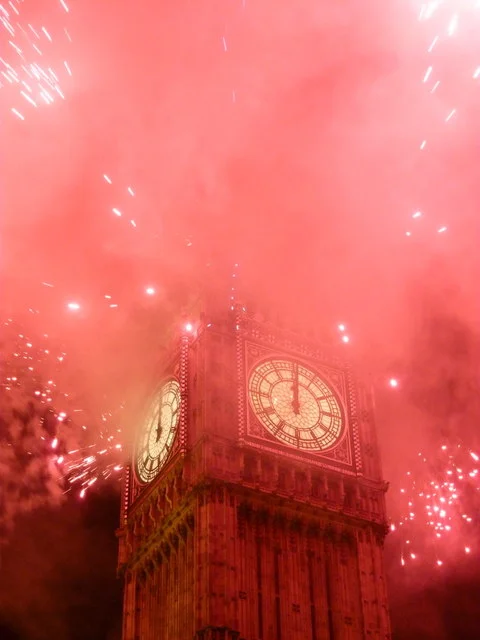
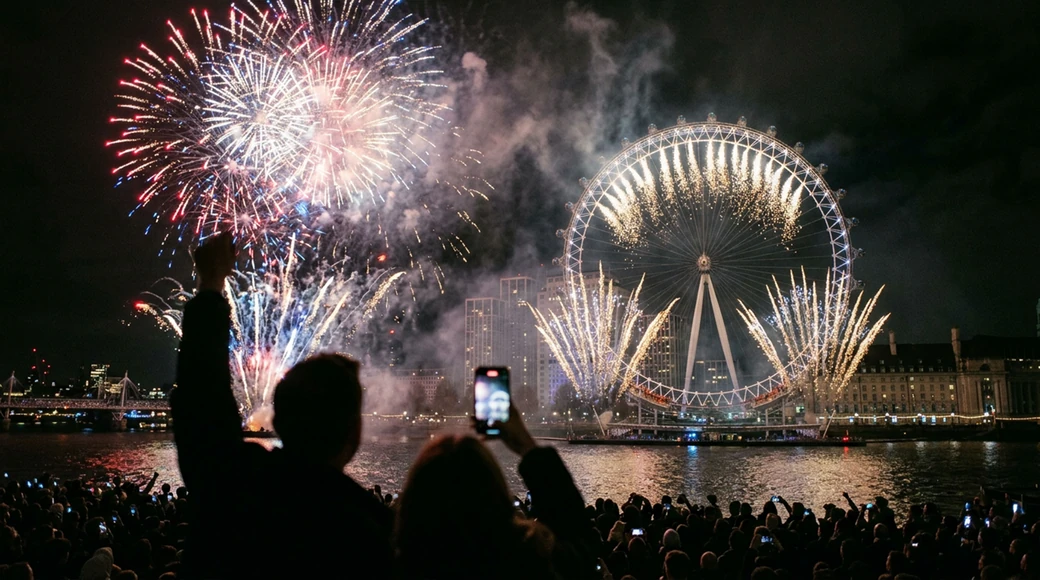
New Year's Eve in London, with fireworks bursting over the River Thames and the London Eye as crowds along the riverbank welcome the new year

New Year in London: Thames Fireworks & New Year's Day Parade

LondonDec 31, 2026 – Jan 1, 2027Partial public holiday↻ Annual
Duration:2 daysType:
Cultural & Traditional Festivals
Admission:From 20 GBPLocationAnnual event — exact dates may vary each year

Big Ben chimes midnight, fireworks launch from the London Eye over the Thames, and the very next afternoon a huge parade of thousands of performers marches through the West End.

About This Festival

London New Year's Eve Fireworks: History from Trafalgar Square to the Thames

For generations, Londoners welcomed the new year by gathering informally in Trafalgar Square. The large organised fireworks display began with the celebrations that welcomed the year 2000, when an estimated three million people watched in person. It settled into a regular tradition in the early 2000s, and since then the Thames riverside around the London Eye has been the capital's New Year stage; the London Eye is the event's official partner. The pyrotechnics have been produced by a Cambridgeshire firm since 2010, and the official viewing areas have been ticketed since 2014 to keep crowds safe and manageable. During the pandemic years the show carried on as a television-only broadcast from landmarks across the city before returning to the riverbank. Every edition has its own theme and message, which is why no two shows look quite alike.
What to Expect at London's New Year's Eve Fireworks: Big Ben, the London Eye and a Twelve-Minute Spectacle

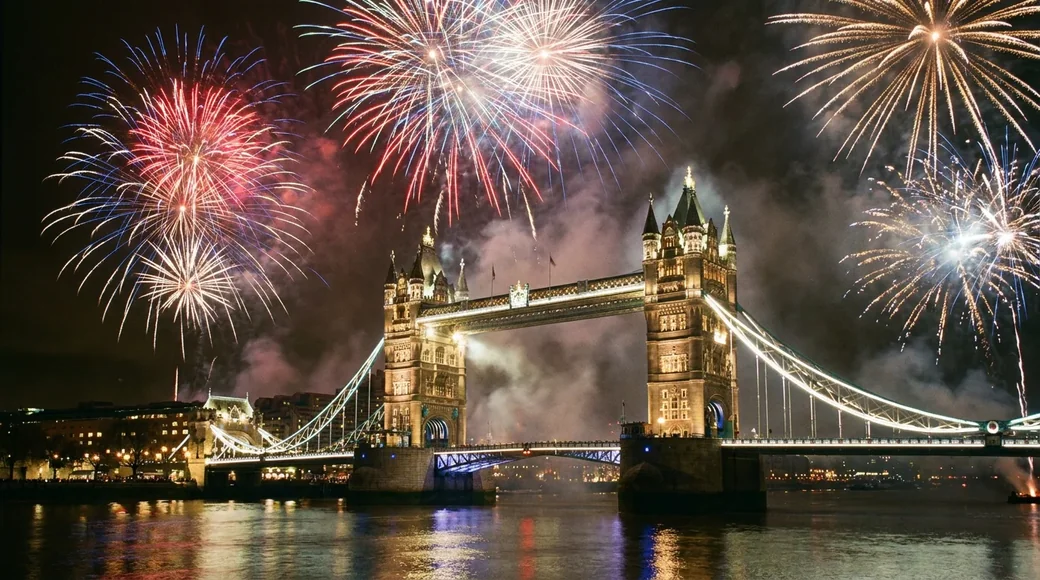
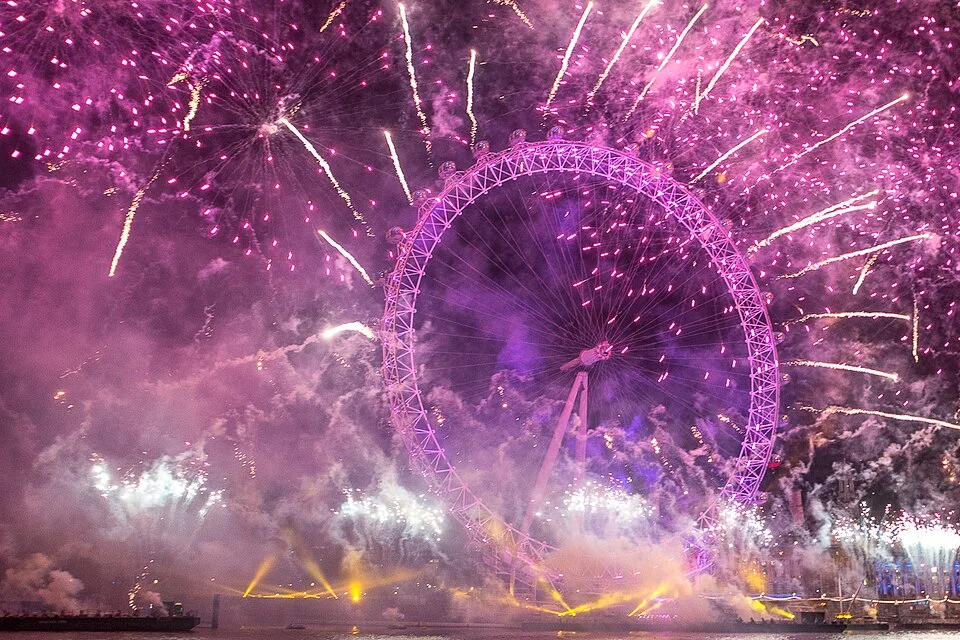
The official programme runs from eight in the evening until half past midnight, but the real moment arrives at midnight. First Big Ben rings out its famous chimes, the "bongs", then fireworks launch from the London Eye and from barges moored beside it. The display lasts about twelve minutes, with well over twelve thousand fireworks and hundreds of lights timed to a soundtrack and projected animations, which makes it the largest annual fireworks show in Europe. Each year's soundtrack and narration look back on the year's moments in sport, culture and community, and the narration is usually carried by recorded voice messages from well-known actors and broadcasters. Around a hundred thousand people watch from the official viewing areas while millions more follow on BBC One and online. The spectacle is short compared with the waiting time, so prepare for the wait, not just the show.

London New Year's Eve Fireworks Tickets: How to Buy Them and What to Watch Out For

You need a ticket to stand in the official viewing areas, and tickets are sold only through Ticketmaster, the sole authorised seller. Tickets bought anywhere else are invalid and can be refused at the gate. Sales usually take place in the autumn in two batches, a large first release and a smaller final one, and tickets tend to sell out within days, so follow the Mayor of London's official page for announcements. Each buyer can purchase up to four tickets; the booker's name is printed on every ticket, photo ID may be checked at the entrance, and the group is expected to arrive together. Londoners get a discount, but your billing address must match the London postcode you entered or the tickets can be cancelled without warning. If you cannot attend, you can pass tickets on only through Ticketmaster's official resale service. No tickets are sold on the night.

London New Year's Eve Viewing Areas Explained: Blue, Red, Pink, Green, White and Orange

In recent years the ticketed riverside has been split into six colour-coded areas. Blue sits on Victoria Embankment and faces the London Eye head-on, which is why visitors often rate its view highest. Red lies a little further east along the same embankment with a slightly angled view. Pink is up on Waterloo Bridge: elevated and wide, but you see the Eye from the side. White is on Westminster Bridge, right beside the Houses of Parliament and Big Ben. Green is located behind the London Eye, so the view is quite different. Orange is on Albert Embankment across the river next to St Thomas' Hospital; it is the accessible area, with a side view of the Eye. Visitor reviews note that views from areas other than Blue are more distant or angled, so choose according to what matters most to you. Every ticket is valid only for its own area and entrance gate, and once inside you generally cannot move to another area or leave and come back. The zone map is refreshed each year, so check the official map before choosing.

What You Can and Cannot Bring to London's New Year's Eve Fireworks: Bag Rules and Packing List

Security searches are carried out at every entrance and a bag restriction applies: backpacks and suitcases are not allowed, so bring a small shoulder bag or, better still, no bag at all. Glass of any kind, fireworks, sparklers and drones are banned. Bicycles, tables, buggies and pets (other than assistance dogs) are not allowed, and chairs are only permitted in the accessible area. Alcohol rules have changed from year to year, from small amounts in plastic bottles or cans to a complete ban, so read the conditions that come with your ticket. Pack warm waterproof layers, a hat, gloves and thick socks, water in a non-glass bottle, a flask of something hot, a light snack and a power bank. Food and drink inside are limited, and leaving to buy something usually means you cannot get back in. Arrive early, ideally before nine in the evening, to avoid the longest queues.

Accessibility and Families at London's New Year's Eve Fireworks: The Orange Area

Spectators with access needs are directed to the Orange area on Albert Embankment, which is less crowded than the main zones. It has accessible toilets, a Mobiloo (accessible toilet) unit with a hoist and changing table, a first-aid point and a nearby drop-off point, and compact folding chairs are allowed there under the rules. Wheelchairs are permitted in all viewing areas, although the other zones, while step-free, are busy and loud. There is no official age limit, but buggies are not allowed and the combination of long standing, cold and dense crowds makes the night unsuitable for small children; older children may find it unforgettable. Families with little ones will usually have a far more relaxed time at the New Year's Day Parade the following afternoon, or by watching the live BBC broadcast from a warm living room.

Getting to and from London's New Year's Eve Fireworks: Tube, Buses, Closures and the Journey Home

Public transport is not free on New Year's Eve; normal fares apply, so use Oyster (London's rechargeable travel card), contactless or a Travelcard (a day or period pass for London transport). Most Tube (London's Underground) lines and night buses run through the night, with a few exceptions such as the Waterloo & City line. To manage the crowds, central stations like Charing Cross, Embankment, Blackfriars and Covent Garden are partly or fully closed in the evening and reopened when it is safe, and Piccadilly Circus and Leicester Square may close briefly around midnight. From the early afternoon, roads in the centre are closed to traffic and many bridges shut, so driving is a bad idea. Plan your way home in advance, expect that you may not be able to leave the way you arrived, and consider waiting half an hour to forty-five minutes after the show instead of joining a hundred thousand people at the station at once. Check Transport for London for the current list of closures.

Where to Watch London's New Year's Eve Fireworks Without a Ticket: Free Spots and Alternatives

The riverside areas are ticketed and the streets and bridges around them are closed for the night, but you still have options. Hills such as Primrose Hill, Parliament Hill on Hampstead Heath, Alexandra Palace, Hilly Fields, Telegraph Hill and Greenwich Park give a distant skyline view, often with other fireworks popping up across the whole city; some of these parks are restricted or closed in certain years, so check beforehand. Southwark Bridge and Vauxhall Bridge have been open in some years with a limited, partial view, while Tower Bridge and London Bridge give poor views and the authorities ask people not to gather on bridges for safety reasons; the crossings nearest the display, such as Westminster and Waterloo, are closed, as is the Millennium Bridge in the evening. Trafalgar Square has a lively mood but only a partial view of the sky. For a more comfortable night, consider a New Year's Eve cruise on the Thames, a riverside restaurant or a rooftop venue such as Sky Garden (London's highest public garden, with 360-degree views) or the Shard's restaurants Aqua Shard and Oblix, all booked months ahead. Or simply watch live on BBC One, BBC iPlayer and the BBC's YouTube channel; ITV and Sky News also broadcast it.

London New Year's Eve Safety Tips: Crowds, Cold, Pickpockets and Solo Travellers

London handles the night well, but it is still a huge crowd, so basic care pays off. Keep your phone and wallet in a zipped inner pocket, agree on a meeting point in case your group gets separated, and fully charge your phone before leaving since there are no charging points in the viewing areas. December nights by the river are damp and windy, and hours of standing can chill you through, so thermal layers and a waterproof outer shell matter more than style. Police, stewards (event marshals) and first-aid points are present in and around the area, and in an emergency you can dial 999 (the UK emergency number). Solo and female travellers will feel most comfortable staying on busy, well-lit streets, and after midnight it is best to use a licensed black cab (London's traditional licensed taxi) or a vehicle booked through an app rather than an unlicensed minicab (a pre-booked private-hire car). The bars of Soho are a lively place to be on the night, welcoming LGBTQ+ travellers and everyone else.

London's New Year's Day Parade (The London Parade): History, Route and Performers

On the afternoon after New Year's Eve, one of the world's largest New Year street events takes over central London, from the West End to Westminster. It began in 1987 as the Lord Mayor of Westminster's Big Parade, was called the Millennium Parade for the year 2000, and is officially known today as The London Parade, or LNYDP (short for London's New Year's Day Parade). More than ten thousand performers from around the world take part, including marching bands, dancers, acrobats, cheerleaders and giant balloons, and the city's town crier (a traditional official who makes announcements aloud) marches too. American school and university bands travel over every year, and the first college band joined the very first parade. Each of London's 32 boroughs (local administrative districts) is encouraged to send an entry judged as part of the event, and the parade raises funds for London charities. Between half a million and a million spectators line the route of about 3.5 kilometres, which starts outside The Ritz on Piccadilly and passes Piccadilly Circus, Regent Street, Pall Mall, Trafalgar Square and Whitehall before ending at Parliament Square. Since the end of the 2000s it has run in this direction so American television audiences get the best view of Big Ben, and PBS stations show it live in the US. A different headline act closes the parade each year; the line-up is published on the event website beforehand.

How to Watch London's New Year's Day Parade: Best Spots, Grandstands and Transport

Watching from the pavement is free. The parade usually steps off around one in the afternoon and takes about three hours to pass any single point. Trafalgar Square and Parliament Square fill up first, while Piccadilly and Regent Street are generally calmer. For a guaranteed view, paid grandstand (raised seating stand) and VIP seats are sold along the route, including on Piccadilly and Whitehall, and ticket holders are normally asked to take their seats by late morning. New Year's Day is a public holiday, so the Tube (London's Underground), buses, DLR (Docklands Light Railway, London's light metro) and trams run reduced Sunday-style services, bus routes are diverted along the route and many roads close; leave early and check station closures. A Street Food Village (an area of street-food stalls) is set up with flavours from around the world. The parade goes ahead in the rain, so dress for it. Around the parade, churches and concert halls host the London Parade Concert Series and an international choral festival.

London New Year Traditions: Big Ben's Chimes, Auld Lang Syne and Folk Beliefs

London New Year Traditions: Big Ben's Chimes, Auld Lang Syne and Folk Beliefs

In Britain the last seconds of the year are counted down to the chimes of Big Ben; after the twelfth stroke people hug, kiss and join hands to sing Auld Lang Syne. The words come from a poem written by the Scottish poet Robert Burns in 1788. The title roughly means "for old times' sake", and the song was first sung at Scottish Hogmanay (the Scottish New Year's Eve celebration) celebrations before spreading across the British Isles. Singers cross their arms over their chests and link hands with whoever stands beside them, and visitors are welcome to join in. A few folk beliefs add colour. According to a popular saying, the first words you speak after midnight should be "white rabbits" (a lucky-charm phrase), three times, to bring luck all year. According to another old belief, the first visitor to cross your threshold in the new year, the "first-footer", should bring coal, bread, money and a sprig of greenery so that the household stays warm, fed, prosperous and long-lived. An old custom also says to open the door at the last stroke of midnight to let the old year out and the new one in. None of this is documented fact; these are cherished stories and playful rituals.

Where to Eat and Drink on London's New Year's Eve: Cruises, Rooftops and Pubs

London's New Year's Eve has no festival dish of its own; it is a night for sparkling wine, beer and hot drinks. Inside the official viewing areas food and drink choices are limited and re-entry is usually impossible, so eat a hot meal beforehand and bring water and a flask. To enjoy the fireworks with a meal or a drink, look at New Year's Eve dinner and party cruises on the Thames, riverside restaurants, and hotel or rooftop bars; all of them book out months ahead. Pubs and restaurants are generally open on the night and the next day, and London's international food scene makes vegan, halal and kosher options easy to find. On New Year's Day you can start with a late full English breakfast (a cooked breakfast with eggs, bacon, sausage, beans and toast) or a hearty pub (a traditional British bar-restaurant) lunch, and the Street Food Village (an area of street-food stalls) along the parade offers small tastes from many cuisines. Drinking alcohol on the street is subject to local rules, and police can ask you to stop in some areas; glass is strictly banned in the viewing areas.

Where to Stay for London's New Year's Eve: Hotels, Luggage and What Happens Around the Event

New Year week is one of the busiest times of the year in London, with hotel rates above normal and river-view rooms disappearing very early, so book months ahead. Waterloo, Southwark, Westminster and Embankment are within walking distance but are hit hardest by closed stations and roads, which can make getting back difficult. Quieter bases such as Victoria, South Kensington or King's Cross let you return on the Tube (London's Underground) that runs through the night. Luggage can be left at central stations and private storage points, though hours may be shorter on New Year's Day. In the days before the night, Christmas markets, theatres and the sales season carry on. On New Year's Day most London shops, museums, galleries and theatres are open, some with bank holiday (official public holiday in the UK) hours, so check before you go. The January sales begin, and ice rinks and free events at the Southbank Centre are good options. A few weeks later, Chinese New Year festivities and Burns Night (an evening honouring the Scottish poet Robert Burns) keep the season going.

London New Year's Eve: Insider Tips, Common Myths and Interesting Facts

A few useful and surprising things. Plenty of Londoners do not go into the centre at all; they ring in the new year at house parties, in neighbourhood pubs (a traditional British bar-restaurant) or in front of the BBC broadcast. London's midnight arrives after Asia and continental Europe, and the show is watched by millions around the world on BBC One, ITV, Sky News and online. The most common misunderstandings are that the fireworks are free (the official viewing areas have been ticketed since 2014), that the main party is in Trafalgar Square (it is on the Thames riverside), that the show lasts an hour (it is about twelve minutes) and that public transport is free that night (it is not). Honest visitor feedback: reviews often complain about long waits, the cold and the crush when leaving, while praising the show itself, and the happiest visitors are those who arrive early, dress warmly and plan their journey home. Practical advice: wait for the official ticket announcement and buy only from Ticketmaster, and try to watch part of the show without looking at a screen, since everyone around you will be filming. Each year's theme and message, honouring achievements in sport, the arts and community, is what makes this more than another fireworks display, and official city analysis shows that ticket-holders alone bring substantial extra business to London's hotels, restaurants and shops.

Memorable Moments and Themes of London's New Year's Eve Fireworks Over the Years

Every edition tells its own story. One year the fireworks were fired outwards from the top of the Elizabeth Tower in the shape and colours of the Olympic flag; another looked back at the best of the Olympic and Paralympic Games and the Diamond Jubilee. In one edition, fruit-scented mists and edible flavoured foam drifted through the crowd in what was billed as the first multi-sensory fireworks display, and in another the city's landmarks were lit blue for a children's campaign with UNICEF. One show looked ahead to a major European football tournament. During the pandemic, broadcast-only shows brought fireworks, lights and drones to landmarks such as The Shard, The O2, Tower Bridge and Wembley Stadium, with a tribute to the NHS (the UK's National Health Service) and an environmental message narrated by David Attenborough. When the show returned to the riverbank, drones were added over Horse Guards Parade, alongside a tribute to Queen Elizabeth II. Later editions celebrated the coronation of Charles III, the 75th anniversary of the NHS and of the arrival of the Empire Windrush ship, then marked the 80th anniversary of the D-Day landings (narrated by Sir Ian McKellen), cheered Team GB's Olympic and Paralympic successes and saluted 25 years of the London Eye. Every new edition adds a theme of its own, so the story carries on each year.

London New Year's Eve Hour by Hour: From Road Closures to the Midnight Fireworks

Early afternoon: vehicle restrictions begin around the event area and last until roughly dawn the next morning, and overnight roadworks to build and later remove the site take place in the days before and after, so check before driving anywhere nearby. Evening: station and bridge closures start at different times; in recent years Charing Cross closed from early evening, Covent Garden became exit-only a little later and Embankment closed later still. From about eight o'clock: the ticketed viewing areas open and the official programme begins. Entry usually closes in the late evening, around half past ten in recent years, so aim to arrive well before. Midnight: Big Ben's chimes ring out, followed by about twelve minutes of fireworks. Half past midnight: the official programme ends and the areas are emptied in a controlled flow along set exit routes; allow at least thirty to forty-five minutes to leave the area and often an hour or more to reach a station. Through the night: most Tube (London's Underground) lines and night buses keep running. Early morning: roads and stations reopen as the clean-up proceeds. Afternoon of the next day: the New Year's Day Parade steps off around one o'clock, takes about three hours to pass any point and finishes near Westminster at around half past four.

Practical Information

When

Every year on the night of New Year's Eve. The official programme runs from 8 pm to 12:30 am, with the fireworks fired right after Big Ben's midnight chimes and lasting about twelve minutes. The next afternoon the New Year's Day Parade steps off around 1 pm and takes roughly three hours to pass.

Where

The Thames riverside around the London Eye in central London: Victoria Embankment, Waterloo Bridge, Westminster Bridge and Albert Embankment. The parade runs from The Ritz on Piccadilly via Regent Street, Pall Mall, Trafalgar Square and Whitehall to Parliament Square.

Cost

The official viewing areas are ticketed and sold only through Ticketmaster; the most recently announced prices ranged from about £20 to £55 per person, depending on the viewing area and whether the buyer lives in London, plus a booking fee. Watching the parade from the pavement is free, while grandstand and VIP seats are paid.

Tips

Travel light (backpacks are not allowed), dress in warm waterproof layers, carry a fully charged phone and a power bank, plan your journey home in advance, and never buy tickets from unofficial sellers.

What makes this festival special

It is one of the most watched New Year celebrations on Earth, built around the chimes of Big Ben and fireworks fired from the London Eye itself, and it carries on the next day with one of the biggest street parades in the world.

Accommodation and hotel options during New Year in London: Thames Fireworks & New Year's Day Parade

Accommodation and hotel options around the event venue, with their prices, are shown by Stay22 as a map and a list. Cookies are used. Your consent is remembered on every page; you can turn it off at any time in the cookie settings.

Keep Exploring

Travel essentials for London

Flights, transfers, car rental, eSIM and insurance — compare your options

Flights

Find the best route

Transfers

Airport & city ground transport

Car Rental

Drive at your own pace

eSIM

Stay connected on arrival

Insurance

Cover your trip