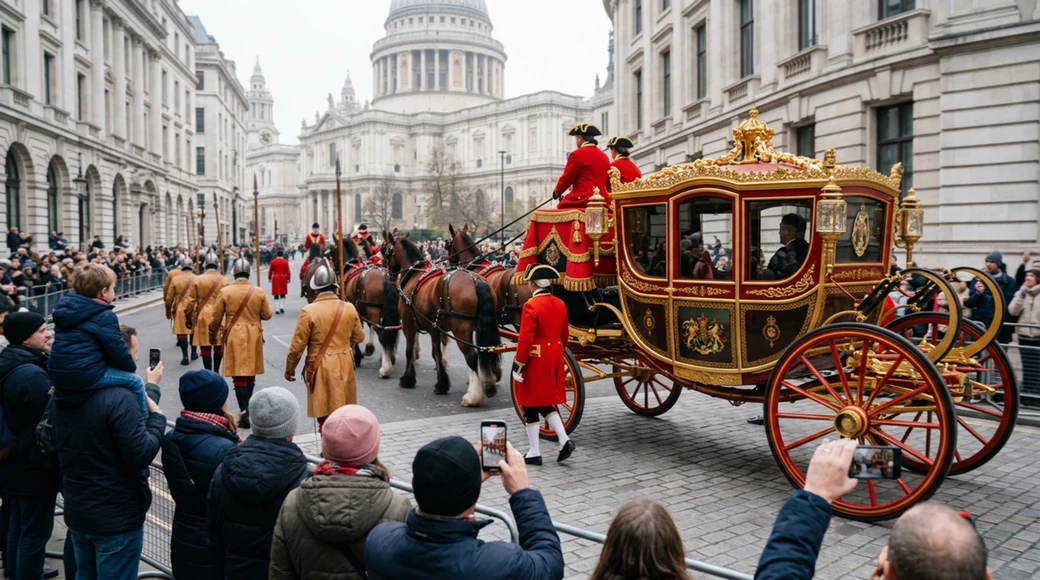
Lord Mayor's Show in London, the historic procession with a gilded state coach, marching bands and floats winding through the City streets before cheering crowds

Lord Mayor's Show (London's Lord Mayor Procession)

LondonNov 14, 2026↻ Annual
Duration:1 daysType:
Cultural & Traditional Festivals
Admission:FreeLocationAnnual event — exact dates may vary each year

A civic procession more than 800 years old: military bands, horses, floats and a gilded State Coach escort the new Lord Mayor of the City of London through the Square Mile to pledge loyalty at the Royal Courts of Justice.

About This Festival

What Is the Lord Mayor's Show? London's Oldest Civic Procession

The Lord Mayor's Show is a grand street procession that fills the City of London, the historic Square Mile at the heart of the capital, once a year. Its organisers describe it as the oldest, longest and least-rehearsed civic procession in the world, and few events anywhere mix medieval ritual and modern pageantry so openly. At its core is a simple purpose: the newly installed Lord Mayor of the City travels in state to the Royal Courts of Justice to pledge loyalty to the Crown. Around that journey has grown a vast parade of bands, soldiers, horses, floats, charities and community groups. Do not confuse this office with the Mayor of London, who governs the wider metropolis and its boroughs; the Lord Mayor heads the City's own ancient governing body, the City of London Corporation. When a woman holds the post, the event is styled the Lady Mayor's Show, a title first adopted by Dame Susan Langley. The Show is also the new Lord Mayor's first public appearance in office, and crowds in the hundreds of thousands line the streets to watch it, while millions more follow it on television.
The 1215 Charter: Why the Lord Mayor Travels to the Royal Courts

The story begins with King John, who needed the loyalty of London during a tense period with his barons. In 1215 he granted the citizens a royal charter allowing them to choose a mayor every year, on one condition: the person chosen had to be presented to the king, or his justices, and swear faithfulness. In those days that meant leaving the walled City and travelling upriver to Westminster, a journey that soon became a public spectacle. The mayoralty itself is older, going back to the late twelfth century, but the charter fixed the yearly election and the oath. William Hardel, who held the mayoralty that year, was one of the twenty-five barons chosen to make sure the king kept to Magna Carta (the "Great Charter" that limited royal power), whose thirteenth clause guarantees London its ancient liberties. The title "Lord Mayor" arrived about two centuries later, and for generations the post was the highest a commoner could hope to reach. Since the law courts moved to the Strand in the nineteenth century, the oath has been sworn at the Royal Courts of Justice, in front of the senior judges, in a ceremony formally called the Presentation of the Lord Mayor.

The Gilded State Coach: The Show's River Roots and Its 1757 Carriage

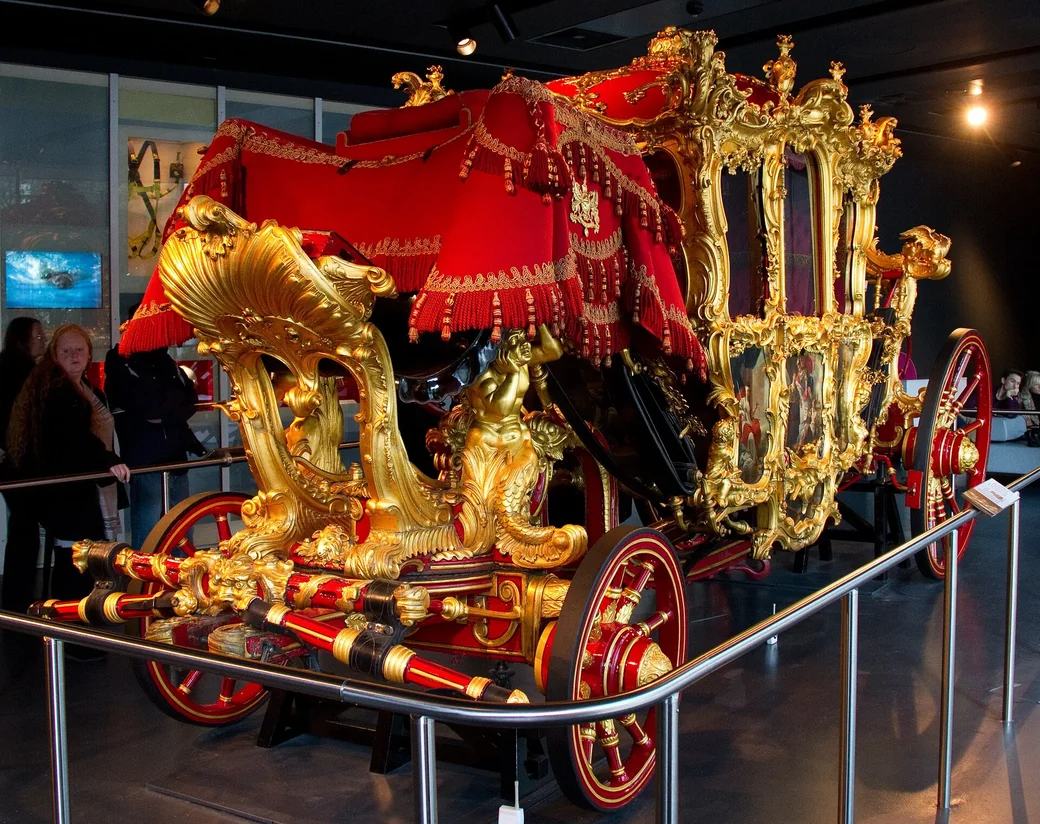
For a long time the new Mayor reached Westminster by water, in a procession of decorated barges, which is why parades the world over still call their decorated vehicles floats. Later the Mayor and aldermen (senior City councillors) rode on horseback, and in the eighteenth century a hired coach took over. Then, in 1757, the aldermen commissioned a coachbuilder from Holborn, Joseph Berry, to create a carriage worthy of the City's standing. It was designed by the same architect who shaped the front of the Mansion House and is covered in gilded carving and painted panels celebrating London's majesty, piety and trading reach. Sir Charles Asgill, who had persuaded his fellow aldermen to order it, became the first Lord Mayor to ride in it, and it has carried almost every holder of the office since. Carefully restored, it is often described as the oldest ceremonial vehicle still in regular use anywhere. Look for it near the very end of the parade, surrounded by the pikemen, when the Lord Mayor finally climbs aboard after more than an hour of marching bands have passed.

When Is the Lord Mayor's Show? The Second-Saturday Rule Explained

The Show always takes place on the second Saturday of November, the day after the new Lord Mayor takes office at the Silent Ceremony (the almost wordless handover of office) in Guildhall. That tidy rule is surprisingly recent. For centuries the procession was held on the feast day of Saints Simon and Jude at the end of October. When the Gregorian calendar was adopted in the middle of the eighteenth century and eleven days vanished from the year, the date moved to the ninth of November and stayed there for roughly two hundred years. By the 1950s a procession that could fall on any weekday was causing too much disruption in a working financial district, so a fixed route was agreed in 1952 and the second-Saturday rule followed in 1959. Before that, the route even changed each year so that the parade could pass through the ward of the newly elected Lord Mayor. The Show often falls on the day before Remembrance Sunday (the national day of remembrance for the war dead), though not every year, so confirm the exact date on the organisers' website when you book flights and hotels. The procession leaves Mansion House at eleven o'clock sharp, and it never waits for latecomers.

Lord Mayor's Show Route and Timetable: Mansion House to the Royal Courts and Back

The route is fixed and easy to follow. The head of the procession leaves Mansion House at eleven, passes the Bank junction, then follows Cheapside to St Paul's Cathedral, descends Ludgate Hill and Fleet Street, and continues to the Royal Courts of Justice on the Strand. The leading bands reach St Paul's about twelve minutes after the start and the Royal Courts about a quarter of an hour later. Because the procession is far longer than its route, it takes over an hour to pass any single point, and the Lord Mayor's coach only joins the line after an hour or so, reaching the cathedral for a blessing shortly after noon. After the oath is sworn, the procession regroups around the Temple and returns in the early afternoon along the Victoria Embankment and Queen Victoria Street, with the head of the column back at Mansion House around half past one and the Lord Mayor home soon after. The Pikemen then put on a spirited display outside the house. Timings are planned to the second, but check the organisers' timetable before you go. The evening fireworks over the Thames mentioned in older guides are no longer part of the programme.

Best Places to Watch the Lord Mayor's Show: Bank, St Paul's or the Embankment

Where you stand shapes the whole experience. For the full-volume version, choose the stretch between Bank and St Paul's during the first hour: narrow streets, loud bands and the liveliest crowds, with the BBC cameras based around Mansion House. Arrive by about half past ten for Bank, and earlier still if you want a front-row spot, because those are claimed early. Fleet Street and the Aldwych end are less packed, with the procession arriving there a little after eleven. For something calmer, wait for the return leg on the Victoria Embankment and Queen Victoria Street from about a quarter past one, where pavements are wider and folding chairs, pushchairs and luggage are easier to manage. A good compromise is to watch the outward procession, have lunch, and be back at Mansion House for the early-afternoon salutes, when the guards present arms and the pageantry peaks. Afterwards you have a City without cars to explore: St Paul's Cathedral, the Barbican and the Thames riverside are all close, and guided walks are often arranged near Mansion House once the last cart has passed.

Getting to the Lord Mayor's Show: Tube, Train, River Bus and Road Closures

Do not plan to drive. The entire City is closed to traffic for most of the day, parking bays are suspended from the previous afternoon, and buses are diverted around the area, so the nearest stops lie on its edges. The route is superbly served by rail, though. For the morning procession use Farringdon (Elizabeth line), City Thameslink, St Paul's or Bank, remembering that the last two are packed; Mansion House, Cannon Street and Blackfriars are calmer alternatives. For the return leg, Temple and Blackfriars stations are a short walk away, and the river bus pier at Blackfriars is ideally placed. Walkers can cross the Millennium Bridge from Bankside straight to St Paul's, and Blackfriars Bridge is closed to vehicles. Cyclists enjoy empty streets but should avoid London Wall, Aldersgate and West Smithfield, where the procession assembles. Once the parade is moving you cannot cross the route at street level, so use the underpasses at Bank, City Thameslink, Mansion House or Blackfriars. Roads usually reopen during the afternoon, and Transport for London publishes bus diversions in the days before.

What You Will See: Military Bands, Floats, Horses and Livery Companies

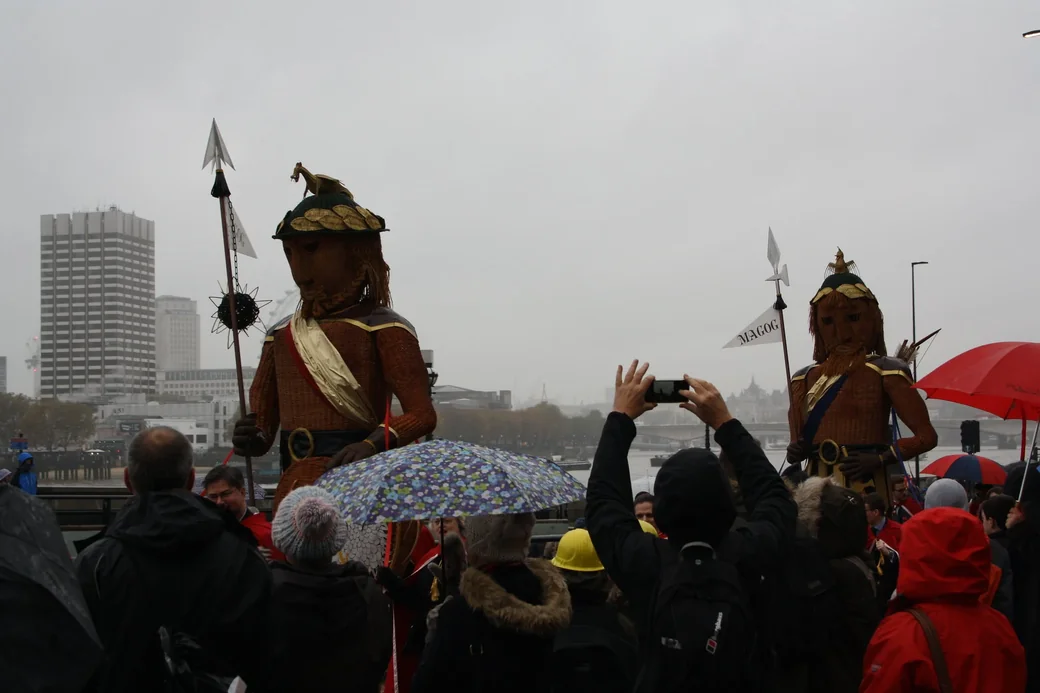
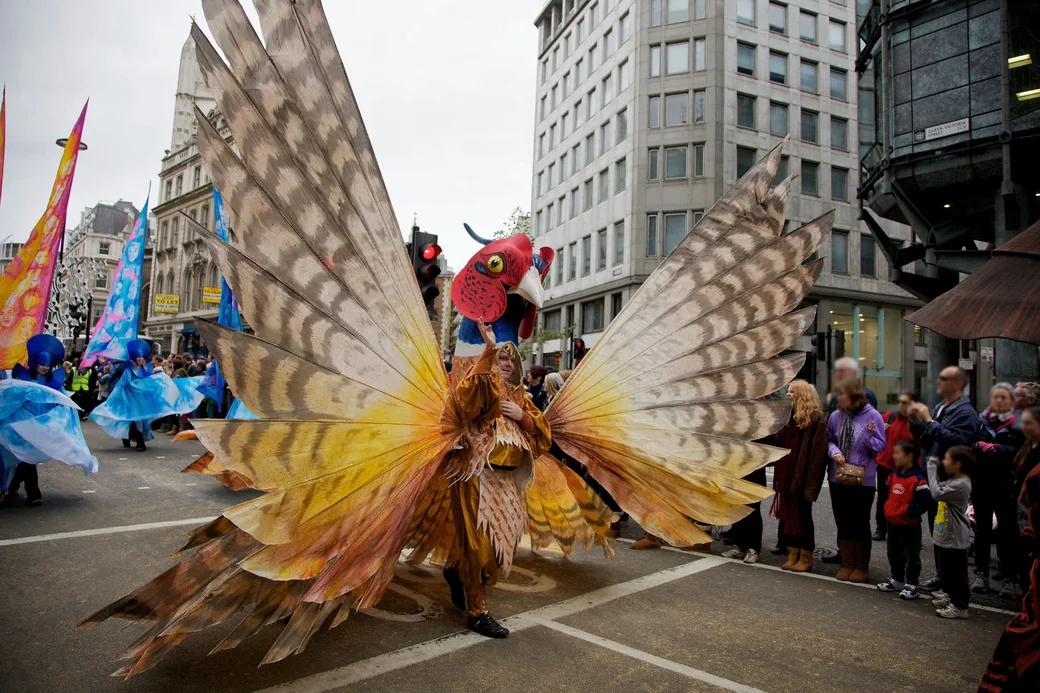
Expect a procession of roughly seven thousand people stretching for more than three miles. Military bands set the pace, marching at exactly one hundred and twenty steps a minute. Between them come decorated floats, mounted riders and knights, drummers, schoolchildren, charity groups and members of the livery companies (the historic City guilds that grew out of medieval trades and still support charity and education). Pearly Kings and Queens (families of traditional London street traders, famous for outfits covered in pearl buttons and for raising money for charity), performers in carnival dress and the occasional giant inflatable creature add a playful note, and the line can include tractors, tanks, boats and ancient carriages. No two years are the same: the running order reflects the interests of the new Lord Mayor and the changing life of the City. Weather permitting, a flypast crosses the sky. The final entry is always the City's street-cleaning team with its horse-drawn cart, which gave London the saying "after the Show comes the ash cart", meaning that the fun is followed by the clearing up. Gog and Magog, the giants, march near the front.

Pikemen and Musketeers: The Lord Mayor's Seventeenth-Century Bodyguard

Marching beside the State Coach are the Pikemen and Musketeers, one of the most photographed groups in the parade. They belong to the Honourable Artillery Company, chartered by Henry VIII in 1537 and widely regarded as one of the oldest military bodies in the world. The word "artillery" in its name originally covered archery weapons, not only guns. The Company of Pikemen and Musketeers was formed in 1925 and received a royal warrant in 1955 to serve as the Lord Mayor's ceremonial bodyguard. Its members dress as soldiers of the 1640s: pikemen in steel breast and back plates with a morion (a crested steel helmet), musketeers in buff coats and wide black hats, and officers in thigh boots and spurs. No more than sixty-three may parade at once, the size of a seventeenth-century company, and their drill follows a manual published in 1638, performed to the beat of drums and fifes. Beyond the Show, they also provide guards of honour and carpet guards at banquets in Mansion House and Guildhall throughout the year.

Gog and Magog: The Legendary Giant Guardians of London

Near the front of the procession you will spot two towering wicker giants. These are Gog and Magog, the legendary guardians of the City, who have appeared in the Show since the Middle Ages. According to legend, told in a twelfth-century chronicle by Geoffrey of Monmouth, Brutus of Troy sailed to the island with his champion Corineus, who defeated the giant Gogmagog in single combat and gave his name to Cornwall, while Brutus founded a "New Troy" that became London. According to another folk version, the last two giants were chained to the gates of a palace on the site of Guildhall, to stand guard for ever. Whatever the truth, carved giants have watched over Guildhall since at least the reign of Henry V, and the pair standing there today were carved in the 1950s. On Magog's shield you can see a phoenix, a symbol of renewal that suits a City which has reinvented itself many times. Chroniclers note that giants and effigies were carried in festival processions across medieval Europe, and these two are simply the longest-serving examples still marching.

Dick Whittington: The Real Mayor Behind the Pantomime Cat

Every winter theatres across the country stage the pantomime (a festive family comedy with songs and audience participation) of Dick Whittington and his cat, but the man behind the tale was a real figure of the City. Richard Whittington, born around the middle of the fourteenth century, was a mercer, a merchant of luxury cloth, who grew wealthy supplying velvets and cloth of gold to the royal court. He served as Mayor of London three times, an extraordinary achievement for the period, and left his fortune to good causes, founding an almshouse and a college of priests that were run by the Mercers' Company. According to the folk tale, a poor boy sent his cat on a ship to a faraway kingdom where it rid a palace of rats, and the reward made his fortune; on Highgate Hill he is said to have heard Bow Bells (the bells of the church of St Mary-le-Bow) calling him back to London to become Lord Mayor. In reality Whittington came from a gentry family and is not known to have owned a cat. The story attached itself to his famous name long after his death, and it is still retold every year, which is why the Show features in the plot.

Behind the Scenes: The Pageantmaster, the Ghost Parade and the Ash Cart

The Lord Mayor's Show is called the largest unrehearsed procession in the world, yet nothing is left to chance. A Pageantmaster (the director who devises and commands the whole event) plans for many months, then directs the day from horseback or a ceremonial Land Rover, sword at his side. Timings are worked out to the second, because a few seconds' delay opens a gap that ripples down the line. About one hundred and fifty marshals start work at dawn, the streets are inspected before sunrise, manhole covers are sealed, and the roads are covered with sand for the comfort of the horses. In the small hours before the Show, a "ghost parade" of carriages, horses and police quietly tests the timings along the empty streets. Floats are assembled early, marched to Aldwych, parked out of sight for lunch, reassembled in the right order and brought back to the City. Horses are kept well away from balloons so that nothing startles them, and all of this is arranged so the spectacle looks effortless.

The Silent Ceremony and the Lord Mayor's Banquet: The Weekend Around the Show

The Show is only one part of a civic sequence that stretches over several days. On the Friday afternoon before it, the Silent Ceremony takes place at Guildhall. The outgoing and incoming Lord Mayors exchange the duties of office amid a lot of tricorne (three-cornered) hats, bows and presentations, in near-total silence broken only by a short declaration from the newcomer, who then signs the book and receives the keys to Mansion House. A limited number of seats for the public are allocated by ballot. The Show follows the next morning, and on the Monday after it the new Lord Mayor hosts the Lord Mayor's Banquet at Guildhall in honour of the predecessor. Guests traditionally include representatives of the Church, the armed forces, commerce and government, and the Prime Minister customarily gives a major speech on foreign affairs. The banquet is by invitation only. Because the Show often falls the day before Remembrance Sunday, the City frequently hosts back-to-back ceremonies, so a weekend in London at this time rewards the curious traveller.

Lord Mayor's Show Accessibility, Crowds and Safety Tips

The Show is open to everyone, with no gates, barriers or fences, but pavements can be very crowded. The busiest points are around St Paul's and Mansion House; anyone who is unsteady on their feet or uneasy in crowds should choose Fleet Street, the Victoria Embankment or Queen Victoria Street, where there is room for folding chairs (none are provided). Wheelchair users often prefer the Embankment in the early afternoon. The stations at City Thameslink and Farringdon, which have level access, are close to the route and quieter than Bank or St Paul's. Blue Badge (disabled parking permit) holders can apply in advance for a pass to a reserved viewing area at the junction of Ludgate Street and Old Bailey, with limited parking nearby, and coaches carrying older or disabled visitors can request space on Queen Victoria Street; places are limited and allocated on a first-come basis. Accessible toilets are located near Blackfriars Bridge, Old Bailey, New Change and Queen Victoria Street, all marked on the official map. A strong police presence, CCTV and counter-terrorism patrols operate throughout the City; report anything unattended to an officer or marshal, cooperate with security checks, and pack waterproofs for the November weather.

The Show in Art, Literature and Television

Few events have been painted, written about and filmed as often as the Lord Mayor's Show. In the middle of the eighteenth century Canaletto painted the river procession several times, and Hogarth closed his series Industry and Idleness with the industrious apprentice riding in his Lord Mayor's coach through an admiring crowd. Samuel Pepys recorded in his diary how he watched the pageants from a linen draper's premises in Cheapside, and the Show appears in the adventures of James Bond, while a Hitchcock thriller of the 1930s uses Show day as its backdrop. The BBC first televised it in 1937, one of its earliest outside broadcasts, and still carries it today, so you can follow every band and float from home. Each year the organisers commission an original artwork for the poster and programme, and the programme is sold on the day by volunteer Scouts and Guides, cash only. If you want to read more, a book marking the Show's eight-hundredth anniversary traces the story from the charter to the present, and the official website holds a rich archive of history pages.

Who Is the Lord Mayor? Election, Livery Companies and the Lord Mayor's Appeal

The Lord Mayor of the City of London is chosen each year, not at a public ballot but by the liverymen (the full members of the City's livery companies, the historic guilds) who gather in the Common Hall (the assembly of liverymen) at Guildhall on Michaelmas Day, the feast of Saint Michael at the end of September. The result is confirmed a few weeks before the Show, and the new holder serves for a single year. As the City's ambassador, the Lord Mayor promotes the financial and professional services based in the Square Mile at home and abroad, speaks for the people who live and work there, and acts as the City's chief magistrate: every quarter the Lord Mayor processes to the Old Bailey (the Central Criminal Court) to open the courts. Each Lord Mayor also selects charities for the Lord Mayor's Appeal. The chosen causes receive support for a major project over about three years, so three partner charities are helped at any one time, funded by the livery companies, the freemen of the City (citizens granted the historic "freedom of the City") and local businesses. That charitable tradition is one reason so many charities, schools and youth groups take part in the procession, and it explains why the Show feels like a community celebration as well as a civic ceremony.

Lord Mayor's Show Online: Official Website, Live Map, Hashtags and Photo Spots

The organisers run a detailed official website with a timetable, a printable one-page map, practical pages on access, road closures and safety, and a long history section that is well worth reading before you go. The running order of the procession is released once the election of the new Lord Mayor has been confirmed, so you can see in advance which groups will be walking, and on the day a live map shows how far the head of the procession has travelled. Official accounts on Instagram, Facebook, X and LinkedIn share updates, and the hashtags #LordMayorsShow and #SoulOfLondon are used for photographs and posts. Television coverage on the BBC is based around Bank and Mansion House, which is also the liveliest corner for photographs. A classic picture is the State Coach pausing in front of St Paul's Cathedral while the Lord Mayor receives a blessing, with the pikemen standing guard around it. Around midday, while the oath is being sworn, the procession regroups around Aldwych and the Temple, and those streets become extremely congested, so avoid them if you want to move around easily. The printed programme is sold only on the day by volunteers, so bring cash if you would like a souvenir.

Practical Information

When

The second Saturday of November, with the procession leaving Mansion House at 11:00 sharp. The outward leg fills the late morning and the return leg the early afternoon; the organisers publish a detailed timetable before the day.

Where

The City of London (the Square Mile). The route runs from Mansion House via Cheapside, St Paul's Cathedral and Fleet Street to the Royal Courts of Justice on the Strand, and returns along the Victoria Embankment and Queen Victoria Street.

Cost

Free. Watching the procession costs nothing and no ticket is needed; the printed programme is sold on the day by volunteers, cash only.

Tips

Do not drive, because the whole City is closed to traffic. Use Farringdon, City Thameslink, Mansion House, Cannon Street, Blackfriars or Temple. Be at Bank by about 10:30, or come from about 13:15 for the calmer Embankment. Bring waterproofs and a folding chair for the quieter stretches.

This festival is special because

it is led by the wicker giants Gog and Magog, guarded by pikemen in seventeenth-century armour, closed by the City's street-cleaning cart, and the new Lord Mayor rides in a gilded coach built in 1757. On this day almost the entire Square Mile becomes a stage without cars.

Accommodation and hotel options during Lord Mayor's Show (London's Lord Mayor Procession)

Accommodation and hotel options around the event venue, with their prices, are shown by Stay22 as a map and a list. Cookies are used. Your consent is remembered on every page; you can turn it off at any time in the cookie settings.

Keep Exploring

Travel essentials for London

Flights, transfers, car rental, eSIM and insurance — compare your options

Flights

Find the best route

Transfers

Airport & city ground transport

Car Rental

Drive at your own pace

eSIM

Stay connected on arrival

Insurance

Cover your trip