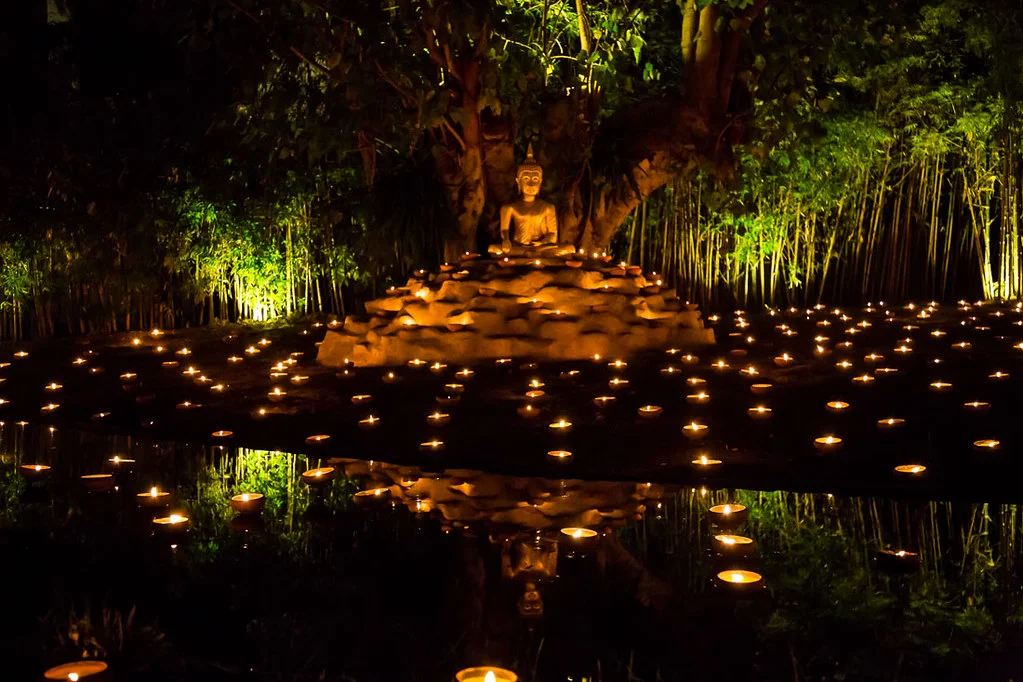
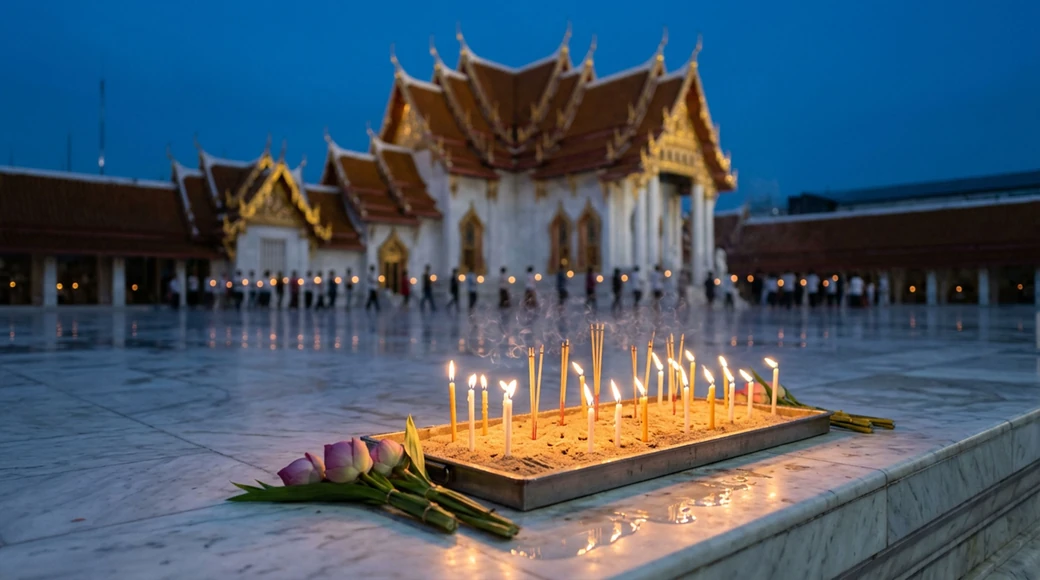
Makha Bucha Day in Bangkok, worshippers holding candles, incense and flowers walk three times around a temple hall in a glowing evening procession

Makha Bucha Day

BangkokFeb 21, 2027Public holiday↻ Annual
Duration:1 daysType:
Religious & Spiritual Days
Admission:FreeLocationAnnual event — exact dates may vary each year

One of Thailand's most sacred Buddhist days. In Bangkok it opens with almsgiving at dawn and closes after dark with a silent candlelit procession, three slow circuits around the ordination hall.

About This Festival

What Makha Bucha Is and Why Bangkok Goes Quiet

Makha Bucha is the second most important day in the Thai Buddhist calendar, after Visakha Bucha, and in Bangkok it feels less like a festival than a citywide pause. There are no floats, no fireworks and no street parties. The city simply turns towards its temples: offices close, families travel to the wat their grandparents used, and by late afternoon the courtyards fill with people holding flowers. English-language sources often call it Sangha Day or Fourfold Assembly Day, because it honours the monastic community rather than an event in the Buddha's own life. If you want to see Thai Buddhism the way Thai people actually practise it, rather than as a spectacle staged for visitors, this is the day to be in the city.
The Gathering of 1,250 Monks Behind the Day

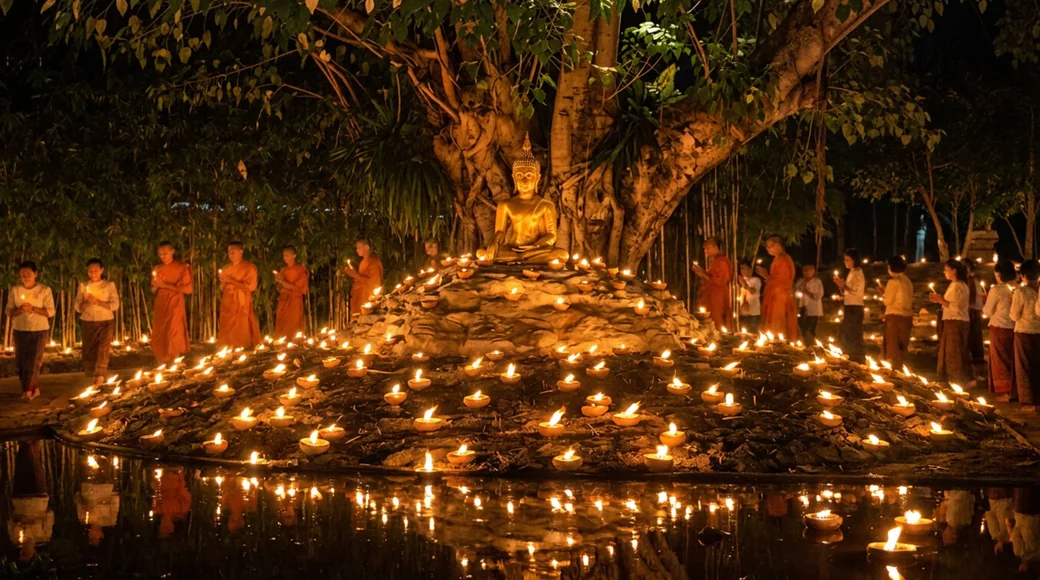
The day commemorates an afternoon at Veluvana, the bamboo grove near Rajagaha in northern India that King Bimbisara had given to the Buddha. Four things are said to have coincided there: 1,250 disciples arrived without being summoned, every one of them was an arahant (a fully enlightened disciple), every one had been ordained by the Buddha himself, and it fell on the full moon of the third lunar month. Thai tradition calls that coincidence Caturangasannipata. To the assembly the Buddha gave the Ovada Patimokkha, a summary of the whole teaching in three lines: do no evil, cultivate what is good, purify the mind. One common mix-up is worth avoiding — the word fourfold refers to those four circumstances, not to four groups of followers.

Why the Date Slides Between February and March

Makha Bucha is tied to the full moon of the third lunar month rather than to a square on the wall calendar, so it drifts. In years when the Thai lunar calendar inserts an extra month, the observance moves to the full moon of the fourth month instead, which is how it can land in February one year and in March the next. The same logic governs its sister holy days, Visakha Bucha and Asalha Bucha, and all of them share the same rhythm of dawn almsgiving, sermons and an evening circumambulation. Confirm the year's announced date before you fix anything around it: when the day falls on a weekend, the substitute day off shifts as well, and that changes which offices are open.

From a Palace Ceremony to a National Holiday

For most of its history the day was observed unevenly across Southeast Asia. Its modern Thai form begins in Bangkok in the mid-nineteenth century: in 1851 King Rama IV ordered a yearly ceremony at the Temple of the Emerald Buddha, at first within the palace, where monks chanted the Ovada Patimokkha. Over the following decades the observance spread from the palace to temples across the kingdom, and in 1957 it became an official public holiday. In 2006 the government added a second name, National Gratitude Day, to highlight thanks towards parents, teachers and the community.

A National Day of Gratitude, Not of Romance

Because the observance often falls close to Valentine's Day, the Thai government declared it National Gratitude Day in 2006, offering young people a spiritual idea of love alongside the romantic one: love and thanks towards parents, teachers and the community. The theme suits the day's story, since the monks who gathered at Veluvana are remembered for their unity and respect towards the Buddha. What people do on the day is concrete and warm. Common ways to mark it include almsgiving, making merit, taking a quiet day away from nightlife, visiting a temple together with relatives, and joining the candle procession in the evening.

How the Day Unfolds, From Dawn Alms to the Night Procession

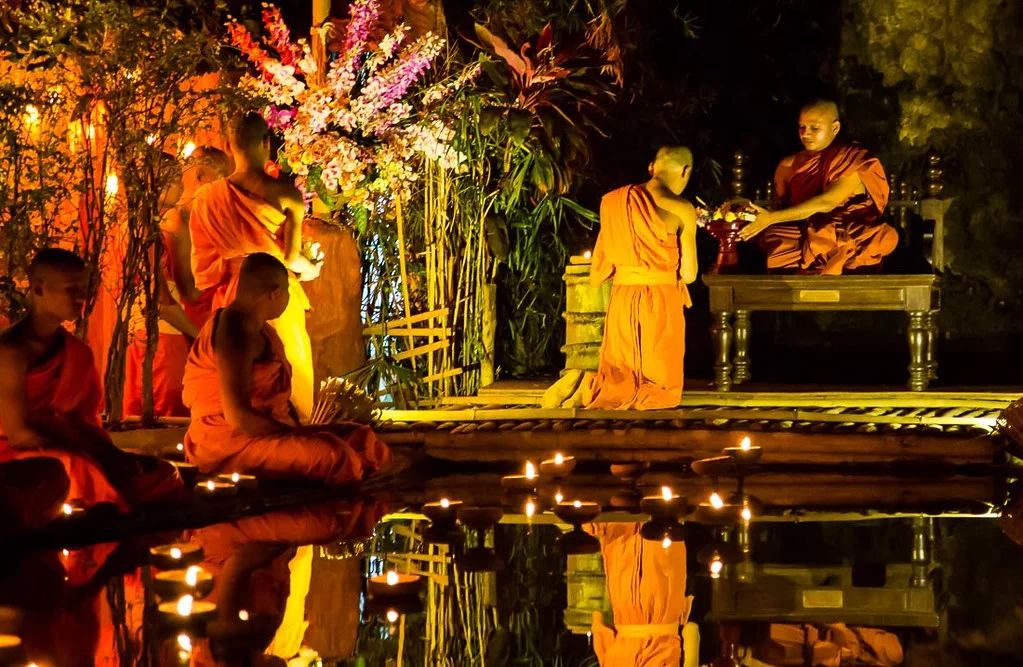
The rhythm is the same at almost every temple. Before sunrise, laypeople line up with rice, dry goods and flowers to offer monks as they pass on their alms round. Mid-morning brings chanting and a sermon on the Ovada Patimokkha; many devout Thais take the eight precepts for the day and stay to meditate. The middle of the day is quiet, and the temple breathes. From late afternoon the courtyards fill again — school groups, elderly regulars, families with children — and vendors set out candles, incense and lotus buds at the gates. After dark comes the evening sermon, then the procession. Aim to arrive an hour before sunset if you want to see both halves of the day.

How to Join the Wian Thian Candle Procession

Visitors are welcome, and no one will test your beliefs. At the gate you will be given, or can take for a small donation, a set of three things: a candle, three incense sticks and a lotus bud or other flower. When the monks lead the way out of the hall, join the back of the line and walk clockwise around the ordination hall three times — once each for the Buddha, his teaching and the monastic community. Hold everything at chest height between your palms, keep the pace of the person in front, do not overtake and shield the flame with one hand. After the third circuit, kneel briefly, then place the flower and incense at the altar.

Wat Arun on Makha Bucha: Merit-Making Beside the River

Wat Arun, the riverside Temple of Dawn, is one of the most atmospheric places in Bangkok to spend the holy day. Mornings follow the usual rhythm of chanting and almsgiving in the cool air, and the temple's towering prang (Khmer-style tower) rising above the Chao Phraya gives the whole occasion an unusually open, riverfront setting. Programmes for the day vary from year to year, so check the temple's announcements before you go. The classic approach is the cross-river ferry from the Tha Tien pier; MRT Sanam Chai puts you a short walk from the pier on the opposite bank.

Wat Saket: 344 Steps to a Procession Above the City

The Golden Mount gives the ritual something no other Bangkok temple can: height. A spiral stairway of 344 steps winds up an artificial hill past small shrines, fountains and bells, and the circumambulation happens on the terrace around the golden chedi (bell-shaped stupa) at the top rather than at ground level. Outside the gate, stalls sell candles in glasses, incense and flowers, and some visitors carry saffron robes as offerings. Go late in the afternoon so the climb is shaded and you reach the terrace as the light drops over the old city. The climb is gentle rather than punishing, but there is no lift, so factor that in for anyone with limited mobility.

The Rattanakosin Route: Three Temples in One Evening

The old royal quarter lets you see three very different moods within a short taxi ride. Wat Phra Kaew is where the modern ceremony began and remains the most formal setting, though parts of the palace complex can close to visitors when royal rites are held, so check on the day. Wat Pho, with its reclining Buddha, draws a steady neighbourhood crowd and feels the most relaxed of the three. Wat Benchamabophit, the marble temple, is the photographer's choice after dark, when floodlight on white Carrara stone turns the courtyard luminous. If you have time for a fourth stop, the iron spires of Loha Prasat are a short walk from Wat Saket.

The Mass Ceremonies Outside the City Limits

The images that travel furthest are not from central Bangkok. North of the city, in Pathum Thani province, an enormous temple complex holds a mass lantern offering in which crowds seated in concentric rings light tens of thousands of flames at once; international agencies photograph it most years. West of the capital, in Nakhon Pathom, the vast Buddhist park built for open-air gatherings hosts mass meditation around a towering walking Buddha. Both need a car or a long taxi ride, both run for several hours, and both are more a disciplined mass event than an intimate neighbourhood ritual. Decide which of the two experiences you actually want before committing an evening to the journey.

Saplings Instead of Candles: the Smoke-Free Turn

A quietly radical variation has spread across Thai temples in recent years: instead of a candle and incense, participants carry a tree seedling through the three circuits. The reasoning is practical. Thousands of sticks of incense produce a lot of smoke and a mountain of waste for temple staff to clear, and the observance often falls in the season when Bangkok's air is at its worst. A growing number of temples now take part and hand out seedlings free of charge, with some inside the capital among them; afterwards you either plant the seedling yourself or leave it for the temple grounds. Ask at the gate — a temple offering both options will tell you which line to join.

Temple Etiquette: Dress, Shoes, Photos and Feet

Shoulders and knees must be covered, and white or muted colours are traditional; some temples rent a wrap at the gate if you arrive unprepared. Shoes come off before you enter any building, and once inside you sit with your feet tucked behind you, never pointing towards a Buddha image or a monk. Photography of the ceremony is generally accepted, but keep the flash off people's faces, do not climb on structures for an angle and never turn your back on the main image for a selfie. Women should avoid handing anything directly to a monk; place it on the cloth provided. If you are unsure of anything, copy the person next to you.

Alcohol Rules and What Closes on a Buddhist Holy Day

Thailand restricts alcohol sales on its major Buddhist holy days, and this is one of them. Under the current rules a narrow set of licensed premises may still serve — hotels registered under the Hotel Act, passenger terminals at international airports, registered entertainment venues and approved tourist zones — while convenience stores, supermarkets and ordinary restaurants may not. Penalties for breaking the rule are real, so staff will not bend it for you. Government offices, banks and schools close; shopping malls, markets and the BTS and MRT operate normally. If a drink with dinner matters to you, check with your hotel the day before rather than assuming the bar will be open.

What to Bring and What to Watch For in the Dry Season

The observance falls in Bangkok's dry season: strong sun by day, warm rather than cool evenings, and the months when haze and fine particulate pollution are at their heaviest. A light long-sleeved layer covers your shoulders and keeps the sun off at once, and many residents carry a mask on bad-air days. Bring small notes and coins, since candle sets and donation boxes are cash only. In the crush at temple gates keep bags in front of you and be careful with open flames near loose clothing and hair. Public transport runs late but taxis thin out near the river once the procession ends, so agree on a way home before you set off.

Practical Information

When

The day falls on the full moon of the third lunar month, so the calendar date shifts between February and March from year to year. It is a one-day nationwide public holiday and the atmosphere peaks after sunset.

Where

There is no single venue — Bangkok marks the day at its temples. Wat Arun, Wat Saket, Wat Pho, Wat Phra Kaew and Wat Benchamabophit hold the best-known ceremonies, while the largest mass gatherings take place at temple complexes north and west of the city.

Cost

Free. Joining the ceremonies and the candlelit procession costs nothing, and candle sets are handed out or offered for a small donation at temple gates. Paid attractions inside a temple complex keep their own separate admission.

Tips

Cover shoulders and knees, arrive before sunset if you want a place near the ordination hall, bring small cash for offerings, and plan around closed government offices and banks while shopping malls and the BTS and MRT run normally.

Unique to this festival

Alcohol sales are restricted nationwide for the day, with only a narrow set of licensed exemptions, so Bangkok's nightlife falls quiet. The evening ritual is a silent triple circumambulation rather than a parade, and a growing number of temples now hand out tree saplings instead of candles and incense to cut smoke during the city's haziest month.

Accommodation and hotel options during Makha Bucha Day

Accommodation and hotel options around the event venue, with their prices, are shown by Stay22 as a map and a list. Cookies are used. Your consent is remembered on every page; you can turn it off at any time in the cookie settings.

Keep Exploring

Travel essentials for Bangkok

Flights, transfers, car rental, eSIM and insurance — compare your options

Flights

Find the best route

Transfers

Airport & city ground transport

Car Rental

Drive at your own pace

eSIM

Stay connected on arrival

Insurance

Cover your trip