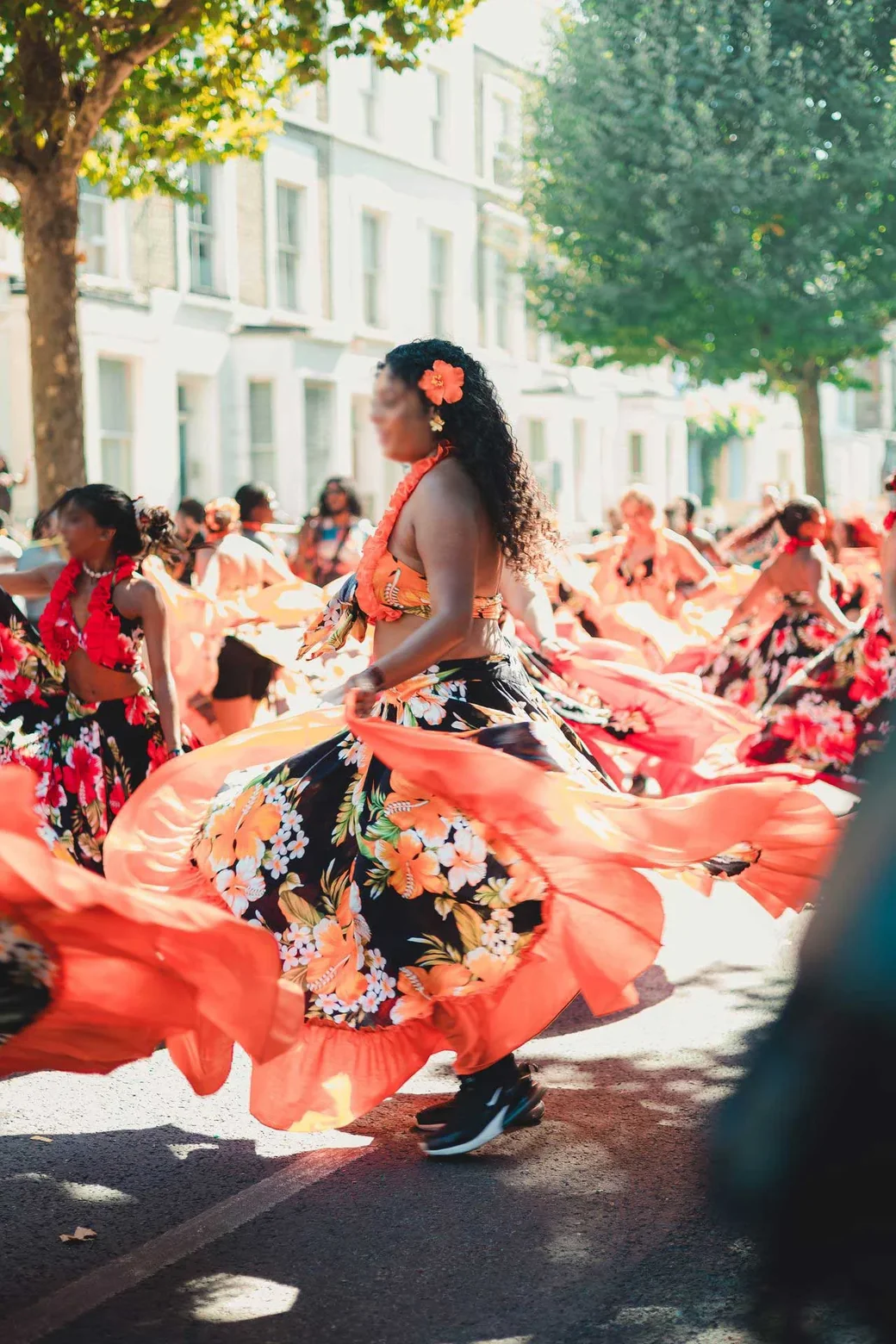
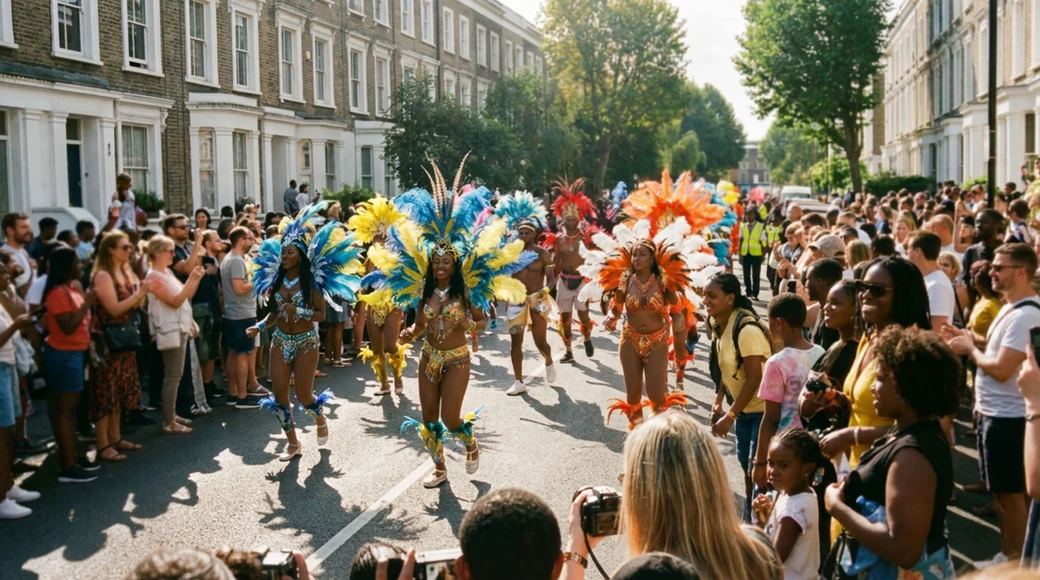
Notting Hill Carnival in London, a joyful Caribbean street parade of dancers in feathered costumes, colorful floats and steel bands before lively crowds

Notting Hill Carnival

LondonAug 28, 2027 – Aug 30, 2027Partial public holiday↻ Annual
Duration:3 daysType:
Cultural & Traditional Festivals
Admission:FreeLocationAnnual event — exact dates may vary each year

Europe's biggest street festival turns Notting Hill into a Caribbean parade of feathered costumes, steel bands (steel-drum orchestras), roaring sound systems and jerk-chicken smoke. Held over the August Bank Holiday weekend (a public holiday) in West London.

About This Festival

What Is Notting Hill Carnival? Europe's Biggest Street Festival in London

Notting Hill Carnival is a Caribbean street festival that fills the roads of Notting Hill, Ladbroke Grove and Westbourne Park in West London every year over the August Bank Holiday weekend (the public holiday at the end of summer). Commonly described as the biggest street festival in Europe, it is usually estimated to draw around two million visitors, with tens of thousands of costumed performers moving along a route of roughly 3.5 miles, about 5.6 km. The festival rests on five carnival arts: mas (short for masquerade, the costume parade), calypso (witty, story-telling songs), steel bands (orchestras playing steel drums), mobile sound systems (speaker trucks that roll along the parade) and static sound systems (fixed towers of speakers with their own DJs). Behind the spectacle stands a huge community effort: more than a million working hours go into over 15,000 costumes each year, much of it by the bands' own members and helpers.
History of Notting Hill Carnival: From an Indoor Caribbean Carnival to a Street Parade

The carnival's story has more than one root. After 1948 many people from the Caribbean settled in Notting Hill and Brixton. In 1959 the journalist and activist Claudia Jones, founder of the newspaper West Indian Gazette, organised an indoor Caribbean Carnival at St Pancras Town Hall, which was televised by the BBC. In 1966 community workers Rhaune Laslett and Andre Shervington staged a street festival for the neighbourhood's children, and the steel band (steel-drum orchestra) leader Russell Henderson led his players on a spontaneous march through the streets with the crowd following. Around a thousand people came to that first street event, and it was repeated every year. Some historians see 1959 as the seed and others see 1966 as the birth, yet all agree the community built it. In the 1970s sound systems (speaker towers with DJs) and mas bands (costume groups) joined.

Notting Hill Carnival Programme: What Happens on Saturday, Sunday and Monday

Carnival unfolds over three days, each with its own character. Saturday evening belongs to Panorama (the national steel band competition), a separate ticketed event. Sunday is Families and Children's Day: J'Ouvert (a pre-dawn street party where people are splashed with paint and powder) runs roughly from 6 to 9 in the morning, the opening ceremony takes place around 10 on Great Western Road, and then the children's parade, Dutty Mas (an adults' paint, powder and chocolate parade) and the sound systems follow. Monday is Adults' Day, the grand finale in which the mas bands (costume groups) dance the whole route, often called the last lap (final stretch) of the year. Sound systems normally play from noon to 7 pm, while the parade wraps up around 8.30 pm. The organisers confirm exact times every year.

Notting Hill Carnival Route and the Best Places to Watch the Parade

The parade loops for about 3.5 miles around W10 and W11. It starts near Westbourne Park station, runs along Great Western Road, Westbourne Park Road and Chepstow Road, turns onto Westbourne Grove, then follows Ladbroke Grove, the longest and most crowded stretch, before circling through Kensal Road and Golborne Road to finish on Elkstone Road. The judges sit on Great Western Road, so bands give their most energetic performances there, and a seated Judging Zone grandstand with reserved places is available for anyone who wants a guaranteed view. On Westbourne Grove the organisers suggest the northern side. For room to breathe, head to Kensal Road or Golborne Road. Powis Square is a stage rather than a parade point. Whatever you choose, arrive early.

J'Ouvert and Dutty Mas: Paint, Powder and Chocolate at Notting Hill Carnival

J'Ouvert, from the French for daybreak, is the rowdy dawn opening of Carnival, starting from the Canal Way roundabout on Ladbroke Grove and rolling out as the sun rises. Its spirit returns in the afternoon as Adults' Dutty Mas on the parade route, where revellers cover themselves and each other in bright paint, coloured powder or melted chocolate while dancing behind huge speaker trucks. Spectators standing close can expect to be splashed too, so wear old clothes you do not mind ruining and closed shoes, and keep your phone and camera in a sealed bag. If you would rather stay clean, watch from a corner a little away from the road, or choose the children's parade, which is colourful but tidy.

Mas Bands and Carnival Costumes: How the Notting Hill Parade Works

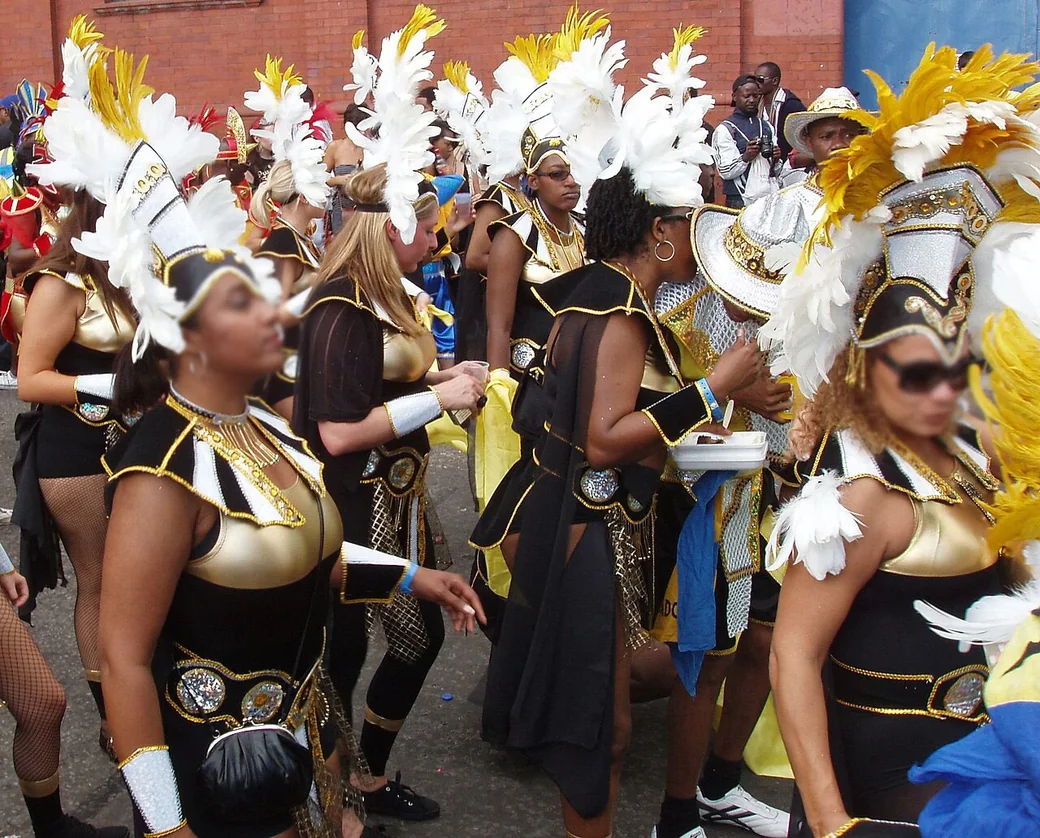
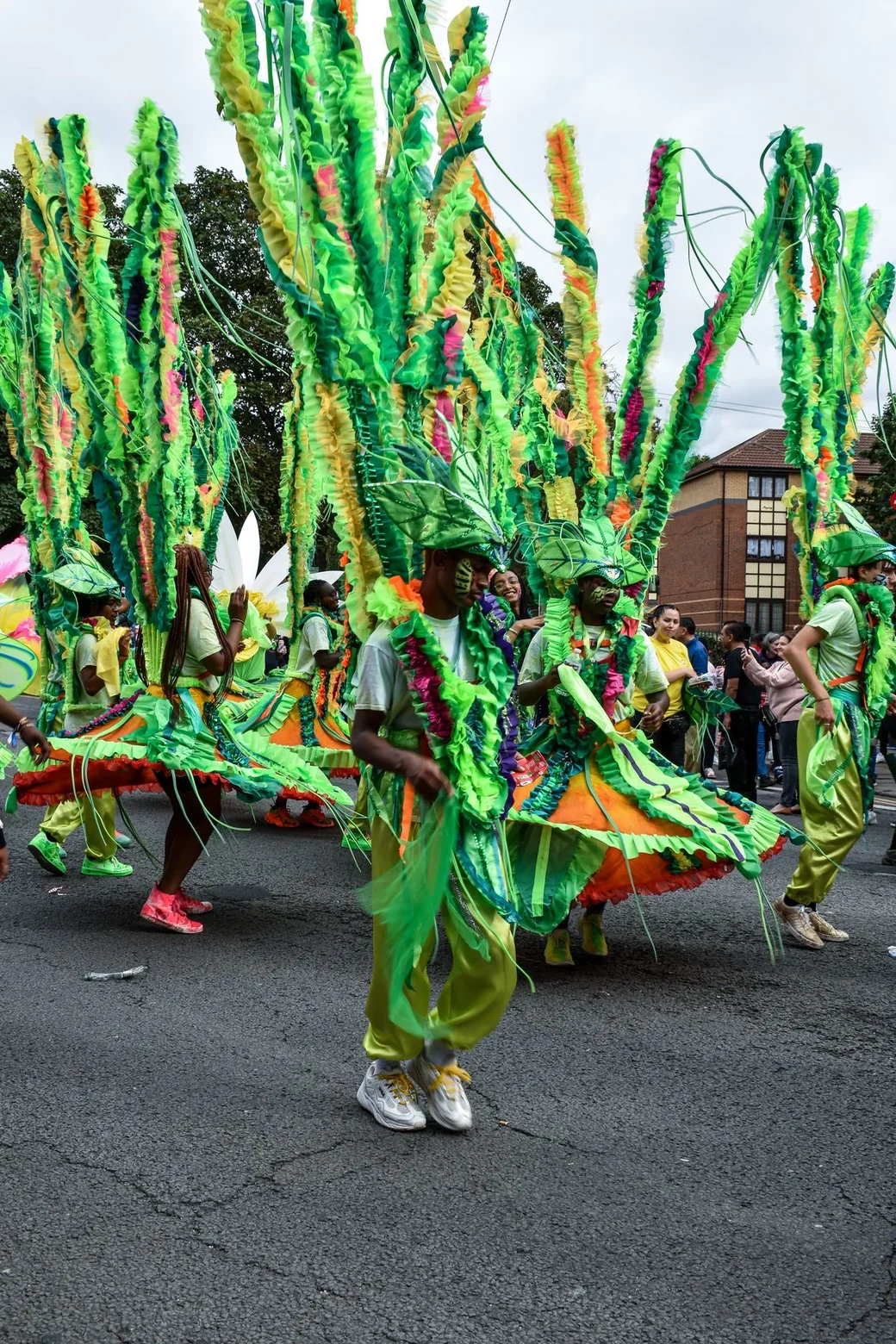
Mas, short for masquerade, is the heart of the parade. Each mas band is a community group that chooses a theme, builds feathered, beaded and sequined costumes through the year, and dances the route with its own music truck and followers. Children's bands parade on Sunday and adult bands on Monday, and samba bands add drums and rhythm. Judges score the bands along Great Western Road, which is why the biggest costumes shine there. You do not need a costume to take part: many spectators pick up a whistle or horn and dance alongside the floats. To wear a band's costume, contact the band several months ahead, because every costume is made by hand and the preparation goes on all year.

Steel Bands and Panorama: The Sound of Steelpan at Notting Hill Carnival

The steelpan (steel drum), a melodic instrument hammered from steel barrels, has been part of Carnival since the very first street procession. Orchestras of dozens of players, such as Mangrove and Ebony, rehearse for months and perform both on the parade and in Panorama (the national steel band competition), which is usually held on Saturday evening in Emslie Horniman's Pleasance Park on Kensal Road. Panorama includes a junior competition and an adult one, and each orchestra plays an arranged piece before judges and a crowd that cheers, whistles and sings along. With seating and a close view of the players, it is the most intimate Carnival experience. On parade days, listen for the pan trucks (trucks carrying steel-drum players) gliding slowly along Ladbroke Grove.

Notting Hill Carnival Sound Systems: Where to Hear Reggae, Dub and More

More than thirty static sound systems (towers of speakers with their own DJs) play at fixed spots around the streets, normally from noon until 7 pm on both main days. The tradition is rooted in Caribbean reggae culture and was welcomed into Carnival during the 1970s. Today you can hear reggae, dub (bass-heavy, echoing reggae), roots (traditional, spiritual reggae), rare groove (hard-to-find funk and soul records), hip hop, jungle (fast, bass-led dance music), house, soca (fast carnival party music) and samba, sometimes only a few streets apart. Long-running names include Channel One, Aba Shanti-I, Gladdy Wax, Rampage and Saxon Sound. Many regulars simply let the bass lead them. Arrive early at the popular ones, because crowds build quickly, and note that the music stops in the evening, a good moment to head home.

Calypso, Soca and Dance: The Music and Moves of Notting Hill Carnival

Calypso and soca are the music of the road. Calypso is known for witty, story-telling lyrics, while soca is its faster, bass-heavy, party-ready cousin. The organisers work to keep these carnival sounds alive on the parade, drawing on traditions from different islands. Away from the road, the Powis Square stage hosts live performances in the afternoons, and The Tabernacle, a community arts centre on Powis Square, hosts calypso events around Carnival week. The dance moves are simple to learn: chipping means moving along the road in small, rhythmic steps, and wining is a rolling movement of the hips, usually danced with friends. Nobody is judging the crowd, so join in; smiling and moving with the beat is enough.

What to Eat and Drink at Notting Hill Carnival: Jerk Chicken and Caribbean Street Food

Hundreds of stalls line the streets with Caribbean flavours. The star is jerk (chicken or pork marinated in a hot spice blend), cooked in a barbecue made from a steel drum, which gives the weekend its smoky, pimento-scented aroma. Look also for curried goat, rice and peas (rice cooked with beans), roti (a soft flatbread wrapped around a curry), fried fish, saltfish fritters (salted-cod fritters), plantain (cooking banana), patties (flaky pastry parcels with spiced fillings) and festival (sweetish fried dumplings). Vegan dishes are easy to find. For drinks, fresh coconut water is chopped open in front of you; Guinness punch (a creamy, spiced drink) is a favourite; and rum punch (a fruity rum cocktail) is the festive classic, but its strength can vary, so sip slowly. Stalls on Golborne Road and around Powis Square have a loyal following.

How to Get to Notting Hill Carnival: Tube Closures, Buses and Walking Routes

Public transport is the best way to reach Carnival, but it does not run as usual. Ladbroke Grove tube station is closed all day, and stations such as Notting Hill Gate, Westbourne Park, Royal Oak, Holland Park and Queensway often become exit-only at certain hours. The organisers' own advice is to travel by tube, Overground or Elizabeth line to Paddington and follow the signed walking route into the carnival area. Buses are diverted or shortened, roads and taxi ranks along the route close, and Transport for London asks visitors not to bring e-bikes or e-scooters. Check live travel information before leaving. In the evening nearby stations get very busy, so many people walk to a station further away. If you stay overnight, book a hotel around Paddington, Bayswater or Kensington months ahead.

Which Day to Choose: Notting Hill Carnival for Families, First-Timers and Accessibility

Sunday is Families and Children's Day, calmer in feel and the best choice for first-timers and for anyone travelling with children, with the children's parade as its highlight. Monday, Adults' Day, brings the biggest crowds, the grandest costumes and the loudest atmosphere, so go early to find a good place. For accessibility, the official advice is to travel via Paddington, which has step-free access, and to use the buses that serve the carnival area. Not every nearby station is step-free, so plan your route in advance. The Judging Zone grandstand offers seating. For quieter moments, retreat to the northern end of the route near Kensal Road and Golborne Road. Carnival goes ahead in the rain, so pack a light waterproof, and consider ear protection for small children near the speakers.

Notting Hill Carnival Safety Tips and What to Bring

Mobile signal often weakens in the crowd, so agree a meeting point with your group before you arrive, ideally a landmark outside the busiest streets. Carry a power bank (portable phone charger), a refillable water bottle, sunscreen, wet wipes and hand sanitiser, and wear comfortable closed shoes because you will walk and stand for hours. Keep your phone and wallet out of sight in a front pocket or zipped bag, as crowded events attract pickpockets. First aid centres, lost-person points and welfare spaces are spread across the area, and stewards (volunteer marshals in high-visibility vests) can guide you to them. If you are with children, take a photo of them before leaving and point out stewards on arrival. Drinking water points are provided, and drones are not allowed. Stay at home if you feel unwell.

Carnival Etiquette: Photos, Dancing and Respect at Notting Hill

Carnival is a community celebration in people's own neighbourhood, so treat it with warmth. Ask politely before taking a close-up photo of a performer, and take special care with children; wide shots of the parade are fine, but do not block the road or the dancers for a selfie. Never touch costumes or climb on barriers, floats or street furniture. Join the dancing if invited, move with the flow of the crowd and listen to stewards. On Sunday at 3 pm Carnival pauses for a 72-second silence in remembrance of community members and carnival pioneers; stop dancing and take part. A few words help: mas is the costume parade, wining is hip dancing, on di road means taking part in the parade, and last lap is the final stretch.

Pioneers and Famous Names of Notting Hill Carnival: Claudia Jones, Russell Henderson, Norman Jay and Levi Roots

Several people shaped Carnival. Claudia Jones is remembered with a blue plaque (a commemorative plaque on a historic building) and honoured for her 1959 indoor Caribbean carnival. Rhaune Laslett, who organised the 1966 street festival, is commemorated with a blue plaque too. The steel band leader Russell Henderson was awarded an MBE (a royal honour for service to the community) in 2006 for the idea of marching bands through the streets. Leslie Palmer, who became chief organiser in the early 1970s, brought in sound systems and mas bands. Norman Jay MBE, a DJ born in Notting Hill, is among the best-loved names on the sound-system scene. The chef and musician Levi Roots first came to Carnival in the late 1970s, when his aunt had a stall, later ran his own jerk stand and began his music career on sound systems.

Around Notting Hill Carnival: Warm-up Parties, After-parties and Other Things to Do in Notting Hill

Carnival spills beyond its own weekend. In the days before, warm-up parties (pre-carnival dance nights) and calypso evenings take place around London, and The Tabernacle on Powis Square hosts calypso competitions around Carnival week. When the parade ends on Monday evening, after-parties (late-night dance parties) continue in clubs and venues, and Notting Hill Arts Club is known for hosting Carnival after-parties. Before or after the weekend, Notting Hill rewards a slow walk: Portobello Road Market (a famous street market) is open daily, the pastel-coloured townhouses are made for photographs, and Westbourne Grove has many cafés, pubs and restaurants. A small bag is the sensible choice at Carnival, so if you arrive with luggage, leave it at your hotel or a storage service near Paddington station.

Insider Tips, Fun Facts and Legends of Notting Hill Carnival

Many longtime regulars say Sunday can be even better than Monday, with thinner crowds and the best food, and J'Ouvert (the dawn street party) feels the most authentic of all. The northern end of the route near Kensal Road and Golborne Road stays more relaxed in the afternoon; one famous chef calls Powis Square beside The Tabernacle the heartbeat of Carnival and suggests eating early on Golborne Road before joining the floats. Toilets are limited, so use the official carnival app (an app with a live map showing toilet locations) and leave before the music stops and the stations fill up. According to a popular account, Rhaune Laslett dreamed of people of every background in bright costumes celebrating together in the street, and she set about making that dream real. Carnival's cousins include the island carnivals of the Caribbean and Rio's samba parades, yet Notting Hill's mix of sound systems, steel bands and mas is entirely its own.

Practical Information

When

Every year over the August Bank Holiday weekend (the public holiday at the end of August), from Saturday to Monday. Saturday evening is Panorama (the steel band competition); Sunday is Families and Children's Day; Monday is Adults' Day with the grand parade. The exact dates are shown in the date fields.

Where

The streets of Notting Hill, Ladbroke Grove and Westbourne Park in West London. The parade route is about 3.5 miles (5.6 km) long and runs from Westbourne Park via Great Western Road, Westbourne Grove, Ladbroke Grove and Kensal Road. Panorama is usually held in Emslie Horniman's Pleasance Park on Kensal Road, and the Powis Square stage hosts live music.

Cost

Free. The Sunday and Monday street carnival needs no ticket. Only Saturday's Panorama and the optional Judging Zone (the stand beside the judges) grandstand seats are ticketed, sold through the official channels.

Tips

Travel via Paddington and follow the signed walking route, because Ladbroke Grove station is closed all day. Agree a meeting point, charge your phone, wear comfortable closed shoes and old clothes in case of paint, and bring water. Sunday suits families; Monday is the busiest day. Sound systems (towers of speakers with their own DJs) usually play from noon to 7 pm and the parade finishes around 8.30 pm.

Specific to this festival

Five carnival arts (mas, the costume parade; calypso, witty storytelling songs; steelpan, the steel drum; and mobile and static sound systems), a 72-second moment of silence on Sunday at 3 pm, J'Ouvert (the dawn street party), Dutty Mas (the paint-and-powder parade) and a route judged on Great Western Road. The carnival goes ahead rain or shine.

Hashtag

#NottingHillCarnival

Accommodation and hotel options during Notting Hill Carnival

Accommodation and hotel options around the event venue, with their prices, are shown by Stay22 as a map and a list. Cookies are used. Your consent is remembered on every page; you can turn it off at any time in the cookie settings.

Keep Exploring

Travel essentials for London

Flights, transfers, car rental, eSIM and insurance — compare your options

Flights

Find the best route

Transfers

Airport & city ground transport

Car Rental

Drive at your own pace

eSIM

Stay connected on arrival

Insurance

Cover your trip