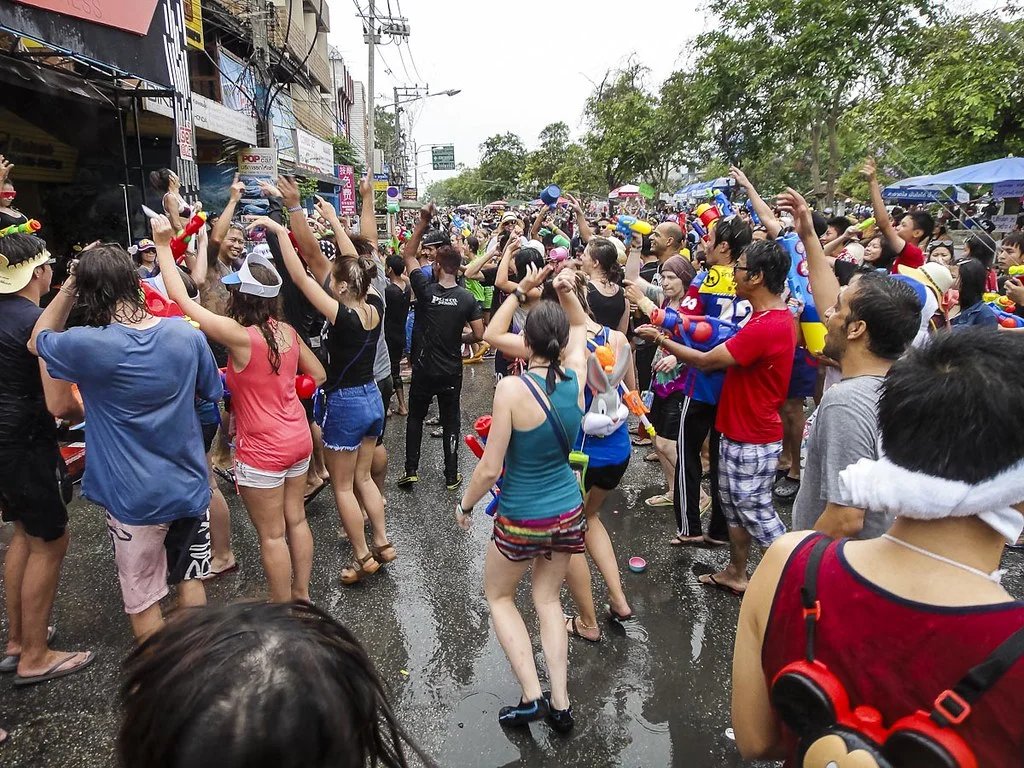
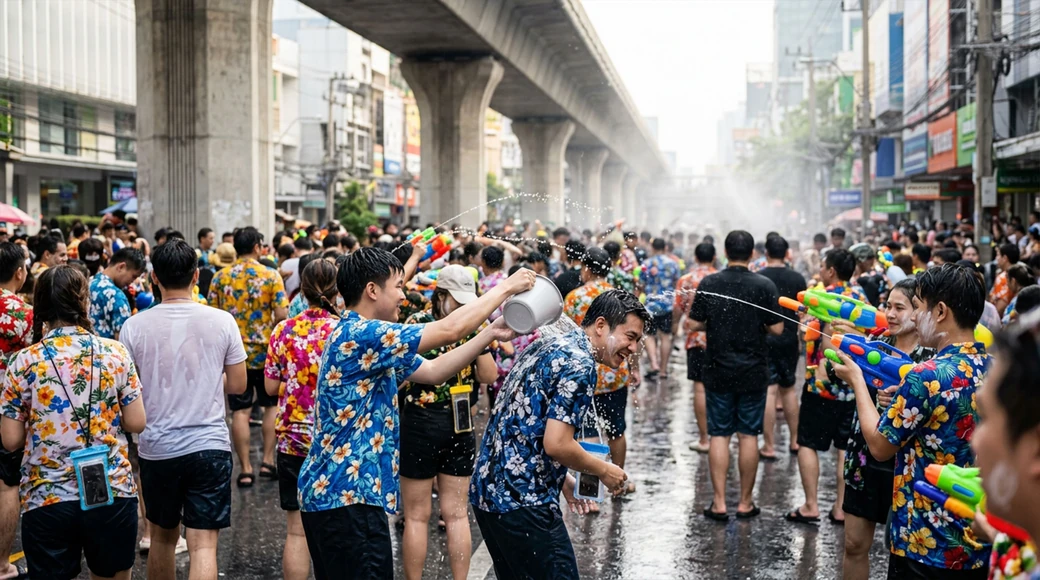
Songkran, the Thai New Year in Bangkok, with cheerful crowds splashing water at each other in the streets in a joyful festival of renewal

Songkran — Thai New Year

BangkokApr 13, 2027 – Apr 15, 2027Public holiday↻ Annual
Duration:3 daysType:
Cultural & Traditional Festivals
Admission:FreeLocationAnnual event — exact dates may vary each year

Thailand's traditional New Year, listed by UNESCO, turns Bangkok into a three-day mix of dawn temple rituals and the largest street water fight on earth, from Silom Road to the old temple quarter.

About This Festival

What Songkran Really Means: A New Year Written in the Sky and Listed by UNESCO

The name comes from the Sanskrit saṃkrānti, meaning an astrological passage — specifically the sun's annual crossing into Aries, the first sign of the zodiac, which the old Thai calendar treats as the turn of the year. That is why the festival belongs to the solar calendar and never drifts the way lunar new years do. UNESCO added Songkran to the Representative List of the Intangible Cultural Heritage of Humanity in 2023, recognising it as a season of family reunion, respect for elders and reverence for sacred images rather than simply a water fight. Cousins of the same passage are celebrated across the region: in Laos, Cambodia, Myanmar, Sri Lanka, in Yunnan in China and in parts of northeast India. Bangkok is simply where it plays out on the largest stage.
The Three Days Each Have a Name: Wan Maha Songkran, Wan Nao and Wan Thaloeng Sok

The festival is not one long party but three named days with different jobs. The first, Wan Maha Songkran, closes the old year: the sun crosses into Aries, households finish their deep clean, and the year's accumulated bad luck is symbolically washed away. The second, Wan Nao, is the in-between day, traditionally spent preparing food and carrying sand to the temple. The third, Wan Thaloeng Sok, is New Year's Day proper, when blessings are given and received. Each year also has its own Songkran goddess, one of seven sisters in the old almanac, whose mount and posture are announced in advance and appear on posters and parade floats. Knowing the sequence explains why the mood in Bangkok shifts noticeably from one day to the next.

From Scented Water to Street Battle: How Songkran Changed Over a Century

Songkran was Thailand's official New Year until the late nineteenth century, when the date was moved to the first of April; the first of January became the start of the year in 1941. The festival survived every one of those administrative changes because it was never really about the calendar. In its older form the water was a small, deliberate gesture: a bowl of scented water tipped gently over a Buddha image or an elder's hands. The mass street version grew in the second half of the twentieth century as cities filled up, hoses and plastic guns became cheap, and the holiday turned into the biggest homecoming week of the year. Today the two versions coexist rather than replace each other, and the state now promotes the festival deliberately as one of the country's strongest cultural exports.

The Morning Belongs to the Temples: Merit-Making, Buddha Bathing and Sand Pagodas

Long before the first water gun is loaded, Bangkok's temple courtyards fill with families carrying rice, flowers and small offerings for the monks. Three rituals repeat everywhere. Song Nam Phra is the pouring of scented water over Buddha images, often over the image matching your day of birth. Chedi Sai is the building of small sand pagodas in the courtyard, a way of returning to the temple the sand carried out on visitors' feet all year. Alms-giving comes first, usually just after sunrise. Wat Pho is the classic place to do all three, Wat Arun and Wat Chana Songkhram near Khao San are quieter alternatives, and the old custom of visiting nine temples in one day is still followed by many Bangkok families.

The Buddha That Leaves the Museum: Phra Phuttha Sihing and the Rattanakosin Ceremonies

The Phra Phuttha Sihing is considered Thailand's most revered Buddha image after the Emerald Buddha, and it normally sits in the Phutthaisawan Hall of the Bangkok National Museum. Once a year it is carried out in procession so the public can sprinkle water on it, and for a few days it stays accessible to anyone who missed the parade. A replica is also installed at Lan Khon Mueang, the open square beside City Hall, which puts the ritual within walking distance of the old town's temples. This is the heart of Songkran in Rattanakosin (the historic royal quarter of old Bangkok): processions along Ratchadamnoen Avenue, classical dance, folk theatre and quiet queues of people waiting with a small bowl. It is the part of the festival most visitors never realise is happening.

Rot Nam Dam Hua: Why Songkran Is Really a Family Holiday

The oldest gesture of the festival is the quietest one. In Rot Nam Dam Hua, younger family members pour scented water over the hands of parents, grandparents and teachers, ask forgiveness for the past year and receive a blessing in return. Households finish a deep clean before the holiday, people put on new clothes, and those working in Bangkok travel back to their home provinces — which is why parts of the capital feel unusually empty in the mornings while the tourist zones are packed. If you are invited into a Thai home during these days, bring fruit or something small, use both hands when you offer it, and let the eldest person present be served first. That single courtesy will tell your hosts you understood what the water is for.

Silom Road: A Closed Street and the City's Biggest Water Battle

Silom is the flagship zone. The stretch between the Sala Daeng and Nararom intersections is closed to traffic and turns into a single moving crowd; in recent years hundreds of thousands of people have passed through across the three days. What makes it work is the layout — marked entry points, walking lanes, defined play areas and a heavy but relaxed police presence — which keeps a crowd that size moving rather than crushing. Access is unusually easy because the elevated BTS walkway at Sala Daeng and the MRT station at Si Lom both drop you straight into it, and you can retreat upstairs when you have had enough. For a first Songkran, this is the zone to choose.

Khao San Road: Loud, Narrow and Strictly Controlled at the Gates

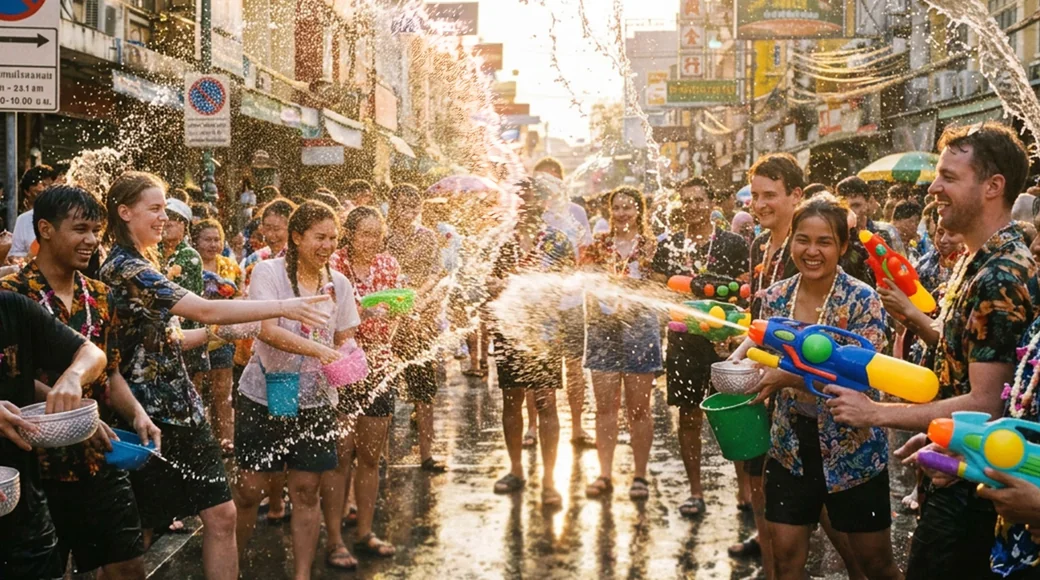
Khao San is the backpacker artery of the old town and the loudest corner of Songkran, with sound systems along the street and a crowd that is largely international. It is also the most tightly managed: police set up screening points at both ends, powder, chalk and high-pressure water guns are stopped at the entrance, and water play is confined to fixed hours on the main festival days. The street is narrow, so density builds fast in the evening — if you want the atmosphere without the squeeze, come in the early afternoon or drift to the quieter parallel lanes around Phra Athit and Rambuttri. Wat Chana Songkhram sits directly beside it, which makes it easy to pair the temple morning with the loudest afternoon in the city.

Where to Go With Children: Siam Square, the Riverside and the Official Festival Grounds

Not every zone is a free-for-all. Siam Square turns into a marked, family-oriented water area with stages and food stalls; the forecourt of CentralWorld runs concerts and a splash zone in front of the mall; and riverside ICONSIAM leans cultural, combining Buddha-bathing rituals, Thai performances and gentler water play. The state-run Maha Songkran World Water Festival is the most structured of all: a grand parade, five-region cultural zones, a separate area for elders and another for children, evening light shows and many food and craft stalls. Its site has moved between editions, so check the current location before you set out. These zones also start earlier and run longer than the street battles, which makes them useful on either side of the main holiday.

The Rules Are Real: Alcohol-Free Zones, a Closing Hour and Banned Water Guns

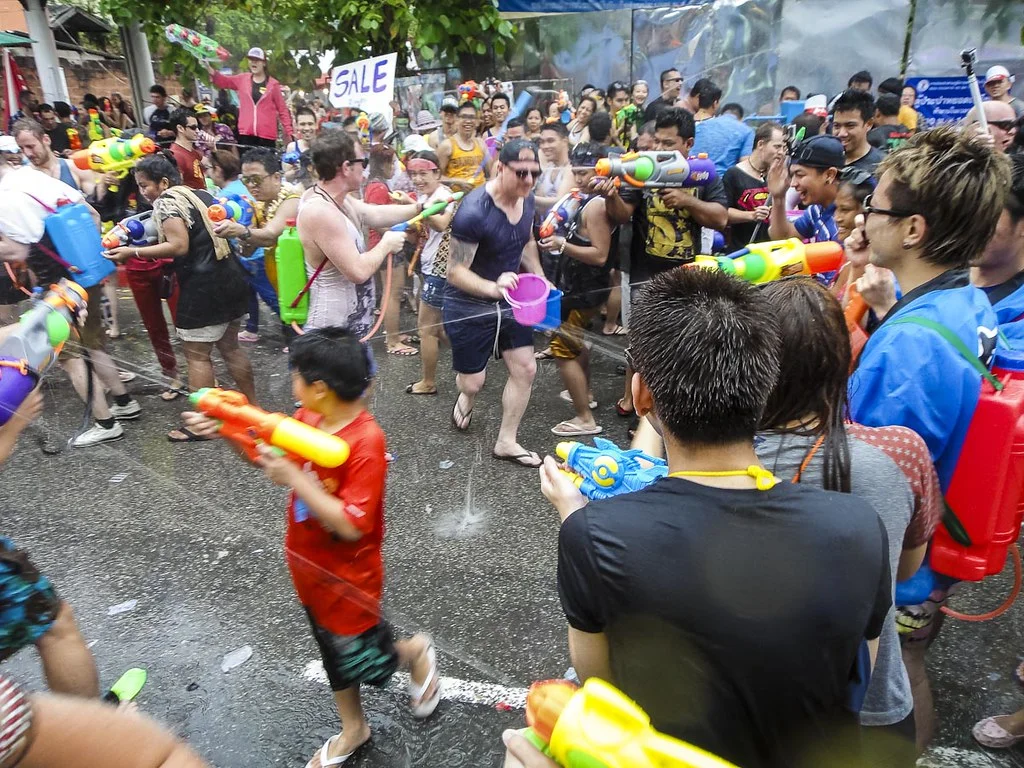
Bangkok's official play zones now run under a clear set of rules and they are enforced rather than announced. Alcohol is not allowed inside the zones, all water play stops at the nightly closing hour, and high-pressure devices — modified guns and home-made pressure tubes — are confiscated at the entrance because of the eye-injury risk. Powder and chalk smeared on faces are also out, a change from the old custom. Splashing people who are clearly not taking part, including riders on motorbikes, is treated as an offence rather than a joke, and officers do act on revealing clothing and on harassment. None of this makes the festival stiff; it simply means the boundaries are known, and following them is the easiest way to be treated as a guest rather than a problem.

Etiquette That Locals Notice: Who Not to Splash and Five Phrases Worth Learning

The unwritten rules matter more than the written ones. Do not splash monks, elderly people, babies, anyone carrying a Buddha image, food vendors at work or riders on two wheels. Do not use ice water, and never aim at a face from close range. Inside temples, cover shoulders and knees, take your shoes off where others do, and never point your feet at a Buddha image or climb on one for a photograph; ask before photographing people mid-ritual. A raised hand and a smile is the recognised sign for do not soak me. Five phrases carry you a long way: sawatdee pi mai for happy new year, suksan wan Songkran for happy Songkran, khop khun khrap or kha for thank you, khor thot khrap or kha for sorry, and mai len nam khrap or kha for I am not playing with water.

Staying Safe: Roads, Crowds, Slippery Pavements and What Not to Swallow

The real risk during Songkran is not the water fight but the road. The holiday week is the country's heaviest travel period and the authorities run a dedicated road-safety campaign across it; speeding and motorcycles dominate the crash statistics, and most collisions happen on straight stretches in daylight rather than on mountain bends. Inside the city, the sensible moves are simple. Avoid renting a scooter these days. Treat the water as non-drinkable, because street water collects dust and road grime, so keep your mouth closed and rinse before eating. Pavements and tiled shopfronts turn slippery, so wear sandals with grip. Keep valuables in a sealed pouch on your body, since dense crowds attract pickpockets, and note where the medical tents and tourist police posts stand when you enter a zone.

April Is Bangkok's Hottest Month: What to Wear and What to Carry

April is the hottest month of the Bangkok year, with afternoon highs around thirty-six degrees and humidity that pushes the feel-like figure far higher; authorities routinely warn about heat stress during the festival. Being wet is not the same as being cool, and people underestimate how fast they dehydrate while soaked. Drink water steadily, take air-conditioned breaks in the nearest convenience store, and keep sunscreen on even though it washes off, because the water reflects sunlight upward. Dress in quick-drying synthetics; a soaked cotton shirt stays heavy for hours, and white turns transparent, which is both uncomfortable and against the dress rules now enforced. Bring a sealed pouch for phone, cash and card, swimming goggles if you dislike water in your eyes, sandals with grip, and a dry shirt in a plastic bag for the ride home.

Getting Around and Sleeping Well: Skytrain, River Boats and Booking Early

Street closures make road transport unreliable, so plan around rail and water. The elevated BTS and the underground MRT keep running and stay dry inside, even where the stations above the action are drenched; the Chao Phraya boats are the smartest way to reach the riverside temples in the morning before the streets fill. Taxis will refuse short trips or take long detours, and motorbike taxis guarantee a soaking. Accommodation is the part most visitors get wrong: rooms in Silom, Banglamphu and Sukhumvit fill weeks in advance and rates rise sharply, so book months ahead. Staying inside a water zone means walking home wet through noise; staying two or three BTS stops away buys quiet without losing access. Leave heavy bags in a station or hotel luggage room rather than dragging them through a crowd.

Tastes, Sounds and a Second Songkran: Khao Chae, Floral Shirts and Phra Pradaeng

Songkran has its own palette and menu. People dress in bright floral shirts, the scent in temple courtyards is jasmine-based nam ob perfume rather than chlorine, and the soundtrack swings between country-style luk thung from shophouse speakers and sound systems in the main zones. On the table, look for khao chae, chilled jasmine-scented rice with elaborate side dishes served in the hottest weeks, alongside grilled chicken, green papaya salad and mango with sticky rice at the peak of mango season. Those same floral shirts and cheap water guns make the most honest souvenirs. If you arrive late, Bangkok has a second act: the Mon community (an ethnic group with its own language and traditions) of Phra Pradaeng, just south of the city, holds its own Songkran about a week after the national holiday, with a goddess procession, folk games, traditional dress and its local kalamae sweets.

Practical Information

When

Songkran is fixed to 13–15 April every year and is a full public holiday across Thailand; in 2027 it runs Tuesday 13 to Thursday 15 April. Temple merit-making starts soon after dawn, while street water play in Bangkok's official zones generally runs from midday until the evening closing hour.

Where

The biggest street zone is Silom Road between the Sala Daeng and Nararom intersections, closed to traffic (BTS Sala Daeng, MRT Si Lom). Other hubs are Khao San Road, Siam Square, the CentralWorld forecourt, riverside ICONSIAM and the temple quarter of Rattanakosin. The state-run Maha Songkran World Water Festival changes venue between editions — recent ones used Sanam Luang and Benchakitti Park — so confirm the location with the Tourism Authority of Thailand.

Cost

Free. Street celebrations, temple ceremonies, parades and mall zones cost nothing; only separately organised music festivals sell tickets.

Tips

Wear quick-dry synthetics rather than white cotton, carry a sealed pouch for phone and cash, keep your mouth shut when water hits your face, and use the BTS and river boats instead of taxis, which avoid the closed streets. Book accommodation months ahead; rates in Silom, Banglamphu and Sukhumvit climb steeply.

Unique to this festival

Songkran is the rare festival where the sacred and the anarchic run in parallel on the same morning — you can pour scented water over a Buddha image and build a sand pagoda at Wat Pho, then walk into a huge water battle a few stops away. Alcohol is banned inside official play zones, high-pressure water cannons and powder are confiscated at entry screening, and the water itself is a blessing rather than a prank.

Accommodation and hotel options during Songkran — Thai New Year

Accommodation and hotel options around the event venue, with their prices, are shown by Stay22 as a map and a list. Cookies are used. Your consent is remembered on every page; you can turn it off at any time in the cookie settings.

Keep Exploring

Travel essentials for Bangkok

Flights, transfers, car rental, eSIM and insurance — compare your options

Flights

Find the best route

Transfers

Airport & city ground transport

Car Rental

Drive at your own pace

eSIM

Stay connected on arrival

Insurance

Cover your trip