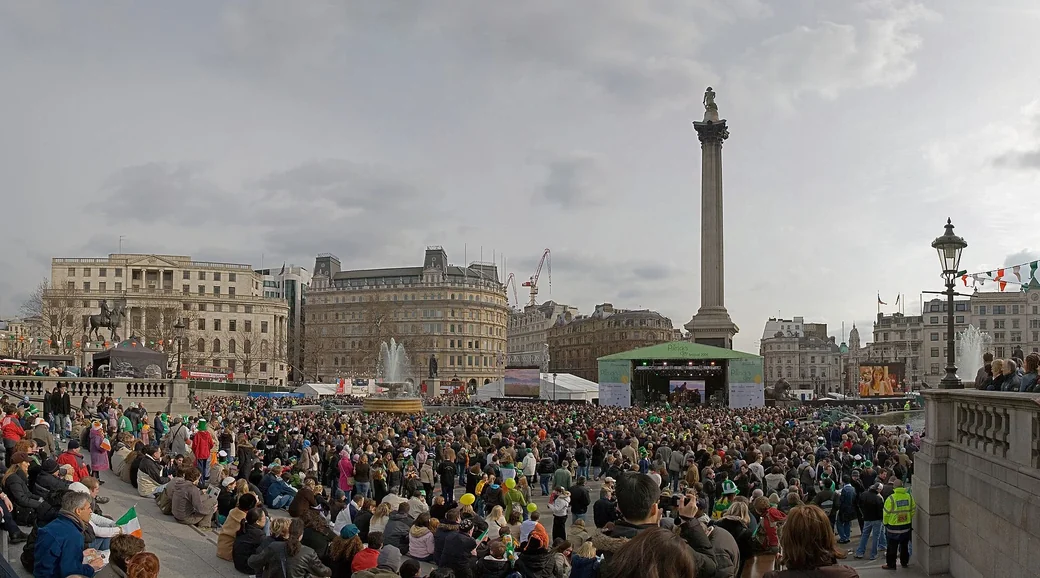
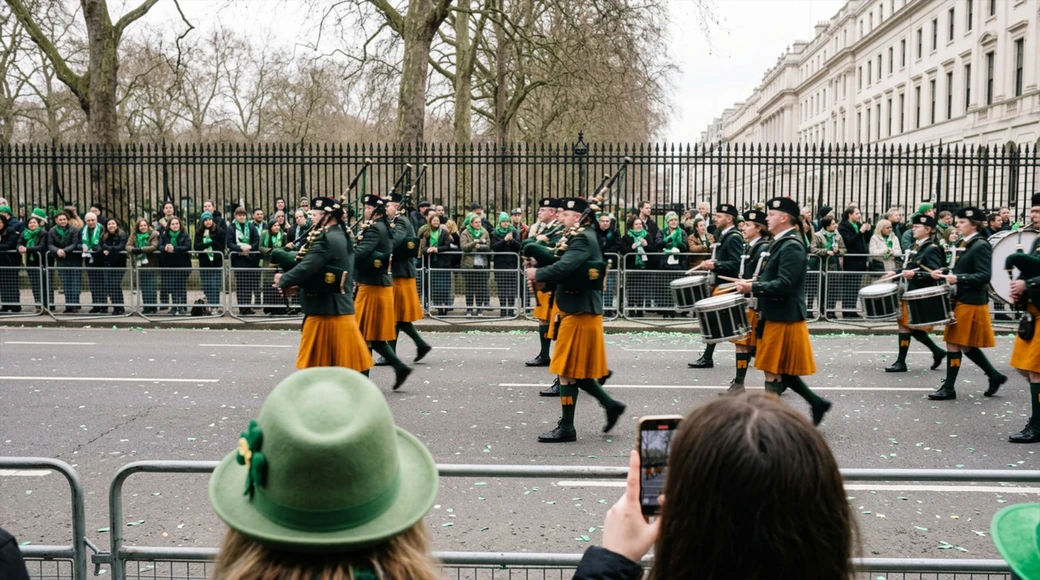
St Patrick's Festival and Parade in London, with a lively procession of green-clad marchers, Irish flags and music filling the streets of central London

St Patrick's Festival and Parade London

LondonMar 14, 2027↻ Annual
Duration:1 daysType:
Cultural & Traditional Festivals
Admission:FreeLocationAnnual event — exact dates may vary each year

A colourful parade through the West End from Hyde Park Corner to Whitehall, followed by an open-air festival of Irish music, dance, food and culture in Trafalgar Square, held on the Sunday before Saint Patrick's Day.

About This Festival

St Patrick's Festival and Parade London: What It Is and Why It Matters

London's St Patrick's Festival and Parade is the capital's biggest annual celebration of Irish culture. It is organised by the Mayor of London and the Greater London Authority, and it combines a colourful procession through the West End with an open-air festival in Trafalgar Square. Saint Patrick, the patron saint of Ireland, is remembered for bringing Christianity to the island, and his feast day on 17 March has become a worldwide occasion for celebrating Irish identity. In London the day is also a thank-you to generations of Irish Londoners who helped to build the city, care for its sick and teach its children. The event is meant for everybody, not only for the Irish community: families, friends, visitors and curious locals all join in. Green is the colour of the day, the shamrock (a three-leaved clover) is its emblem, and no ticket or booking is needed to take part.
History of London's St Patrick's Day Celebrations: From 1768 to Trafalgar Square

Irish Londoners have been marking St Patrick's Day for centuries. In 1713 Jonathan Swift wrote that the Mall was so full of people wearing crosses on the day that he felt the whole world was Irish, and in 1768 Irish dockworkers marched through Wapping and Shadwell with shamrocks in their hats. After the Second World War, as many Irish men and women settled in London, county associations and the Catholic Church organised a procession from Whitehall to Westminster Cathedral, and by the 1960s pipe bands, floats and dancers had joined in. The celebration took more modest, community-based forms in some later decades, then returned in a big way in 2002, when the Mayor of London and the Council of Irish County Associations launched the parade and Trafalgar Square festival we know today. Since then it has welcomed new voices, including the Montserrat community, LGBTQ+ groups and second- and third-generation Irish Londoners.

When Is the London St Patrick's Day Parade? Date Rule, Times and Schedule

The London parade does not always fall on 17 March. By tradition it is held on the Sunday before Saint Patrick's Day, or on the day itself when 17 March is a Sunday, so that families and workers can attend. The celebration lasts one day. The parade usually sets off at noon, and the Trafalgar Square festival runs from around midday until early evening, so most visitors plan to arrive in the late morning and stay for the afternoon stage programme. The exact date, the line-up and the list of road closures are normally announced by the Mayor of London's office in the early part of the year, so always check the official event page before you travel. Smaller celebrations carry on through the whole month and on 17 March itself, when pubs, cultural centres and Underground stations host their own events.

London St Patrick's Day Parade Route: Hyde Park Corner to Whitehall and the Best Viewing Spots

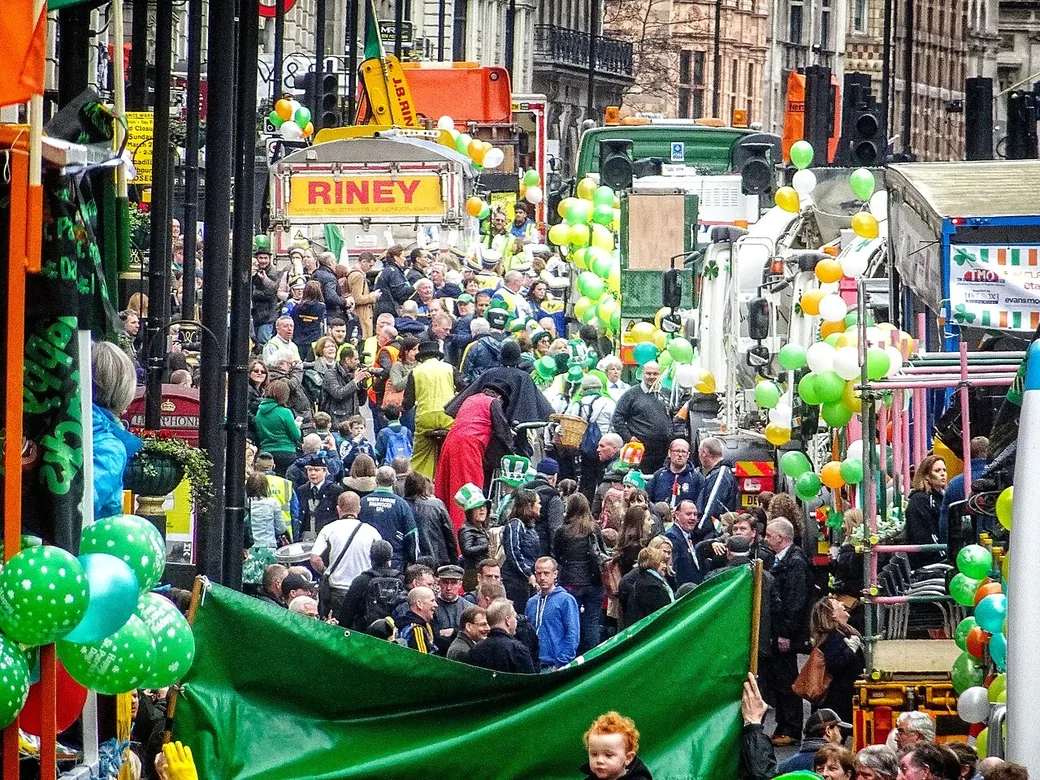
The parade starts at the western end of the West End, near Hyde Park Corner and the Green Park end of Piccadilly, and covers roughly one and a half miles, about 2.4 kilometres. It follows Piccadilly past Piccadilly Circus, continues through the St James's area and along Cockspur Street, passes Trafalgar Square and finishes on Whitehall. Barriers do not usually line the entire route, so you can find a place almost anywhere. For a relaxed view, choose a stretch of Piccadilly or Pall Mall where the crowd is thinner; for atmosphere, pick the final approach near Cockspur Street and Trafalgar Square. Arrive at least forty-five minutes before noon to secure a spot at the front. The starting point and some streets are adjusted slightly from year to year, so check the official route map before you go.

Who Marches in the London St Patrick's Parade: Grand Marshals, Bands and Community Groups

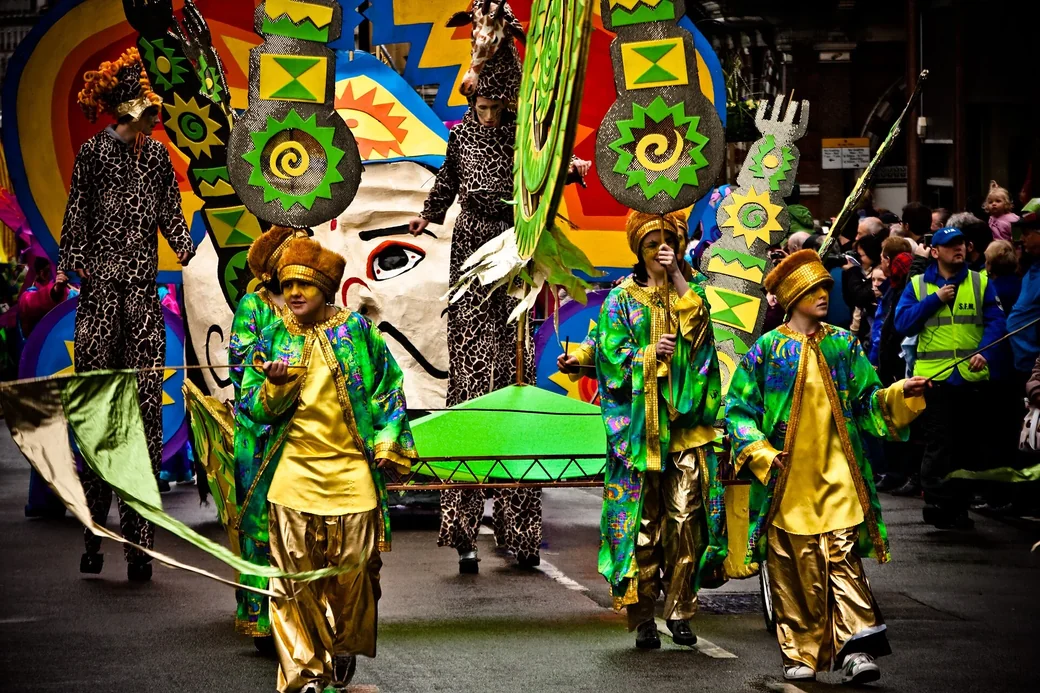
The procession is a moving portrait of Irish London. Irish county associations walk behind their banners, followed by community organisations, schools, sports clubs, marching bands, music ensembles, step dancers, carnival performers and large puppets. Each year a Grand Marshal (an honorary leader) leads the parade; past marshals have included the writer and broadcaster Emma Dabiri, the performer and activist Panti Bliss and respected figures from London's Irish community. The parade is also deliberately inclusive: the Montserrat community, whose island celebrates St Patrick's Day as a public holiday, LGBTQ+ groups, women's organisations and young people of Irish descent all march together. Many participants are volunteers who spend months preparing costumes and floats, which is why the parade feels more like a gathering of neighbours than a corporate spectacle.

What to Expect at the Trafalgar Square Festival: Stages, Workshops and Exhibitions

When the parade reaches Trafalgar Square, the festival takes over the whole square with the National Gallery as its backdrop. The main stage presents a mix of traditional and contemporary Irish and London-Irish acts with a host to guide the afternoon, and the spoken parts are usually signed in British Sign Language. Around it you will find a tent for comedy, spoken word and short films, exhibitions about Irish history and the diaspora, craft and art workshops for children on Pall Mall East, Irish-language taster sessions, stalls run by tourism and cultural organisations, and installations such as a recreated traditional cottage. In recent years short poems by Irish writers have also been read in nearby Underground stations. The programme changes every year, so treat this as a guide to the kind of activities on offer and check the official schedule for set times.

Irish Music and Dance in London: Bodhrán, Fiddle, Step Dancing and Famous Performers

Music is the heartbeat of the day. Listen for the bodhrán (a frame drum that gives Irish tunes their pulse), the fiddle (violin), the tin whistle (a small metal flute), the accordion and the uilleann pipes (Irish bagpipes played with a bellows under the arm). Step dancers, with their still upper bodies and flying feet, perform on the stage and in the parade, while céilí (traditional social dance) groups invite the audience to join traditional group dances. The stage has featured a wide range of artists over the years, from folk and traditional bands such as Kíla and Jig and a Swig to singer-songwriters like David Keenan and Nell Mescal, youth orchestras, community choirs and shows honouring Irish rock heroes. The actor and musician Robert Arkins, known from the film The Commitments, has also headlined. The afternoon often ends with a communal sing-along.

Irish Food and Drink at the London St Patrick's Festival and Beyond

Food stalls line the edge of Trafalgar Square, offering Irish classics alongside the international street food London is known for. Vendors change every year, but expect black pudding (blood sausage) from Irish producers, seafood, churros, bao buns, ice cream and coffee, plus a bar serving Irish stout (a dark beer) and other drinks. Across the city, restaurants celebrate modern Irish cooking: Anna Haugh's Myrtle in Chelsea is famous for its beef-filled boxty (a traditional potato pancake) and her stall has appeared at the festival, while Homeboy in Islington mixes Irish coffees and playful cocktails. Traditional dishes worth trying include Irish stew, colcannon (mashed potato with cabbage or kale) soda bread, smoked salmon and a full Irish breakfast. Vegetarian options are easy to find, while vegan and halal choices vary from stall to stall, so ask the vendor before you order.

Best Irish Pubs and Trad Music Sessions in London for St Patrick's Day

The party does not stop when the stage closes. Soho's Irish pubs, especially The Toucan on Carlisle Street and The Devonshire on Denman Street, are favourites for a well-poured pint (about 568 ml) of Guinness after the parade. For traditional music, head to The Auld Shillelagh in Stoke Newington, known for its live sessions, to Feeney's in Whitechapel, east London, or to Homeboy in Islington for a modern Irish bar. The Irish Cultural Centre in Hammersmith, which opened in 1995, runs a regular Friday evening session of traditional music in its bar and hosts concerts, plays, comedy and ceilidhs (traditional dance evenings) throughout the year, while the London Irish Centre in Camden, founded in the mid-1950s, has long been the community's meeting place and often hosts breakfast and music on parade morning. Pubs are very busy on the day itself, so arrive early or reserve a table where you can.

How to Get to the London St Patrick's Parade: Tube, Train, Bus and Road Closures

Central London is closed to traffic for much of the day, so use public transport. Charing Cross is the closest Underground station, on the Northern and Bakerloo lines, and Charing Cross rail station is about a three-minute walk from the square. Westminster, on the Jubilee, District and Circle lines, has step-free access and is around ten minutes away on foot, while Leicester Square and Embankment are other options within a short walk. Many central bus routes are diverted or shortened, usually from early morning until late afternoon, and streets such as Piccadilly, Pall Mall East, Cockspur Street and Whitehall are among those closed. If you are staying overnight, hotels in Westminster, Covent Garden, Soho and Victoria let you walk to the parade. Leave a few minutes early afterwards, because Charing Cross becomes crowded when the festival ends. Bus routes such as 3, 6, 9, 11, 12, 15, 23, 87, 88, 91, 139 and 176 normally serve the area but are diverted on the day, so check the TfL (Transport for London, the city's transport authority) journey planner.

Accessible and Family-Friendly: Step-Free Access, Sign Language and Relaxed Spaces

The festival is designed to be open to everyone. The Trafalgar Square site has a level-access entrance, step-free paths and a lift connecting the north terrace with the main square. An accessible viewing area on the north terrace offers seating and a hearing loop, and in recent editions it could be reserved in advance by emailing the organisers. Spoken performances on the main stage have been accompanied by British Sign Language interpreters shown on a screen beside the stage, ear defenders can be borrowed from the information point, and an accessible toilet with a hoist and changing table is provided; if you need the hoist, bring your own sling. Assistance dogs are welcome, and Blue Badge (UK disabled parking permit) parking bays exist on nearby St Martin's Street. The atmosphere is relaxed and informal, so you can come and go as you please, and a children's craft zone makes the day easy for families.

Safety, Crowds and Rules: What to Know Before the London St Patrick's Parade

Everyone entering the Trafalgar Square site passes a bag search, and CCTV operates throughout, so travel light and leave glass bottles, outside alcohol and anything that could be used as a weapon at home. Water refill points are available on site. Pickpockets can be active in any big London crowd, so keep phones and wallets in zipped inner pockets and bags in front of you. In Westminster, a controlled drinking zone allows officers to ask people to stop drinking in public places and to hand over their drinks; refusing is an offence, so enjoy your pint inside a pub or at the licensed festival bar. March weather is changeable, so dress in layers and bring a waterproof jacket and comfortable shoes, since you will be standing for hours. Carry a power bank, pay by card or phone, and agree on a meeting point if you are in a group. The atmosphere is welcoming to solo travellers, women and LGBTQ+ visitors, and stewards and volunteers in high-visibility jackets are always nearby.

Etiquette, What to Wear and Five Irish Phrases for St Patrick's Day in London

Wearing green, a shamrock pin or a hat is part of the fun, and nobody will mind if you join in the singing and dancing. Be respectful of the day's religious roots by avoiding costumes that mock priests, saints or religious symbols, and treat Irish traditions with the same warmth you would want for your own. Photography is welcome, but ask before taking close-up portraits of individual performers, and leave commercial filming to those with permission from the organisers. Remember that the correct name is St Patrick's Day, and that it celebrates a culture, not just a drink. A few Irish phrases will be appreciated: Lá Fhéile Pádraig sona duit (Happy St Patrick's Day), Sláinte (cheers, pronounced roughly SLAWN-cha), Céad míle fáilte (a hundred thousand welcomes), Go raibh maith agat (thank you) and craic (fun and good company, pronounced like crack).

Green London: Landmarks Turning Green, Photo Spots and Irish London Beyond the Parade

Part of the magic is seeing London turn green. Through Tourism Ireland's Global Greening initiative (an annual scheme that lights landmarks green), landmarks such as the London Eye and Nelson's Column have been lit green around the day, and the fountains of Trafalgar Square have joined in too; the list changes from year to year. For photographs, the north terrace in front of the National Gallery gives the best view over the stage and the crowd, the steps around the Shaftesbury Memorial at Piccadilly Circus show the procession from above, and the final stretch toward Whitehall frames the parade against Nelson's Column. To explore Irish London beyond the parade, visit St Patrick's Church in Soho Square, recognised as the first church in England dedicated to the saint since the Reformation, where a chapel opened in 1792 and the present building was first used for worship on 17 March 1893. You can also walk through Kilburn, affectionately nicknamed County Kilburn for its long Irish heritage, and neighbouring Cricklewood and Camden. For a quieter hour, the National Gallery and the church of St Martin-in-the-Fields are beside the square.

Legends, Curiosities and the Story Behind the Shamrock

According to legend, Saint Patrick used the three-leaved shamrock to explain the Christian Trinity, which is why the plant became Ireland's emblem and a symbol of the festival. Another tale says he drove all the snakes out of Ireland, although naturalists point out that the island never had any after the Ice Age. Folklore also describes the custom of drowning the shamrock, in which a sprig is dropped into the last glass of the day for luck. London has traditions of its own: the Irish Guards regiment receives sprigs of shamrock each year, traditionally presented by a member of the royal family, and the festival is supported by Irish tourism and food bodies and community newspapers. Cities from Dublin to New York hold famous parades, but London's is special as the home of the largest Irish community in Britain, and the Cheltenham horse racing festival often takes place the same week, drawing many Irish visitors out of the capital.

Behind the Scenes: Who Organises the London St Patrick's Festival, Plus Fiddler of London and Irish Film Screenings

The festival is organised by the Mayor of London's office through the Greater London Authority, together with a programme partner that curates the stage line-up; in earlier years this was the London Irish Centre. The Council of Irish County Associations, a founding partner since 2002, still brings the county banners to the parade. Tourism Ireland, Bord Bia (the Irish food board), Irish companies and the community newspapers The Irish Post and The Irish World have supported recent editions. More than 50,000 people typically line the route. Around the main day you may also find the Fiddler of London (an annual competition for Irish traditional fiddle players, linked to the St Patrick's celebrations), Irish film and short-film screenings, and clubs from London GAA (the London branch of the Gaelic Athletic Association, which promotes Gaelic football and hurling) taking part. When Ken Livingstone, then Mayor of London, opened the first Trafalgar Square celebration in 2002, he spoke of the contribution Irish people had made to the city: helping to build it, nursing its sick and teaching its children. Team London volunteers and stewards are on hand throughout the day.

Plan Your Day: Timeline, Weather, Luggage and Where to Stay Near the London St Patrick's Parade

A relaxed plan works best. Reach the Piccadilly or St James's stretch at around eleven to choose a viewing spot, watch the parade set off at noon, then walk toward Trafalgar Square, where the head of the procession usually arrives in the early afternoon. Spend the afternoon at the main stage, the craft zone and the food stalls, and keep the last hours for a pint (about 568 ml) or a visit to the National Gallery next door. March can be wet and cold, and the event is mostly outdoors, so pack a waterproof layer. Toilets, water refill points and an information point are on site, but queues grow at peak times. Mobile signal can be slow in a dense crowd, so save an offline map and agree on a meeting point. Charing Cross Underground station is the closest but has no step-free access, whereas Westminster station and the Charing Cross rail station do offer a step-free route. Hotels in Westminster, Covent Garden, Soho and Victoria suit the day well, and commercial luggage-storage points near the main stations help if you travel with bags, since large bags slow down the entrance search.

Practical Information

When

The Sunday before 17 March (or on 17 March itself when it falls on a Sunday). The parade sets off at noon and the Trafalgar Square festival runs from about 12:00 to 18:00.

Where

The parade runs from Hyde Park Corner along Piccadilly, past Piccadilly Circus and along Cockspur Street to Whitehall. The festival takes place in Trafalgar Square, Westminster, London WC2N 5DN. Nearest stations: Charing Cross (Underground and rail) and Westminster (step-free).

Cost

Free. No ticket or booking is needed.

Tips

Arrive early, travel by public transport, wear layers, carry a power bank, pay by card and expect a bag search at the entrance to the square.

Specific to this festival

One of the largest St Patrick's Day parades outside Ireland, organised by the Mayor of London. It combines a procession of county associations, bands and dancers with a day-long festival of Irish music, food, exhibitions and family activities, and it is known for its strong accessibility provision.

Accommodation and hotel options during St Patrick's Festival and Parade London

Accommodation and hotel options around the event venue, with their prices, are shown by Stay22 as a map and a list. Cookies are used. Your consent is remembered on every page; you can turn it off at any time in the cookie settings.

Keep Exploring

Travel essentials for London

Flights, transfers, car rental, eSIM and insurance — compare your options

Flights

Find the best route

Transfers

Airport & city ground transport

Car Rental

Drive at your own pace

eSIM

Stay connected on arrival

Insurance

Cover your trip