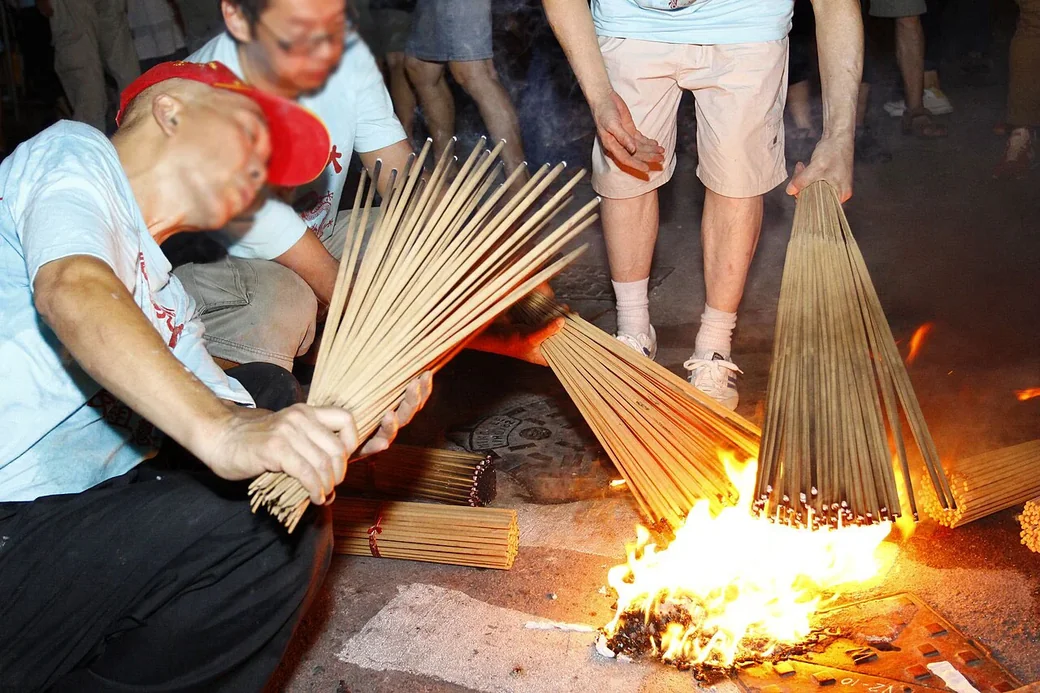
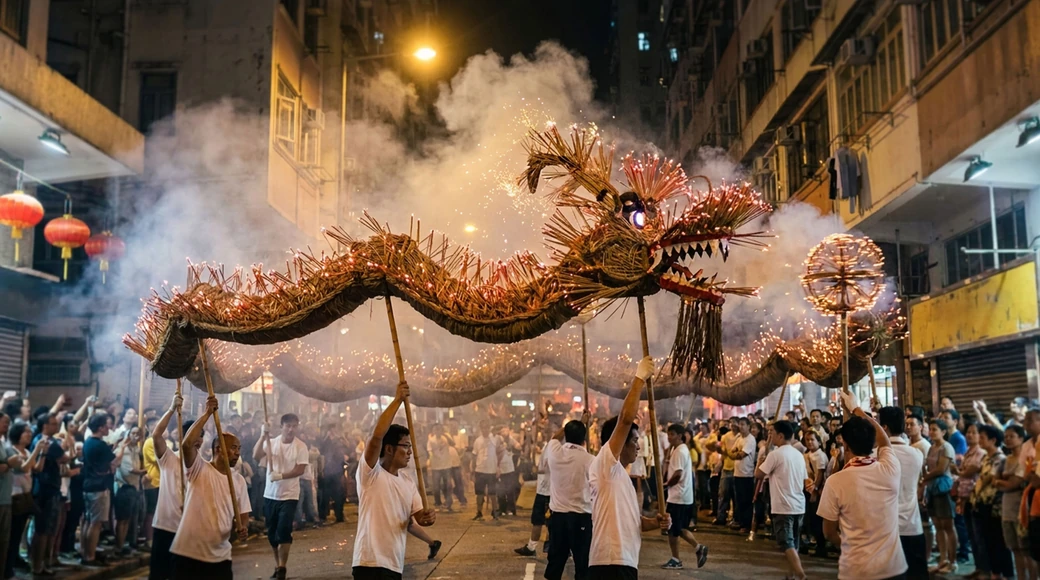
Tai Hang Fire Dragon Dance in Hong Kong, where performers carry a straw dragon studded with thousands of glowing incense sticks through the neighbourhood's streets at night during Mid-Autumn

Tai Hang Fire Dragon Dance (大坑舞火龍)

Hong KongSep 14, 2027 – Sep 16, 2027Partial public holiday↻ Annual
Duration:3 daysType:
Cultural & Traditional Festivals
Admission:FreeLocationAnnual event — exact dates may vary each year

A 67-metre dragon glowing with about 12,000 burning incense sticks winds through the lanes of Tai Hang in Causeway Bay on three evenings around the Mid-Autumn Festival, a Hakka village tradition listed as national intangible cultural heritage.

About This Festival

Tai Hang Fire Dragon Dance in Hong Kong: What It Is and Why It Matters

Every year around the Mid-Autumn Festival, the quiet lanes of Tai Hang (大坑), a small neighbourhood tucked behind Causeway Bay on Hong Kong Island, light up with a dragon of fire. The Tai Hang Fire Dragon Dance (大坑舞火龍) is performed on three consecutive evenings, the 14th, 15th and 16th nights of the eighth lunar month, and is organised by the Tai Hang Residents' Welfare Association, a community group that has handed the tradition from one generation to the next. In 2011 it was inscribed on China's third national list of intangible cultural heritage, and it also appears on Hong Kong's own representative list. It began in a Hakka (客家, a Chinese community with its own language and customs) village of farmers and fishermen, and more than 140 years later it is still a neighbourhood celebration at heart, with children, parents and old friends all taking part. The association recruits participants every summer, and everyone trains before taking part, so the festival is a shared project that the neighbourhood prepares for all year. In 2019 the dance was also listed as an outstanding safeguarding practice case on the national heritage list. The Mid-Autumn Festival (中秋節, also called the Moon Festival) falls on the 15th day of the eighth lunar month, when families gather to admire the full moon and share mooncakes.
The 1880 Legend of the Fire Dragon: Python, Plague and a Village Elder's Dream

According to a local legend, the story begins in 1880, when a typhoon swept over the Hakka (a Chinese community with its own language and customs) village of Tai Hang and a large python wandered into the settlement. The villagers dealt with the snake, but its body is said to have vanished by morning. Soon afterwards illness spread through the village and the people grew deeply worried. Then, the legend continues, a village elder had a dream in which he was told to make a dragon from straw, cover it with burning incense and parade it through the lanes on the nights of the Mid-Autumn Festival, accompanied by firecrackers. Villagers followed the advice, and as the smoke and sparks filled the streets the sickness is said to have faded. Whatever the truth behind the tale, the villagers kept the ritual every year afterwards, and it grew into the festival we see today. In another telling, the figure who appeared in the dream was the Buddha, and so the legend lives on in slightly different versions.

History of the Tai Hang Fire Dragon Dance: From Hakka Village to National Heritage

Tai Hang takes its name from a large stream that once ran down between two hills to the sea, and the early settlers farmed and fished here. As Causeway Bay was reclaimed from the harbour, the shoreline moved far away and the village slowly became a city neighbourhood, yet the dragon kept dancing. Older residents remember shopkeepers hanging long strings of firecrackers from their ceilings and setting them off as the dragon passed, and in the 1950s a "Cai Qing" (採青, a lion-dance-style ritual of plucking lucky greens) performance joined the programme. The dance has paused only on a few exceptional occasions, most recently during the pandemic years, and it returned to the streets in 2023 to a warm welcome. In 2022 a heritage centre opened in the neighbourhood to share the story year-round. Today the dance is open to residents as well as people from across Hong Kong and some visitors from abroad, and children's and youth teams help pass it on. The stream behind the name is the Tai Hang Nullah (大坑明渠, a drainage channel); its upper course was later covered and became Wun Sha Street, and a walkway called the Fire Dragon Path (火龍徑) now carries the dance's name.

How the Fire Dragon Is Made: 67 Metres, 32 Segments and 12,000 Incense Sticks

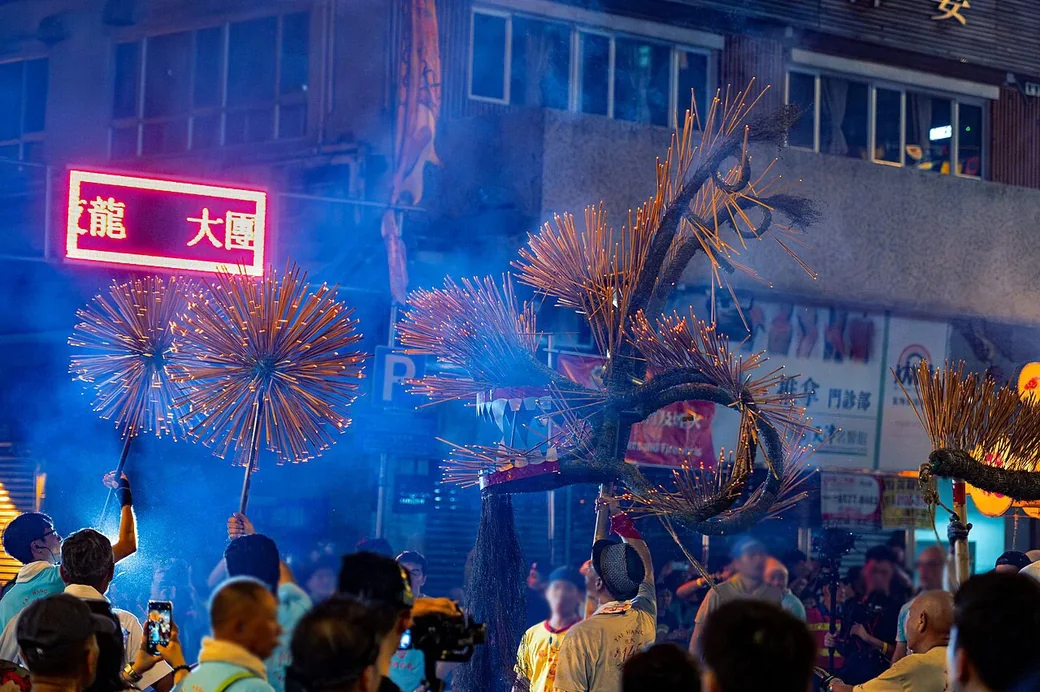
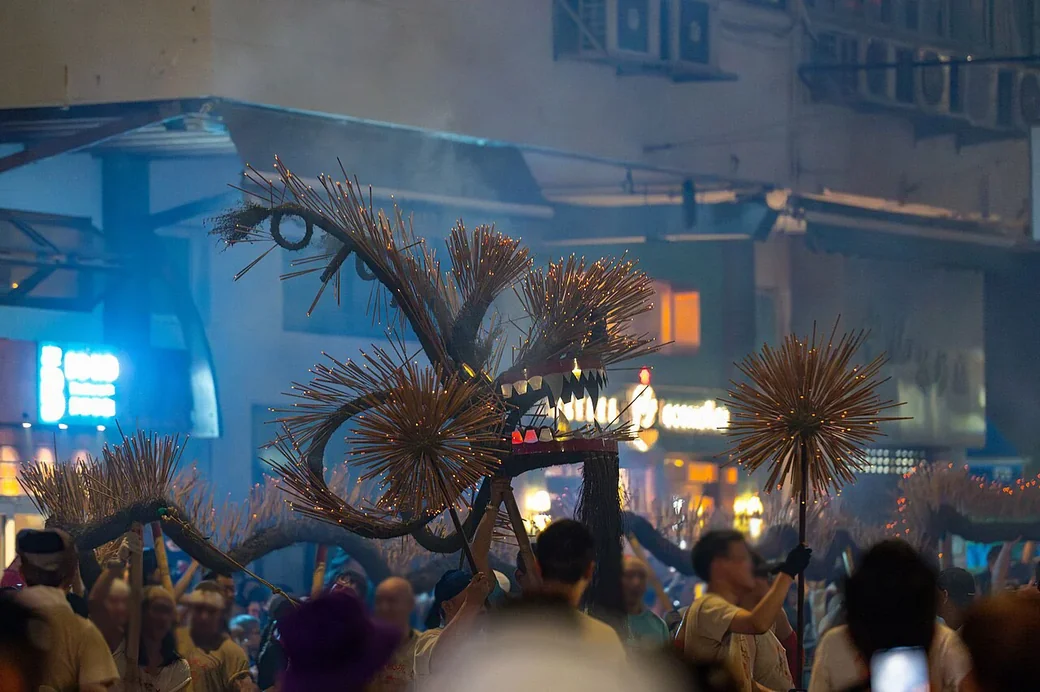
The dragon is built afresh by Tai Hang residents every year, and the work takes one to two months. A frame of flexible rattan forms the head and tail, a thick rope acts as the spine, and the whole body, divided into 32 segments, is wrapped in pearl grass (珍珠草, a soft chamberbitter weed that holds the incense well). On the festival evenings about 12,000 long incense sticks are pushed into the body, so the dragon glows orange in the dark. It stretches 67 metres, roughly the length of five and a half double-decker buses, and the head alone weighs close to 50 kilograms. About 300 performers carry it in turns. Two "dragon pearls", pomelos (large citrus fruits) stuck with incense, lead the way and are spun like glowing moons. The dragon's eyes were once made from large flashlights, and today LED lights have taken their place, while the handwork stays the same. Each incense stick is a "longevity incense" (長壽香, long-life incense) about 45 centimetres long.

A Night at the Fire Dragon Dance: Consecration, Eye-Dotting and the Parade Step by Step

On the first evening the dragon is taken to Lin Fa Kung (蓮花宮, "Lotus Palace"), the neighbourhood temple of Kwun Yum (觀音, the Goddess of Mercy), where it is consecrated in the Hakka (a Chinese community with its own language and customs) language and its eyes are dotted to "wake" it. The dragon then moves to Ormsby Street (安庶庇街), where dancers burn incense in respect, red flowers are pinned on the head and the incense sticks are lit and inserted. Led by the two pearls and driven by drums and gongs, the dragon begins its parade. Midway, the burnt incense is replaced and the still-glowing sticks are handed to the crowd. A second, more athletic round follows with the dragon's signature moves. On the final night the dragon is sent off in a farewell ritual known as "Dragon Returning to Heaven". In earlier times the dragon was sent into the sea on the last night; today it is sent off in another way to protect the water, so the ritual keeps its meaning while caring for the environment.

Fire Dragon Dance Moves: Pearls, Bridges and the Nine-Step Relay

Watch for the named figures that make the Tai Hang performance so distinctive, including "The Awakening", "The Circling", "Bridge Crossing" and "Double-Pillar Mount", as well as the dragon coiling into a tight "dragon cake" (打龍餅, a spiral knot) and a reunion with colourful lanterns. The pearl bearers have a demanding job: they walk backwards, facing the dragon, to guide its path. Carrying the head is a team effort in which each person takes just nine steps before passing it on, so balance and timing matter more than strength. Traditionally the dragon's body is carried by men, while women and children join the lantern, lotus-lamp and music groups. A youth team and a small LED dragon danced by children keep the tradition growing. Children's lantern teams walk alongside the dragon, so that generations meet in the same scene, and the shared rhythm of everyone with the gongs and drums is the real highlight. The small LED dragon, made of about ten thousand LEDs, dances alongside the large dragon as a sign of passing the flame on to the next generation.

Where to Watch the Tai Hang Fire Dragon: Parade Route and Best Viewing Streets

The dragon circles the neighbourhood clockwise through a grid of small streets, passing Warren Street (華倫街), Brown Street (布朗街), Ormsby Street (安庶庇街), Wun Sha Street (浣紗街), Sun Chun Street (新村街), King Street (京街), Jones Street and Lai Yin Street, and finishing near School Street (書館街). The most popular viewing spots are Wun Sha Street (浣紗街) and Tung Lo Wan Road (銅鑼灣道), where the dragon performs many of its tricks, so these fill up first. Ormsby Street is a good choice if you would like to see the incense being lit and the opening ceremony. On the night of the festival, the dragon has in recent years also visited Victoria Park (維多利亞公園), which offers more room to breathe than the narrow lanes. You can stay in one spot or wander between streets to catch different scenes; each lane has its own atmosphere, and visiting two or three places gives a broader sense of the neighbourhood.

When to Go: Dates, Evening Schedule and the Best Night to See the Fire Dragon

The festival follows the lunar calendar, so it always falls on the 14th, 15th and 16th evenings of the eighth lunar month, with the Mid-Autumn Festival itself on the middle night. Exact dates move from year to year, and the organisers announce them shortly in advance on the official website. Performances take place in the evening after dusk, with the rhythm of the evening building toward the second round of tricks. Each of the three nights has its own atmosphere. The middle night, the Mid-Autumn Festival itself, carries the strongest festive spirit, and the streets are lively on all three evenings. Whichever night you choose, arriving early rewards you with a front-row spot. When you arrive, follow the marshals' directions and the official announcements together; knowing the flow of the evening makes it easier to plan which street to watch.

How to Get to Tai Hang for the Fire Dragon Dance: MTR, Tram and Walking Routes

The easiest approach is by MTR (Hong Kong's metro system) to Tin Hau station (天后站). From exit A1, cross the road, walk along King's Road toward Causeway Bay, then turn onto Tung Lo Wan Road (銅鑼灣道) and continue for a few minutes into Tai Hang; exit B has a lift for visitors who need step-free access. You can also walk about ten minutes from Causeway Bay (銅鑼灣) station, or take the tram to the Hing Fat Street stop beside Victoria Park. During the festival, police close several local streets in the evening and suspend parking, so public transport and a relaxed walk are far more pleasant than a taxi. Give yourself extra time, because the final stretch is on foot among the crowds. Beside Tin Hau station there is also a bus terminal, so reaching Tai Hang from other parts of Hong Kong is easy. Another pleasant approach is the Fire Dragon Path (火龍徑), a pedestrian walkway named after the dance that leads down to Wun Sha Street. Walk back slowly afterwards and enjoy the calm lanes.

Fire Dragon Dance Safety and Etiquette: What to Wear, Weather Tips and Crowd Advice

Burning incense gives off smoke and tiny embers, so wear closed shoes and clothes you are happy to get a little ash on, and consider glasses or sunglasses to shield your eyes. Stay behind the barriers, keep a respectful distance from the dragon and follow the instructions of marshals and police, who guide the crowd. Hold small children by the hand in the busiest streets and agree on a meeting point in case you are separated. September and October are typhoon season, so check the weather forecast; rain dampens the incense, and organisers have continued the dance once the rain stops, and the small LED dragon can step in if the weather turns. Keep your phone charged and your bag light. Volunteers and marshals guide the crowd along the streets, so simply follow the signs and gestures and move slowly; taking it easy is the safest and most enjoyable way to watch. According to local guides, the event may be cancelled if an Amber Rainstorm Warning or a Tropical Cyclone Signal No. 8 or higher is issued, so check the official announcements on the day.

Lin Fa Kung Temple in Tai Hang: The Lotus Palace Where the Dragon Is Awakened

Lin Fa Kung (蓮花宮, "Lotus Palace") is a small, atmospheric temple at the end of Lin Fa Kung Street, dedicated to Kwun Yum (觀音, the Goddess of Mercy). It was built in 1863 on a great rock beside what was then the shoreline. According to local legend, villagers saw the goddess appear on that "lotus rock", and they raised a shrine in her honour. Part of the rock is still visible inside. Look up to find a dragon painted across the ceiling, a fitting link to the festival, and hundreds of small lotus lamps glowing in the hall. Visitors can try kau chim (求籤, fortune sticks shaken from a canister and read by a temple keeper). Each year, the fire dragon's eyes are dotted here before the parade begins. Besides Kwun Yum, the temple also honours Tai Sui (太歲, the deity of the year), Wei Tuo (韋陀, the temple guardian) and the god of wealth. Visiting in daytime lets you wander calmly in the incense-scented quiet. Some records mention an earlier shrine dating to 1846, with the present form from 1863, and the temple is today a declared monument (法定古蹟, a legally protected historic site).

Tai Hang Fire Dragon Heritage Centre: Exhibition, Hakka Dining and AR Heritage Trail

Open throughout the year in the daytime, the Tai Hang Fire Dragon Heritage Centre (大坑火龍文化館) at 12 School Street (書館街) is the best place to understand the dance when the dragon is resting. The building began in 1909 as Hung Shing Yi Hok (孔聖義學, a free school for children from modest backgrounds) and was lovingly restored as a heritage centre in 2022. The ground floor holds an exhibition on the dragon's history, its craftsmanship and Hakka (a Chinese community with its own language and customs) culture, with videos and models. The first floor has a restaurant serving Hakka dishes with a modern twist, and the second floor hosts workshops and talks. With the "City in Time" app you can scan AR (augmented reality) markers around the neighbourhood and see 360° illustrations and historical photos. The building is a Grade 3 historic building (assessed in 2010); going up floor by floor lets you enjoy the exhibition, a meal and a workshop in one day. The school was rebuilt in 1949 after the war, and the centre opened in 2022. Opening days and hours can vary, so check the current schedule before you visit.

What to Eat Around the Fire Dragon Dance: Hakka Flavours, Mooncakes and Tai Hang Cafés

Make an evening of it by eating well before the parade begins. The restaurant at the heritage centre offers Hakka cooking (客家菜, hearty, savoury country cuisine of the Hakka people) blended with modern ideas, a delicious way to taste the neighbourhood's roots. Mid-Autumn is also the season of mooncakes (月餅, round pastries filled with lotus seed paste or salted egg yolk, shared among family and friends), which you will find in bakeries all over the city, and hairy crab, a seasonal delicacy that appears from autumn. Tai Hang is also known for its relaxed cafés, bakeries and small restaurants, so you can enjoy a coffee on a quiet side street before joining the crowd along Wun Sha Street. Mooncakes are traditionally given as gifts to family, neighbours and colleagues, so bakeries fill with carefully packed boxes; pick a flavour you like and share it while admiring the moon.

Photographing the Fire Dragon Dance: Smoke, Sparks, Drums and the Best Camera Tips

The Tai Hang dragon is as much an experience for the ears and nose as for the eyes. Gongs and drums set the pace, the air fills with the sweet scent of incense, and thousands of glowing tips throw golden sparks into the dark. For photographs, arrive early for a front spot, raise your ISO and use a steady hand or a small support, because the light is soft and the dragon moves quickly. Capture a wide shot of the whole body winding through the lane, and then move in for details such as the pearls, the glowing head and the faces of the carriers. Be considerate of those around you, keep flashes off, and do not forget to simply watch with your own eyes. The small LED dragon can be seen closer up and is a lovely subject for children's expressions and movement; photographing the large fire dragon and the small one together tells the story of a tradition passed between generations.

Beyond Tai Hang: Other Hong Kong Fire Dragons, Cantonese Phrases and Fun Facts

If you love the spectacle, Pok Fu Lam (薄扶林) village on Hong Kong Island also stages its own century-old fire dragon on Mid-Autumn night, and the festival season brings lantern displays at Victoria Park (維多利亞公園). The dance is inscribed on China's national list of intangible cultural heritage. Learn a few Cantonese words: 中秋節快樂 (Zung1 cau1 zit3 faai3 lok6, "Happy Mid-Autumn Festival"), 合境平安 (Hap6 ging2 ping4 on1, "peace for the whole neighbourhood"), 火龍 (Fo2 lung4, "fire dragon"), 唔該 (M4 goi1, "thank you" or "excuse me") and 好靚 (Hou2 leng3, "so beautiful"). According to a popular belief, incense taken home from the dragon brings good luck to the household. Mid-Autumn is linked to the story of the moon goddess Chang'e (嫦娥) and the hero Hou Yi (后羿), and watching the dragon's glow together with the full moon is a gift of this night. In some years a fire dragon also performs at Lee Tung Avenue (利東街) in Wan Chai.

Practical Information

When

The dance takes place every year on three consecutive evenings around the Mid-Autumn Festival, on the 14th, 15th and 16th nights of the eighth lunar month. Because the lunar calendar shifts, the dates change each year and are announced by the organisers. The parade usually starts around 8 pm and continues until about 10:30 pm. The night of the festival itself is the liveliest.

Where

The heart of the event is Wun Sha Street (浣紗街) and Tung Lo Wan Road (銅鑼灣道) in Tai Hang (大坑), a short walk inland from Causeway Bay. The consecration ceremony takes place at Lin Fa Kung (蓮花宮, "Lotus Palace"), and the dragon then circles the neighbourhood streets. From Tin Hau station (天后站) it is roughly a 10-minute walk.

Cost

Free. Watching from the streets is free of charge, and no ticket or registration is needed.

Tips

Arrive one to two hours early to secure a spot along the barriers, use the MTR (Hong Kong's metro system) rather than a taxi, wear closed shoes and light clothing you do not mind getting a little ash on, and bring water. Keep a respectful distance from the dragon and follow the marshals' directions. Stay until the end, when burning incense sticks are shared with the crowd as a blessing.

Specific to this festival

The dragon is 67 metres long, built anew by neighbourhood residents every year from rattan, rope and pearl grass, and studded with around 12,000 incense sticks. Carriers pass the heavy dragon head along in relays of just nine steps each. Rituals are performed in the Hakka (a Chinese community with its own language and customs) language, and a small LED dragon carried by children dances alongside the large one.

Accommodation and hotel options during Tai Hang Fire Dragon Dance (大坑舞火龍)

Accommodation and hotel options around the event venue, with their prices, are shown by Stay22 as a map and a list. Cookies are used. Your consent is remembered on every page; you can turn it off at any time in the cookie settings.

Keep Exploring

Travel essentials for Hong Kong

Flights, transfers, car rental, eSIM and insurance — compare your options

Flights

Find the best route

Transfers

Airport & city ground transport

Car Rental

Drive at your own pace

eSIM

Stay connected on arrival

Insurance

Cover your trip