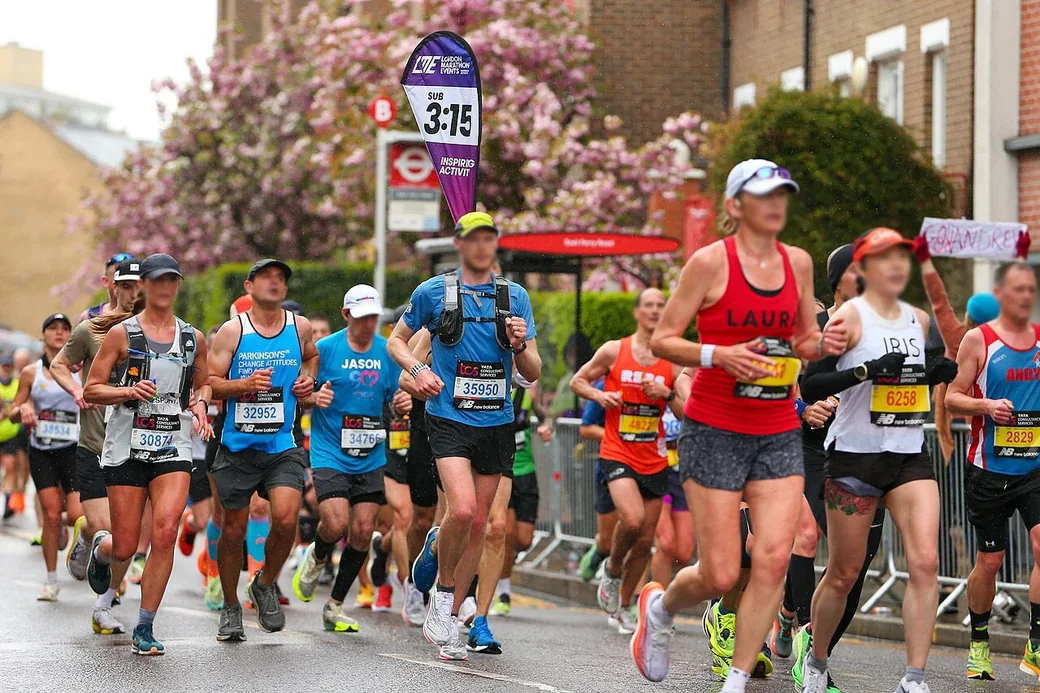
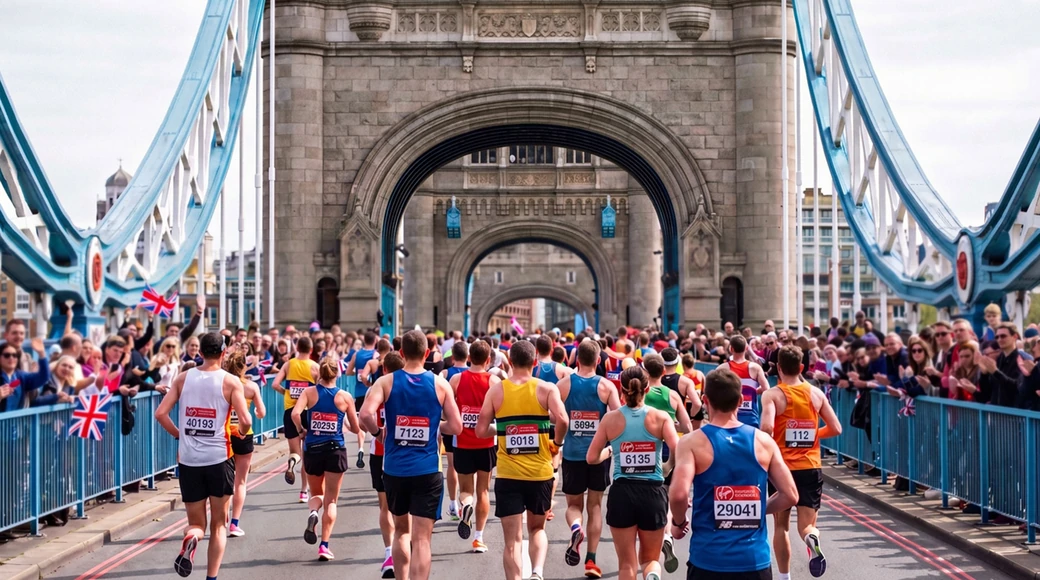
TCS London Marathon, thousands of runners in colorful kit crossing Tower Bridge while crowds cheer them on along the River Thames

TCS London Marathon

LondonApr 24, 2027 – Apr 25, 2027↻ Annual
Duration:2 daysType:
Sports & Outdoor Events
Admission:From 79.99 GBPLocationAnnual event — exact dates may vary each year

A 26.2-mile journey from Greenwich to The Mall in front of Buckingham Palace: the roar of Tower Bridge, the glass towers of Canary Wharf and hundreds of thousands of spectators. Home of world records and the biggest one-day charity fundraiser on earth.

About This Festival

London Marathon History: A People's Festival Born in 1981

The London Marathon began with an article. After running the New York City Marathon, Olympic champion and journalist Chris Brasher wrote in The Observer that he had just seen the greatest folk festival the world had known, and he resolved to stage one in London. With fellow athlete John Disley he did exactly that: the first race took place on 29 March 1981, when roughly seven thousand of more than 20,000 applicants started and 6,255 reached the finish. The men's race ended in a tie, with Dick Beardsley and Inge Simonsen crossing the line hand in hand, while Joyce Smith won the women's title. Wheelchair racing joined in 1983, and since 2006 the elite race has belonged to the Abbott World Marathon Majors. The finish began at Constitution Hill, moved to Westminster Bridge, and has been on The Mall since 1994. Title sponsorship has passed from Gillette to Flora and Virgin Money; since 2022 it has been the TCS London Marathon.
London Marathon Route: 26.2 Miles from Greenwich to The Mall

The route begins south of the Thames at three start areas (red, green and blue) around Blackheath and Greenwich Park, and the three streams merge at Woolwich after about 4.5 kilometres. Next come Charlton, Greenwich around the Cutty Sark, Deptford, Rotherhithe and Jamaica Road, with the halfway point on Tower Bridge. On the north bank runners follow The Highway through Wapping and Limehouse, loop round the Isle of Dogs and Canary Wharf, then return via Tower Hill to Victoria Embankment and Birdcage Walk. The final turn in front of Buckingham Palace opens onto the finish on The Mall. The course is largely flat, with only about 85 metres of climbing. Why 26.2 miles? London plays a leading role: the 1908 Olympic marathon was measured from Windsor Castle to the royal box at the stadium, and that distance became the standard in 1921. According to a popular tale, Queen Alexandra asked for the start to be moved so that the young royals could watch from the nursery window, but the sources do not confirm it.

From Cutty Sark to Tower Bridge: The Course's Unforgettable Moments

The London route works like a stage set. Around mile six, runners circle the historic Cutty Sark clipper amid some of the thickest crowds on the course. Approaching halfway, the road rises slightly onto Tower Bridge, yet the wall of sound on the bridge wipes out any fatigue; experienced pacers call it the loudest place on the route. In Canary Wharf the tall buildings funnel the wind and can confuse GPS watches, so trust the mile markers. The London Eye and Big Ben come into view along the Embankment, the last kilometre begins on Birdcage Walk with spectators packed on both sides, and the turn at Buckingham Palace brings you onto The Mall, which many runners describe as the finest marathon finish in the world. Have your name printed on your vest and thousands of strangers will shout it. The BBC's long-running theme tune is Ron Goodwin's music for the 1966 film The Trap, and today the melody is remembered more for the marathon than the movie.

Rainbow Row and Neighbourhood Cheer Zones: The Marathon's Street Party

Along the route there are dozens of live bands, DJs, charity stations and running-club cheer points. Around mile 21, on Butcher Row in Limehouse, the 250-metre Rainbow Row celebrates the LGBTQIA+ community and inclusion, giving runners a huge lift just when fatigue peaks. Nearby, since 2012 the London running group Run Dem Crew has turned Commercial Road outside the former Limehouse Town Hall into a street party with music and confetti cannons. On the Rotherhithe Peninsula a two-mile stretch is full of bands, the Isle of Dogs has a DJ-led community point on Westferry Road, and Poplar High Street is a lovely place to watch alongside local residents. Because runners pass along The Highway twice, spectators can see them on the way out and the way back from the same spot. Colourful charity cheer points then turn the stretch from Tower Hill to the Embankment into a corridor of noise and encouragement.

World Records and Elite Racing: London's Fast Course

London has hosted some of the sport's defining moments. World records on this course have been set by Grete Waitz (1983), Ingrid Kristiansen (1985), Paula Radcliffe (2002, 2003 and 2005) and Mary Keitany (2017) among the women, and by Khalid Khannouchi in 2002 among the men. Radcliffe's 2:15:25 from 2003 is still quoted as the women's course record. The 2026 race made history: Sabastian Sawe ran 1:59:30, the first marathon under two hours in an official race, while runner-up Yomif Kejelcha clocked 1:59:41 on his marathon debut and third-placed Jacob Kiplimo also beat the previous world record. Among the women, Tigst Assefa ran 2:15:41 to improve the women-only world record, and three women went under 2:16 in the same race for the first time. The BBC has shown the race live from start to finish for decades, reaching more than 190 countries. Because the elites start separately from the mass field, an amateur runner and a world-record holder share the same streets on the same morning.

Wheelchair Racing, Support Runners and Accessibility Guide

Wheelchair racing joined the London Marathon in 1983, when 19 athletes started and 17 finished, and the race is credited with raising the visibility of disabled athletes. Today the elite wheelchair races are an integral part of the day. Standard wheelchairs are welcome, assisted wheelchairs are allowed within limits on numbers and helper teams, and battery-powered robotic exoskeletons may also be used. Runners who are visually impaired, or whose medical condition requires it, can request a free place for a support runner, and the Richard Whitehead Foundation helps with pairing. Drinks stations are accessible to wheelchair users, and accessible toilets are provided at the start, the finish and at set miles along the course. For spectators there are five barrier-free, steward-managed viewing areas with accessible toilets at the Cutty Sark, Canary Wharf, Rainbow Row, Tower Hill and Victoria Embankment, and a disabled spectator may bring one companion. The finish area offers a Sensory Calm Space, a Parent and Child Space for feeding and young children, and a multi-faith prayer space open to everyone.

Running for Charity: The World's Biggest One-Day Fundraiser

The London Marathon is far more than a sports race: since 1981 it has raised more than 1.4 billion pounds for good causes. Most participants run through charities, which ask runners to commit to a fundraising target; terms differ from one charity to the next. In 2025 the total passed 87 million pounds, a world record for an annual one-day fundraising event, and in 2026 the figure had already been beaten within days of the race. Donations flow through online platforms such as Enthuse and JustGiving, and each year one charity is chosen as Charity of the Year. The organiser's yearly surplus goes to the London Marathon Foundation, which has awarded more than 110 million pounds to around 1,700 projects that get people active. After the race many charities host receptions for their runners and families, so contact yours in advance if you have no invitation. Records are part of the culture: Sir Steve Redgrave in 2006 and Steve Chalke in 2011 each set Guinness records for money raised in a single marathon.

Fancy Dress and Guinness World Records: The Fun Side of the London Marathon

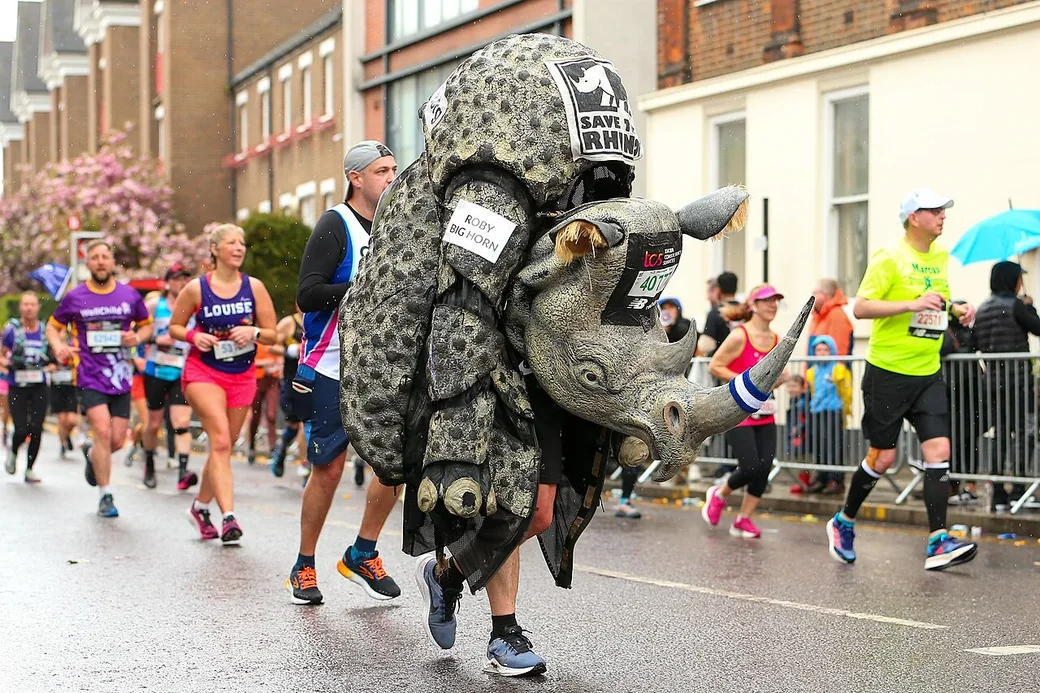
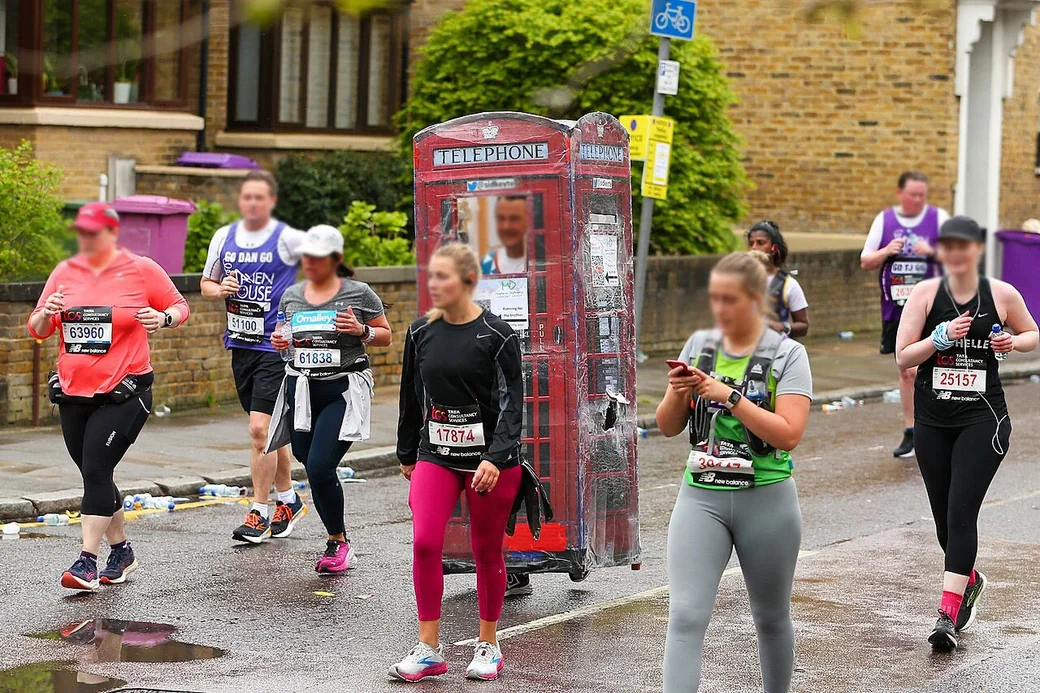
The London Marathon is famous for fancy dress. Runners regularly take on 26.2 miles as a badger, a helicopter, a knight in armour or a two-person elephant, usually to support a charity. In 2002 Lloyd Scott finished in a diving suit weighing around 50 kilograms. Guinness World Records partners with the organisers every year: anyone holding a place can register their own record attempt before race day, and it is verified at the finish line. Fastest-marathon records have fallen here in categories such as elf, pirate, alien, traffic cone, mascot, suit and a ten-person costume. The event itself keeps breaking records: in 2026 it set a Guinness World Record for the most finishers in any marathon, with 59,830 people crossing the line. The "Ever Presents", runners who have completed every London Marathon since 1981, numbered 42 when their list began in 1995 and had fallen to ten by 2019, and they remain a cherished part of the tradition.

How to Enter the London Marathon: Ballot, Charity, Good For Age and More

There are several ways in. The public ballot opens briefly about a year before the race, the draw is completely random and results arrive by email in early summer. Demand keeps growing: the last three ballots drew more than 840,000, 1.1 million and 1.3 million applications, and the chance of success has fallen to a low single-digit percentage. Those who donate their entry fee get a second draw. If the ballot fails, a charity place is the most realistic route, with registration and fundraising terms set by each charity. Fast runners can use Good For Age, a limited quota split equally between women and men that requires residency in the host country, a time on a certified course and proof of age. Championship entry is for high-level runners registered with their federation; the qualifying time lets you apply but does not guarantee a place. There are also running-club places, a separate route for participants with disabilities, an international ballot and official tour operators. You must be 18 on race day; places cannot be transferred but can be deferred under certain conditions, and pregnant or postnatal women can defer to a year of their choice.

Running Show and Race Pack: Where to Collect Your Bib

At the London Marathon your bib is collected only at the TCS London Marathon Running Show at ExCeL London (Royal Victoria Dock) in the days before the race. There is no collection on race day and nothing is posted, with no exceptions. You will need the QR code from your email and photo ID. If you cannot go, someone else can collect for you, bringing a copy or screenshot of your ID, your written consent and their own ID, and they may collect for only one other person besides themselves. The pack holds a chipped bib, safety pins and an official kitbag with a sticker matching your number, which you drop at the start into the baggage lorry allocated to you. The Running Show is among the biggest running expos anywhere, with expert talks, shoe and wearable-tech demos, charity stands, name printing on vests and a massage area. Friday and Saturday queues can reach an hour, so Wednesday or Thursday is smarter. ExCeL is reached from Custom House station (Elizabeth line and DLR). Medal and T-shirt are optional at registration, and a tree is planted for everyone who skips the T-shirt.

Race Day Guide: Starts, Pacers, Water Stations and Toilets

Runners at the red, green and blue starts are guided by the colour code on their numbers. Only participants may enter the start area, so plan to meet family near the finish. You cannot move forward in your start wave, but you are free to drop back. Pacers carry a flag showing their finish time and cover targets from about 2 hours 45 minutes to 7 hours 30 minutes. Water stations come every three miles at first and then every two; a sports drink is handed out at miles 7, 15, 21 and 23, and gels at miles 13 and 19. Refill points for bottle belts and hydration packs are at miles 5, 10, 14, 17 and 20. Toilets are at the start, at every mile from 1 to 24 and at the finish. No food is given out at the finish, so bring your own snack. GPS watches can drift in Canary Wharf and the Westferry underpass, so rely on mile signs. The first three miles are a net downhill but crowded, so avoid weaving. The official app lets friends track you live and can be downloaded about ten days before.

Watching the London Marathon: Best Spots, Quieter Corners and the Meeting Area

The six busiest areas are Cutty Sark/Greenwich, Canada Water/Rotherhithe, Tower Bridge/Tower Hill, Canary Wharf, Rainbow Row (Limehouse) and Victoria Embankment/Westminster. Quieter options include the Rotherhithe Peninsula (miles 9–11), The Highway (miles 14 and 22, where you see runners twice), Westferry, the DJ-led Isle of Dogs and Poplar High Street, where you stand with locals. Station queues can reach 90 minutes, so consider walking to Cutty Sark from Deptford or Greenwich, using London Bridge instead of Tower Hill for Tower Bridge, the Elizabeth line or DLR for Canary Wharf, and Shadwell or Westferry for Limehouse. Westminster station is usually exit-only on race day. To find your runner, use the lettered Meet and Greet Area around Horse Guards Avenue, Whitehall, Horse Guards Road and Horse Guards Parade; runners take about half an hour to reach it, so agree a letter beforehand and do not rely on your phone alone. According to a popular tradition, spectators hand runners jelly babies and orange slices, an old London custom, though it is wise to treat food from strangers in line with your own fuelling plan.

London Marathon Weekend: Transport, Road Closures and Where to Stay

Road closures are confirmed about five weeks before the race and published on the official site; bus routes are diverted or suspended along the course, so check TfL announcements. The DLR, London Overground, Elizabeth line and Underground form the backbone, and there is also the river: Uber Boat by Thames Clippers links Woolwich (Royal Wharf) and Westminster, calling at Greenwich, Canary Wharf, Rotherhithe, Tower and Embankment piers, with toilets and a café bar on board. Two accommodation strategies stand out: Greenwich, Blackheath or Canary Wharf if you want to be near the start, or Westminster, Victoria and Waterloo for the finish and celebrations. London Bridge and Southwark are the easiest bases for watching halfway at Tower Bridge on foot. The official hotel partner, Marathon Tours & Travel, offers exclusive rates, flexible payment plans and optional transport to the start. Hotels fill very early on marathon weekend, so book months ahead. The organiser sells no hospitality tickets, and for visitors from abroad official tour operators offer guaranteed-entry packages. The official kitbag you drop at the start is collected at the finish from the lorry matching your number.

Safety, Medical Support and Lost Property at the London Marathon

The organisers work with the Metropolitan Police and other bodies: trained security staff, random bag searches, sniffer dogs and extensive CCTV are used, along with measures you cannot see. Medical cover is extensive, with around 150 doctors, more than 1,500 St John Ambulance volunteers, over fifty first-aid posts along the route and field hospitals at the finish. Information points and drinks stations stock bladder pads, tampons and sanitary towels, and anyone with a bladder or bowel condition can get a Just Can't Wait card. April weather in London is changeable, so dress in layers and pack sun cream and a light windproof. Phone coverage can fail in crowds, so set a meeting point and a backup plan, and keep your phone out of sight. Lost property is handled through an official online form, and found items are kept safely for 30 days after the race. If your time is wrong or missing, use the correction form on the results page, which is also where you find your photos and finisher's certificate through Sportograf.

Sustainability, the Mini Marathon and London's Sister Events

The London Marathon became the first road race to reach platinum level in World Athletics' Athletics for a Better World standard. Around 60 per cent of waste was kept out of landfill and incineration; Buxton and Lucozade Sport bottles are recycled in a closed loop into new bottles, refill points have been increased, numbers are printed on demand and no food is handed out at the finish. Medals are made from recycled zinc alloy and shipped by sea. Around the marathon sits a family of events: the TCS Mini London Marathon covers the last three miles of the course for schoolchildren, and TCS London Marathon MyWay lets you complete 26.2 miles anywhere in the world within the day. The same organiser stages the Big Half, the Vitality London 10,000, the Westminster Mile, Swim Serpentine and the Royal Parks Half. The London Classics medal goes to those who finish the marathon, a long-distance cycling event and a two-mile open-water swim in the Serpentine, and it is engraved "Et ego Londinium vici": "I too have conquered London".

Practical Information

When

Every year in April, traditionally on a Sunday. The elite races, the wheelchair races and the mass race all start in the morning, and the course stays open into the afternoon for slower runners. The race dates and the format of each edition are announced on the official website.

Where

The three start areas lie around Greenwich Park and Blackheath (Charlton Way, St John's Park and Shooter's Hill Road); the finish line is on The Mall, beside Buckingham Palace and St James's Palace. Race numbers are collected at the Running Show at ExCeL London (Royal Victoria Dock, E16 1XL).

Cost

Watching is free and no ticket is needed. For runners, a successful ballot entry carries a fixed fee, higher for international entrants because it includes a carbon offset for travel; charity places carry a registration fee plus a minimum fundraising target that varies by charity. Current amounts are shown in the price fields of this page, and fees are reviewed every year, so check the official website.

Tips

Collect your race pack on the Wednesday or Thursday to avoid the Friday and Saturday queues. Carry photo ID and the QR code from your email. Choose walkable alternatives to the busiest stations, agree a lettered meeting point for the finish, dress in layers because April weather is changeable, and book your hotel months ahead.

Specific to this festival

First run in 1981, the London Marathon is one of the World Marathon Majors and holds the record as the world's largest annual one-day fundraising event, so many runners take part for a charity. The route links the city's landmarks, passing the Cutty Sark in Greenwich, crossing Tower Bridge near halfway and running along the Embankment past the Houses of Parliament before finishing on The Mall. Runners in costume chase Guinness World Records along the way, the Mini London Marathon gives young people races of their own, and the TCS London Marathon MyWay option lets you cover the distance on a route of your choice.

Accommodation and hotel options during TCS London Marathon

Accommodation and hotel options around the event venue, with their prices, are shown by Stay22 as a map and a list. Cookies are used. Your consent is remembered on every page; you can turn it off at any time in the cookie settings.

Keep Exploring

Travel essentials for London

Flights, transfers, car rental, eSIM and insurance — compare your options

Flights

Find the best route

Transfers

Airport & city ground transport

Car Rental

Drive at your own pace

eSIM

Stay connected on arrival

Insurance

Cover your trip