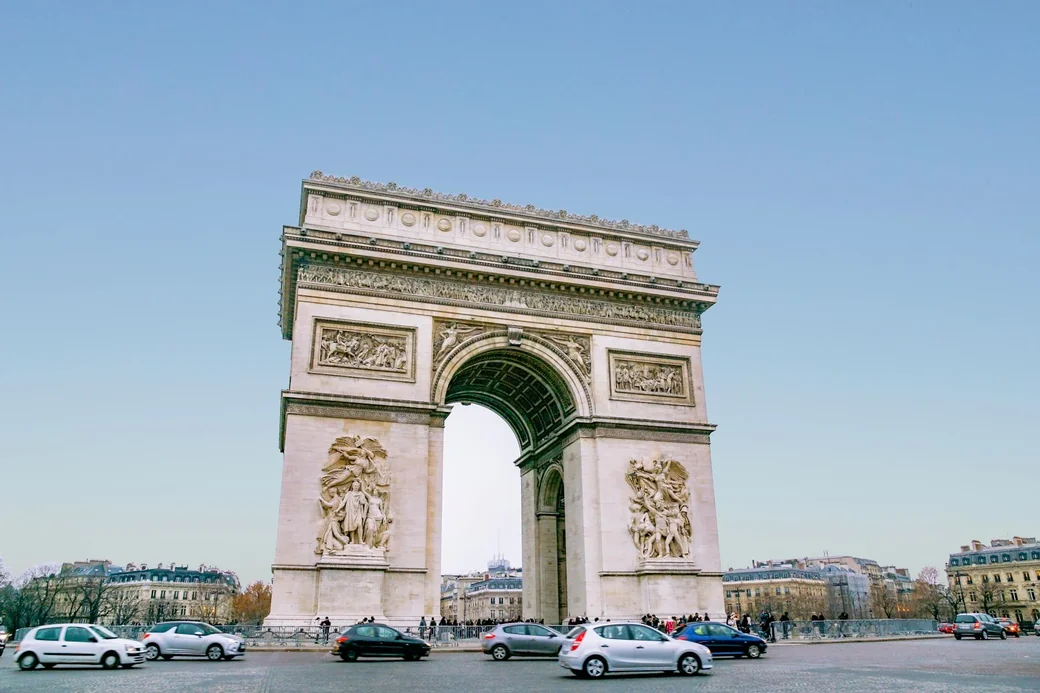
The Arc de Triomphe is a monumental triumphal arch and one of the foremost national memorials of France. It stands at the western end of the Champs-Élysées, in the centre of Place Charles-de-Gaulle on the Right Bank of Paris, on the rise that crowns the avenue. Its massive stone piers are covered in sculpture, a rooftop terrace sits on top, and its outline has become as much a symbol of Paris as the Eiffel Tower.
Arc de Triomphe: Location, accommodation options and contact
Place Charles de Gaulle, 75008 Paris, France
The place's location on the map and nearby accommodation and hotel options are shown by Stay22. Cookies are used. Your consent is remembered on every page; you can turn it off at any time in the cookie settings.
Napoleon Bonaparte commissioned the arch in 1806, a few months after his victory at the Battle of Austerlitz, to honour the soldiers of the French Revolution and the Empire. Architect Jean Chalgrin modelled it on the ancient Arch of Titus in Rome but multiplied its scale — 50 metres tall, 45 metres wide, 22 metres deep, making it the largest triumphal arch in the world until 1938; only the Monumento a la Revolución in Mexico City and the Arch of Triumph in Pyongyang exceed it today. Construction stalled repeatedly through the political turbulence of the following decades; work all but stopped during the Bourbon Restoration, when honouring Napoleonic victories fell out of official favour. The arch was finally inaugurated in 1836 under King Louis-Philippe, thirty years after it was first conceived and fifteen years after Napoleon died in exile on Saint Helena, having never seen it completed.
The Tomb of the Unknown Soldier and the Eternal Flame
Beneath the arch lies the Tomb of the Unknown Soldier, where an unidentified French casualty of the First World War was interred in 1921 to represent all of the conflict's nameless dead. The inscription reads simply: here rests a French soldier who died for the homeland. Its Eternal Flame was first lit in November 1923 and has been rekindled every evening at 6:30pm without interruption since — through the German occupation of Paris, the Liberation, and eight decades of change — by veterans' associations in a ceremony now considered one of Europe's longest-running acts of remembrance. Visitors are welcome to attend, but it is a solemn moment: keep your voice down and treat photography with restraint near the flame. Whatever the season, a small, quiet crowd gathers every evening to watch.
Sculptures and Inscriptions Worth Seeking Out
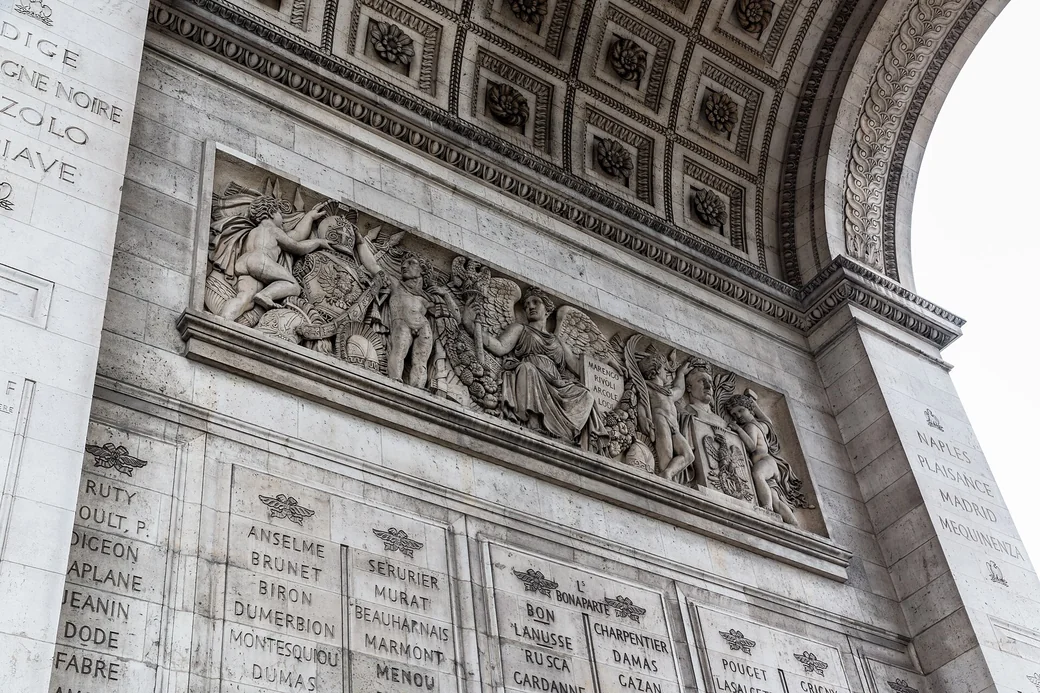
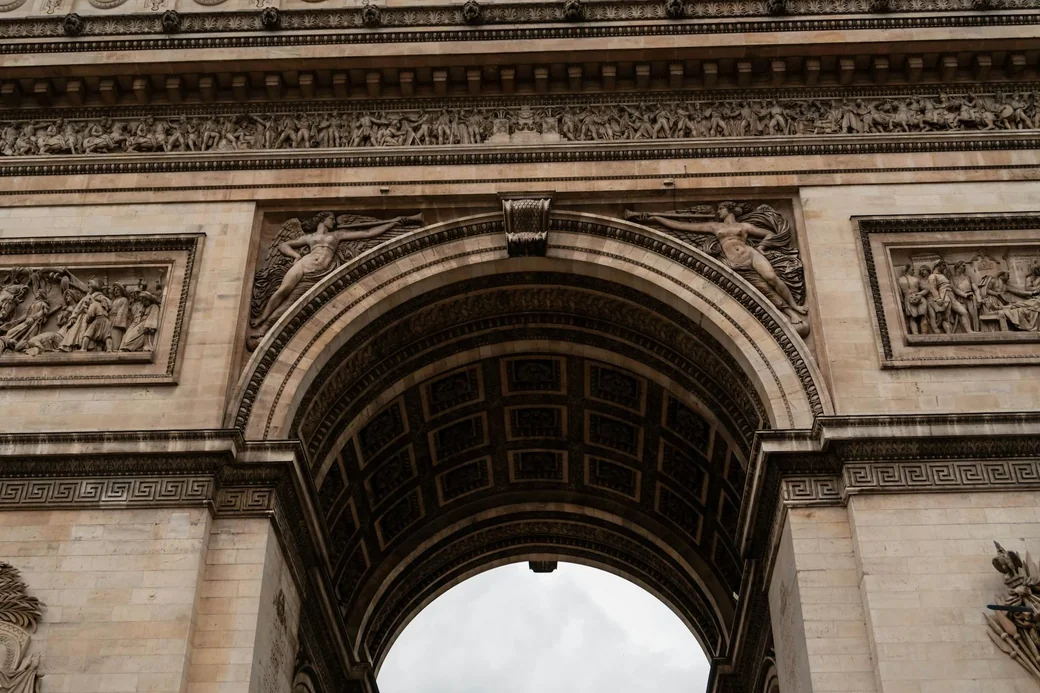
Look closely and the arch reveals itself as a monument covered in storytelling. The most famous of its four great relief panels is François Rude's 'La Marseillaise', formally titled Departure of the Volunteers of 1792, showing citizen-soldiers rallying beneath a winged personification of Liberty. Its three companion reliefs depict Triumph, Resistance and Peace, marking different chapters of the Napoleonic era. Above them, a continuous frieze of sculpted soldiers wraps the structure. Step inside and you'll find 660 names — 558 of them French generals — and 128 major battles of the Revolutionary and Napoleonic Wars carved into the stone pillars — a roll call of military history that takes a genuinely long walk to read in full.
The Panoramic Terrace and Its Star of Avenues
The reward for the climb — 284 spiral stone steps — is one of the best free-standing viewpoints in Paris. From the 50-metre-high rooftop terrace, twelve grand avenues radiate outward from the roundabout in a perfect star pattern, the feature that gave the square its historic name, Place de l'Étoile. Look one way and the Champs-Élysées runs arrow-straight toward the Louvre and Place de la Concorde; look the other and the glass Grande Arche de la Défense rises on the skyline, in near-perfect alignment with this arch and the Louvre's own triumphal arch — a sightline sometimes called the Axe Historique. On a clear day you can also pick out the Eiffel Tower and the white domes of Sacré-Cœur.
Reaching the Arch Without Crossing Traffic
Place Charles de Gaulle is one of the busiest roundabouts in Paris, where twelve avenues converge into a single ring of traffic — and it is genuinely not possible, or safe, to cross it on foot at street level. Instead, look for the signed underground pedestrian passages that run beneath the roundabout, with two entrances: one at the top of the Champs-Élysées on the north (even-numbered) side, the other on Avenue de la Grande Armée. Follow the 'Arc de Triomphe' signage through the tunnel and you'll come up directly at the ticket office, without ever setting foot on the roadway above.
Nearest Metro, Bus and Parking
Charles-de-Gaulle–Étoile station sits directly beneath the monument and is one of the largest transit hubs in Paris, served by Métro lines 1, 2 and 6 as well as RER A — by far the simplest way to arrive. Multiple bus routes, including lines 22, 30, 31, 52, 73 and 92, stop within a short walk along the surrounding avenues. Drivers can find several underground pay car parks along Avenue Foch and Avenue de Wagram, though spaces fill quickly; a marked drop-off point for taxis and private vehicles sits on the median of Avenue de la Grande Armée, just outside the pedestrian tunnel entrance.
Accessibility for Wheelchair and Reduced-Mobility Visitors
Loaner wheelchairs are available at the entrance in exchange for an ID card, and a lift reserved for visitors with reduced mobility runs up to the museum level beneath the roof. It does not reach the panoramic terrace: the remaining steps have to be climbed on foot, so the terrace itself is not wheelchair accessible. It is worth checking lift status before you go, since the full 284-step staircase is the only alternative during maintenance work. Restrooms adapted for reduced mobility are available on site, and guide or assistance dogs are welcome throughout. Magnifying glasses and noise-cancelling headphones can be borrowed from the ticket office for visitors who need them.
Best Time to Visit and How to Skip the Crowds
The calmest windows are right at opening time or in the last couple of hours before closing, when tour groups have thinned out. Weekdays, especially Tuesday through Thursday, run noticeably quieter than weekends. Midday during the busy April-to-September season brings the heaviest coach-tour traffic, so if your schedule is flexible, aim either side of it. Sunset is the single most popular slot for the view and for photographs, which means it's also the most crowded — booking a timed ticket online in advance is the best way to secure that golden-hour spot on the terrace without a long wait.
What to Wear and Bring
There's no formal dress code here — it's an open-air national monument, not a religious site — but a few practical choices make the visit easier. The terrace is reached by 284 spiral stone steps so comfortable, flat shoes matter more than anything else you pack. The rooftop is exposed to wind and can feel noticeably cooler than street level, even on a mild day, so a light jacket is worth carrying. Security screening at the entrance is similar to an airport checkpoint, so keep bags small and be ready to have them checked.
Photography Tips and the Best Angles
The arch is among the most photographed monuments in the world, so a little planning helps your pictures stand apart. The terrace itself, right at sunrise or sunset, gives the single best shot: the twelve avenues fanning out symmetrically below, lit low and golden. For a classic ground-level silhouette, stand back along Avenue de la Grande Armée and frame the arch against the sky. Looking uphill along the Champs-Élysées from a few blocks down creates a strong forced-perspective shot, with the avenue's plane trees lining the frame. Tripods are impractical in the terrace crowds, but a steady handheld shot works fine in daylight; at night the façade is floodlit, so flash photography adds little and is best left off.
Ideal Visit Duration and Nearby Sights to Pair It With
Budget roughly 45 minutes to an hour for the climb, the terrace and the small museum space inside the arch, with extra time built in for security queues during the busy season. It pairs naturally with a walk down the Champs-Élysées toward Place de la Concorde and the Tuileries Garden, past the avenue's flagship shops and cafés — about a 30-to-40-minute stroll. Alternatively, head the other direction along Avenue Kléber toward Trocadéro, roughly 20 minutes on foot, for one of the classic postcard views of the Eiffel Tower across the Seine.
Language Support and Guided Tour Options
Self-guided visit booklets are available on site in eleven languages, so most visitors can follow the history without a live guide. Lecturer-led guided tours, when scheduled, run in French and English. An interpretive digital app and a separate 360-degree terrace experience add narrated context in French, English and Spanish, and the information panels displayed inside the monument itself are presented bilingually in French and English.
Etiquette: What to Do and Avoid
This is an active war memorial as much as a tourist landmark, so a little restraint goes a long way, particularly near the Tomb of the Unknown Soldier and during the daily 6:30pm flame ceremony — keep your voice down and be mindful with cameras in that moment. Drones are prohibited around the monument, and large suitcases, oversized backpacks and glass bottles will be refused at the security checkpoint, with no storage available on site. Climbing on the stonework outside marked visitor areas isn't permitted. On the terrace, stay behind the safety barriers rather than leaning over them for a photo — the platform is higher, and windier, than it looks from the ground.
Visiting with Children
The star-shaped web of avenues seen from the terrace tends to fascinate children as much as adults, but the platform's railings sit at roughly waist height for an adult, so hold young hands firmly rather than letting them explore the edge alone. Strollers cannot be taken up the 284-step staircase and there's no stroller parking or cloakroom at the base, so plan for a carrier or for one adult to carry a child up. If your visit lines up with early evening, the flame-lighting ceremony is a gentle, low-key moment to introduce children to why the monument matters, without needing to dwell on the harder details of the history.
A Living Stage for National Ceremonies
Over time, the arch's meaning has broadened from a tribute to one emperor's campaigns into a memorial to French military history as a whole. The arch is still very much a working national monument rather than a historical relic. France's Bastille Day military parade sets off from beneath it every 14 July and marches the length of the Champs-Élysées, and troops passed under it during the Liberation of Paris in August 1944, a moment still commemorated at the site. State funerals and the Armistice Day wreath-laying on 11 November are also held at the Tomb of the Unknown Soldier. On these occasions the monument can close to regular visitors for part of the day, so it's worth checking the official calendar before planning a trip around those dates.
Arc de Triomphe: Visitor Tips
Book your timed entry online before you go — it skips the ticket-office queue, though not the security check. Arrive with a small bag: large suitcases, big backpacks and bulky luggage are turned away at the security screening, and there's no on-site storage or cloakroom.
Arc de Triomphe: Best Time to Visit
Arrive near sunset for golden light over the Champs-Élysées, or on a weekday morning to beat the tour-bus crowds; the 6:30pm flame ceremony is a daily highlight.
Arc de Triomphe: Admission Fees
Adult – low season
Applies to visits from October to March. Covers the exhibition and the panoramic rooftop terrace; walking beneath the arch to the Tomb of the Unknown Soldier is free.
€16
Adult – high season
Applies to visits from April to September. Covers the exhibition and the panoramic rooftop terrace; walking beneath the arch to the Tomb of the Unknown Soldier is free.
€22
Adult – Wednesdays in high season
The low-season price applies on Wednesdays during the high season. Covers the exhibition and the panoramic rooftop terrace; walking beneath the arch to the Tomb of the Unknown Soldier is free.
€16
Under 18 (free)
Free for all visitors under 18, whatever their nationality. A valid ID showing date of birth may be requested.
Free
Ages 18–25 from the EEA (free)
Free for nationals or residents of an EEA country aged 18 to 25. ID (and proof of residence where relevant) is required.
Free
Visitors with disabilities + companion (free)
Free for visitors with a disability, plus one companion. Proof of disability status is required.
Free
First Sunday of the month (free)
Free for everyone on the first Sunday of the month, from November to March.
Free
Job seekers from the EEA (free)
Free for job seekers from the EU or EEA who show a job-seeker certificate less than six months old.
Free
Quick Info
45m
moderate
Arc de Triomphe: Getting There
The Arc de Triomphe sits directly above Charles-de-Gaulle–Étoile, one of the busiest interchange stations in Paris, served by Métro lines 1, 2 and 6 plus RER A — so arriving by public transport is by far the easiest option. From the station, follow signs for 'Arc de Triomphe' through the underground passages; you'll emerge right at the ticket office without ever touching the surface roundabout. Bus lines 22, 30, 31, 52, 73 and 92 all stop nearby along the Champs-Élysées or Avenue de la Grande Armée. If you're walking from central Paris, the most scenic approach is on foot up the Champs-Élysées from Concorde, roughly a 30-40 minute stroll past the avenue's flagship stores and cafés. Driving is not recommended: the Place Charles de Gaulle roundabout is famously chaotic, with twelve avenues merging into a single traffic circle, and street parking nearby is scarce and expensive.
Nearby stops & parking
Charles-de-Gaulle–Étoile (Métro 1, 2, 6 and RER A) sits directly beneath the arch, with exits onto the Champs-Élysées, Avenue Foch, Avenue Kléber and Avenue de la Grande Armée. Bus stops for lines 22, 30, 31, 52, 73 and 92 are within a two-minute walk. Drivers will find several underground pay car parks along Avenue Foch and Avenue de Wagram; a taxi and private-vehicle drop-off point is marked on the median of Avenue de la Grande Armée.
Arc de Triomphe: Dress Code & Etiquette
There is no dress code — this is an open-air monument, not a place of worship. The only practical consideration is footwear: the climb to the terrace is 284 spiral stone steps, so comfortable flat shoes make a real difference, and a light jacket is worth carrying since the rooftop can be breezy even on a mild day.