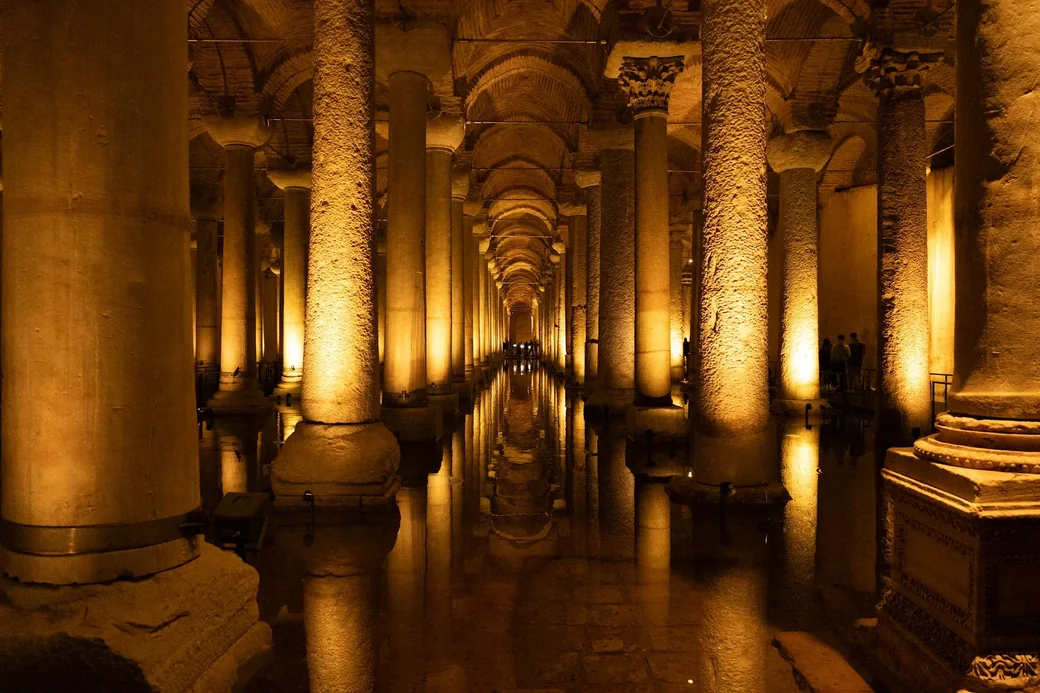
The Basilica Cistern (Yerebatan Sarnıcı) is a vast underground water reservoir from the Byzantine era, hidden beneath the streets of Sultanahmet in the heart of Istanbul's historic peninsula. It is the largest covered Byzantine cistern that survives in the city. Inside, a dimly lit forest of marble columns rises from shallow water, creating one of the most atmospheric spaces in Istanbul, and the cistern is now open to visitors as a museum.
Basilica Cistern: Location, accommodation options and contact
Alemdar Mahallesi, Yerebatan Caddesi No: 1/3, 34110 Sultanahmet, Fatih, Istanbul, Türkiye
Google Maps: https://www.google.com/maps/search/?api=1&query=41.008384,28.977878
The place's location on the map and nearby accommodation and hotel options are shown by Stay22. Cookies are used. Your consent is remembered on every page; you can turn it off at any time in the cookie settings.
Basilica Cistern history: Justinian's underground reservoir of 532
The Basilica Cistern is generally dated to 532, when Emperor Justinian I rebuilt Constantinople after the Nika riots; some sources give a wider construction span between 527 and 542. A basilica had stood on the site, reportedly burnt in 476 and restored, which is why the cistern bears its name. It stored water for the Great Palace and nearby buildings, fed by aqueducts from the Belgrade Forest. Locals later called it Yerebatan Sarayı, the Sunken Palace, because of the columns rising from the water. It lies southwest of Hagia Sophia. The basilica that gave the cistern its name was the Stoa Basilica, a great public square and basilica complex on the first hill of the city, and the Belgrade Forest, the source of its water, lies around twenty kilometres to the north.
336 columns and Byzantine engineering: Basilica Cistern facts and figures
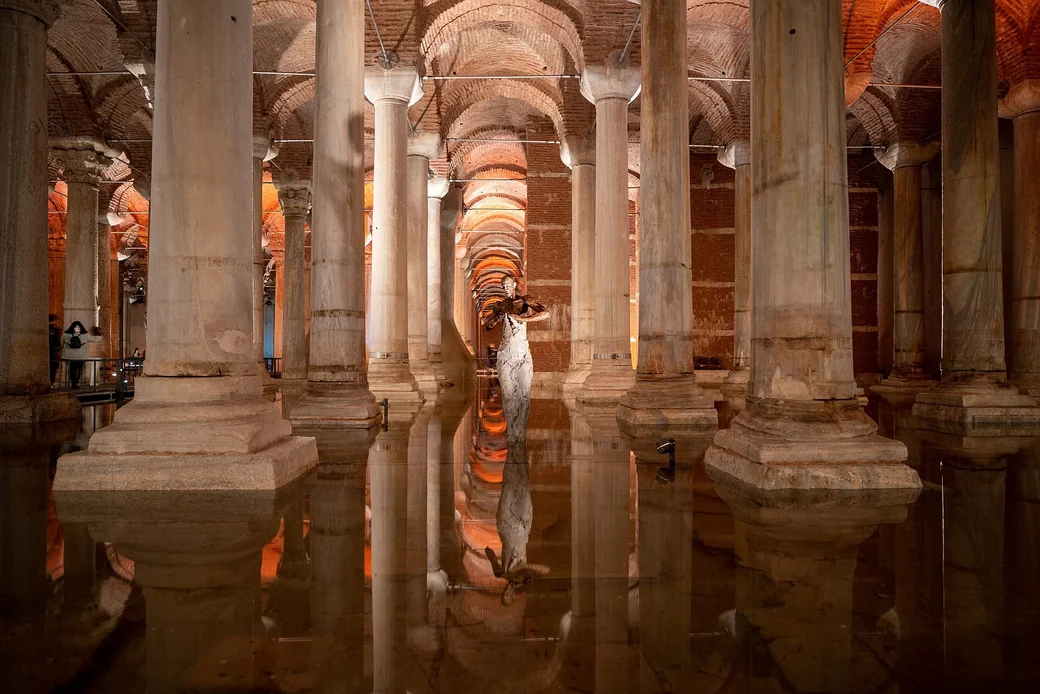
The chamber measures about 140 by 65 metres and covers close to 10,000 square metres. Its 336 marble columns stand about nine metres tall in twelve rows of twenty-eight, spaced roughly 4.8 metres apart, and carry brick vaults built without formwork. Walls and floor were sealed with a thick hydraulic mortar. Capacity is usually given as 80,000 cubic metres, though some sources say 100,000 tonnes. According to some sources, about forty columns on the northwest side are hidden behind fill and walls, and several were later reinforced with concrete. Many of the columns and capitals were reused from older buildings, which is why hardly any two look alike.
Medusa heads of the Basilica Cistern: facts and legends
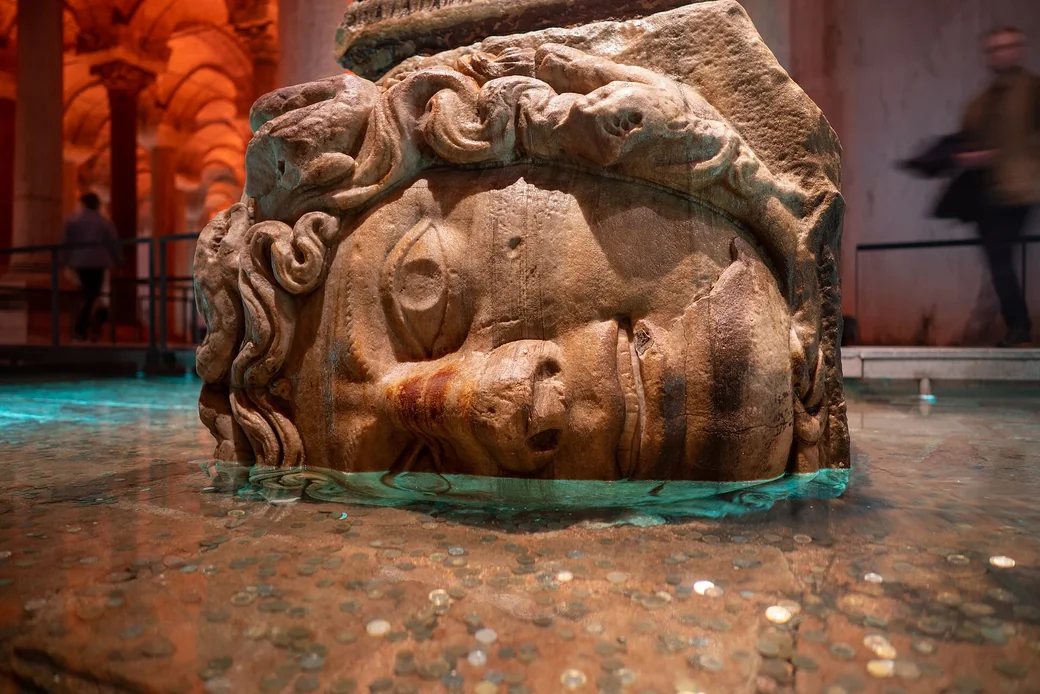
Two carved Medusa heads, believed to date from the Roman period, serve as column bases in the northwest corner, one sideways and one upside down. Nobody knows which building they came from. According to legend, they were turned so that no one would be turned to stone by Medusa's gaze, or they were placed as protective talismans. In a popular retelling, Athena, jealous of Medusa's beauty, curses her; this version differs from the classical myth, in which Perseus is sent to kill her. Most scholars see a practical height adjustment.
The Weeping Column (Hen's Eye): the legend of the slaves and the wish
One column is carved with raised eyes, slanting branches and teardrops, much like columns of the Arch of Theodosius I. According to legend, it honours the slaves who died building the cistern; tradition speaks of 7,000 workers and a construction lasting 38 years, figures no document confirms. Another account says the stone seems to weep simply because it looks damp. Visitors say that if you put your thumb in the hollow and turn your hand a full circle while making a wish, it will come true. This is a modern custom, not a historical one.
Secret stories of the Cistern: the Şahmeran sarcophagus, the vanished killer and more
More rumours circulate. According to legend, Venetian envoys asked Mehmed the Conqueror in 1456 for a sarcophagus said to lie in the cistern; centuries later, under Abdülhamid II, a lid was lifted and a mummified creature with a human head and a serpent's body, the Şahmeran, was shown at the Fatih Mosque. No record confirms it. Another tale says a killer fleeing the police in the 1970s vanished inside after a wall was built. The geographer İnciciyan also mentions a statue of Solomon above the cistern.
Rediscovery of the Basilica Cistern by Petrus Gyllius in 1545
After the Ottoman conquest of 1453 the cistern was largely forgotten by outsiders, yet neighbours knew it well. In the 1540s the French scholar Petrus Gyllius, whom some sources call Dutch, heard that people near Hagia Sophia lowered buckets through holes in their cellars to draw water and even catch fish. He went down with a torch, explored by small boat, measured the space and counted 336 columns. One account adds that residents hung watermelons on ropes down the shafts to keep them cool.
Restorations of the Basilica Cistern, from Ahmed III to today
Repairs began in the early eighteenth century under Ahmed III, by the architect Mehmed Ağa of Kayseri, and continued under Abdülhamid II. In 1968 cracks in the masonry and damaged columns were repaired. From 1985 to 1987 the municipality removed more than 50,000 tons of silt, revealing the Medusa bases, and opened a museum in 1987. A deep restoration reopened the cistern in 2022 with a modular steel walkway.
What to see inside the Basilica Cistern: carp, reflections and atmosphere
Follow the raised walkway slowly. Carp swim in the shallow water between the column bases, water drips from the vaults, and the air stays around 14 °C all year, so it feels cool in summer and mild in winter. Look for the difference between plain and carved capitals, the Medusa corner at the far end, the Weeping Column and the reflections of the colonnade. The 2022 restoration also introduced a digital exhibition called Daha Derine (“Going Deeper”) along with contemporary art and lighting; displays can change, so check what is on show during your visit.
Basilica Cistern in film and fiction: From Russia with Love and Inferno
The cistern's mood has attracted filmmakers. It appears in the 1963 James Bond film From Russia with Love, in which Sean Connery moves among its columns, and it features in Dan Brown's novel Inferno and the film made from it. In the novel a dangerous virus is hidden in the water, which is pure fiction rather than legend. If you enjoy these stories, look for the Medusa bases and imagine the scenes; the walkway offers the best angles.
Best time to visit the Basilica Cistern and how to avoid the crowds
The cistern is among Istanbul's busiest sights. Crowds are heaviest around midday and early afternoon; the first hour after opening and the late afternoon are calmer, and weekdays beat weekends. Spring and autumn bring pleasant weather for the walk through Sultanahmet, while summer visitors enjoy the cool interior. Plan the cistern for the quieter hours of your day when you combine it with Hagia Sophia, and check current opening hours before you go.
Photography in the Basilica Cistern: no flash, best spots and settings
Photos and video without flash are allowed as long as you do not disturb other visitors, but costumed photo sessions are not. Tripods and professional shoots require written permission, so apply in advance. Light is dim: use night mode, raise the ISO, brace your elbows on the railing and wait for gaps between groups. The classic shots are the colonnade from the first platform, reflections in the water and a close-up of the Medusa bases. Avoid stopping in narrow spots where others need to pass.
Practical tips for visiting the Basilica Cistern: shoes, jacket and steps
Wear shoes with good grip because the walkway can be damp and slippery. Bring a light jacket: it is around 14 °C inside. Expect about fifty steps down and back up. Suitcases and travel luggage are not allowed in, for security reasons. Allow 30 to 60 minutes; photographers and history lovers may stay longer. Queues form at peak times, so check whether advance booking is possible.
Do's and don'ts at the Basilica Cistern
Do walk slowly, follow staff instructions, keep to the walkway and step aside to let others pass while you photograph. Do keep your voice low, because the vaults echo. Don't use flash, don't touch or lean on the historic columns and don't climb the railings. Avoid throwing coins into the water: visitors make wishes this way, but it is not a documented tradition and the water is part of the monument. Keep children close, as the floors are wet.
Accessibility and family visits at the Basilica Cistern
The way down includes around fifty steps, so access matters. A lift and staff-assisted entry are reported for wheelchair users, and the raised walkway is flat, which also suits strollers; please confirm the arrangements with staff on arrival. Children usually love the fish and the Medusa story, but the walkway is wet and dim, so hold small hands. Visitors with limited mobility should allow extra time.
Near the Basilica Cistern: Hagia Sophia, Milion Stone, Blue Mosque and other cisterns
The cistern is part of the Historic Areas of Istanbul, a UNESCO World Heritage Site since 1985. Hagia Sophia is a few minutes away on foot, and the Milion Stone, the Byzantine zero point for distances, stands beside the entrance. The Blue Mosque and the Hippodrome are close, as are the Istanbul Archaeology Museums, where a similar Medusa head stands in the garden. Cistern lovers can continue to the Binbirdirek Cistern and the Şerefiye Cistern, both within walking distance.
Basilica Cistern: Visitor Tips
Arrive at opening, plan about 45 minutes and wear shoes with a good grip. Bring a light layer, because the interior stays cool all year. Photography and video without flash are allowed as long as you do not disturb others; tripods and professional shoots need written permission. Walk the platform slowly and pause at the Medusa corner and the Weeping Column. Combine the visit with Hagia Sophia and the Milion Stone nearby. Check the current opening hours and session times before you go. Treat every legend you hear as a story handed down by tradition, not as documented history.
Basilica Cistern: Best Time to Visit
Right at opening or in the last hour; weekdays are calmer. Spring and autumn are the most comfortable seasons, and the cool interior is a refuge in summer heat and winter rain.
Basilica Cistern: Admission Fees
Daytime entry – international visitors
Standard daytime admission to the cistern's columned hall and its elevated walkways.
TRY 1,950
Evening session – international visitors
Admission to the cistern's evening session, a calmer visit through the columned hall under atmospheric lighting.
TRY 3,000
Children up to 6 (free)
Free entry for children aged 6 and under; proof of age may be requested.
Free
Visitors with disabilities + companion (free)
Free for visitors with a disability and one companion; proof of eligibility is required.
Free
Quick Info
45m
easy
Basilica Cistern: Getting There
The Basilica Cistern sits in Sultanahmet, on the historic peninsula, a few minutes' walk from Hagia Sophia. The easiest way is the T1 Kabataş–Bağcılar tram: get off at Sultanahmet and walk a short distance; the Gülhane stop is also within walking distance. From the Asian side, take the Marmaray rail line to Sirkeci and continue by T1 tram or on foot. Ferry passengers can land at Eminönü or Karaköy and ride the tram from there. Driving is not recommended, because the streets of Sultanahmet are narrow, partly restricted and crowded. A taxi can drop you at Sultanahmet Square, a short walk from the entrance; just ask for "Yerebatan Sarnıcı".
Nearby stops & parking
The nearest stop is Sultanahmet on the T1 tram, about a three-to-five-minute walk away, and Gülhane is slightly farther. Sirkeci is the closest Marmaray station, with the T1 tram alongside it. Parking in the old city is scarce, so leaving your car outside the historic peninsula and using public transport saves time and stress. Taxis and tour buses use the area around Sultanahmet Square; ask your driver to stop near Hagia Sophia and walk from there.
Basilica Cistern: Dress Code & Etiquette
The cistern is not a place of worship, so there is no strict dress code, but modest, comfortable clothing works best. The interior is cool and humid and the walkway can be slippery: choose closed shoes with grip and bring a light jacket. If you also plan to visit Hagia Sophia or the Blue Mosque nearby, cover shoulders and knees, and women should carry a scarf for covering the hair. Keep your voice low, follow staff instructions and avoid flash.
Guide / Language
tr
en
Basilica Cistern: Amenities & Facilities
Lift and assisted access for visitors with reduced mobility