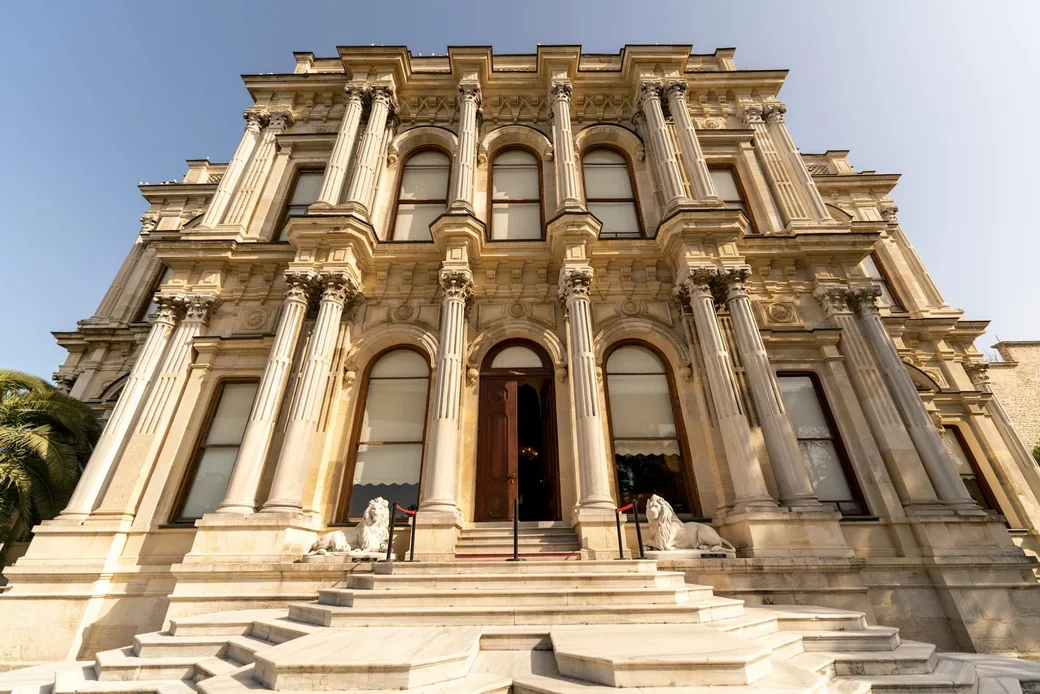
Beylerbeyi Palace (Beylerbeyi Sarayı) is a nineteenth-century Ottoman imperial palace on the Asian shore of the Bosphorus, in Istanbul's Üsküdar district, right beside the Bosphorus Bridge. Its white façade rises directly from the water's edge against a green hillside, and seen from the sea it is one of the most graceful sights on the whole strait. Today the palace is open to visitors as a museum, where the rooms and their furnishings still reflect the life of the late Ottoman court.
Beylerbeyi Palace: Location, accommodation options and contact
Abdullahağa Caddesi No:12, Beylerbeyi, 34676 Üsküdar / Istanbul, Türkiye
The place's location on the map and nearby accommodation and hotel options are shown by Stay22. Cookies are used. Your consent is remembered on every page; you can turn it off at any time in the cookie settings.
Beylerbeyi Palace History: From a Burned Wooden Palace to the 1865 Bosphorus Summer Residence
The area was known as Istavroz in Byzantine times and later took the name Beylerbeyi from a waterfront mansion of the Rumelian governor Mehmed Pasha. Sultan Mahmud II built a wooden palace here between 1829 and 1832, which caught fire in 1851 while Sultan Abdülmecid was staying. Abdülaziz had the remaining buildings pulled down in 1861. Work on the new palace began on 6 August 1863 and finished in 1864, and the official opening took place on 21 April 1865. The architect was Sarkis Balyan, whom some sources name together with his brother Agop. The Balyans were a family of architects who designed many imperial buildings of the period, and Abdülaziz conceived the palace both as a summer residence and as a place to receive foreign guests.
Beylerbeyi Palace Architecture and Interiors: Baccarat Chandeliers, Hereke Carpets and the Pool Hall
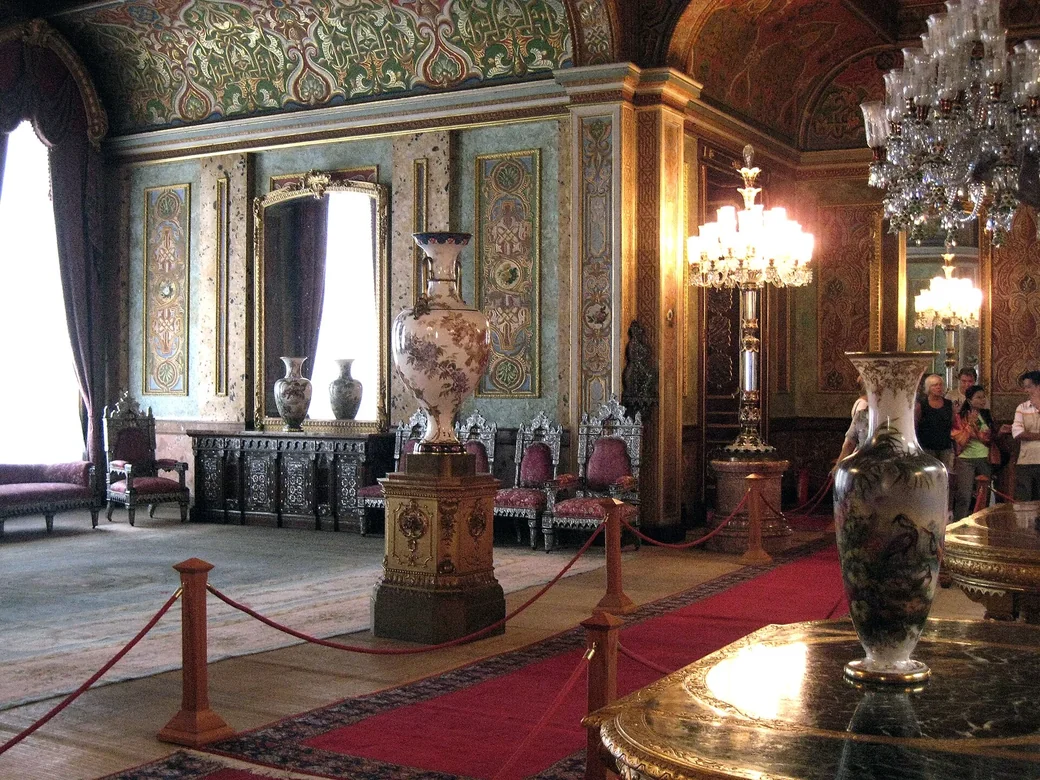
The palace mixes Renaissance, Baroque, Rococo and Neoclassical elements with the plan of a Turkish house. It has 24 rooms and six halls on three levels, and the Mabeyn and Harem wings have separate entrances. Floors are covered with Egyptian reed mats and Hereke carpets, and Baccarat chandeliers hang in the halls. The Pool Hall, with its marble pool and fountain, separates the two wings, and the Blue Hall lies above it. The three levels include the basement, the Mabeyn is the reception wing, and in keeping with the Turkish-house plan the rooms open onto central halls. Clocks made in England, France and at the Golden Horn shipyard stand in the rooms, along with vases of Chinese, Japanese, French and German porcelain and of Yildiz porcelain.
Sultan Abdülaziz's Passions at Beylerbeyi: Ship Ceilings and Bronze Animal Sculptures
Abdülaziz loved the sea, and ship scenes were painted in the ceiling frames of the palace. According to accounts, wild animals were first painted on the middle and upper floors and were later replaced by ships at the sultan's wish, by the court painter Mason. In the garden stand bronze lions, deer and a bull ordered from Paris by the sultan, who was fascinated by wild animals. The sculptures are attributed to Pierre Louis Rouillard and are counted among the first sculpture commissions of an Ottoman palace.
Royal Guests at Beylerbeyi Palace: Empress Eugénie, Franz Joseph and Wilhelm II
Beylerbeyi worked as the empire's guest palace. Its first important foreign visitor was Empress Eugénie of France in October 1869, who came in return for Abdülaziz's 1867 visit to France and stayed in the sultan's apartment, room 24. Emperor Franz Joseph of Austria-Hungary was hosted in the same year, Prince Nikola of Montenegro in 1874 and later Kaiser Wilhelm II. In the Republican period the palace continued to be used as a state guesthouse.
Abdülhamid II at Beylerbeyi Palace: Last Years, Room 8 and His Own Furniture
After the Balkan Wars the deposed Sultan Abdülhamid II was brought here from Thessaloniki. From 1 November 1912 he lived in the Harem section until his death on 10 February 1918 in room 8. His bedroom, study, bathroom and the room of his wife Müşfika Kadınefendi (title of a sultan’s official consort) have been restored, and the bed in which he died is displayed again. Chairs in the dining room carry the name Abdülhamid and come from the imperial workshop. Items from his study are also shown at the Abdülhamid Han Museum in Yıldız.
Beylerbeyi Palace Opening Hours, Closed Days and Holiday Schedule
The palace is closed on Mondays and open the other six days. It is closed on 1 January and on the first day of the Ramadan and Sacrifice festivals, but open on the other public holidays. Opening times can change with the season, so check the official National Palaces website or call +90 216 321 93 20 before you go. Only the main building is open, while the sea pavilions and upper-terrace pavilions are closed.
How to Get to Beylerbeyi Palace: Marmaray, Buses, Metrobus and Driving
From the European side, take Marmaray to Üsküdar and board a 15-series bus near the ferry pier, getting off at Beylerbeyi Sarayı. From Kadıköy, buses 15F, 12H and 14M go to the same stop. Üsküdar is also the terminus of the M5 metro line, ferries reach Üsküdar from Eminönü, Karaköy, Beşiktaş and Kabataş, and coastal ferries from Üsküdar also stop at Beylerbeyi. The metrobus stop at the Bosphorus Bridge (officially the 15 July Martyrs Bridge) is a short downhill walk away. Drivers leave the bridge on the Anatolian side and follow Beylerbeyi signs, where a parking area is reported. The address is Abdullahağa Caddesi No:12, Üsküdar. Map: https://www.google.com/maps/search/?api=1&query=41.042645,29.039905
Best Time to Visit Beylerbeyi Palace and Where to Take the Best Photos
Weekday mornings are calmest, and the rooms can feel more crowded after midday. Spring adds the blossom of the Judas trees, and the late afternoon light is lovely on the quay. The best viewpoints are the terrace facing the Bosphorus, the quay with the sea pavilions and the garden path from which the Bosphorus Bridge frames the water. Photography and video are not allowed inside the palace; outdoors, in the garden and on the quay, non-professional shooting is permitted as long as no costumes, extra equipment or lighting are used. In some summer periods the garden and quay have stayed open on selected evenings, so ask for the current schedule.
Beylerbeyi Palace Gardens and Pavilions: Terraces, Sea Pavilions and the Marble Pavilion
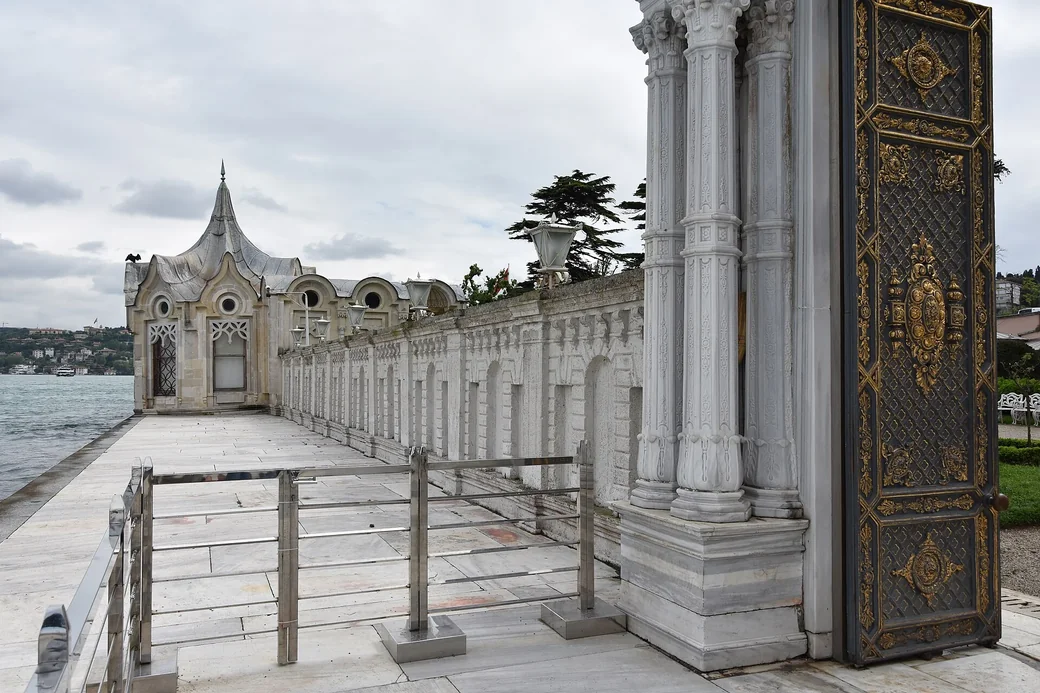
The terraced gardens, about 70 dönüm (a traditional land unit of roughly 1,000 square metres), rise from the sea and are linked by stairs and ramps. Magnolias and chestnuts in the private garden, lindens in the Harem garden and Judas trees on the terraces are known to have been planted in Abdülhamid II's time. The two sea pavilions have tent-like octagonal roofs painted with animals. The Marble Pavilion, a 1829–1832 hunting lodge, has a pool, and the Stable Pavilion has twenty stalls and horse-head reliefs. The gardens also hold the Yellow Pavilion. These pavilions are closed to visitors.
The Historic Beylerbeyi Palace Tunnel under the Terraced Gardens
A masonry tunnel runs beneath the terraced gardens of the palace. It was built under Mahmud II between 1829 and 1832 and served as the coastal road between Üsküdar and Beylerbeyi until the 1970s, when it was closed. It was reopened to traffic in 2016 after restoration that preserved its original fabric. Because it is part of the palace's own story, it is worth looking for on a map when you explore the area.
Beylerbeyi Palace Visiting Rules: What to Do and What to Avoid
Do follow the visiting route set by the staff and keep your voice down inside the building. Do take your pictures on the terrace and the quay, where outdoor photography is allowed; photos and video are not allowed inside. Do not touch the furniture, carpets, curtains or walls, Weapons are forbidden in all National Palaces, security checks are carried out at the entrance, and the palace's closed pavilions must not be entered. Do not climb on the garden sculptures or lean on the balustrades.
Beylerbeyi Palace Legends and Tales: The Stories Told About the Palace
Tradition adds colour to the palace, but none of these stories is a proven fact. According to legend, the wooden palace was thought unlucky after the 1851 fire. It is said that Empress Eugénie admired the window of her guest room so much that she had it copied for the Tuileries. According to one tale, Abdülaziz's tame lion played outside its cage and frightened bystanders. Legend says the Pool Hall fountain hid secret talks, that the district's name Istavroz comes from a huge cross, and that Abdülhamid II said the site was good but the layout poor, that he arrived saying his mother had died here, that he died of cold, that some chairs are his own work, that his furniture hid secret compartments and that 381 kinds of animals were once kept in the gardens.
Beylerbeyi Palace Accessibility and Visiting with Children
Beylerbeyi is a historic building with stairs and uneven surfaces, so access for wheelchairs and strollers is limited. Ask at the entrance for the most accessible route and for help from the staff. The gardens are laid out on terraces joined by stairs and ramps. Children usually enjoy the garden, the quay and the animal sculptures, while the palace rooms are best visited at a calm pace. Strollers are not allowed inside, so plan accordingly if you travel with a baby.
Audio Guide and Guided Tours at Beylerbeyi Palace
An audio guide is available at the palace, and an English version exists, with Turkish also offered. Licensed tour guides also work in the palace, and a guided visit usually takes about an hour. A guide or audio guide helps you recognise the Mabeyn and Harem sections, the Pool Hall and the rooms of Eugénie and Abdülhamid II.
What to See Near Beylerbeyi Palace: Küçüksu Pavilion, Çengelköy, Kuzguncuk and More
Other National Palaces on the Anatolian side include the Küçüksu Pavilion and the Beykoz Mecidiye Pavilion, both pleasant on the same day. Çengelköy lies along the coast beyond Beylerbeyi, and the palace tunnel once carried the coastal road between Üsküdar and Beylerbeyi. Kuzguncuk and Üsküdar are close by for a stroll and a meal. On the European shore, Dolmabahçe Palace and Yıldız Palace are other National Palaces that make a good contrast with the quieter Beylerbeyi. Beylerbeyi itself belongs to the Directorate of National Palaces, and next to Dolmabahçe it feels smaller, calmer and more intimate.
Beylerbeyi Palace: Visitor Tips
Arrive when the doors open, because the rooms are small and a single tour group can fill them. Keep an hour and a half for the palace and the gardens together. Photography and video are not allowed inside the palace; outdoors (garden and quay) non-professional shooting is permitted, and the terrace and quay give the best views of the Bosphorus Bridge. Wear comfortable shoes for the stairs and the sloping gardens. The ticket office closes before the palace does, so do not leave your arrival to the last half hour. Finish with a break at the garden café above the water.
Beylerbeyi Palace: Best Time to Visit
Weekday mornings just after opening; spring, when the Judas trees bloom; late afternoon light from the Bosphorus terrace
Beylerbeyi Palace: Admission Fees
Palace entry – international visitors
Visit of the palace's state rooms and Harem (the private quarters of the sultan's family) on the Bosphorus shore.
TRY 800
Gardens only
Access to the palace gardens without entering the palace rooms.
TRY 100
Foreign students aged 12–25 (ISIC card)
Reduced rate for foreign students; a physical International Student Identity Card (ISIC) must be shown.
TRY 200
Children up to 6 (free)
Free entry for children aged 6 and under; proof of age may be requested.
Free
Quick Info
1h 30m
easy
Beylerbeyi Palace: Getting There
Beylerbeyi Palace is on the Asian side of Istanbul, at Abdullahağa Caddesi No:12 in Üsküdar. From the European side, take Marmaray to Üsküdar, then catch one of the 15-series buses from the area near the ferry pier and get off at the Beylerbeyi Sarayı stop. From Kadıköy, buses 15F, 12H and 14M also stop there. Üsküdar is also the terminus of the M5 metro line, ferries reach Üsküdar from Eminönü, Karaköy, Beşiktaş and Kabataş, and coastal ferries from Üsküdar also stop at Beylerbeyi. The metrobus to the Bosphorus Bridge (15 July Martyrs Bridge) stop leaves you a short walk downhill to the sea. By car, leave the bridge on the Anatolian side and follow the signs for Beylerbeyi. A parking area near the entrance is mentioned by visitors. Route and map: https://www.google.com/maps/search/?api=1&query=41.042645,29.039905
Nearby stops & parking
The nearest bus stop is Beylerbeyi Sarayı, a few minutes on foot from the gate. Another good option is the metrobus stop at the Bosphorus Bridge, followed by a short walk down towards the water. Üsküdar, with its Marmaray station and ferry pier, is the main interchange for buses and minibuses. Taxis can drop you directly at the entrance. A parking area is reported near the palace, but spaces and rules should be checked on the day, particularly at weekends and in summer evenings.
Beylerbeyi Palace: Dress Code & Etiquette
Beylerbeyi is a museum palace, not a place of worship, so there is no strict dress code. Smart, comfortable clothes and flat shoes are best for the marble stairs and the garden slopes. The usual museum etiquette applies: do not touch furniture, carpets or walls, keep your voice low, follow the route set by the staff and do not take photos or video indoors. Weapons are not allowed in any of the National Palaces, and security checks are carried out at the entrance.