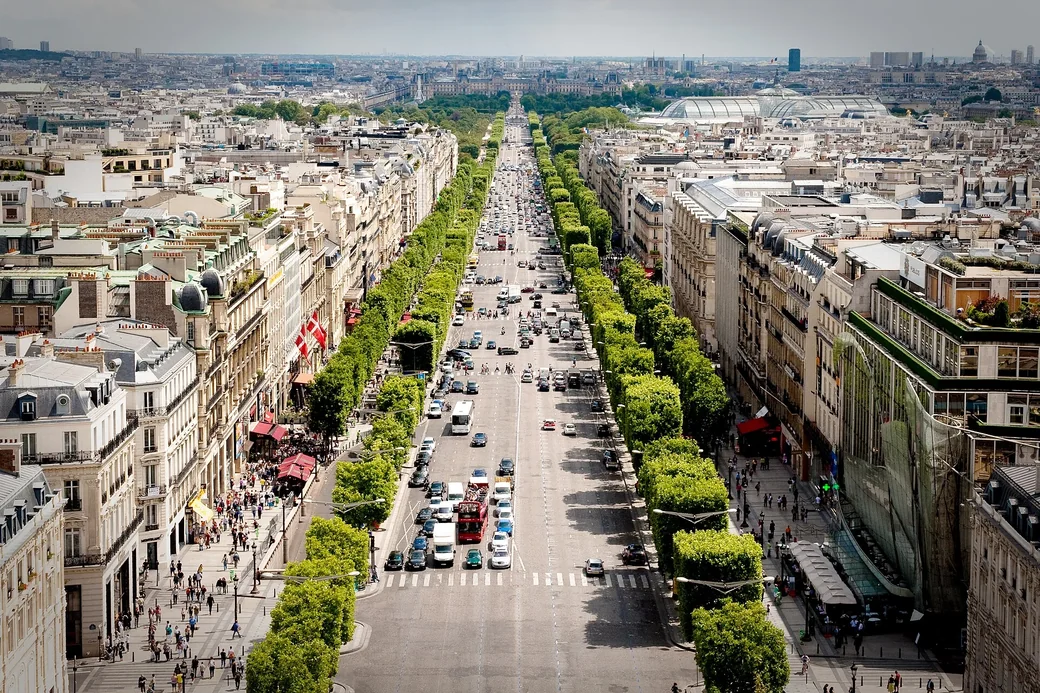
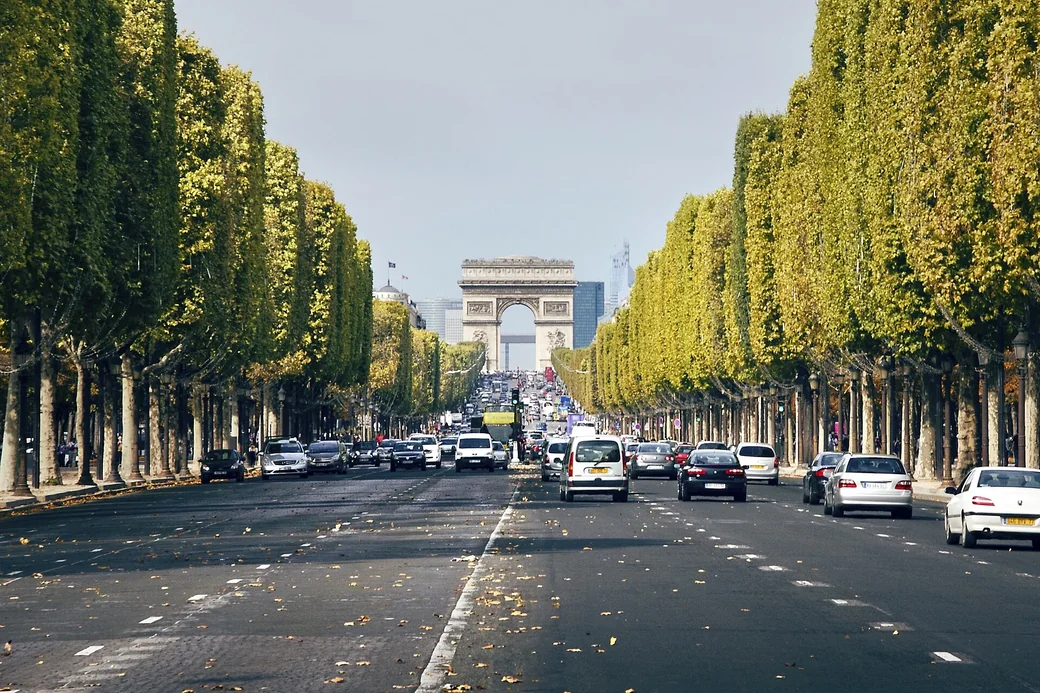
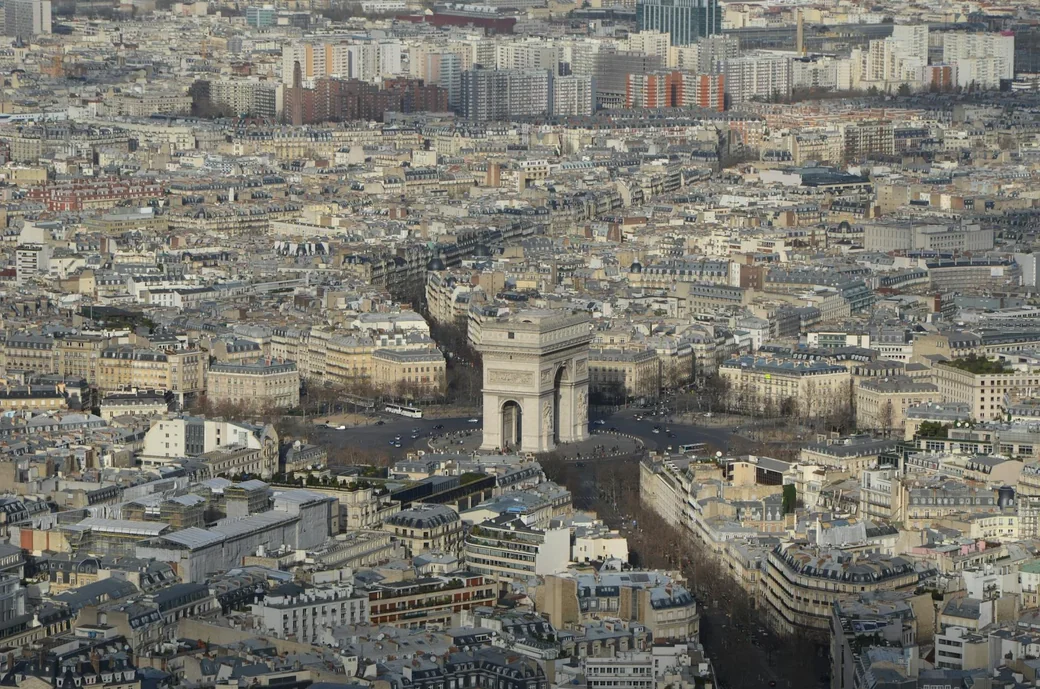
The Avenue des Champs-Élysées is the great ceremonial avenue of Paris, a broad, tree-lined boulevard in the 8th arrondissement that runs from Place de la Concorde to the Arc de Triomphe. Gardens, theatres, flagship stores, cinemas and cafés line its course, making it both an elegant promenade and one of the liveliest shopping streets in the city. For many visitors, walking its length with the Arc de Triomphe in view is an essential part of a first trip to Paris.
Avenue des Champs-Élysées: Location, accommodation options and contact
Avenue des Champs-Élysées, 75008 Paris, France (from Place de la Concorde to Place Charles de Gaulle)
The place's location on the map and nearby accommodation and hotel options are shown by Stay22. Cookies are used. Your consent is remembered on every page; you can turn it off at any time in the cookie settings.
The Axe Historique: The Champs-Élysées' Perfect Straight Line and Its True Size
The avenue is the middle section of the Axe historique, the ceremonial line running from the Louvre through the Tuileries, Concorde and the Arc de Triomphe out to the Grande Arche at La Défense. There is a real gradient between Concorde and the Étoile: the Arc stands on the high point, which is exactly why the perspective hits so hard. One detail breaks the illusion — the Grande Arche is deliberately offset from the axis by about 6.3 degrees. The avenue measures about 1.9 km from Concorde to the Étoile and 70 metres across. It is the most famous street in Paris, but not the widest: Avenue Foch, running west from the same roundabout, is 120 metres across. The name comes from the Elysian Fields of Greek mythology, where heroes rested after death — a grand label for what was, until the eighteenth century, marshland and open fields.
Two Avenues in One: The Rond-Point Divide and the Shady and Sunny Sides
Split the avenue at the Rond-Point des Champs-Élysées and it suddenly makes sense. The lower half towards Concorde is parkland — shaded gardens, the Théâtre Marigny, the Théâtre du Rond-Point, the Grand Palais and the Petit Palais, and almost no shops. The upper half towards the Étoile is the commercial heart: flagship stores, cinemas and huge crowds. If you want quiet, walk downhill; if you want the buzz, walk up. The two pavements are not interchangeable. The odd-numbered south side stays shaded for most of the day, which makes it far more comfortable in summer. The even-numbered north side catches the sun and is home to the entrances of the covered galleries, so it tends to carry the heavier foot traffic. Flagship stores line both sides, so the shady pavement loses nothing for window-shopping.
Common Champs-Élysées Mix-Ups: The Théâtre, the Élysée Palace and the Famous Song
The Théâtre des Champs-Élysées, where Stravinsky's Rite of Spring caused its famous riot in 1913, stands at 15 avenue Montaigne, not on the avenue that shares its name. The Élysée Palace, the President's residence, is on rue du Faubourg Saint-Honoré just to the north. Both are within a ten-minute walk, but neither is where the guidebook name suggests. Joe Dassin's 1969 hit Les Champs-Élysées is an adaptation of Waterloo Road by the British band Jason Crest. One of the songs the world treats as pure France was written about a London street. It is the kind of detail that makes a good opening line when you stand at the top of the avenue.
Champs-Élysées History: From Marshland in 1616 to the Liberation of 1944
In 1616 Marie de Médicis laid out the Cours-la-Reine, a tree-lined walk by the Seine — the first landscaping in the area. In 1667 the royal gardener André Le Nôtre extended the Tuileries axis westwards into what he called the Grand Cours, then still fields and marsh. The name Champs-Élysées became official in 1709, and by 1724 the avenue reached the hill at the Étoile. Napoleon ordered the Arc de Triomphe in 1806 to Chalgrin's design, but his fall delayed completion until 1836. In 1828 the avenue was handed over to the city, which added pavements, fountains and gas lighting while the architect Hittorff laid out the lower stretch as gardens. The 1900 World's Fair then filled that end with the Grand Palais, the Petit Palais and the Pont Alexandre III. German troops paraded down the avenue in 1940; on 26 August 1944 de Gaulle led the liberation march along the same stretch. Those two sequences fixed the boulevard's weight in French national memory and explain why the state still stages its most symbolic ceremonies here rather than anywhere else in Paris.
The Étoile Roundabout: Why You Take the Underpass and Why Nobody Is at Fault
Twelve avenues meet at Place Charles de Gaulle and there is no pedestrian crossing at street level — walking over it is both forbidden and genuinely dangerous. The entrance to the underpass is on the north side of the Champs-Élysées, the even-numbered pavement, near the top of the avenue. It leads directly to the base of the Arc de Triomphe. Twelve avenues feed Place Charles de Gaulle, and unlike most French roundabouts it still runs on priority to the right. Popular lore has it that assigning blame after a collision here is so difficult that insurers simply split the damage fifty-fifty. The arch has its own aviation story too: on 7 August 1919 the pilot Charles Godefroy flew his Nieuport straight through it, in protest at war pilots being made to march rather than fly in the victory parade. The moment was caught on film.
Visiting the Arc de Triomphe: Timed Tickets, Queues and the Evening Flame Ceremony
The panoramic terrace sits 50 metres up and is reached by a spiral staircase of 284 steps; the lift is reserved for visitors with reduced mobility. Ground level, including the Tomb of the Unknown Soldier and the eternal flame, is open to all without a ticket. For the terrace, book a timed slot online before you arrive — the ticket desk is where the long waits happen. In high season the queue at the monument's ticket desk regularly runs from half an hour to a full hour, and it is at its worst in the late afternoon when everyone wants the sunset from the terrace. Booking a timed online slot in advance skips most of that wait. If you turn up without one, go early in the morning instead. Every evening at 18:30 the flame on the Tomb of the Unknown Soldier is rekindled in a short ceremony that has run without interruption since 1923. It is free, open to the public, lasts ten to fifteen minutes and appears on almost no tour itinerary. While you wait, look up: among the 660 names carved on the arch, the underlined ones mark commanders killed in battle.
Legendary Addresses: Fouquet's, Ladurée, Guerlain, the Old Lido and the Hôtel de la Païva
At no. 99, Fouquet's has been open since 1899 and still hosts the dinner after the César awards. Ladurée at no. 75 is the classic macaron stop, Louis Vuitton's global flagship stands at no. 101, and Guerlain has occupied no. 68 since 1914 with a listed interior. Publicis Drugstore near the Étoile mixes pharmacy, restaurant, bookshop and newsstand. The legendary Lido at no. 116 ended its cabaret era in 2022 and reopened as a musical-theatre stage, while the avenue's cinemas keep its long film tradition alive. Behind a discreet façade at No. 25 stands the only 19th-century private mansion still surviving on the avenue, built for the courtesan La Païva. Inside are a staircase of yellow onyx and a lavish Moorish-style bathroom. It now houses the Travellers Club and is normally closed to the public, but opens during the European Heritage Days on the third weekend of September.
Shopping on the Champs-Élysées: Sunday Opening, Tax-Free Refunds and the Golden Triangle
The avenue is classified as a Zone Touristique Internationale (International Tourist Zone), which lets shops trade on Sundays and late into the evening — unlike most of Paris, where Sunday retail is heavily restricted. If your trip includes a Sunday and you want to shop, this is the address. It also means Sunday is one of the busiest days on the upper stretch, so go early if crowds bother you. Travellers resident outside the EU can reclaim VAT on purchases above a legal minimum spent in the same shop on the same day. Ask for the détaxe (tax-refund) form at the till, keep the receipt and leave the goods unused. Processing at the airport takes time, so leave an extra margin before your flight rather than arriving at the usual check-in hour. Shops display the current threshold at the counter. The Champs-Élysées regularly ranks among the most expensive retail addresses in the world, alongside Fifth Avenue in New York, Via Montenapoleone in Milan and New Bond Street in London. Just to the south, Avenue Montaigne and Avenue George V close the Triangle d'Or, the Golden Triangle: quieter, devoted to haute couture and where Parisians themselves go for luxury.
Behind the Avenue: Covered Passages, Neighbourhood Cafés and Where to Eat One Street Back
Between Nos. 74 and 84 several covered passages cut through the block: the Galerie du Claridge, the Arcades du Lido and the Galerie des Champs. Walk through any of them and you come out on rue de Ponthieu, a lively street of everyday Parisian cafés and bistros. It is the quickest shortcut from the crowds to the neighbourhood's local rhythm. Terraces facing the avenue come with the view, and one coffee there is part of the experience. For everything after that, walk one street back. Rue de Ponthieu, rue Marbeuf and rue de Berri are lined with brasseries and cafés used by the people who work in the offices above the shops, which means shorter waits, smaller rooms and a noticeably more local atmosphere within two minutes of the crowd.
Hidden Corners of the Gardens: The Carré Marigny Stamp Market and the Palais de Glace
The horse chestnut trees of the lower gardens shade a few surprises that most visitors walk straight past. In the gardens of the lower avenue, at the Carré Marigny, collectors set out their tables every Thursday, Saturday and Sunday. Stamps, old postcards and telephone cards change hands here much as they did decades ago. Film lovers will recognise the spot: the 1963 thriller Charade, with Cary Grant and Audrey Hepburn, filmed one of its key scenes in this very market. The rotunda that houses the Théâtre du Rond-Point began life as the Palais de Glace, a fashionable ice rink of the Belle Époque (the prosperous years c. 1871–1914) where Paris society skated in circles under a glass roof. The building kept its round shape when it became a theatre, so the auditorium still sits inside the old rink. Worth a look even if you are not seeing a play.
The Rond-Point and Its Gardens: Bouroullec Fountains After Dark and Michelin-Starred Pavilions
Since 2019 the Rond-Point des Champs-Élysées has been ringed by six fountains designed by the brothers Ronan and Erwan Bouroullec: 13-metre bronze masts hung with crystal, through which the water falls as the structures slowly turn. They stand in historic basins that once held René Lalique's glass fountains. Come back after sunset, when the crystal is lit, and the roundabout becomes one of the most photogenic spots on the avenue. The gardens of the lower avenue hide two of the most historic restaurants in Paris. The Pavillon Ledoyen, home to Yannick Alléno, is one of the city's great Michelin-starred tables; Laurent, in its own neoclassical pavilion, is the classic address for a long lunch under the trees. Both need booking well ahead, and both feel a world away from the crowded pavements a hundred metres uphill.
Big Days on the Avenue: The 14 July Parade and the Tour de France Finish
On Bastille Day the avenue becomes the stage for the national military parade, opened by the Patrouille de France (the French Air Force aerobatic team) tracing the tricolour across the sky. The grandstands are by invitation only, but the standing places along the pavements are free and fill up between roughly 07:00 and 08:00. Arrive later and you will be watching the backs of several rows of heads. The Tour has finished here since 1975, with Nice in 2024 as the exception. From 2025 the closing stage added climbs of the Butte Montmartre, which changed the ending completely. In 2026 wildfires forced organisers to shorten the final stage: the riders started on the avenue itself, climbed Montmartre three times and returned here, where Mathieu van der Poel took the stage and Tadej Pogačar sealed his fifth overall title.
Free Art at the Petit Palais, a Carousel and a Puppet Theatre for Children
The permanent collection of the Petit Palais is free to enter, and its inner courtyard garden with a café is one of the calmest places near the avenue. Families have more to work with in the lower gardens: an old-fashioned carousel and a guignol puppet theatre keep children busy while the adults finally sit down. Together they turn the walk into an easy half-day.
Seasonal Moments: Christmas Lights, New Year's Eve, Car-Free Sundays and Early-Morning Photos
Around mid-November a switch-on ceremony lights roughly four hundred trees along the avenue, and the display runs until early January. The first forty-five minutes after the lights come on are the best: the sky still has colour and the crowd has not yet thickened. On 31 December the Arc de Triomphe carries a light and sound show, and the whole area is closed to traffic. On the first Sunday of each month the avenue closes to cars, giving you twelve days a year when you can stand in the middle of the roadway and photograph the Arc de Triomphe without a single vehicle in frame. On any other day, the window between 07:00 and 08:30 does almost the same job: soft light, open pavements and shops still shuttered.
Staying Safe on the Champs-Élysées: Classic Street Scams and Easy Habits After Dark
Two approaches repeat endlessly around the metro exits and the mouth of the Arc de Triomphe underpass: someone asking you to sign a petition, and someone who has just found a gold ring and insists it must be yours. Both end with a request for money, and both work by holding your attention while your pockets are worked on. A short no and a step sideways ends it. After dark the avenue's evening life gathers on the upper half between the Rond-Point and the Arc de Triomphe, where shopfronts, cinemas and brasseries stay lit late into the night. The garden stretch of the lower half settles into a calm, softly lit promenade that is at its best in the early evening. As in any busy crowd, a few easy habits are enough: carry bags closed and in front, and keep phones out of back pockets. The avenue itself is public space, open and free to stroll at any hour of the day or night.
Avenue des Champs-Élysées: Visitor Tips
Cross to the Arc de Triomphe only through the underpass on the north (even-numbered) side of the avenue — walking across the roundabout is forbidden and dangerous. Book a timed rooftop ticket online; the ticket-office queue can run 30-60 minutes. Eat one street back on rue de Ponthieu, rue Marbeuf or rue de Berri rather than on the avenue itself. The shaded south (odd-numbered) pavement is far more comfortable in summer, while the sunny north side has the shops and the covered galleries. Watch for petition and lost-ring scams around metro exits and the underpass entrance.
Avenue des Champs-Élysées: Best Time to Visit
07:00-08:30 for empty pavements and east-west light; sunset for the Arc de Triomphe axis. First Sunday of the month the avenue is car-free.
Avenue des Champs-Élysées: Admission Fees
Free admission
Free to enter and open to everyone; no ticket is needed.
Free
Quick Info
2h 30m
easy
Avenue des Champs-Élysées: Getting There
Five métro stations serve the avenue along its length: Concorde (M1, M8, M12) at the eastern end, Champs-Élysées–Clemenceau (M1, M13), Franklin D. Roosevelt (M1, M9), George V (M1) and Charles de Gaulle–Étoile (M1, M2, M6 and RER A) at the Arc de Triomphe. Line 1 runs directly under the boulevard, so you can ride one stop at a time and walk the rest. Driving is impractical: parking is scarce and expensive, and the Étoile roundabout is one of the most demanding in Europe.
Nearby stops & parking
Closest stops: George V and Franklin D. Roosevelt on métro line 1 for the shopping stretch, Champs-Élysées–Clemenceau for the gardens, Grand Palais and Petit Palais, and Charles de Gaulle–Étoile (métro 1, 2, 6 and RER A) for the Arc de Triomphe. Several bus routes run along or across the avenue, and Vélib' bike docks stand at the Rond-Point and near George V. Underground car parks exist beneath the avenue and around the Étoile, but rates are among the highest in Paris. Taxi ranks operate at George V and at the Étoile.
Avenue des Champs-Élysées: Dress Code & Etiquette
No dress code applies: this is a public avenue. Comfortable shoes matter more than anything else, since walking the full length and climbing the 284 steps of the Arc de Triomphe adds up. Dress warmly in winter — the boulevard is wide, open and exposed to wind. At the Tomb of the Unknown Soldier, quiet and respectful behaviour is expected, especially during the 18:30 flame ceremony.
Guide / Language
en
fr
es
de
it
pt
ru
ar
zh
ja
ko
nl
Avenue des Champs-Élysées: Amenities & Facilities
Wide step-free pavements (Arc terrace not accessible)
Shaded gardens with benches, carousel and puppet theatre