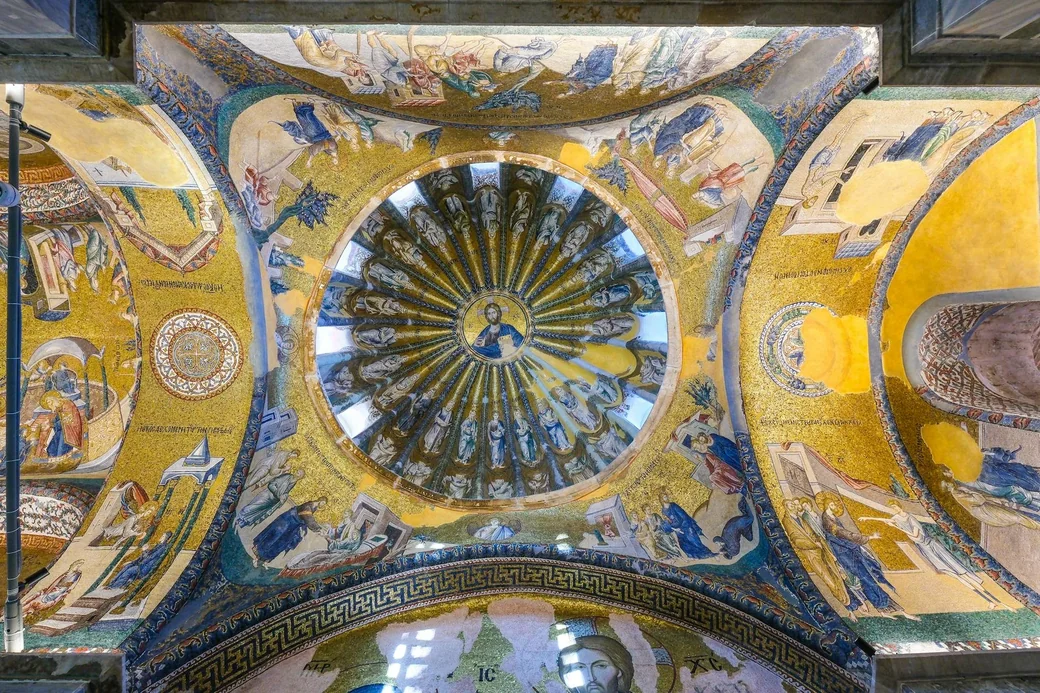
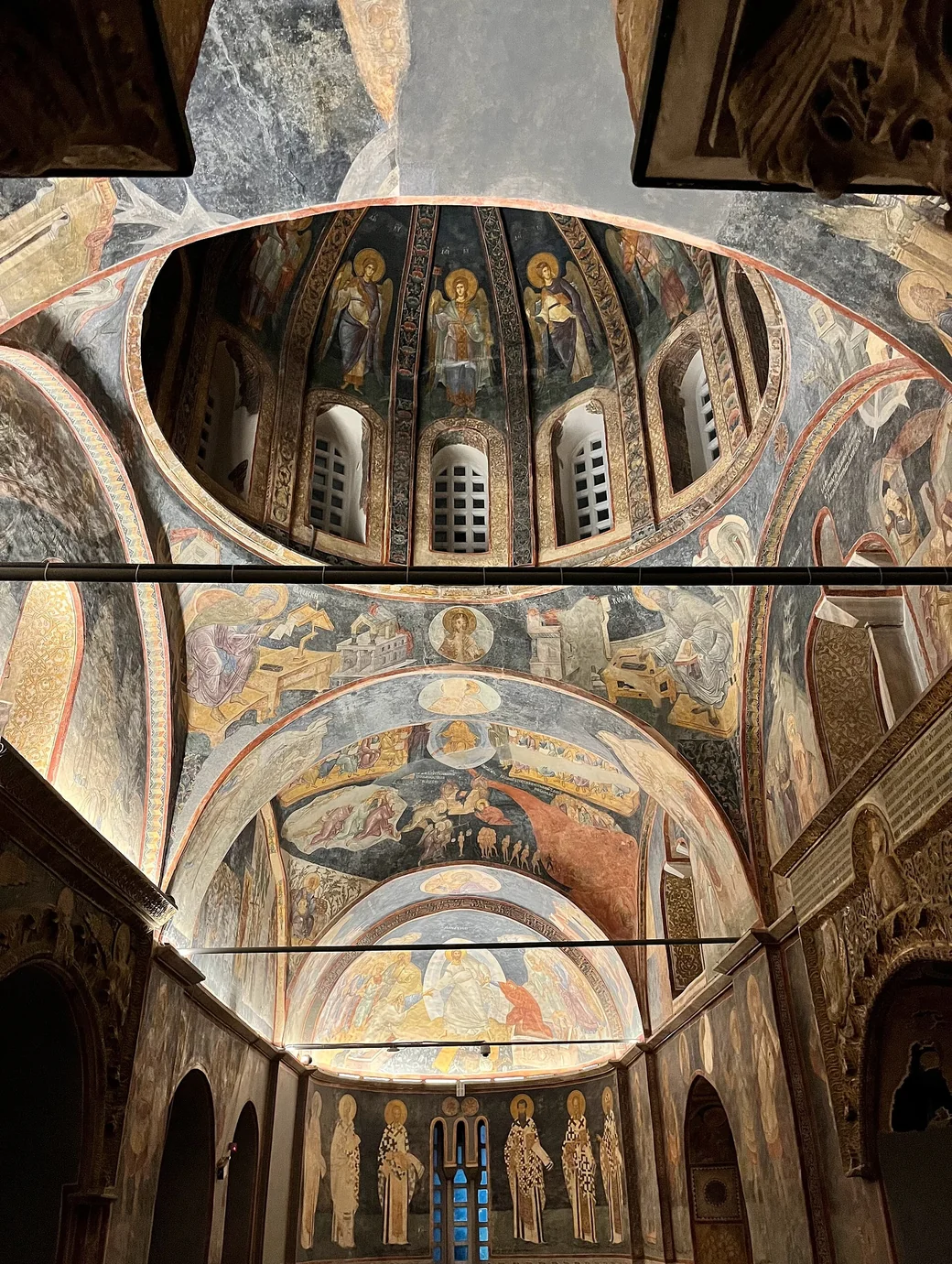
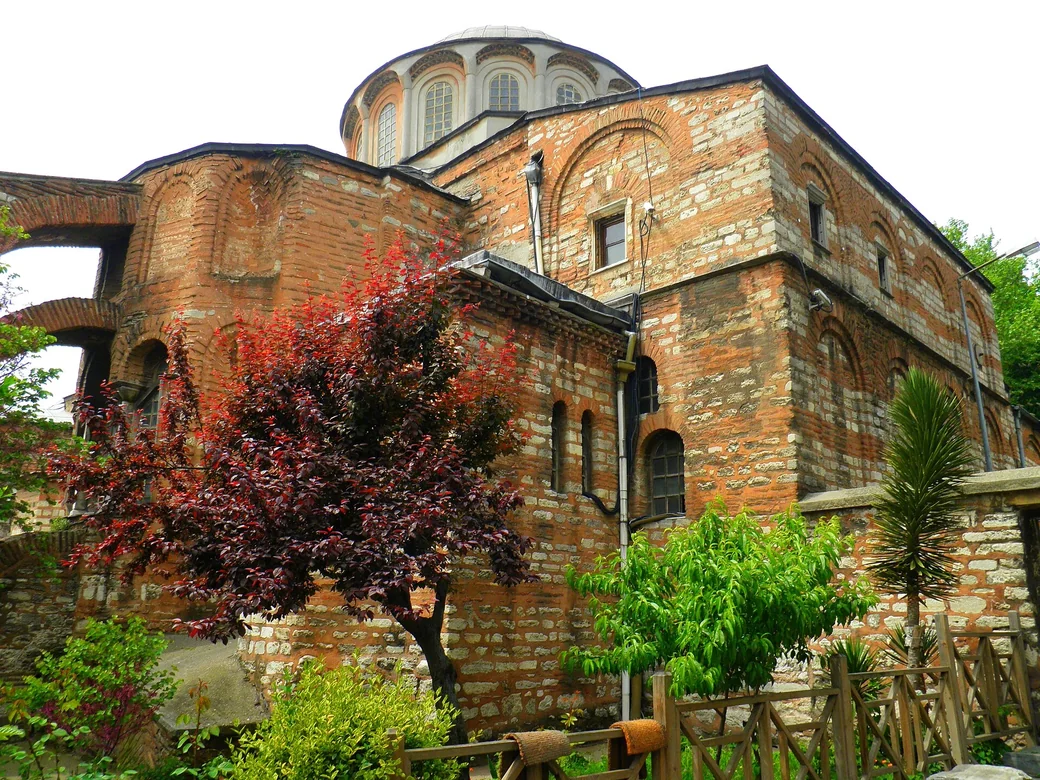
The Chora Church (Kariye Camii) is a Byzantine church in Istanbul’s Edirnekapi district, on the western edge of the old city, that today serves as a mosque. Behind its modest exterior lies one of the world’s finest surviving ensembles of Byzantine mosaics and frescoes. Small in scale yet extraordinarily rich inside, it ranks among Istanbul’s greatest treasures of medieval art and offers a quieter, more intimate experience than the city’s grand central monuments.
Chora Church (Kariye Mosque): Location, accommodation options and contact
Derviş Ali Mahallesi, Kariye Cami Sokağı No: 18, 34087 Fatih, Istanbul. Google Maps: https://www.google.com/maps/search/?api=1&query=41.031205%2C28.939188
The place's location on the map and nearby accommodation and hotel options are shown by Stay22. Cookies are used. Your consent is remembered on every page; you can turn it off at any time in the cookie settings.
Chora Church history: from monastery outside the walls to mosque
A church is said to have stood here since the 4th century, although the earliest surviving archaeological traces date from the 6th. The building was rebuilt in the 11th century by Maria Doukaina, mother-in-law of Emperor Alexios I Komnenos, and again in the early 12th century by his son Isaac Komnenos, who gave it its cross-shaped plan. The occupation that followed the Fourth Crusade (1204–1261) left the monastery damaged. Between 1315 and 1321 Theodore Metochites rebuilt and decorated it. The Ottoman grand vizier Hadım Ali Pasha converted it into a mosque in 1511. It served as a museum from 1945 and became a mosque again in 2020. The mosaics and frescoes date from Theodore Metochites’ rebuilding of 1315–1321, a time when the Byzantine Empire was already under heavy pressure, yet was still producing some of its most expressive art.
What does Chora mean? The story behind the name Kariye
Chora, from the Byzantine word chōra, means countryside or the land outside the city: the monastery originally lay beyond the walls built by Constantine. Later walls enlarged the city and swallowed the site, but the name stayed. In Ottoman times it became Kariye, a form that also echoes the word for village. Inside, the mosaics add a second meaning. Christ is inscribed as the “Land of the Living” and the Virgin Mary as the “Container of the Uncontainable”, a play on chōra as a place that holds what cannot be held. Look for these two panels as you pass through the narthexes.
Theodore Metochites, the statesman behind Chora’s mosaics
Theodore Metochites served as Grand Logothete, in charge of the imperial treasury, under Emperor Andronikos II Palaiologos. A poet, scholar and book collector, he financed the rebuilding of Chora between 1315 and 1321 and added the narthexes and the funerary chapel. Above the door into the nave he is shown kneeling and offering a model of the church to Christ. After falling from power he was exiled in 1328, returned in 1330 as a monk named Theoleptos, and died in the monastery in 1332. His burial niche is thought to be in the side chapel, and his library once made Chora a small centre of learning.
Narthex mosaics: Christ’s infancy, miracles and genealogy
Start in the two narthexes, the entrance halls. The outer narthex tells the infancy of Christ and, in its vaults, scenes of his ministry and miracles, including the healing of the blind. Over the door leading into the inner narthex, Christ is titled the “Land of the Living”. In the inner narthex, two domes show Christ surrounded by his ancestors in the genealogy, while the lunettes follow the life of the Virgin Mary, from her blessing by the priests to the Deesis. Gold backgrounds, soft colors and natural gestures make these scenes famously lively for Byzantine art.
The nave: Dormition of the Virgin and Chora’s great panels
The nave, the main prayer hall, is clad in marble and keeps just three large mosaic panels. Two show Christ and the Virgin with Child, and the third is the Dormition of the Virgin above the main doorway: Mary lies on her bier among the apostles while Christ holds her soul as a small swaddled figure. Because the nave is used for prayer, the mosaics here are covered by a retractable curtain system during worship and revealed again afterwards. If the curtains are closed when you arrive, spend the time in the narthexes and return later.
The parekklesion and the Anastasis fresco, Chora’s masterpiece
The parekklesion, a side chapel added by Metochites as a burial place, is decorated with frescoes rather than mosaics. In the apse semi-dome, the Anastasis shows the risen Christ trampling the broken gates of Hell and pulling Adam and Eve from their tombs by the wrists, with kings and prophets looking on. Nearby are the Last Judgment, the Virgin and Child in the dome surrounded by angels, and arched niches that served as tombs. Many art historians count the Anastasis among the great works of late Byzantine painting, so give it the time it deserves.
Artworks in Chora Church at a glance: a short guide
Christ Pantokrator: the mosaic over the inner narthex door, inscribed “Land of the Living”. The Virgin: the facing panel, the “Container of the Uncontainable”. Metochites: the donor portrait above the nave door, offering the church to Christ. Genealogy of Christ: two narthex domes filled with ancestors. Infancy cycle: the birth and early life of Jesus in the outer narthex. Miracles and parables: the healing of the blind man and the Good Samaritan, among others. Deesis: Christ and the Virgin with the donors Isaac Komnenos and the nun Melane. Christ and the Virgin Hodegetria (“she who shows the way”): the pair of devotional panels in the nave. Dormition: above the nave doorway. Anastasis and Last Judgment: frescoes in the parekklesion. Pantokrator is a Greek title meaning “ruler of all”.
Legends and traditions about Chora Church
According to tradition, the first monastery was founded in the 6th century by a man named Theodore, said to be an uncle of Empress Theodora, and was wrecked by the earthquake of 557 before Emperor Justinian built a larger one. This story was written down centuries later, and historians do not accept it as fact. According to another tradition, the relics of Saint Babylas were buried here in the early 4th century, making the ground sacred. Reportedly, during the siege of 1453 the Virgin Hodegetria icon, believed to protect the city, was carried to Chora because it stood close to the walls; what became of it is unknown. All three remain traditions rather than proven history.
Surprising facts and firsts about Chora Church
After 1453 the church was not converted at once; it stood for nearly six decades before becoming a mosque. The mosaics survived because they were covered in plaster and whitewash rather than destroyed, and restoration work from 1948 uncovered them over about a decade. The 1894 earthquake damaged the building and brought down its minaret. The monastery once had a bathhouse and a shelter for the blind. In 2020 the first prayer in 75 years was held, with a curtain system installed to cover the nave mosaics during worship. Chora is often called the best-known Byzantine monument in Istanbul after Hagia Sophia. The building also lies within the Historic Areas of Istanbul, inscribed on the UNESCO World Heritage List in 1985.
Chora Church opening days, hours and prayer times
Kariye is an active mosque, so visiting follows the rhythm of prayer. Sightseeing is possible every day except Friday, when the building is open only for worship. Sightseeing pauses around each of the five daily prayers and resumes once the prayer is over, so look up the prayer times for Istanbul before you set out. Worshippers may enter at any time. Plan to arrive at least an hour before closing so you are not caught by an evening prayer, and check the current schedule at the entrance if you are visiting on a religious holiday.
Best time to visit Chora Church and how long to stay
Plan about 60 to 90 minutes, or up to two hours if you like to study each scene. The best moment is a weekday morning soon after opening, when the narthexes are quiet and you can finish before the midday prayer. Avoid arriving close to prayer times, since the pause can mean a wait outside. Spring and autumn are comfortable for the walk through the old walls district, summer afternoons are hot and winter days are short, so aim for the morning in every season. Remember that Fridays are reserved for worship.
What to see near Chora Church: walls, Mihrimah Sultan Mosque and more
Chora is a good anchor for a half-day in the Byzantine and Ottoman west of the old city. The Theodosian Land Walls and the Edirnekapı gate are only a few hundred meters away, and the Mihrimah Sultan Mosque, designed by Sinan for the daughter of Süleyman the Magnificent, crowns the hill above the gate. Tekfur Palace, a late 13th-century Byzantine palace set between the inner and outer walls, is within walking distance, and the former Pammakaristos Church, now the Fethiye Mosque, with mosaics of its own, is about 15 minutes away on foot. The old wooden houses of the Kariye neighborhood are worth a stroll.
How to get to Chora Church by Metrobus, bus, tram or taxi
The easiest approach is the Metrobus to the Edirnekapı stop; take the overpass exit on the right-hand side and follow the Kariye Cami Sokağı signs for a walk of about five minutes. Buses 31E, 32, 336E, 36KE and 37E run from Eminönü to Edirnekapı, bus 87 runs from Taksim, and the T4 tram also stops at Edirnekapı. From the Asian shore, cross by ferry to Eminönü first. A taxi from Sultanahmet covers roughly 4 km. If you drive, approach along Abdülezelpaşa Caddesi and follow the signs.
Dress code and etiquette at Chora Church: what to wear and do
Kariye is a working mosque, and the rules protect both worshippers and artworks. Women cover their hair and shoulders, and everyone covers their knees; scarves and cover-ups can be obtained at the entrance if needed. Move quietly, speak softly and keep clear of anyone who is praying. Follow the signs and the staff’s instructions on shoes and on photography, avoid flash and do not photograph worshippers. Do not touch the walls or the mosaics, and do not sit or lean against historic surfaces. Switch your phone to silent before you step inside.
Visitor tips for Chora Church: crowds, photo spots and accessibility
Entry to the building is managed at a single booth, so arrive early to avoid a queue. For photographs, the best compositions are the Pantokrator at the entrance, the two narthex domes with the genealogy and the Anastasis in the side chapel; steady your camera instead of using flash. Audio guides and private guided tours can be booked through tour operators and booking platforms, and a good guide makes the stories in the mosaics much easier to follow. A ramp and an accessible restroom serve visitors with reduced mobility, although the surrounding streets slope down toward the Golden Horn. A small café stands beside the mosque.
Chora Church (Kariye Mosque): Visitor Tips
Check the prayer times before you leave, because sightseeing pauses ahead of each call to prayer. Cover your knees, and cover your shoulders and hair if you are a woman. Start with the mosaics at the entrance, look up into the narthex domes and keep the Anastasis in the side chapel for last. Combine the visit with the nearby city walls and the Fethiye Mosque.
Chora Church (Kariye Mosque): Best Time to Visit
Weekday mornings soon after opening, outside prayer times; spring and autumn suit the walk through the old walls district. Sightseeing is closed on Fridays.
Chora Church (Kariye Mosque): Admission Fees
Adult – international visitors
Standard adult rate for visitors from abroad. Visits pause shortly before each prayer time.
€20
Turkish citizens and worshippers (free)
Free for Turkish citizens and for people who come to pray; identification may be requested.
Free
Quick Info
1h 30m
easy
Chora Church (Kariye Mosque): Getting There
Chora Church sits in Edirnekapı, about 4 km from Sultanahmet. The simplest public-transport route is the Metrobus to the Edirnekapı stop: leave by the overpass on the right-hand side and walk about five minutes, following the Kariye Cami Sokağı signs. From Eminönü, buses 31E, 32, 336E, 36KE and 37E all stop at Edirnekapı, and from Taksim bus 87 does the same. Visitors staying on the Asian shore can cross by ferry from Kadıköy or Üsküdar to Eminönü and continue by one of those buses. The T4 tram also has an Edirnekapı stop. If you drive, follow Abdülezelpaşa Caddesi and then the Kariye Cami Sokağı signs, or simply take a taxi.
Nearby stops & parking
The closest stops are the Edirnekapı Metrobus station and the bus and tram stops around the Edirnekapı junction, all within a short walk of the mosque. A taxi from Sultanahmet or Eminönü can drop you on Kariye Cami Sokağı beside the building. The mosque sits inside a residential old quarter, so public transport is usually the easier option than looking for a place to park. A small café and public restrooms stand next to the mosque.
Chora Church (Kariye Mosque): Dress Code & Etiquette
Kariye is a working mosque, so modest dress is expected. Women should cover their hair and shoulders, and everyone should cover their knees; scarves and cover-ups are available at the entrance booth if you forget. Be ready to remove your shoes wherever signs or staff ask you to. Keep your voice low and do not walk through areas where people are praying. Avoid flash, never photograph worshippers, and follow the instructions of the staff and the signs about photography.
Guide / Language
tr
en
Chora Church (Kariye Mosque): Amenities & Facilities