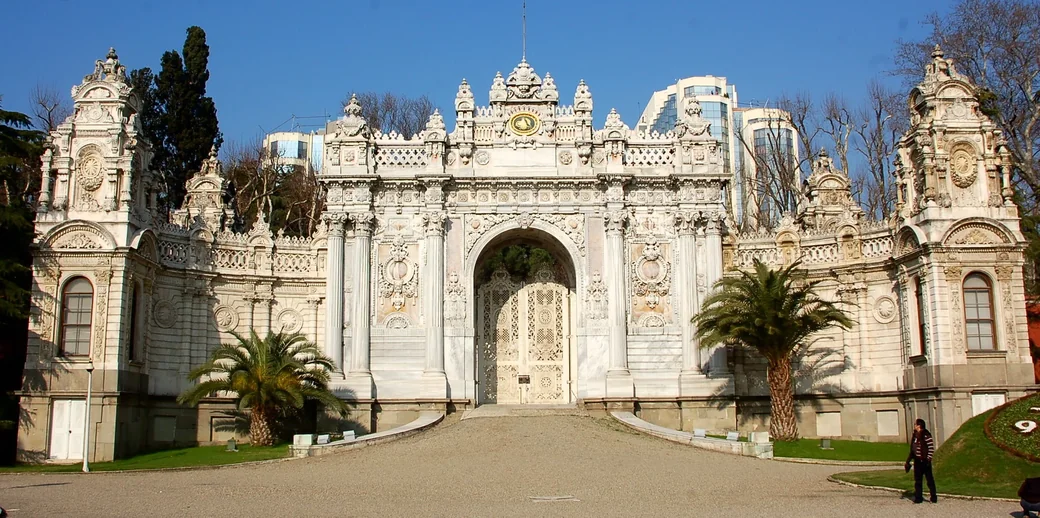
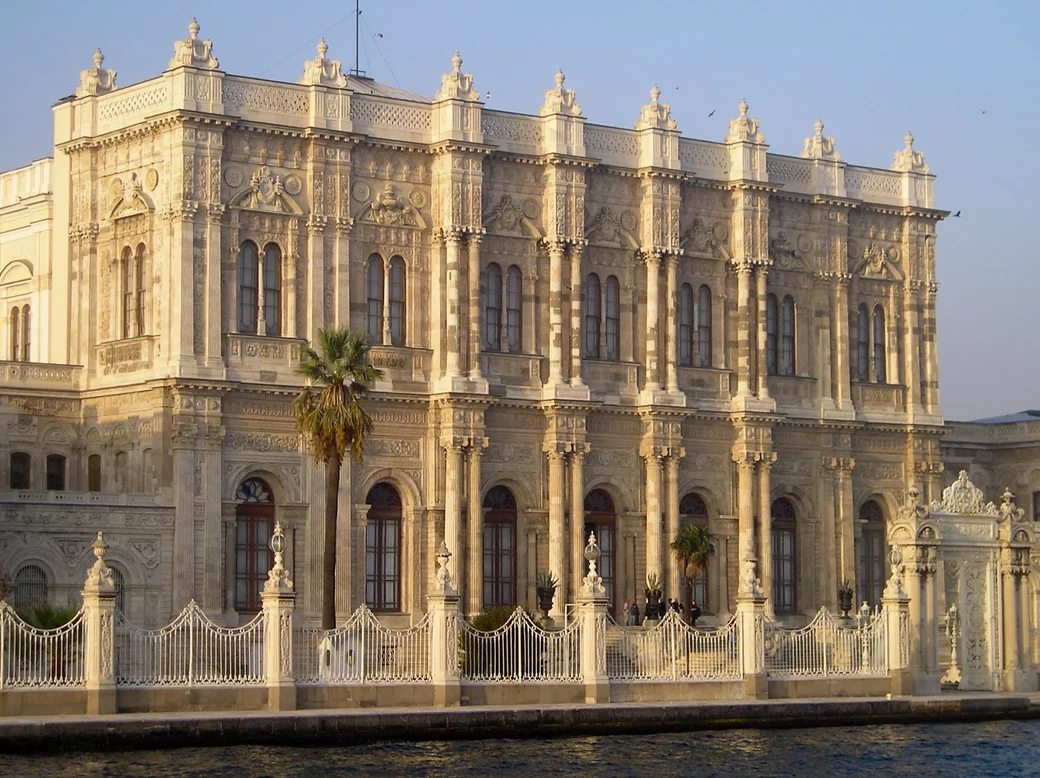
Dolmabahçe Palace (Dolmabahçe Sarayı) is a grand nineteenth-century Ottoman palace on the European shore of the Bosphorus, in Istanbul’s Besiktas district between Kabatas and the Besiktas ferry quay. Built as a residence for the sultans of the late empire, it is now a museum where visitors walk through richly decorated state rooms and private quarters. Its long facade stretching along the water makes it one of the most striking sights on any journey along the Bosphorus.
Dolmabahçe Palace: Location, accommodation options and contact
Vişnezade Mah., Dolmabahçe Cd., Beşiktaş, Istanbul | Google Maps: https://www.google.com/maps/search/?api=1&query=41.039164,29.000459
The place's location on the map and nearby accommodation and hotel options are shown by Stay22. Cookies are used. Your consent is remembered on every page; you can turn it off at any time in the cookie settings.
Dolmabahçe Palace History: From a Filled Bay to the Sultan's Bosphorus Residence
Long before the palace, this stretch of the Bosphorus was a sheltered bay where ships anchored. From the seventeenth century it was gradually filled in and turned into an imperial garden, which is where the name Dolmabahçe, 'filled garden', comes from. Wooden pavilions there became known as the Beşiktaş Coastal Palace. Sultan Abdülmecid had that old complex pulled down and commissioned a new palace; construction began on 13 June 1843 and the building entered use on 7 June 1856. The design is credited to the Armenian court architects Garabet Balyan and his son Nigoğayos Balyan, working with a wider team of royal builders. The site covers more than 110,000 square metres, and the main building is considered the largest palace in the country. The works were overseen by Hacı Said Ağa as building steward from 1843 to 1850 and then by Esseyyid Ali Şahin Bey until 1856; the official record also names Ohannes Serveryan and James William Smith among the builders.
Dolmabahçe Palace Architecture: Baroque, Rococo and Neoclassical Meet the Ottoman Plan
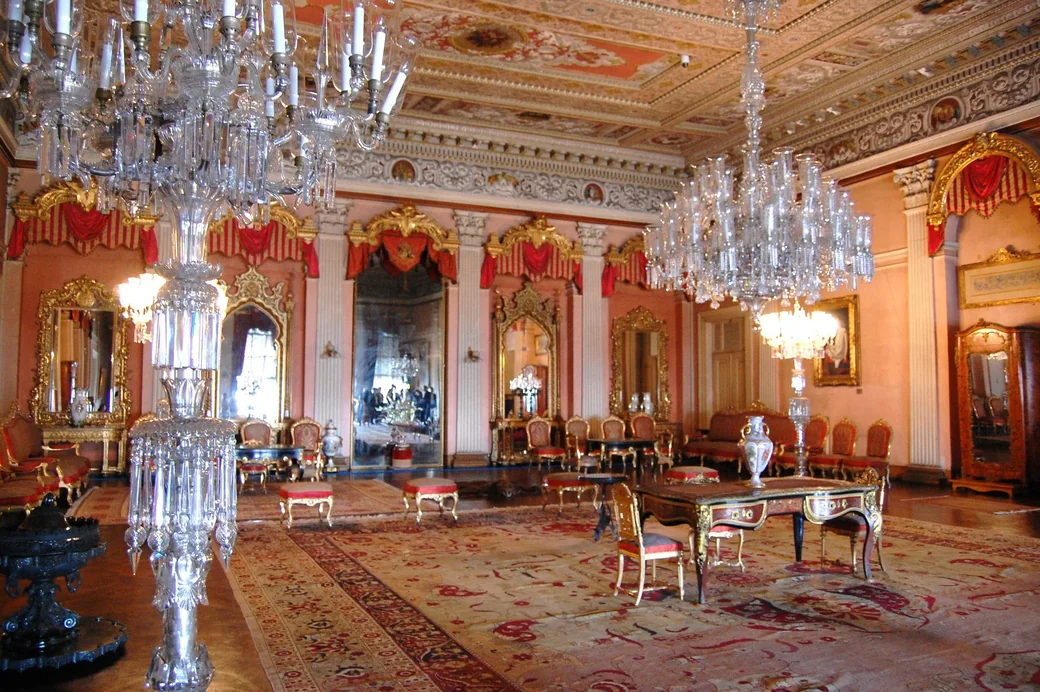
The main building is a single block stretched along the shore, with two regular floors plus a basement and an attic level. Officially it has 285 rooms, 44 halls, 68 toilets and six hammams on a footprint of 14,595 square metres. The facades and interiors borrow Baroque, Rococo and Neoclassical forms from European palaces, yet the plan still follows Ottoman palace tradition, with a central hall and corner rooms like a grand traditional house. The decoration mixes Hereke carpets, Baccarat crystal, Sèvres and Yıldız porcelain, diplomatic gifts and paintings by Western artists. The building is divided into three parts: the Selamlık for state business, the Muayede Hall for ceremonies and the Harem for the sultan's family.
Selamlık Interiors: Crystal Staircase, Ambassadors' Hall and the Sultan's Alabaster Bath
Visitors enter the Selamlık, the state side of the palace, through the Medhal Hall. The Crystal Staircase, also called the Sultan's Staircase, climbs to the upper floor between balustrades with crystal fittings. Upstairs, the Ambassadors' Hall (Süfera Salonu) was used to receive foreign envoys, and the Red Room (Kırmızı Oda) takes its name from its red furnishings. The Zülvecheyn Hall, whose name refers to its two fronts, links the state rooms with the sultan's private apartment, which includes a study, a library and the Hünkâr Hamamı, whose walls are covered in Egyptian alabaster over a Marmara marble floor. In the Ambassadors' Hall a pair of bear skins is displayed; according to some sources one was a gift from the Russian tsar and the other was ordered to match it.
Muayede Hall: The Ceremonial Heart of Dolmabahçe Palace
Between the Selamlık and the Harem lies the Muayede Hall, the palace's largest and tallest room, used for holiday greetings and major state ceremonies. It covers more than 2,000 square metres, rises under a dome about 36 metres high and is ringed by 56 columns. The floor is dominated by a huge hand-woven Hereke carpet of roughly 124 square metres. Hot air from furnaces in the basement was originally channelled into the hall through the bases of the columns, and central heating, electricity and telephone lines were added later as the palace modernised. During the long reign of Sultan Abdülhamid II the hall was used mainly for the twice-yearly holiday ceremonies. The name Muayede refers to the exchange of holiday greetings, and the sultan's meeting with senior statesmen on holidays was one of the main purposes of the hall.
Harem Quarters and Atatürk's Room 71: Where the Republic's Founder Died
The Harem section was the private home of the sultan's family, and it is also where Mustafa Kemal Atatürk spent his last days. Atatürk stayed in the palace on and off between 1927 and 1938, about four years in total, and worked from here when he was in Istanbul. He died in room 71 on 10 November 1938 at 09:05. The room is preserved, the bed is covered with a flag and the clock in the room is stopped at the time of his death. Every year at 09:05 on 10 November a ceremony is held there with a siren, a minute of silence and the national anthem. The palace stayed the presidential residence in Istanbul until 1949, and in 1984 it opened as a palace-museum with its original furnishings. During the annual ceremony the presidency's wreath is presented, bouquets are laid on the bed on behalf of the governorship, the armed forces and the municipality, and two police officers keep a guard of honour at its sides.
The Last Sultans of Dolmabahçe: Abdülhamid's Departure, the Caliph and the End of an Era
From 1856 six sultans lived here in turn: Abdülmecid, Abdülaziz, Murad V, Abdülhamid II, Mehmed V Reşad and Mehmed VI Vahdeddin. The last caliph, Abdülmecid Efendi, stayed until 1924. Abdülmecid I himself reportedly spent only a few winter months a year in the palace. In 1876 Murad V received a second oath of allegiance in the Mabeyn (the sultan’s state and reception apartments) apartments, and when Abdülhamid II took the throne he is said to have been working on the constitution in a single lit room. Fearing assassination, Abdülhamid left for the more secluded Yıldız Palace in April 1877 after only 236 days, and for decades Dolmabahçe was opened mostly for holiday ceremonies. When the caliphate was abolished, Abdülmecid Efendi left the palace for good. When Mehmed V Reşad took the throne, the palace had gone about thirty years without proper maintenance and was in poor repair.
Painting Museum and Service Buildings in the Palace Grounds
Beyond the main building, the complex includes sixteen separate sections that once kept the palace running, among them stables, mills, a pharmacy, kitchens, a birdhouse, a glass workshop, a foundry and a confectionery. At the northern end, the Crown Prince's apartments were restored and opened in March 2014 as the National Palaces Painting Museum, with galleries of nineteenth-century Ottoman and European paintings by artists such as Osman Hamdi Bey and Şeker Ahmed Paşa. The princes who waited for the throne, including Abdülaziz, Murad V and Abdülhamid II, once lived in these rooms.
Dolmabahçe Clock Tower and Gardens: A Quiet Break on the Bosphorus
The neo-Baroque Clock Tower was commissioned by Sultan Abdülhamid II, designed by Sarkis Balyan and built between 1890 and 1895 between the Bezmialem Valide Sultan (Valide Sultan means the sultan’s mother) Mosque and the palace's Sultan's Gate (Saltanat Kapısı). The gardens are organised in several parts. The Hasbahçe, or Selamlık garden, is built around a large pool with two circular paths, the Harem garden has an oval pool and geometric flowerbeds, and the Crown Prince's garden is dotted with small pavilions and glasshouses. The planting includes trees that are not part of Istanbul's natural flora. After the interior rooms, the gardens are a calm place to rest, and non-professional photos are allowed there as long as no tripod or other equipment is used.
Balyan Architects and the Beşiktaş Shore: Dolmabahçe Mosque, Ortaköy Mosque and More
Dolmabahçe belongs to a wider Balyan landscape along the Bosphorus. The same Armenian family of imperial architects designed the neighbouring Dolmabahçe Mosque, commissioned by Bezmialem Valide Sultan and dated around 1853–1855, and the Ortaköy Mosque a few kilometres to the north, completed in 1854 or 1856 depending on the source. Walking from the Beşiktaş quay towards the palace you pass the Naval Museum and the Palace Collections Museum on the shore road, and the Beşiktaş waterfront and market are close by. Walking this stretch from Kabataş to Ortaköy feels like an open-air lesson in nineteenth-century Ottoman architecture along the water.
Little-Known Facts About Dolmabahçe: Gold, Technology and Early Owners
Some sources claim that the palace cost about five million Ottoman gold liras, equivalent to roughly 35 tonnes of gold, and that around 14 tonnes of gold leaf were used to gild its ceilings; these figures are widely repeated but not confirmed in official material, and the real cost remains debated. What is better documented is how modern the palace was for its time, with heating, electricity and a telephone service installed in a building meant to rival the European courts. The land has a long past as well: the traveller Evliya Çelebi described it as a pasha's waterside mansion in the age of Sultan Bayezid before it became an imperial garden, and the older Beşiktaş palace on the site was damaged by a fire in 1815 and rebuilt. Sources disagree on exactly when the bay was filled in: Eremya Çelebi places it under Ahmed I (1603–1617), while an account relayed through İnciciyan credits the time of Suleiman the Magnificent.
Dolmabahçe Palace Legends and Rumours: What the Old Stories Say
Dolmabahçe has no single famous legend, but several stories cling to it, none of them confirmed by evidence. According to legend, the Argonauts' ship Argo anchored in the shallow bay in front of the palace while they searched for the Golden Fleece. According to an old tale, Sultan Mehmed II landed his ships on this shore during the conquest of Constantinople before they were moved towards the Golden Horn, and the official visitor site itself calls this a rumour. According to another rumour, a secret tunnel beneath the palace runs under the Marmara Sea all the way to Büyükada, and Sultan Abdülmecid was sometimes seen there on moonlit nights. Some say hidden passages and forgotten rooms were built for the sultans' safety. It is also said that Abdülmecid declared that nothing evil or ugly would be allowed in his new palace.
Dolmabahçe Palace Opening Hours, Closing Days and How Long to Plan
The palace is closed on Mondays and open the rest of the week. It is also closed on 1 January and on the first day of both religious holidays, but it stays open on the other public holidays, including 23 April, 1 May, 19 May, 15 July, 30 August and 29 October. Count on two to three hours for a full visit. The Selamlık section takes roughly 60 to 90 minutes and the Harem 45 to 60 minutes, and the gardens and the Painting Museum add more. Go early, because the ticket office closes before the palace itself does, and check the official palace page for the exit time on the day you visit.
Dolmabahçe Palace Visitor Rules: Photography, Etiquette, Guides and Accessibility
Photography and video are not allowed inside the Selamlık and the Harem; in the gardens and courtyards you may shoot as long as you use no tripod, lighting or other professional equipment. Weapons are banned throughout the palace. Do not touch furniture, textiles or walls, keep your voice low and follow the staff. Wear comfortable shoes because the visit involves many stairs and slopes; wheelchair access is only partial, so call +90 212 236 90 00 before you go. An audio guide is available in several languages; confirm yours at the entrance.
How to Get to Dolmabahçe Palace: Tram, Funicular, Ferry and Taxi
The simplest way is the T1 tram from Sultanahmet or Eminönü to the last stop, Kabataş, then a short walk of five to ten minutes along the shore. From Taksim Square, ride the F1 funicular down to Kabataş and walk from there. Taksim is also served by the M2 metro line, which connects there with the F1 funicular down to Kabataş. If you come from the Asian side, take a ferry from Kadıköy or Üsküdar to Beşiktaş or Kabataş; the walk from either pier takes about ten minutes. Buses along the coastal road also reach both districts. Taxis are easy to find, though traffic on the shore road can slow them down. Parking around the palace is very limited, so leave the car behind and use the tram, funicular or a ferry.
Best Time to Visit Dolmabahçe Palace, Crowd Tips and Photo Spots
Weekday mornings right after opening are the quietest time, while late mornings and holiday afternoons bring tour groups. On 10 November the palace opens very early and the queue for Atatürk's room can be long, so arrive at the start of the day if you plan to be there. Spring and autumn are the most pleasant seasons, and April to October suits the gardens best. For photographs, the sea-facing facade looks best from the Bosphorus promenade or from a ferry, while the Clock Tower and the Sultan's Gate frame the entrance. Because photography is not allowed inside, make the gardens and the waterfront your photo stops.
Dolmabahçe Palace: Visitor Tips
Plan two to three hours. Photography and video are not allowed inside the palace; in the gardens you may shoot as long as you use no tripod or other professional equipment. Comfortable shoes help because of the many stairs. On the day, check whether visits use guided groups or audio guides, and ask whether the room you most want to see, such as Atatürk's room, is open.
Dolmabahçe Palace: Best Time to Visit
Weekday mornings right after the ticket office opens; April to October for the gardens; avoid 10 November and public-holiday afternoons, when queues grow.
Dolmabahçe Palace: Admission Fees
Palace visit: Selamlik, Harem and Painting Museum
One ticket for the Selamlik (the ceremonial state apartments), the Harem (the private quarters of the sultan's family) and the Painting Museum; valid for one week.
TRY 2,000
Foreign students aged 12–25 (ISIC card)
Reduced rate for foreign students; a physical International Student Identity Card (ISIC) must be shown.
TRY 300
Children up to 6 (free)
Free entry for children aged 6 and under; proof of age may be requested.
Free
Combined – Dolmabahce plus European-side palaces
Covers Dolmabahce Palace, Yildiz Palace and other palaces, pavilions and museums of the National Palaces on the European side; Topkapi Palace and the Kucuksu picnic area are not included. Valid for one month, with one visit per site.
TRY 2,750
Combined – Dolmabahce plus Asian-side palaces
Covers Dolmabahce Palace plus Beylerbeyi Palace and the other palaces, pavilions and museums of the National Palaces on the Asian side; the Kucuksu picnic area is not included. Valid for one month, with one visit per site.
TRY 2,750
National Palaces Full Pass (all palaces and pavilions)
One ticket for Dolmabahce Palace and the palaces, pavilions and museums of the National Palaces on both the European and Asian sides, Topkapi Palace excepted; valid for one month, with one visit per site.
TRY 3,500
Quick Info
2h 30m
easy
Dolmabahçe Palace: Getting There
The easiest route is the T1 tram (Kabataş–Bağcılar) to its last stop, Kabataş, followed by a flat walk of five to ten minutes north along the shore road to the palace gate. From Taksim, take the F1 funicular down to Kabataş. Taksim is also served by the M2 metro line, which connects there with the F1 funicular down to Kabataş. By ferry, reach the Beşiktaş or Kabataş pier from Kadıköy, Üsküdar, Eminönü or Karaköy and walk about ten minutes. Many buses run along the coastal road to Beşiktaş and Kabataş. A taxi from Sultanahmet or Taksim is simple, but the shore road is slow at rush hour. Parking near the palace is very limited, so public transport is the better choice.
Nearby stops & parking
Closest stops: Kabataş (T1 tram terminus, F1 funicular, ferry pier and bus hub), about 5 to 10 minutes on foot, and Beşiktaş (ferry pier and bus terminal), about 10 minutes on foot. Some bus lines also stop at a stop named Dolmabahçe on the coastal road. Taxis can drop you at the street entrance on Dolmabahçe Caddesi. Parking around the palace is scarce, so it is wise to leave the car elsewhere and come by tram, funicular or ferry.
Dolmabahçe Palace: Dress Code & Etiquette
The official visitor information lists no formal dress code, but this is a state museum, so smart-casual clothing is appreciated. Wear flat, comfortable shoes for the many stairs and polished floors. Weapons are banned. Keep your voice low, do not touch furniture, textiles or walls, and follow the staff. If you also visit the neighbouring Dolmabahçe Mosque, cover your shoulders and knees and remove your shoes.