The Eiffel Tower (Tour Eiffel) is the wrought-iron lattice tower that has become the symbol of Paris and, for much of the world, of France itself. It stands at the end of the Champ-de-Mars on the Left Bank of the Seine, in the 7th arrondissement, facing the Trocadéro across the river. Named after the engineer Gustave Eiffel, it is one of the most visited monuments on earth, and its three visitor levels open onto wide views over the city.
Eiffel Tower: Location, accommodation options and contact
Champ de Mars, 5 Avenue Anatole France, 75007 Paris, France
The place's location on the map and nearby accommodation and hotel options are shown by Stay22. Cookies are used. Your consent is remembered on every page; you can turn it off at any time in the cookie settings.
Stairs or Lift, Second Floor or Summit: The Shortest Queue and Why 115 Metres Is Often Enough
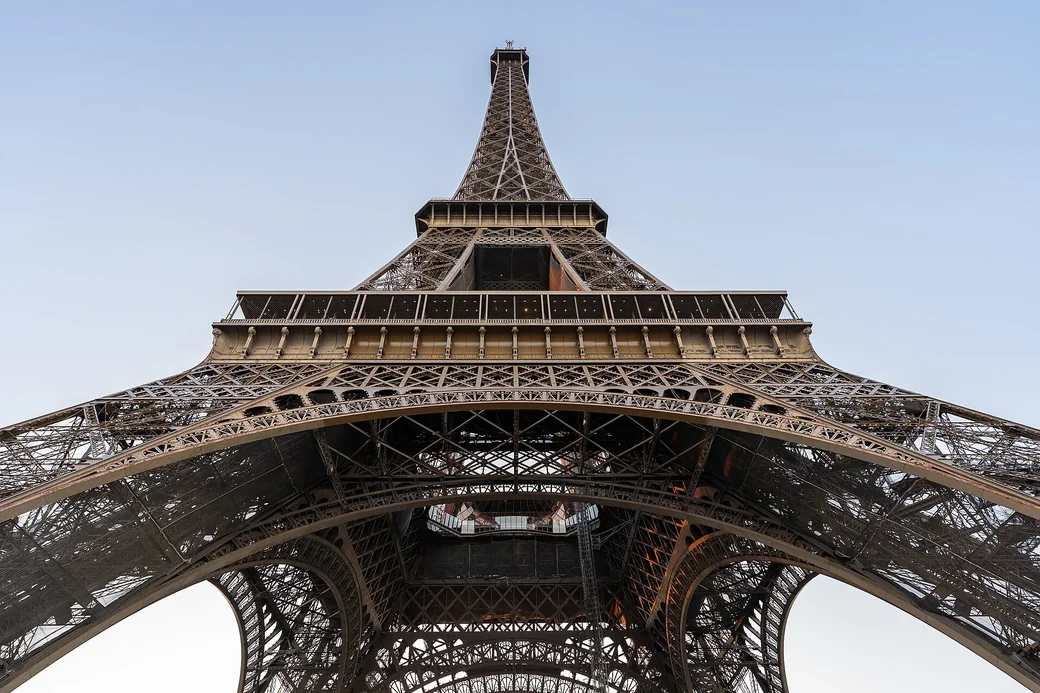
The stair queue is consistently the shortest on the site, and 674 steps bring you to the second floor in twenty to twenty-five minutes at an easy pace. You also get the one thing the lift cannot offer: the riveted ironwork passing within arm's reach the whole way up. The summit is higher, but height flattens the city: from 276 metres Paris starts to look like a map. The second floor sits at the height where the Seine, the Louvre, the Invalides dome and the Arc de Triomphe all stay recognisable, and where the streets below still read as streets rather than texture. On a clear day the white domes of Sacré-Cœur on the Montmartre hill stand out to the north-east as well.
When to Visit the Eiffel Tower: Book Sunset Slots Early and Aim for the Quietest Windows
Timed tickets are released online well in advance, and summit slots sell out first; in summer, anything within ninety minutes of sunset disappears fastest. Booking online also lets you choose your entry time precisely, so you can plan the rest of the day around it. Crowds build through the late morning and peak from midday to early evening. Arriving for the first slots of the day or booking a late-evening slot avoids both. Season matters even more: between November and February the whole site runs at a different pace, with short waits and clear winter air that often gives the longest sight lines of the year.
Lifts and Access: The Restaurant Entrance and Step-Free Routes to Floors One and Two
Guests with a table booked at Le Jules Verne, the gastronomic restaurant on the second floor, use a dedicated entrance at the south pillar and a private lift, bypassing the general queue entirely. The meal becomes the smoothest possible way up the tower, with the city spread out beside your table. Wheelchair users can reach the first and second floors by lift, where the viewing galleries, restaurants and accessible toilets are. The lift that serves the summit is not adapted, so book with that in mind rather than discovering it on the day.
Getting In: Two Site Entrances, the Calmer East Pillar and Security Without Suitcases
Everyone reaches the esplanade through one of two entrances, at the east and south pillars, and the east side is generally the less crowded of the two. Once you are inside, lifts board in the east, west and north pillars while the stairs start at the south pillar, and the information point sits at the west pillar. The esplanade beneath the pillars is open without a ticket, but a glass perimeter surrounds it and everyone goes through a bag check that can take twenty minutes at peak times. There is no left-luggage service: suitcases, large rucksacks and glass bottles are all refused, so plan the visit around your hotel rather than the station.
Photographing the Eiffel Tower: Trocadéro at Sunrise and Viewpoints With the Tower in the Frame
The terrace above the Palais de Chaillot gives the frontal view everyone recognises, with the Pont d'Iéna leading the eye straight to the pillars. By ten in the morning it is shoulder to shoulder; an hour after sunrise it is nearly empty, and the low light rakes across the ironwork from the east. The one thing you cannot see from the Eiffel Tower is the Eiffel Tower. The Montparnasse terrace faces it squarely across the rooftops, the Arc de Triomphe puts it beside the Champs-Élysées in a single frame, and the rooftop terraces of the big department stores on Boulevard Haussmann open onto it without an admission gate at all.
Framing the Tower in the City: Three Streets and the Arches and Columns of the Pont de Bir-Hakeim
Rue de l'Université lines the tower up at the end of a corridor of façades, and the signature view sits near the junction with Avenue de la Bourdonnais. Rue Saint-Dominique gives a livelier version with cafés in the frame, and Avenue de Camoëns adds a short flight of ornamental steps in the foreground. Social media has made the first of these genuinely busy, so come early and leave the pavement clear for residents. The bridge carries the elevated metro on an arcade of steel arches, and shooting along the lower deck stacks those arches into a receding tunnel with the tower framed at the end. Trains passing overhead add motion. Stand well clear of the cycle lane, which is busy at commuter hours.
The hourly sparkle is watched from outside, not from the tower
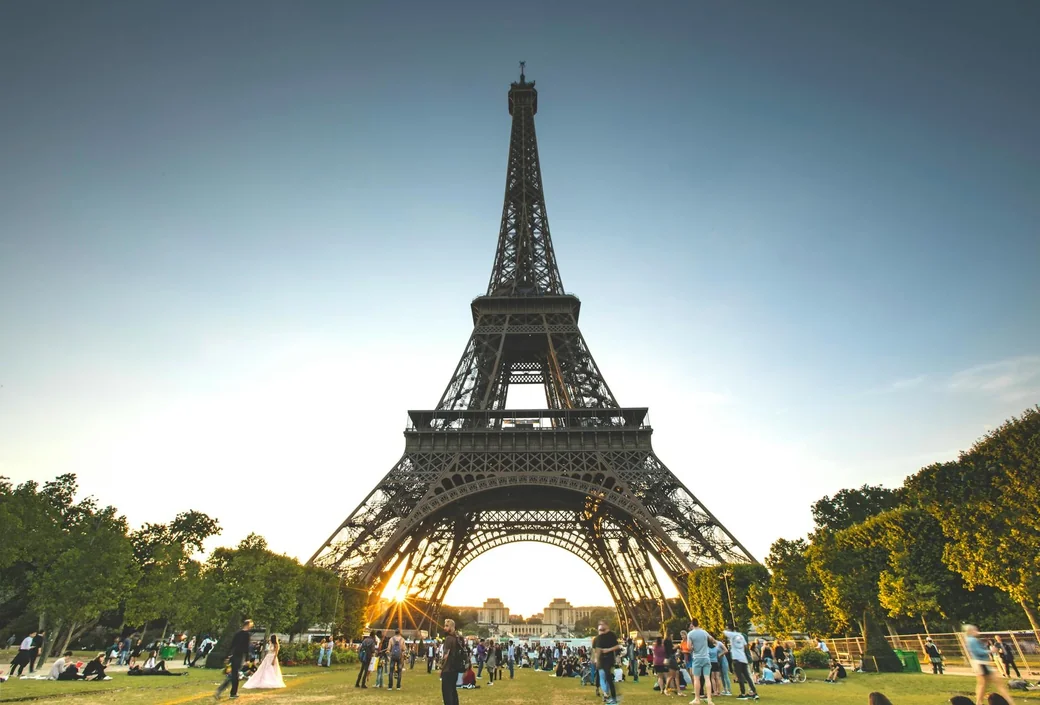
Every evening at dusk the whole tower is floodlit in a warm golden light. For five minutes at the top of every hour after dark, thousands of small lamps flash across the ironwork. It is the single most photographed thing about the tower and it is completely invisible if you are standing on it. Plan to be on the Champ-de-Mars lawns, at Trocadéro or on a Seine bridge instead.
Hidden Details on the Tower: Gustave Eiffel's Summit Apartment and the 72 Names Engraved Around the First Floor
Tucked behind the summit gallery is a small wood-panelled apartment the engineer built for himself, complete with wallpaper and a piano. According to a popular story, wealthy Parisians offered large sums to rent it for a night and Eiffel turned every one of them down. Today it can be viewed through glass, staged with wax figures of Eiffel, his daughter Claire and Thomas Edison. Eiffel chose seventy-two French scientists, engineers and mathematicians and had their names cut into the frieze on all four sides. The letters were painted over in the early twentieth century and only restored in the 1980s. Not one of the seventy-two is a woman, an omission that is still argued over today.
What to Expect on Each Level: The First-Floor Glass Floor and Summer Terrace, the Windy Summit
Most visitors ride straight past the first level, which is a mistake. It carries a transparent floor panel looking fifty-seven metres down onto the esplanade, a museum trail along the north and east galleries, a free children's route, and in summer a terrace laid out as an open-air lounge with shade and long views. At 276 metres the open deck sits in whatever weather is passing, and it runs several degrees colder than the pavement with nothing to break the wind. Access can also be suspended in gales or icing conditions, sometimes at short notice, so check the official site on the morning of your visit before you build the day around it. Just below the open deck, the summit also has an enclosed gallery with the same views, a sheltered fallback when the wind picks up.
Stories From the Tower's Past: Saved From Demolition by Radio and 'Sold' for Scrap in 1925
The tower went up in just over two years for the 1889 Exposition Universelle, the world's fair held to mark the centenary of the French Revolution. The permit ran for twenty years and the tower was due to come down in 1909. What kept it standing was its usefulness as a transmitting mast: the army had already begun using it for wireless telegraphy. During the First World War the station intercepted German signals, work that fed directly into the defence of Paris. In 1925, Victor Lustig posed as a government official, told a group of scrap dealers the tower was to be dismantled, and ran a confidential tender. According to the widely told account, the winning bidder was too embarrassed to report the fraud; when Lustig tried the same trick again a month later, the next victim went to the police and the con man slipped away.
Living Iron: The Tower Grows in Summer, Leans Away From the Sun and Is Repainted by Hand Every Seven Years
Gustave Eiffel's workshops shaped more than 18,000 iron parts for the tower and joined them with some two and a half million rivets. Iron expands with heat, so on a hot day the structure stretches by around fifteen centimetres. The side facing the sun expands more than the shaded side, which tips the summit as much as eighteen centimetres away from the light. The whole thing settles back overnight, and the movement is designed into the structure. Paint is the only thing keeping the iron from rusting, so a full repaint comes round roughly every seven years and uses about sixty tonnes of paint applied by brush rather than spray. The shade is the tower's own registered brown, and it is laid on in three tones, darkest at the base, to correct how the eye reads the height.
The lift machinery in two pillars dates from 1899
The cabins have been renewed many times, but the hydraulic mechanism that drives them in the east and west pillars is original nineteenth-century engineering, still in daily service. Look through the glazed panels near the boarding area on the way up and you can watch the pistons and cables working.
The official app is a free multilingual audio guide
Download it before you arrive rather than fighting for signal in the queue. It carries commentary in several languages, floor plans and live information on which levels are open, which is the fastest way to learn that the summit has closed before you have queued for the lift.
Staying Safe Around the Tower: Pickpocket Hotspots at Trocadéro and the Champ-de-Mars and Four Street Approaches to Ignore
Thefts cluster exactly where attention goes upward: the Trocadéro terrace, the lawns, the security queue and the RER platform below. Carry nothing loose in a back pocket, keep bags closed and in front of you, and be especially alert during the sparkle show, when every head in the crowd turns the same way at once. The friendship-bracelet knot tied on your wrist before payment is demanded; the gold ring supposedly just found at your feet; the clipboard petition that occupies both your hands; and the unlicensed souvenir sellers who scatter when police appear. None of these needs a conversation. A short no without breaking stride ends all four.
Beyond the Tower: A Champ-de-Mars Picnic With One Packing Rule and a Half-Day Walk From Trocadéro to the Invalides
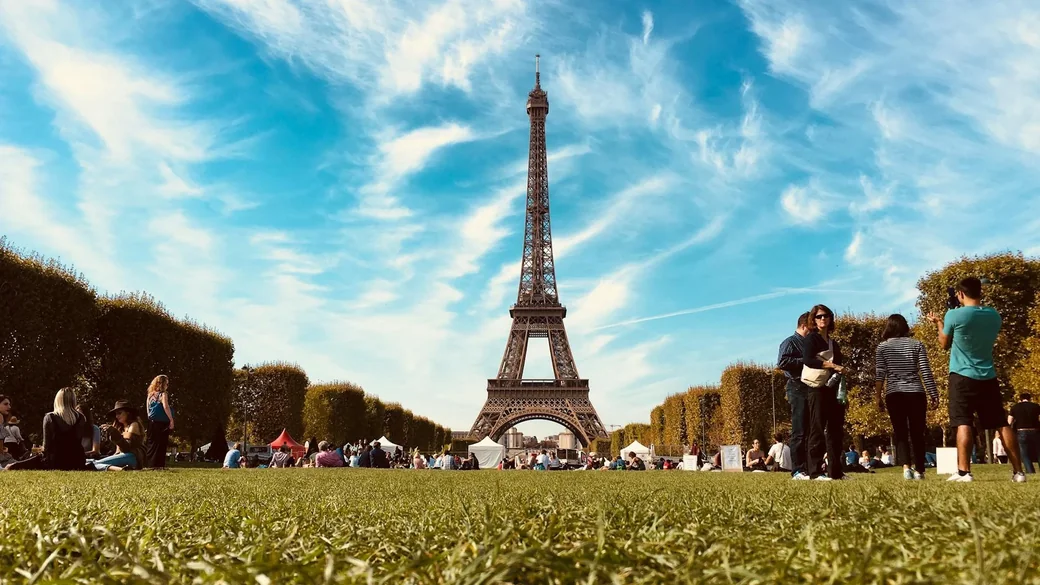
The long lawns south of the tower are the cheapest good seat in Paris, and locals treat them exactly that way on warm evenings. Buy bread, cheese and fruit on Rue Cler a few streets away. Leave glass bottles behind: they are refused at the security perimeter and confiscating one at the gate ends the picnic before it starts. Start on the Trocadéro terrace for the frontal view, cross the Pont d'Iéna, pass under the pillars and walk the length of the Champ-de-Mars to the École Militaire. From there it is a flat fifteen minutes east to the gold dome of the Invalides, and another ten to the Rodin Museum garden if the legs are still willing.
Eiffel Tower: Visitor Tips
Take the stairs to the second floor if you are reasonably fit: the queue is far shorter and you see the ironwork up close. The second floor, not the summit, gives the views most people actually want, because landmarks stay recognisable. Book online well ahead; sunset slots go first. Enter by the east pillar, the calmer of the two site entrances. Dress warmer than street level — the summit is exposed and windy. Watch the hourly sparkle from the Champ-de-Mars or Trocadéro, not from the tower itself.
Eiffel Tower: Best Time to Visit
The first slot of the morning or the last slots of the evening, when queues thin out. For photos, book about 90 minutes before sunset to catch daylight, blue hour and the first sparkle in one visit.
Eiffel Tower: Admission Fees
Summit by lift – Adult
Full rate for visitors aged 25 and over; advance online booking is recommended.
€36.70
Summit by lift – Youth (12–24)
Reduced rate for ages 12 to 24; proof of age may be requested.
€18.40
Summit by lift – Child (4–11)
Reduced rate for ages 4 to 11; the same rate applies to visitors with a disability, with proof.
€9.20
Summit – stairs to 2nd floor, then lift – Adult
Full rate for visitors aged 25 and over; advance online booking is recommended.
€28
Summit – stairs to 2nd floor, then lift – Youth (12–24)
Reduced rate for ages 12 to 24; proof of age may be requested.
€14
Summit – stairs to 2nd floor, then lift – Child (4–11)
Reduced rate for ages 4 to 11; the same rate applies to visitors with a disability, with proof.
€7
2nd floor by lift – Adult
Full rate for visitors aged 25 and over; advance online booking is recommended.
€23.50
2nd floor by lift – Youth (12–24)
Reduced rate for ages 12 to 24; proof of age may be requested.
€11.80
2nd floor by lift – Child (4–11)
Reduced rate for ages 4 to 11; the same rate applies to visitors with a disability, with proof.
€6
2nd floor by stairs – Adult
Full rate for visitors aged 25 and over; advance online booking is recommended.
€14.80
2nd floor by stairs – Youth (12–24)
Reduced rate for ages 12 to 24; proof of age may be requested.
€7.40
2nd floor by stairs – Child (4–11)
Reduced rate for ages 4 to 11; the same rate applies to visitors with a disability, with proof.
€3.80
Under 4 (free)
Free for children under 4; a free entry ticket is still required, and the accompanying adult pays the regular rate.
Free
Quick Info
2h 30m
easy
Eiffel Tower: Getting There
Métro line 6 to Bir-Hakeim or line 9 to Trocadéro, which gives the best first view across the Pont d'Iéna; line 8 stops at École Militaire on the far side of the Champ-de-Mars. RER C calls at Champ de Mars–Tour Eiffel, minutes from the south pillar. Buses 42, 69, 82 and 87 all pass close by, and the Batobus river shuttle has a Tour Eiffel landing. Driving is a poor idea: the district sits inside the low-emission zone and street parking is scarce.
Nearby stops & parking
Bir-Hakeim (line 6) is about five minutes on foot from the east pillar. Trocadéro (lines 6 and 9) is roughly ten minutes away across the Pont d'Iéna. RER C Champ de Mars–Tour Eiffel sits beside the south side. Underground car parks on Quai Branly and Avenue de Suffren fill early in the day. Taxis and ride-hailing cars drop off along Quai Branly; bicycle docking stations ring the Champ-de-Mars.
Eiffel Tower: Dress Code & Etiquette
There is no dress code, but the summit sits fully exposed and runs noticeably colder and windier than street level — bring a jacket even in July. Comfortable shoes matter if you climb, and the metal steps can be slick after rain. Large hats and loose scarves are easily lost over the railings on the open deck.