Eyüp Sultan Mosque is a mosque and pilgrimage complex in the Eyüp district of Istanbul, on the western shore of the Golden Horn just beyond the old city walls. It grew up around the tomb of Abu Ayyub al-Ansari, a revered figure of early Islam, and remains an active place of worship today. Visitors of every background are welcome to explore its courtyards, its tiled tomb and the historic neighbourhood around it, which together make it one of the most atmospheric sacred places in the city.
Eyüp Sultan Mosque: Location, accommodation options and contact
Eyüp Merkez Mahallesi, Cami Kebir Sokak, 34050 Eyüpsultan, Istanbul
The place's location on the map and nearby accommodation and hotel options are shown by Stay22. Cookies are used. Your consent is remembered on every page; you can turn it off at any time in the cookie settings.
Why Eyüp Sultan Mosque matters: the shrine of the Prophet's standard-bearer
Few places in Istanbul carry the emotional weight of this mosque. Abu Ayyub al-Ansari, known locally as Eyüp Sultan, was a companion of the Prophet Muhammad and carried his standard in many campaigns. Tradition says that after the migration to Medina the Prophet stayed in his house for about seven months, which earned him the title of the Prophet's host. He later joined the first Muslim siege of Constantinople in the second half of the seventh century and died during it. Many visitors call the shrine one of the holiest in the city, an expression of devotion rather than an official ranking. He is not the prophet Job, whose name is the same in many languages; here Eyüp Sultan always means Abu Ayyub. For more than five centuries, pilgrims, families and travellers have come here to pray, to make a wish or simply to sit for a while in the shade of the courtyard.
History of Eyüp Sultan Mosque: from the 1458 foundation to the 1800 rebuilding
After the conquest of 1453, Sultan Mehmed II had the tomb built, and in 1458 a mosque rose beside it as part of a complex with a school, a soup kitchen and a bathhouse. A great earthquake in 1766 damaged the building beyond repair. Selim III therefore ordered its demolition in 1798 and a new mosque, completed in about twenty-eight months under the supervisor Uzun Hüseyin Efendi, opened for Friday prayer in the autumn of 1800. Only the older minarets were kept. Lightning struck the sea-side minaret in the early 1820s, and a twentieth-century restoration later secured the structure. The tomb is regarded as the first Ottoman building raised in the city after the conquest. Earthquake damage in 1894 was repaired within a year, and a large repair followed in 1956–58.
Architecture of Eyüp Sultan Mosque: dome, Baroque details and courtyards
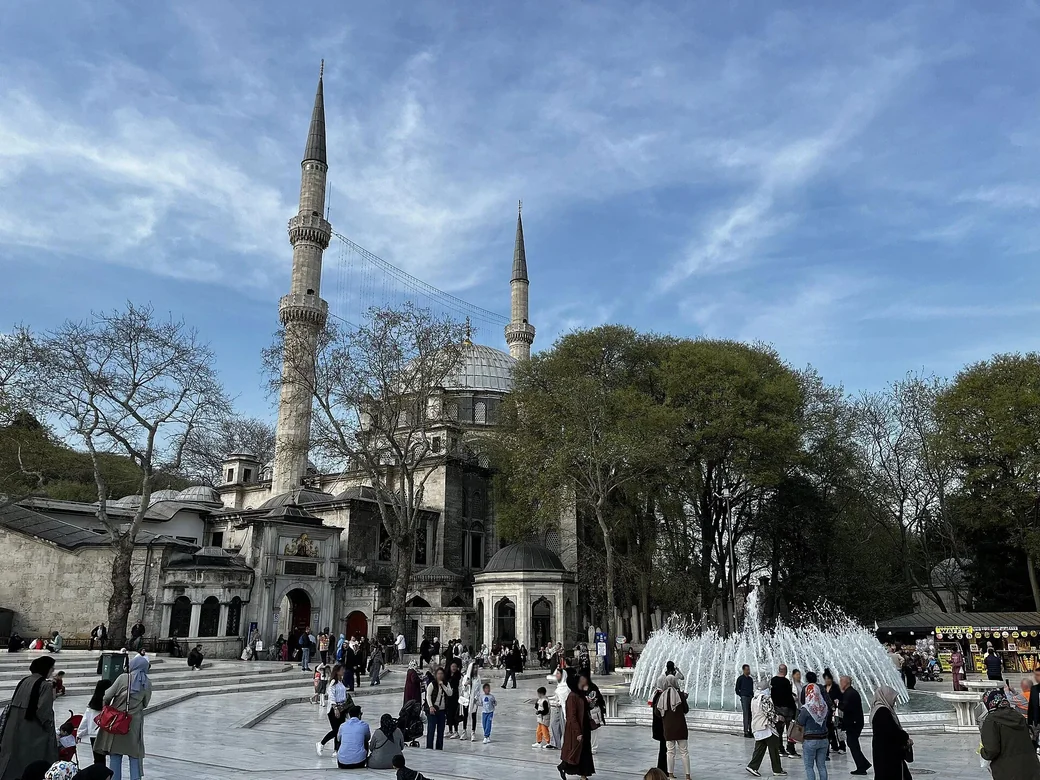
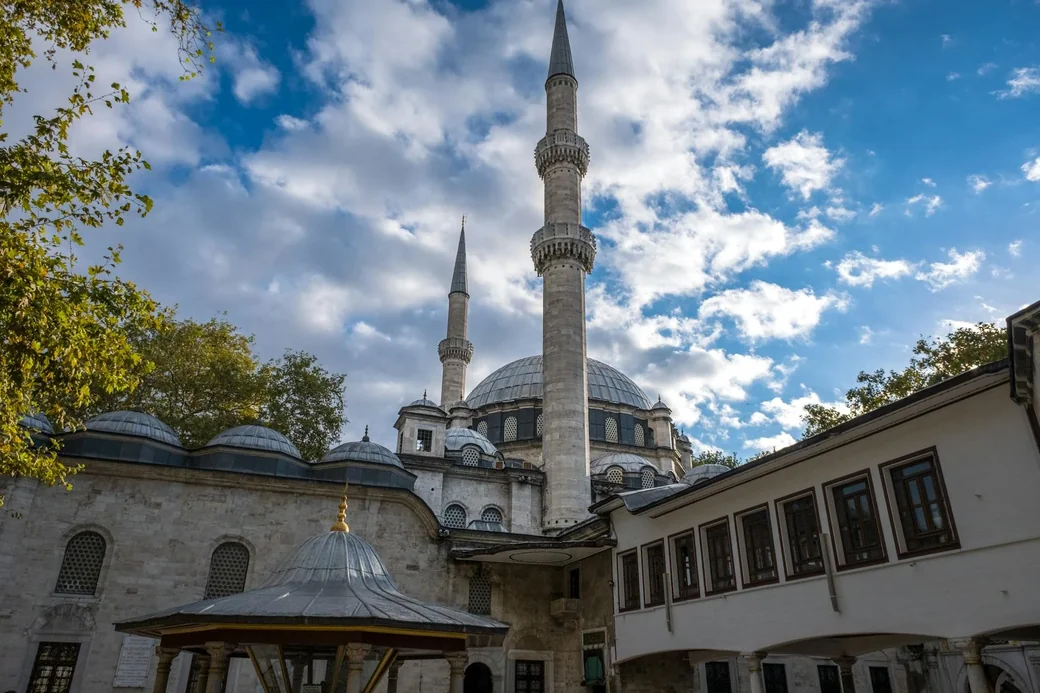
Although it was rebuilt in the late eighteenth century, the mosque is faithful to the classical plan popularised by Sinan: a central dome about seventeen and a half metres wide rests on six columns and two piers, surrounded by half-domes and small corner domes. The pale limestone walls contrast with Baroque touches such as engaged columns, shell and leaf carving, a gilded mihrab niche and a marble pulpit. A portico with six columns and seven domes leads in. A raised, enclosed passage along the outer courtyard once carried the sultan to his private balcony. In this way the mosque keeps the octagonal scheme of the great imperial architects of the classical period, dressed in late Ottoman ornament.
Tomb of Abu Ayyub al-Ansari: Iznik tiles, silver lattice and the prayer window
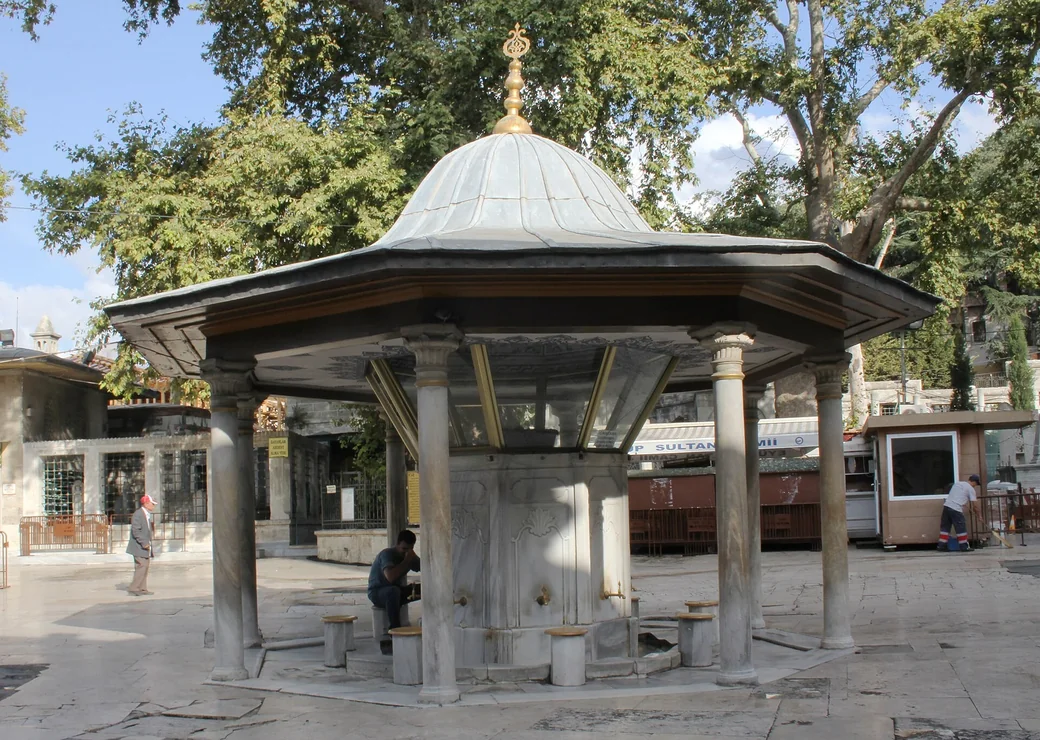
The octagonal, single-domed tomb stands apart from the courtyard, and its outer wall is covered with Iznik tile panels from different periods. Facing the courtyard is a bronze prayer window, where many visitors stop to pray before entering. Inside, blue and white tiles rise to a band of Quranic verses, and a Baroque silver lattice, dated to the 1790s, encloses the sarcophagus beneath a dark embroidered cover. Dozens of gold and silver incense burners hang above it. A small women's prayer room lies beside the entrance, and a well is kept at the foot of the sarcophagus. A fountain kiosk (sebil) built under Ahmed I stands beside the entrance, and tiles that may once have decorated the old bathhouse are now displayed in museums in London and Paris.
The plane tree, the wish fountains and local beliefs in the inner courtyard
In the middle of the inner courtyard an ancient plane tree grows on a raised, railed platform. Four small marble fountains with the monogram of Selim III stand at its corners, and the railings are topped with the caps of the Mevlevi dervishes (followers of the Sufi order inspired by Rumi, known for its whirling ceremony), since that sultan followed the order. Locals call them wish or fortune fountains, and tradition holds that unmarried young women who walk around them will find luck. The platform is also said to be where Abu Ayyub's body was washed. Hundreds of pigeons share the square, adding to the lively atmosphere. Some say the old tree grew from the staff or sapling of Akşemseddin; one of two plane trees said to date from Mehmed II's time fell early in the twentieth century.
Sword-girding ceremonies: how Ottoman sultans were crowned at Eyüp
Eyüp was the place where a new sultan was ceremonially girded with the sword of Osman, a rite that served as the Ottoman equivalent of a coronation. The custom is said to have begun with Mehmed II. Some days after his accession, the sultan travelled by boat from the Sinan Pasha pavilion to the Bostan pier, prayed at the tomb and received the sword from a leading religious figure. He then returned by land through the city along what is still called the Accession Way. Animals were sacrificed and the meat was given to the poor.
Legend of the lost grave: Akşemseddin, the saplings and the ring
According to tradition, the grave was lost for about eight centuries until Sultan Mehmed II asked his teacher Akşemseddin to find it. One version says the sheikh saw a light descend on the spot each night and planted two plane saplings at the head and foot. To test him, the sultan moved the saplings and secretly buried his ring on the true spot; the next day the sheikh ignored the saplings, pointed to that spot and said that a ring lay in the soil and a stone two metres down. In the chronicler Evliya Çelebi's version, the sheikh prayed on a rug, then asked his followers to dig where it lay, and a stone with an old inscription appeared. Evliya adds that when the stone was lifted the body lay fresh in a saffron-scented shroud with a bronze seal in its right hand. Another account says the army prayed the Friday prayer on this spot from the first days of the siege.
Legends of the burial wish, the Byzantine rain prayers and the camel
According to tradition, Abu Ayyub asked to be buried as far into enemy land as the army could reach, and some accounts add that horses were ridden over the grave to hide it. A well-known story says the Byzantine emperor threatened to desecrate the grave, but the army commander replied that churches in the Muslim lands would suffer, so the emperor left it alone. Another account claims that local Christians visited the grave in droughts to pray for rain. A further tradition, written inside the prayer window, says the Prophet let his camel choose a host in Medina, and it knelt at Abu Ayyub's door. Many accounts also recall the Prophet's saying that Constantinople would be conquered and that a righteous man would be buried beneath its walls; Abu Ayyub is said to have joined the siege in his nineties, hoping to be that man.
Relics, the sacred well and Sultan Ahmed's dream: stories told at the tomb
Beside the tomb entrance, a cabinet is said to hold a footprint attributed to the Prophet, and some visitors also mention a hair of his beard. These relics are matters of belief, not proof. Local tradition also says the well at the foot of the sarcophagus is connected with the spring of Zamzam, and one story tells how a Byzantine princess was cured after bathing in its water. Evliya Çelebi relates that Sultan Ahmed I once brought a footprint relic from Cairo but, after a dream in which the Prophet judged against him, sent it back and kept a copy. The sacred banner is said to have been kept in the tomb until 1730, when it was moved to Topkapı Palace after the Patrona revolt; only two banner covers remain. The dark curtains at the tomb windows were reportedly made for the Prophet's tomb in Medina.
Eyüp Cemetery and the royal tombs: viziers, princesses and the Mihrişah complex
Behind the mosque, Eyüp Cemetery climbs the hillside among cypresses, and it is one of the oldest Muslim burial grounds in the city. For centuries people have wished to rest near Eyüp Sultan, so the slopes are full of tombs of viziers such as Sokollu Mehmed Pasha, Siyavuş Pasha and Lala Mustafa Pasha, as well as royal women including Mihrişah Valide Sultan (Valide Sultan is the title of the reigning sultan's mother) and Adile Sultan. Next to the mosque stands the Baroque complex of Mihrişah Sultan, built a few years before the rebuilding. The tomb of Sultan Mehmed V Reşad, designed in 1918, overlooks the water.
Pierre Loti Hill, the Golden Horn view and the legend of Aziyadé
The cemetery path ends at a hilltop café that has watched over the Golden Horn for generations. Pierre Loti, a naval officer who became a novelist, lived in Eyüp in the 1870s, and his novel Aziyadé appeared in 1879. According to tradition, he wrote at this café, then known as Rabia Kadın, and fell in love with a woman named Aziyadé. Where she is buried remains disputed. You can walk up through the graves on a steady climb or take the short cable car ride of about five minutes; sunset gives the best light for photographs of the water and the minarets.
Opening hours, best time to visit and crowd tips for Eyüp Sultan Mosque
The mosque is open for worship every day, and visitors may enter outside prayer times; during the five daily prayers, wait quietly in the courtyard. The tomb is usually open to visitors from early morning until late evening, but hours shift with the seasons and holidays, so check on the spot. Plan about ninety minutes for the mosque and tomb, and three hours if you add the cemetery and the hilltop. Mornings are calm, Friday midday and weekend afternoons are busy, and Ramadan evenings are crowded but atmospheric. Photography is fine in the courtyards. Good photo spots are the facade and twin minarets from the outer square in morning light, the plane tree courtyard, the tiled wall beside the prayer window and, at sunset, the Golden Horn from Pierre Loti Hill. At the tomb, visitors usually enter by one door and leave by another.
How to get to Eyüp Sultan Mosque: tram, ferry, bus and parking
The simplest way is the T5 tram from Eminönü along the Golden Horn to the Eyüpsultan Teleferik or Feshane stop, followed by a walk of about a quarter of an hour. If you start in the north, ride the M7 metro to Alibeyköy and change to the T5. A ferry on the Golden Horn line ends at the Eyüp pier, five minutes from the mosque, and gives lovely views. Drivers will find limited paid parking that fills up on Fridays, weekends and holidays. Typing the mosque's name into your map app works well, or use https://www.google.com/maps/search/?api=1&query=41.047923,28.933851 The Üsküdar–Eyüp ferry calls at Karaköy, Fener and Balat on the way, so the crossing doubles as a small Golden Horn tour.
Dress code and etiquette at Eyüp Sultan Mosque: dos and don'ts
Treat the visit as a pilgrimage. Dress modestly, with shoulders and knees covered, and women should cover their hair. Remove your shoes, speak softly and silence your phone. Do not photograph people praying, use flash inside, touch the tiles or lean on the lattice. Do not walk in front of worshippers, and do not eat or drink in the prayer areas. Follow the line at the tomb, pause briefly and leave room for others. Accept offers of help politely, and feel free to decline anything you do not need.
Accessibility, guides and local traditions around Eyüp Sultan Mosque
Access is only partly step-free: the outer square is open, but the courtyards, the tomb entrance and the crowds make wheelchairs and strollers difficult, so a helper is wise. Guided walks of the district are offered in several languages, and audio guides exist, though the mosque itself has no formal tour desk. Local life adds colour: boys in princely costumes arrive for circumcision celebrations, families picnic at iftar (the sunset meal that ends the daily Ramadan fast) in Ramadan, and stalls sell rose water, prayer books and simit (a ring of bread coated with sesame seeds). Nearby you can also visit the Mihrişah complex, Zal Mahmud Pasha Mosque, Feshane and Balat. The old bazaar was once known for yoghurt, clotted cream, kebabs and toys, and one workshop is reported to still make the traditional Eyüp toys.
Eyüp Sultan Mosque: Visitor Tips
Arrive early, dress modestly and carry a light scarf. Enter the tomb by the quieter door and keep moving so that others can pray. Photograph the courtyards and facades freely, but never people at prayer. Finish with a walk up the cemetery path to Pierre Loti Hill for the Golden Horn view.
Eyüp Sultan Mosque: Best Time to Visit
Early morning on a weekday, or after the afternoon prayer; avoid Friday midday and Ramadan evenings if you want calm.
Eyüp Sultan Mosque: Admission Fees
Free admission
Entering the mosque courtyard and the tomb area is free; visitors are asked to dress modestly and observe prayer times.
Free
Quick Info
1h 30m
easy
Eyüp Sultan Mosque: Getting There
The easiest route is the T5 tram that runs along the Golden Horn between Eminönü and Alibeyköy. Get off at Eyüpsultan Teleferik or Feshane and walk about ten to fifteen minutes towards the waterfront square, following the crowds and the minarets. From the north of the city, the M7 metro connects to the T5 tram at Alibeyköy. Buses such as 50B and 55T also stop close to the tram stations.
For a scenic arrival, take a Golden Horn ferry; the Eyüp pier is about five minutes on foot from the mosque. Driving is possible, but parking in the district is limited and paid, and it becomes very difficult on Fridays, weekends and religious holidays. A taxi can drop you at Eyüp Sultan Square. Type Eyüp Sultan Camii into any navigation app, or open this link: https://www.google.com/maps/search/?api=1&query=41.047923,28.933851
Nearby stops & parking
Closest stops: the T5 tram stations Eyüpsultan Teleferik and Feshane, the Eyüp ferry pier on the Golden Horn, and several bus stops on the main Eyüp Sultan boulevard. The lower cable car station for Pierre Loti Hill is also within walking distance. Public car parks operated by the city are scattered around the square and the waterfront, yet spaces vanish quickly at weekends, so public transport is the calmer choice. Taxis and private cars can stop at the square only briefly; walk the last few minutes along the pedestrian streets.
Eyüp Sultan Mosque: Dress Code & Etiquette
This is a working mosque and a pilgrimage site, so modest dress is expected of everyone: shoulders and knees covered, no shorts, no sleeveless tops. Women cover their hair; scarves are reportedly lent at the entrance, but bringing your own is easier. Shoes come off before the prayer hall, and shoe bags are useful. Speak quietly, keep phones silent, do not eat inside, and give worshippers space. Public displays of affection are out of place here.