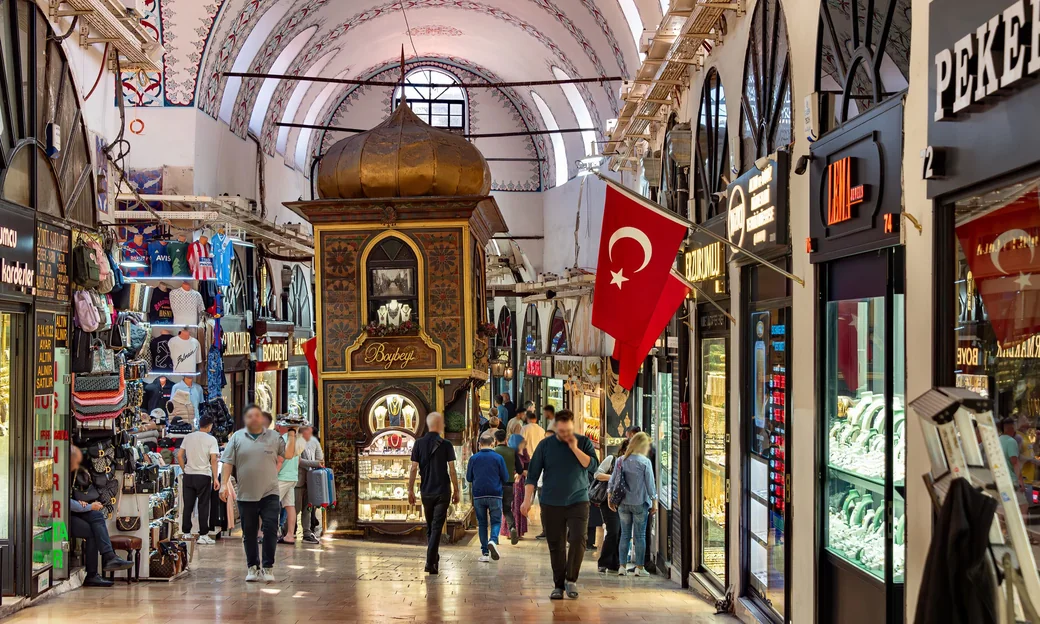
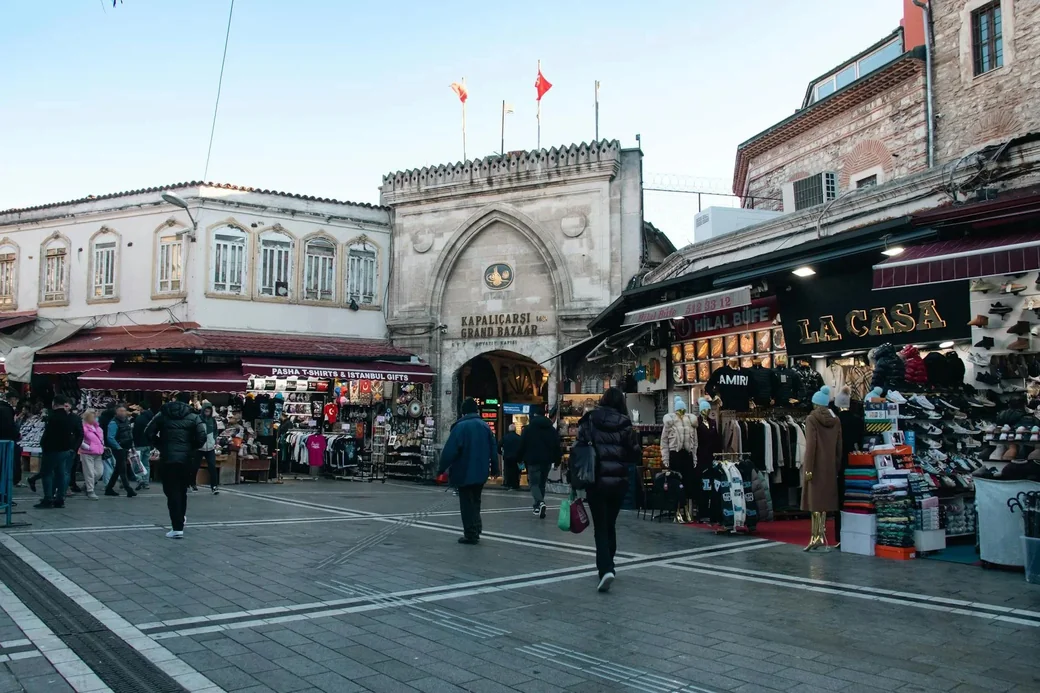
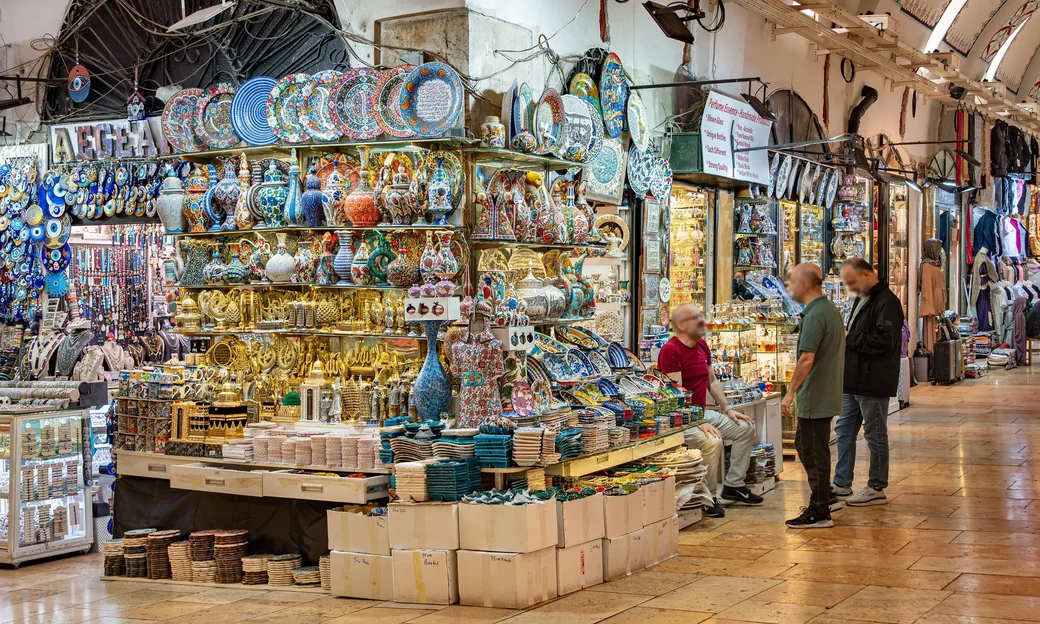
The Grand Bazaar (Kapalıçarşı), whose Turkish name means “Covered Market”, is a vast historic market in the heart of Istanbul’s Historic Peninsula, in the Fatih district. It is one of the largest and oldest covered markets in the world: a roofed maze of lanes, inner courtyards and vaulted halls lined with small shops and workshops. For visitors it is as much a walk through living history as a shopping trip, a place where a new discovery waits around almost every corner.
Grand Bazaar: Location, accommodation options and contact
Kapalıçarşı, Beyazıt Quarter, 34126 Fatih, Istanbul, Türkiye (main gates: Beyazıt and Nuruosmaniye) | Google Maps: https://www.google.com/maps/search/?api=1&query=41.010685,28.968068
The place's location on the map and nearby accommodation and hotel options are shown by Stay22. Cookies are used. Your consent is remembered on every page; you can turn it off at any time in the cookie settings.
Grand Bazaar Istanbul History: From Mehmed II's Bedesten to Today
Construction of the bazaar's core began in the winter of 1455–56, soon after the conquest of Constantinople. The İç Bedesten, also called the Cevahir Bedesten, was finished in the winter of 1460–61 and endowed to the waqf of Hagia Sophia; 1461 is the founding year most often cited today. The Sandal Bedesten followed, and sources disagree on whether Mehmed II or Süleyman I had it built. By the early seventeenth century the market had its final shape and, with the surrounding hans, was the hub of Mediterranean trade. Around 1638 Evliya Çelebi counted about 3,000 shops plus 300 more in the hans, and the streets were not yet roofed at that time. Evliya Çelebi described the bazaar as a mighty fortress and the great treasure house of the Ottomans. A waqf is a charitable endowment: the rent from the Cevahir Bedesten went to the upkeep of Hagia Sophia, which had become a mosque, and a whole commercial quarter gradually grew up around this first core.
Fires, Earthquakes and Restoration: How the Grand Bazaar Survived
Fire struck the bazaar again and again, from 1515 and 1548 to the great blaze of 1701, after which Grand Vizier Nevşehirli Damat İbrahim Pasha rebuilt large parts in 1730–31 and wooden structures gave way to stone, brick and vaults. The earthquake of 1894 led to repairs under Mahmud Celaleddin Pasha until 1898; the bazaar shrank and the Bit Pazarı (flea market) was left outside its walls. The streets received official names in 1927, the last fires came in 1943 and 1954, and the restoration was completed on 28 July 1959, followed by another in 1980. In recent years ceilings, walls, wiring and ground were reinforced, with painted decoration recreated from nineteenth-century engravings. The aim of this latest work was to make the whole structure more resistant to future earthquakes.
Cevahir and Sandal Bedesten: the Grand Bazaar's Original Vaulted Safes
The two bedestens are the stone core of the Grand Bazaar. The İç Bedesten, about 43 by 29 metres, is roofed by 15 brick domes, while the Sandal Bedesten has 20; its name comes from a silk-and-cotton fabric woven in Bursa. Inside the İç Bedesten, 44 vaulted cellars once served as strongrooms, which is why one author calls the bedesten the ancestor of the rental safe. Precious goods were auctioned there, and in 1915 the Sandal Bedesten became an auction house for carpets. Today the İç Bedesten is known for antiques and jewellers. Some scholars suspect Byzantine origins, but the brickwork points mostly to the later fifteenth century. The Byzantine eagle relief behind this theory sits above the İç Bedesten's eastern Jewellers' Gate (Kuyumcular Kapısı). Today the Sandal Bedesten is known for leather goods, clothing and bags, including imitation brands. One author adds that the bedesten walls are about six metres thick and that roughly three shops shared each cellar. A bedesten is a solid, domed stone hall that could be locked at night, which made it the safest place in the market for valuable goods.
Gates, Streets and Hans: How to Find Your Way Inside the Grand Bazaar
The traders' association names eleven main gates: Beyazıt, Çarşıkapı, Çuhacıhan, Kuyumcular, Mahmutpaşa, Nuruosmaniye, Örücüler, Sepetçihan, Takkeciler, Tavukpazarı and Zenneciler. Counts of all entrances vary, with 22 in several guides. Kalpakçılar Caddesi links the Nuruosmaniye and Beyazıt gates, and Yağlıkçılar Caddesi crosses it. Shop numbers run odd on the left and even on the right as you enter, and at number 64 a right turn leads to the İç Bedesten. Zincirli Han, Cebeci Han, Çuhacı Han and Kalcılar Han are the best-known hans. Between Ağa and Aynacılar streets, currency dealers and gold traders crowd into a lively spot known as the Ayaklı Borsa (roughly, the "walking exchange"). Most hans are named after the goods once made or sold there, such as Çuhacı (cloth), Yağcı (oil), Astarcı (linings) and Safran; the ground floor was used for storage and for resting horses, while merchants were lodged around the courtyard. Çukur Han is known for brightly dyed cottons. The word han means an inn built around an open courtyard, and these courtyard buildings give the bazaar much of its maze-like character.
Grand Bazaar in Numbers: Shops, Visitors, Workers and Owners
Figures differ by source and by what is counted. One common reference lists 61 covered streets and 30,700 square metres; the traders' association gives 65 streets, 14 hans and 110,868 square metres in total, of which 45,000 are covered; Istanbul's culture portal lists 61 streets and 40 hans. One guide notes that the shops belong to the traders, the walls to the state and the streets to the municipality. The management also lists a health team, a post office, bank branches, a police point, cafés and restaurants inside the complex. Istanbul's culture portal also lists counts of shops and rooms that closely match an 1890 survey (4,399 shops and 2,195 rooms), so they may be historical figures.
Guilds, Stalls and Daily Life in the Ottoman Grand Bazaar
Traders were organised in guilds led by a kethüda (guild steward) appointed by the kadı (Islamic judge). Until the 1894 repairs there were no shops in the Western sense: merchants sat on wooden divans in small stalls called dolap, kept their best goods in cabinets, drew drapes at closing time and never advertised. Sellers of the same goods stood on the same street, which gave streets their names. Gates were locked every night, and entering after dark required an imperial edict; the only official night opening came in 1867 for Sultan Abdülaziz. There were no restaurants, so traders brought lunch in a sefertası (a tiered metal lunch box). Guilds were abolished in 1913; by then European competition and changing tastes had led many merchants, especially from minority communities, to move to Pera and Galata. The old booksellers' market (Sahaflar) moved to its present place near Beyazıt Mosque only after the 1894 earthquake, and in the nearby Esir Pazarı slaves were traded, a use carried over from Byzantine times.
Legends and Rumours of the Grand Bazaar: the Wild Bird, the Disguised Sultan and More
According to Evliya Çelebi, a fearsome winged bird figure watched over the Jewellers' Gate; the story goes that it reminded merchants that profit is a wild bird that can only be caught gently. Above the same gate a Byzantine eagle relief survives, which feeds rumours of older origins. Rumour also has it that Sultan Mahmud II came in disguise to eat pudding at a small kiosk near the crossing of Halıcılar and Acıçeşme streets. A tale from 1591 says 30,000 gold coins vanished from the İç Bedesten, the bazaar stayed shut for two weeks and a young musk seller was hanged once the gold surfaced. A modern rumour speaks of a "time portal" in the Cevahir Bedesten; nothing documents it. Treat all of this as rumour, not fact.
Dua Meydanı: the Ahi Tradition of Opening Shops with a Prayer
Under the Ahi tradition (the medieval Anatolian brotherhood of craftsmen and tradesmen), traders gathered each morning in a dua meydanı (prayer square) and, led by a trusted elder, prayed for honest and blessed earnings before opening their shops. The bazaar is said to have had two such squares: one where Zenneciler and Feraceciler streets cross the Fesçiler and Yağlıkçılar avenues, and one inside the Sandal Bedesten. The management describes the custom as alive today and says that Friday prayers were held here in Ottoman times, when Syriac, Armenian, Jewish, Greek and Muslim traders worked side by side. Ahilik Week marches begin at the Dua Meydanı with a mehter band (the Ottoman military band).
Grand Bazaar Roof Tours and Films: Skyfall, Taken 2 and the Cat Path
The restored roof, with its red-tile "cat path" (kedi yolu), can only be visited on guided tours booked through agencies. Groups of about ten people walk for roughly twenty minutes with a guide and security. Visitors are insured before going up; people aged 16 to 65 are admitted because the route involves heights and stairs, and bookings are taken only through authorised agencies. The renovated roof, open to tourism since 2019 according to the management, offers views of the Süleymaniye Mosque, the Beyazıt Tower, Istanbul University and the skyline of the Historic Peninsula; the path is single-file, and photos and videos are allowed only while standing still. The bazaar is also a film location: the opening scene of Skyfall (2012) is set here, scenes of Taken 2 were shot in it, and Jackie Chan's The Accidental Spy has bazaar scenes. Süha Arın's 1980 documentary 40,000 Steps in the Grand Bazaar shows the market through the eyes of a sherbet seller who had walked its streets for forty years.
Grand Bazaar Opening Hours, Closing Days and the Best Time to Visit
The bazaar is open Monday to Saturday and closed on Sundays. It also closes on the first day of the religious holidays and on public holidays, so check before you plan a trip around one. Individual shops may keep their own hours. Weekday mornings are the calmest; weekends bring far larger crowds, and Saturday afternoon is the busiest moment, while late afternoon feels livelier. Because the streets are covered, the bazaar is a good plan for a rainy day, and on Sundays the Spice Bazaar in Eminönü is normally open. For a first visit, plan about one to two hours, and more if you want to shop. Entry through any of the gates is free, so you can step in for a short stroll as easily as for a long shopping day.
Shopping in the Grand Bazaar: Haggling, Gold Safety and Tax-Free Tips
Jewellery dominates, but you will also find İznik tiles, carpets, textiles, leather, ceramics and gifts, many of them made in Anatolia. Prices are negotiable: start below the first offer, stay friendly and relaxed, and feel free to decline politely and walk on. The first sale of the day is called siftah and traditionally brings a better deal. For gold, remember that there is a retail and a wholesale side; compare at least two shops, be wary of unusually low prices and insist on an invoice and an assay certificate. Imitation brands and imitation gold are on sale. Visitors who live abroad can ask member shops about tax-free refunds and should keep the invoice, passport and goods ready. The area around Kalpakcilar Avenue (Kalpakçılar Caddesi), lined with jewellers, is still a reference point for the gold and currency trade across Turkey.
Where to Eat and Take a Break in the Grand Bazaar
Eating inside is a modern habit, because in Ottoman times there were no restaurants. Today Havuzlu Restaurant, founded in 1959 and named after the fountain pool at its entrance, serves traditional pot dishes and soups, and its walnut rice is often recommended. Şark Kahvesi on Yağlıkçılar Caddesi is the busiest tourist coffeehouse, Day Day pastry shop is a morning tea stop, and Bahar Restaurant is a traders' lunch spot; Kilis-style kebab and wood-fired döner stalls are also mentioned. Many guide articles are old, so check that a place is still open. Shopkeepers often offer tea during a chat, and accepting does not oblige you to buy. Alongside the bazaar’s long-established eateries, more and more small cafés now offer a pause between shops.
How to Get to the Grand Bazaar and What to See Nearby
The nearest tram stop is Beyazıt–Kapalıçarşı on the T1 line, a few minutes from the gates. By metro, take the M2 to Vezneciler and walk five to ten minutes. From the Asian side take Marmaray to Sirkeci and change to the T1, or ferry to Eminönü and continue by tram. Sultanahmet and Hagia Sophia are ten to fifteen minutes away on foot, and driving is discouraged because of traffic and scarce parking. Nearby you can visit Beyazıt Mosque, Beyazıt Square, the main gate of Istanbul University, the old booksellers' market, Süleymaniye Mosque, Nuruosmaniye Mosque, Çemberlitaş Hamam and the Spice Bazaar in Eminönü.
Photo Spots and Hidden Corners in the Grand Bazaar
Zincirli Han is the most photographed han, with red walls, green shutters, a courtyard fountain and a plane tree; its name is said to come from chains that guided rainwater down from the roof. Cebeci Han on Yağlıkçılar Caddesi is known for coppersmiths, Astarcı Han for thread and bobbins and Kalcılar Han for silver workshops, while the Kürkçüler market is the only two-storey part, covered in iron and glass. Look up for the restored painted ceilings, the tall vaults of the Sandal Bedesten and the Byzantine eagle relief above the Jewellers' Gate. The calmest light and fewest people come shortly after opening. Ask permission before photographing people. The oldest tenant of Zincirli Han is said to be Şişko Osman's carpet shop.
Do's, Don'ts, Etiquette and Accessibility in the Grand Bazaar
Do greet shopkeepers, ask before photographing people or workshops, carry a small bag, keep valuables close in crowds and keep invoices for gold, carpets or anything you might return. Don't rush a purchase, accept very cheap "gold" without checking, or leave your only visit for a Sunday. Dress modestly out of respect, although no strict code applies. Accessibility is partial: the main corridors are wide and some gates are step-free, with the Beyazıt Gate often recommended, but floors can be uneven or sloping, many shop doors have steps, there are no elevators, accessible toilets are limited and crowds make wheelchairs and strollers hard to manage at peak times. Security checks may be in place at the gates. One guide reports no official audio guide, only information panels at the main entrances; guided tours are run through agencies and licensed guides.
Grand Bazaar: Visitor Tips
Arrive close to opening on a weekday for the calmest walk; Saturdays are the busiest day. Enter through the Nuruosmaniye Gate, where it is easier to get oriented, and leave through the Beyazıt Gate to cross the whole bazaar. The bazaar has many exits, so remember the name of a shop near your gate. Look up: restored painted ceilings, the Byzantine eagle relief above the Jewellers' Gate (Kuyumcular Kapısı) and the courtyard of Zincirli Han all reward a slow look. Ask before photographing shopkeepers or workshops. Compare at least two shops before buying jewellery, and keep every invoice. Take a tea break in a han, and remember that the bazaar is closed on Sundays, when the Spice Bazaar in Eminönü is usually open.
Grand Bazaar: Best Time to Visit
Weekday mornings shortly after opening; spring and autumn are comfortable. Avoid Saturdays and holiday periods, which are the most crowded.
Grand Bazaar: Admission Fees
Free admission
Walking through the covered market's lanes and courtyards is free; you only pay for what you choose to buy.
Free
Quick Info
2h
easy
Grand Bazaar: Getting There
The easiest way is the T1 tram (Kabataş–Bağcılar): get off at the Beyazıt–Kapalıçarşı stop, cross the street and you are at the gates within a few minutes. By metro, take the M2 line to Vezneciler station and walk roughly five to ten minutes. If you start on the Asian side, ride Marmaray to Sirkeci and change to the T1 tram, or take a ferry to Eminönü and continue by tram. Many bus lines also stop around Beyazıt. From Sultanahmet and Hagia Sophia it is a walk of about ten to fifteen minutes up Nuruosmaniye Street. Driving is not recommended: traffic is heavy and parking in the surrounding streets is limited. Taxis can drop you near several gates.
Nearby stops & parking
The closest stops are Beyazıt–Kapalıçarşı on the T1 tram, Çemberlitaş (one stop towards Sultanahmet) and Vezneciler station on the M2 metro, plus bus stops around Beyazıt Square. There is no dedicated car park at the bazaar and the nearby streets fill up quickly, so public transport is strongly advised. If you arrive by taxi, ask to be dropped at the Nuruosmaniye or Beyazıt gate and agree on your meeting point in advance, because the many exits make it easy to come out in an unexpected street.
Grand Bazaar: Dress Code & Etiquette
There is no strict dress code, but modest, comfortable clothing is appreciated, and shoes with good grip are wise because the stone floors are worn and some corridors slope. If you step into one of the small prayer rooms (mescits) inside the complex, cover your shoulders and knees, remove your shoes and keep your voice low. Be courteous when photographing people, and greet shopkeepers before asking questions or taking pictures of their goods.