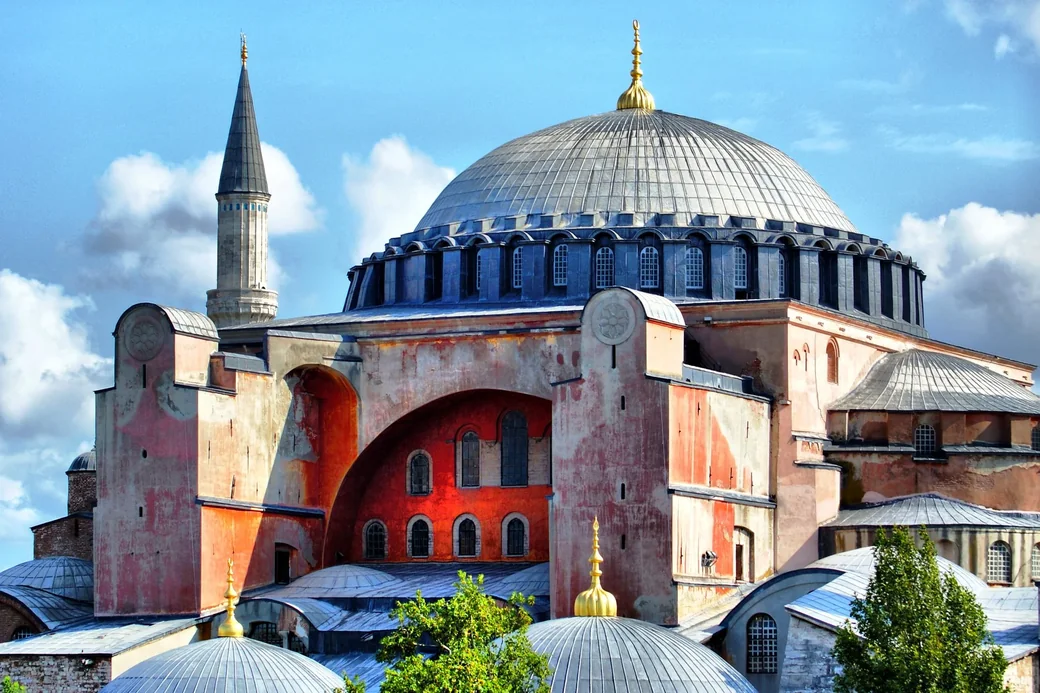
Hagia Sophia Grand Mosque (Ayasofya-i Kebir Cami-i Şerifi) stands in Sultanahmet, on Istanbul's historic peninsula. Built as the great cathedral of Byzantine Constantinople and later converted into an imperial mosque, it is today an active place of worship that also welcomes visitors. Its vast dome and its blend of Byzantine and Ottoman heritage make it one of the world's most celebrated buildings, and it forms part of the “Historic Areas of Istanbul” UNESCO World Heritage Site.
Hagia Sophia Grand Mosque: Location, accommodation options and contact
Sultanahmet Mah., Ayasofya Meydani No:1, 34122 Fatih / Istanbul
The place's location on the map and nearby accommodation and hotel options are shown by Stay22. Cookies are used. Your consent is remembered on every page; you can turn it off at any time in the cookie settings.
Hagia Sophia History: From Byzantine Cathedral to Mosque
Hagia Sophia's story spans three buildings. The first church was consecrated in 360 and the second in 415, and both were lost to fire. After the Nika riots of 532, Justinian I commissioned the present structure, which was consecrated in December 537. Designed by the architects Anthemios of Tralles and Isidore of Miletus, it served for nearly a thousand years as the principal church of Constantinople. A dome collapse after earthquakes led to a taller rebuilding completed in 562, and another earthquake in 989 required further repairs. Latin crusaders held the church from 1204 to 1261. After 1453 it became an imperial mosque, in 1935 a museum, and since 2020 a mosque again. In 1054 a papal delegation laid a bull of excommunication on the altar here, an act seen as the start of the split between the Eastern and Western churches. According to a chronicle tradition, envoys of the Rus who came to judge the faiths felt they no longer knew whether they stood in heaven or on earth.
Architecture and the Floating Dome: Why Hagia Sophia Amazes
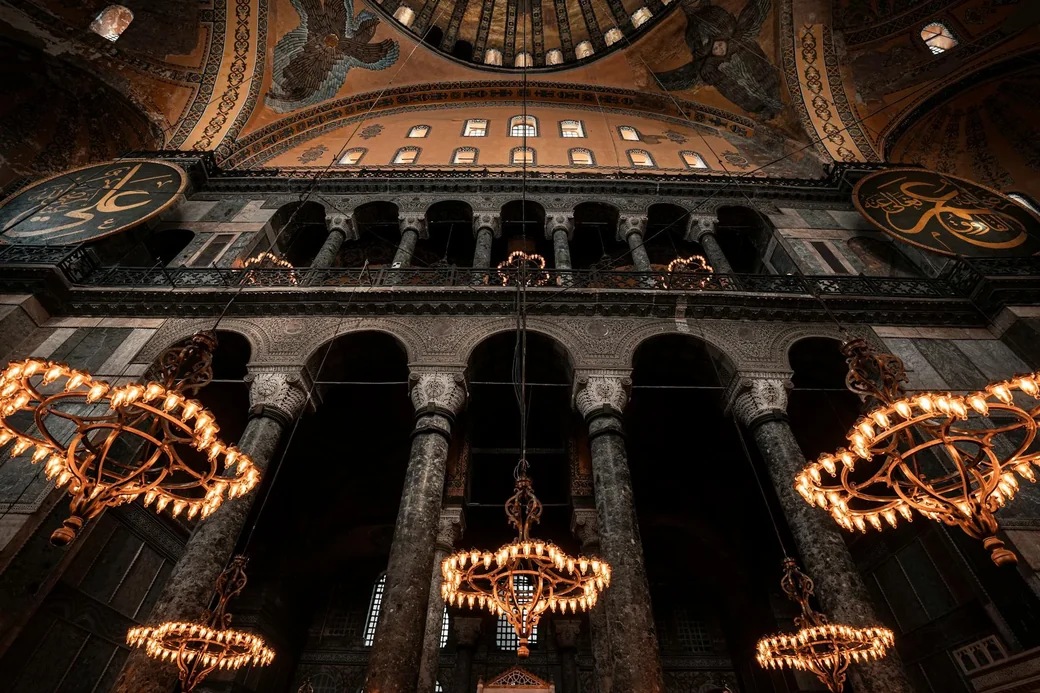
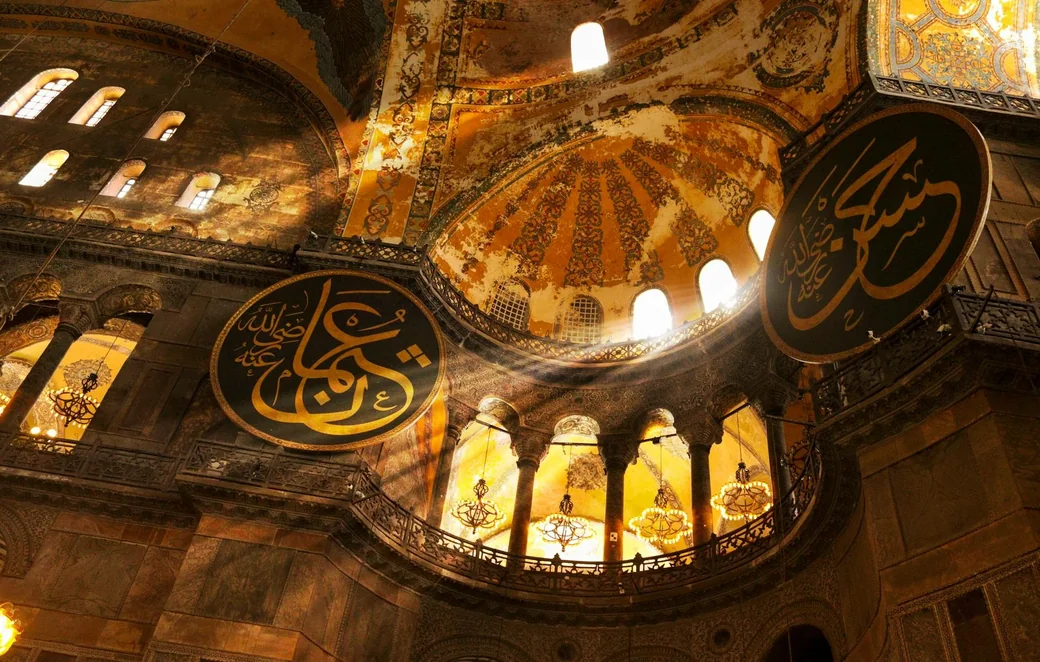
The main dome measures roughly thirty-one metres across and rises about fifty-six metres above the floor. Forty windows ring its base, so sunlight seems to hold the dome in the air. Pendentives (curved triangular supports that carry the dome) pass its weight to four great piers, while half-domes extend the nave in a flowing sequence. Columns salvaged from older ancient sites, including Baalbek, and floors of Proconnesian marble (from the island of Marmara) add to the richness. Together with the surviving gold mosaics, these elements create an interior that has amazed travellers for centuries. Acoustics matter too: researchers who reconstructed the sound of the nave measured a reverberation of around eleven seconds, which is why voices and footsteps dissolve into a long, soft echo.
Byzantine Mosaics in the Upper Gallery: Deësis, Zoe and Komnenos
Most visitors meet the mosaics in the upper gallery. The Deësis panel, showing Christ with the Virgin and John the Baptist, is dated to the thirteenth century, although its exact date is debated. The Zoe panel from the eleventh century shows an emperor and an empress presenting gifts to Christ, and the faces were reworked more than once. The Komnenos panel pictures John II, Empress Eirene and the Virgin. Near the end of the route, a vestibule mosaic shows Constantine and Justinian offering the city and the church to the Virgin. Restorers uncovered many panels from 1931 onward, after centuries under plaster.
Ottoman Layers: Calligraphy, Mihrab, Library and Sultan Tombs
After 1453 the church became the heart of a mosque complex. Sinan strengthened the structure with buttresses and added minarets, while huge marble urns brought from Pergamon were placed in the nave under Murad III. In 1739 Mahmud I added a library with tiled walls. The large calligraphic medallions and the verse at the summit of the dome belong to the mid-nineteenth-century restoration by the Fossati brothers. The mihrab (prayer niche facing Mecca) sits only slightly to the right of the old apse axis. In the courtyard stand the tombs of sultans and princes, so check on site which parts are open to visitors. Under the Ottomans, the great seraph (six-winged angel) mosaics in the pendentives had their faces covered with gold stars, and one face was uncovered again in 2009. Five sultans and around 150 members of the dynasty rest in the courtyard tombs. By tradition, Mehmed II reportedly drew his sword on a soldier who was prising up marble paving on the day of the conquest, and mosaic tesserae (the small pieces that make up a mosaic) are said to have been sold to visitors as talismans.
Hidden Details: Viking Runes, the Omphalion and the Dandolo Marker
Look closely and the building keeps secrets. On the marble balustrades of the gallery, runic inscriptions read the name Halfdan, discovered in 1964, and a second name, Ari or Arni; they were probably carved by Viking soldiers serving the emperor. From above you can see the Omphalion, a decorative circle in the floor traditionally linked with imperial coronations, although that role is debated. A commemorative marker in the gallery floor recalls Enrico Dandolo, the Doge of Venice who was buried here during the Latin occupation. Even the ramp and the stairs are worn smooth by centuries of footsteps. The building's best-loved resident was Gli, a cat born in 2004 who grew up here, charmed visitors, became a symbol of Hagia Sophia and died at the age of sixteen.
The Weeping Column: Legend of the Wishing Hole
In the north-west corner of the ground floor stands the Weeping Column, also called the Wishing Column. According to legend, Emperor Justinian cured a headache by leaning on it, and its constant dampness was said to be the tears of the Virgin Mary. Tradition holds that you place your thumb in the worn bronze hole, turn your hand a full circle and make a wish; if the thumb comes out moist, the wish is said to come true. A medieval chronicle even claims that an invisible guardian stays beside it, and that visitors scraped the stone so much that it had to be covered in bronze. Scientists think the moisture is condensation. Access depends on the current visitor route.
The Boy and the Angel: Legend of the Guardian of the Dome
A ninth-century narrative about the construction of the building tells the following tale, as the legend goes. While the builders were working on the gallery vaults, their master was summoned to the palace and left his young son to watch the tools. A figure in a shining robe appeared and promised to stand guard until the boy returned. The emperor gathered his eunuchs, but the boy recognised none of them, so everyone understood that the visitor was an angel. The boy was forbidden to return, so that the angel would guard the church forever. A later chronicle retells the story with an apprentice, a hidden treasure and a holy man identified by some as Saint George. Look for the archangel mosaics beside the apse.
Khidr Legends: The Place Under the Dome and the Qibla Tale
In later centuries popular belief linked the building with Khidr, the mysterious figure of Islamic folklore, who in some stories merges with Saint George. The seventeenth-century traveller Evliya Çelebi wrote that the spot beneath the dome was known as Khidr's station, where thousands of holy people were said to have met him. A story collected in 1894 tells of a man who lay on his back beneath the dome during Ramadan to hear the angels preaching in the cupola, and who turned out to be a hidden saint. Another tale says that a mysterious man, or Khidr himself, tried to turn the whole church towards Mecca by means of a device in the Weeping Column, but was spotted and vanished. These are folk traditions, not records.
More Rumours: Noah's Ark Door, the Cold Window and the Marble King
Other stories cling to the building. By tradition, the wood of the Imperial Gate came from Noah's Ark. Rumour says a window in the south gallery stays cold even in summer because an angel once promised divine protection there. Some say an angel figure on one of the inner columns protects the church, and another tale claims that angels held the dome in place when the scaffolding collapsed during construction. In one story Justinian dreamed of a radiant figure holding a silver plate with a drawing of a church. Folklore also tells of a giant who carried a column from Mount Qaf, and of the last Byzantine emperor, the Marble King, who waits in a cave for his return. It is also said that Justinian, on first seeing the finished church, declared that he had surpassed Solomon. The wooden Imperial Gate is dated to the sixth century, and tradition says that only the emperor was allowed to pass through it.
Entrances, Tickets and Audio Guide: How the Visit Works
The ground-floor prayer hall is reserved for worshippers. Other visitors use the visitor entrance on the north-east side, opposite the fountain of Sultan Ahmed III, pass a security check, show a ticket and climb a long stone ramp to the upper gallery. The route loops through the gallery and descends to the south-west vestibule. Professional guides are not permitted inside, so audio guides are offered through a QR code in more than twenty languages. Procedures can change, so check on the day. Ottoman archives are said to show that tickets for the upper gallery were already sold to foreign visitors in the past.
Opening Hours, Best Time to Visit and Photo Spots
The visitor route is normally open daily from morning until evening, but visits pause briefly around prayer times, especially at Friday midday prayer, so check the hours on the day. Queues are longest around midday; arrive at opening on a weekday or in the last ninety minutes before closing. Spring and autumn are the most comfortable seasons. For photographs, the gallery balcony gives the widest view of the dome, the apse mosaic and the nave. Look across the aisle from an eastern pier for the archangel mosaic. Allow about ninety minutes and keep the flash switched off.
Accessibility, Security and Practical Tips for Families
The ground-floor prayer hall has a step-free ramp for worshippers. The visitor route to the upper gallery uses a long, steep, cobbled ramp and uneven surfaces, so it is difficult for wheelchair users and demanding for anyone with limited mobility; ask the staff what help is possible. Everyone passes a security check, large backpacks and wheeled luggage are not allowed, and there is no luggage storage at the mosque. Accessible toilets are available in the park around the square. Families can take the ramp slowly, and an audio guide helps older children stay curious. As in any crowded queue, keep your valuables close and watch out for pickpockets.
Dress Code and Etiquette: What to Wear in Hagia Sophia
Treat the visit as you would any mosque visit. Cover shoulders and knees, choose loose clothing and bring a light scarf, because women are generally expected to cover their hair. Reports differ on whether shoes must be removed along the gallery route, so carry socks. Speak softly, silence your phone and never touch mosaics or walls. Do not walk in front of people who are praying, do not photograph worshippers, and do not eat or drink inside. Keep to the marked route, do not climb over barriers or lean on railings, and respect any temporary closures at prayer times.
Restoration Works: What to Expect Inside and Outside
Hagia Sophia is a very old structure, and conservation work is a regular part of its life. Large restoration programmes on the domes, façades and minarets can put scaffolding or protective covers into your photographs, and a few areas may close temporarily. The building has remained open to worship and visitors while specialists clean and stabilise surfaces, including mosaics. Treat the scaffolding as one more chapter in the monument's long story, check the current situation at the ticket point and keep your photo plans flexible, because the view from the gallery is still remarkable. Specialists also reported documenting a network of seven tunnel lines, roughly 1,600 years old, beneath the building, a reminder of how much of its story is still being uncovered.
Nearby Sights: Blue Mosque, Topkapi Palace and Basilica Cistern
Hagia Sophia sits at the heart of Sultanahmet, so it combines easily with other landmarks. The Blue Mosque faces it across the park and can be visited outside prayer times. Topkapi Palace (Topkapı Sarayı) lies at the far end of the hill, the Basilica Cistern and Hagia Irene are a short walk away, and the Hürrem Sultan Bathhouse, a sixteenth-century work by Sinan, stands on Hagia Sophia Square. Start at Hagia Sophia in the morning, then visit the Blue Mosque while queues are shorter, and keep Topkapi Palace for another half day.
Hagia Sophia Grand Mosque: Visitor Tips
Arrive at the visitor entrance early and book a timed ticket where possible. Carry a light scarf and a pair of socks, travel without large bags and keep your phone on silent. For photographs, the upper gallery gives the best view of the dome and the apse, while a glance across the aisle from an eastern pier reveals an archangel mosaic. Flash is best avoided. Pause for a moment beneath the dome: the long echo is part of the experience. Always follow staff instructions, especially around prayer times.
Hagia Sophia Grand Mosque: Best Time to Visit
Weekday mornings right at opening, or the last hour before closing. Avoid midday queues, Friday prayer time and summer afternoons.
Hagia Sophia Grand Mosque: Admission Fees
Upper gallery visit – international visitors
Visitor route through the upper gallery, with close views of the Byzantine mosaics and the great dome; the ground-floor prayer hall remains dedicated to worship.
€25
Ground-floor prayer hall (free)
Entering the ground-floor hall to pray is free of charge for worshippers.
Free
Children up to 7 (free)
Free entry for children aged 7 and under; proof of age may be requested.
Free
Quick Info
1h 30m
easy
Hagia Sophia Grand Mosque: Getting There
The simplest way to reach Hagia Sophia is by public transport. Take the T1 tram (Kabataş–Bağcılar line) and get off at Sultanahmet; from there the mosque is about a two-minute walk across the square. If you arrive by ferry or from the Asian side, reach Eminönü or Sirkeci and continue on the T1, or walk uphill through the old streets in roughly fifteen minutes. The Gülhane tram stop is another good option, especially if you plan to combine the visit with Topkapi Palace (Topkapı Sarayı). By bus you can reach Beyazit and walk for about ten minutes. Driving is not recommended: the streets of the old city are narrow, traffic is heavy and parking is scarce, so a taxi to the square is easier. Visitors enter through the visitor entrance on the north-east side of the building, opposite the fountain of Sultan Ahmed III.
Nearby stops & parking
The closest stop is Sultanahmet on the T1 tram, followed by Gülhane and Sirkeci on the same line; Beyazit is a longer walk. Taxis can drop passengers at Sultanahmet Square. There is no luggage storage at the mosque, and the nearest storage is at Sirkeci railway station. Public toilets are found in the park between Hagia Sophia and the Blue Mosque. Parking near the square is very limited, so it is wiser to leave a car outside the historic peninsula and continue by tram.
Hagia Sophia Grand Mosque: Dress Code & Etiquette
Hagia Sophia is an active mosque, so modest clothing is expected from everyone: cover shoulders and knees, and avoid tight, transparent or very short garments. Women are generally expected to cover their hair with a scarf when entering. Rules about head coverings and footwear are applied at the entrance and can vary, so bring a light scarf and a pair of socks to be safe. Keep your voice low, silence your phone, do not touch the walls or mosaics, avoid walking in front of people who are praying, and do not eat or drink inside. Follow the instructions of the staff, especially around prayer times.