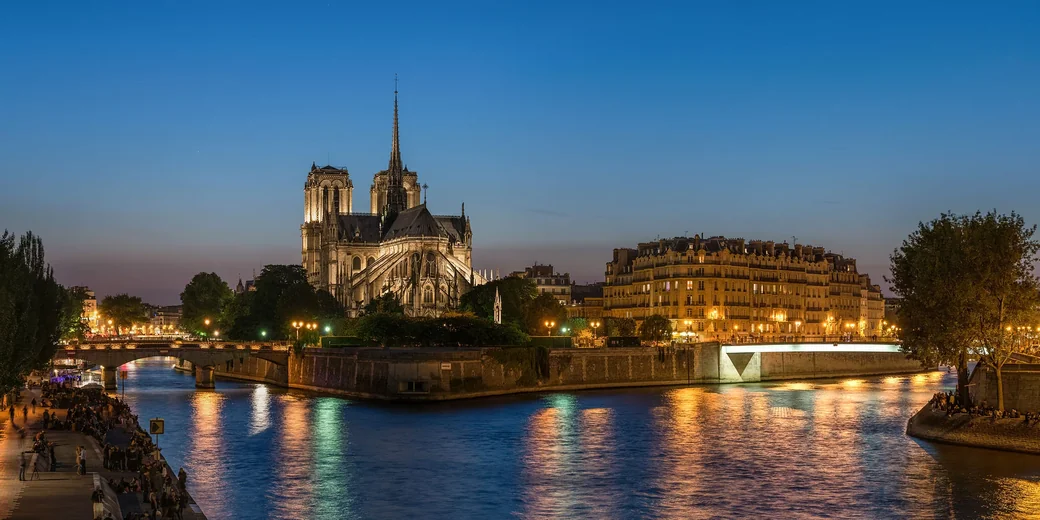
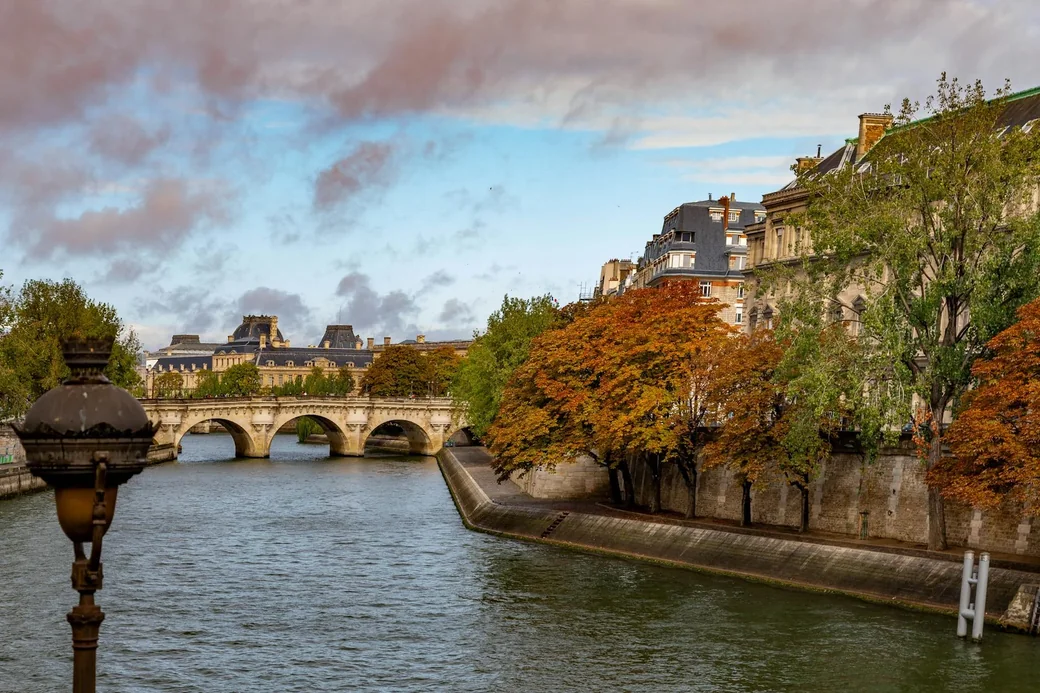
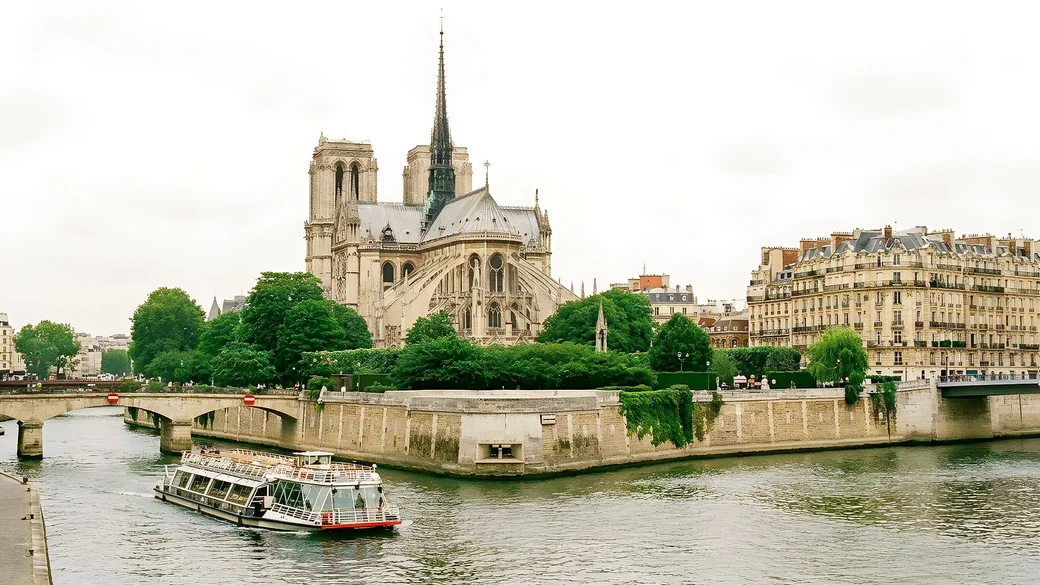
Île de la Cité is a small natural island in the middle of the Seine, at the historic heart of Paris. It packs some of the capital's most celebrated monuments into a compact, walkable space, among them the cathedral of Notre-Dame, the stained-glass chapel of Sainte-Chapelle and the Conciergerie. Between the great landmarks, leafy squares, a flower market and riverside views reveal a calmer, more intimate side of the island.
Île de la Cité: Location, accommodation options and contact
Île de la Cité, 1st & 4th arrondissement, 75001 / 75004 Paris, France
The place's location on the map and nearby accommodation and hotel options are shown by Stay22. Cookies are used. Your consent is remembered on every page; you can turn it off at any time in the cookie settings.
Every city has a starting point, and for Paris, this island is it. Long before the word “Paris” existed, a Gallic people called the Parisii settled on or near this spot in the Seine, part of a wider settlement known as Lutetia that may date back as far as the 3rd century BC. The island's position, surrounded entirely by water, gave it a natural defensibility that later attracted Roman attention: after conquering the region in 52 BC, Rome turned it into a fortified outpost. Centuries later, as Roman authority crumbled across Gaul, the Frankish king Clovis I saw the same strategic advantages and, in 508 AD, made the island his capital, a decision that effectively planted the seed from which modern Paris grew. Standing on the island today, amid the crowds heading to Notre-Dame or the quiet corners near Place Dauphine, it is worth pausing to remember that this small patch of land, actually just over a kilometer long, is where the story of an entire capital city began. The island's political importance did not end with Clovis, either: from around the twelfth century until 1364 it was the seat of royal power in France, home to the king's residence and the machinery of the state – all packed into an area of only about 22.5 hectares.
Notre-Dame de Paris Today: What to Expect After the 2024 Reopening
Notre-Dame de Paris dominates the eastern end of the island, its twin towers visible from almost every approach. Construction on the Gothic cathedral began in 1163 and was largely finished by 1345, but its more recent history has been dramatic: a devastating fire in April 2019 destroyed the spire and much of the roof, prompting years of painstaking restoration. A reopening ceremony was held on 7 December 2024, though the cathedral was not yet open to the public that day; public admission began the following day, 8 December 2024, alongside an inaugural mass, with normal public visiting hours resuming on 16 December 2024. Visiting the cathedral's ground floor is free, though given its renewed popularity, queues can be substantial, particularly on weekends and around midday. Arriving early in the morning or later in the afternoon tends to mean a shorter wait. A free timed-entry reservation can also be booked online a few days ahead at resa.notredamedeparis.fr to cut the wait, though walk-ins are always accepted. Inside, look up at the restored vaulting and take in the atmosphere of a building that has been at the center of French life for the better part of a thousand years, through coronations, revolutions, and now a remarkable second life.
Sainte-Chapelle: A Masterpiece in Stained Glass
Tucked within the walls of the Palais de Justice, Sainte-Chapelle can be easy to miss from the street, but it is one of the island's true treasures. Built in under seven years in the mid-13th century for King Louis IX, later canonized as Saint Louis, the chapel was constructed specifically to house holy relics he had acquired, including the Crown of Thorns, obtained in 1239, and a fragment of the True Cross. The name of the chapel's master builder was never definitively recorded, but whoever designed it achieved something extraordinary: an upper chapel wrapped almost entirely in stained glass, fifteen soaring windows containing roughly 1,113 individual panels in total. Bathed in colored light on a sunny day, it remains one of the most complete surviving sets of thirteenth-century stained glass anywhere, telling biblical stories in jewel tones across walls that seem to dissolve into color. It is a compact visit compared to Notre-Dame, but many travelers rank it among the most moving stops on the island.
The Conciergerie and the Shadow of the Revolution
Before it became a monument, the Conciergerie was a working part of the French justice system, and before that, a royal palace. Its most famous chapter belongs to the French Revolution, when it served as a prison holding those awaiting trial and, often, execution. Queen Marie-Antoinette was held within its walls before she was sent to the guillotine, and the chapel built on the site of her cell, alongside a recreation of the cell itself, is part of the visit today. Walking through its vaulted medieval halls, some of the oldest surviving remnants of the original royal palace on the island, offers a striking contrast to the elegance of Sainte-Chapelle just next door, proof of how many different roles this small island has played across the centuries, from royal seat, to place of judgment, to place of memory. For anyone interested in the more turbulent side of French history, it rounds out a visit to the island's monuments with a perspective that Notre-Dame and Sainte-Chapelle alone do not provide. When the monarchy moved away, first to the Louvre and later to Versailles, the island did not fade: it was reborn as the judicial heart of the nation, a role still carried on today by the Palais de Justice, which occupies roughly a third of the island.
Pont Neuf and Point Zéro: Where Distances Begin
Two small landmarks on the island carry an outsized symbolic weight. Pont Neuf, meaning “New Bridge,” is something of a joke by now, since it is actually the oldest standing bridge across the Seine in Paris, completed in 1607; it was also the first Paris bridge built without houses crowding its edges, which is why it still offers such open views up and down the river, along with its equestrian statue of Henri IV. A short walk away, on the square in front of Notre-Dame, a small marker set into the paving stones known as Point Zéro marks the point from which all road distances in France are traditionally measured. Visitors often pause here for a photograph, and, according to popular belief, anyone who stands on the marker and makes a wish is bound to return to Paris one day. Together, the bridge and the marker are two of the most photographed, and most quietly meaningful, spots on the entire island.
Place Dauphine and the Flower Market: Quieter Corners of the Island
Not every part of Île de la Cité revolves around the crowds near Notre-Dame. At the island's western end, Place Dauphine is a triangular residential square laid out from 1609 under Henri IV, lined with trees and townhouses that make it feel almost like a village square tucked inside the city. It is a favorite spot for a quiet break, away from the lines at the monuments. Near the middle of the island, the flower market at Place Louis-Lépine has been bringing greenery and color here since 1808; renamed the Marché aux Fleurs Reine Elizabeth II in 2014, it remains one of the last historic flower markets of its kind in Paris. Together, these two spots are an easy way to slow down and see a gentler, more residential side of an island otherwise dominated by grand monuments and long queues, and they reward visitors willing to wander a little off the most obvious path.
Best Time to Visit: Beating the Crowds Around Notre-Dame
Île de la Cité is busy nearly all day, every day, simply because it holds so many of Paris's biggest draws in one small space. The single most useful piece of timing advice is to arrive early, ideally soon after sunrise, when the parvis (forecourt) in front of Notre-Dame is at its quietest and the light is soft for photographs. Since Notre-Dame's reopening in December 2024, queues have often been long, especially in the late morning and afternoon and throughout the summer months, so visiting Sainte-Chapelle and the Conciergerie early as well can save considerable waiting time. Booking tickets online in advance, where it is offered, is generally worthwhile for the monuments that require them. Late afternoon, closer to golden hour, is another good window, particularly for photography along the riverbanks once the midday crush has thinned out. Weekdays outside school holidays tend to be calmer than weekends.
The Best Photo Spots on and Around the Island
Photographers have no shortage of options here. The parvis (forecourt) directly in front of Notre-Dame offers the classic straight-on view of its towers and restored facade, especially striking in early morning light. Along the quais (riverside embankments) at water level, especially on the Left Bank looking back toward the island, you can frame the cathedral, the bridges, and the Seine together in a single view, a composition that has drawn artists and photographers for generations. Pont Neuf, with its statue of Henri IV, makes a strong foreground for wider river shots, while a stroll to the eastern tip of the island, past the Mémorial des Martyrs de la Déportation, offers quieter river views with fewer people. For a different angle, some of the small bridges connecting to the Left Bank and to Île Saint-Louis provide elevated views back over the rooftops of the island itself. Early morning and the hour before sunset generally offer the most flattering light and the thinnest crowds.
Getting to Île de la Cité
Reaching the island could hardly be easier, since it sits at the literal center of the city's transport network. Métro line 4 has its own stop directly on the island, Cité, recognizable by its deep station entrance built in the Art Nouveau style associated with Hector Guimard. Just across the river, on the Left Bank, Saint-Michel station (also served by line 4) and the combined Saint-Michel–Notre-Dame stop for RER lines B and C both sit within a short walk over a bridge. Numerous bus lines also run along the riverside quays on both banks. Many visitors, however, simply arrive on foot, since the island connects to both banks of the Seine by nine separate bridges, making it a natural stop while walking between the Louvre, the Latin Quarter, or Le Marais. Public transport or walking is almost always the most relaxed choice for this part of central Paris, letting you step straight from the station or bridge onto the island's sights.
A Suggested Walking Route Across the Island
A relaxed loop of the island can be done in a couple of hours, or extended for a full morning with stops at the monuments. Starting from Pont Neuf on the western tip, walk past the equestrian statue of Henri IV and into Place Dauphine for a quiet first impression of the island. From there, head east toward the Palais de Justice complex, where Sainte-Chapelle and the Conciergerie sit close together. Continuing on, the flower market at Place Louis-Lépine appears roughly at the island's midpoint. From here, the parvis (forecourt) in front of Notre-Dame opens up, with Point Zéro embedded in the paving stones nearby, worth a brief stop before or after visiting the cathedral itself. Finally, continue east past Notre-Dame to the quieter tip of the island for the Mémorial des Martyrs de la Déportation, a fitting, reflective end point before crossing Pont Saint-Louis onward to Île Saint-Louis, if time allows. The memorial at the tip was dedicated in 1962 and honors the roughly 200,000 people deported from France during the Second World War, so it deserves a quiet, unhurried moment before you move on.
Accessibility and Mobility Notes
The island's main streets and the parvis (forecourt) in front of Notre-Dame are generally level and manageable for visitors with limited mobility or wheelchair users, though the cobblestones found in some areas and the density of crowds, especially near the cathedral, can still make movement more difficult than it first appears. Service animals are welcome throughout the public areas of the island. Individual monuments vary considerably in their own accessibility: the Conciergerie and Sainte-Chapelle, in particular, involve older buildings with narrow stairways in places, including Sainte-Chapelle's spiral staircase to the upper chapel, which may not be suitable for all visitors. Because accessibility features and available accommodations can change and differ from site to site, it is worth checking directly with each individual monument before a visit if accessibility is a priority, rather than assuming that access to the island itself guarantees the same ease of access inside every building on it.
What to Wear Inside Notre-Dame and Sainte-Chapelle
Walking around the island itself calls for nothing more formal than comfortable shoes, since there is no dress code for the public streets, bridges, and squares. Stepping inside Notre-Dame or Sainte-Chapelle is a different matter, however, because Notre-Dame is an active cathedral and Sainte-Chapelle a former royal chapel, both sacred spaces as well as historic monuments. Modest clothing is expected in both spaces: covering the shoulders is recommended, and it is worth avoiding overly casual beachwear or anything considered inappropriate for a solemn interior. Hats are typically removed as a sign of respect, and voices should stay low, particularly if a service or moment of prayer is taking place. Since these buildings continue to serve worshippers as well as visitors, dressing and behaving thoughtfully is simply part of being a considerate guest in a working sacred space, not just a tourist attraction, a distinction worth keeping in mind throughout the visit.
Do's and Don'ts for a Respectful Visit
A few simple habits make a visit to the island smoother for everyone. Do expect to queue, particularly at Notre-Dame and Sainte-Chapelle, and plan your schedule with that waiting time in mind rather than trying to rush through. Do keep noise levels down inside any of the religious buildings, and be mindful that photography rules vary by site; flash photography and tripods are commonly restricted or banned inside the churches, so it is worth checking signage on arrival. Don't block narrow walkways or bridge entrances for photographs, since the island's streets get very crowded, especially around midday. Don't attempt to bring food or drink into any of the monument interiors. Do take a little time to walk beyond Notre-Dame itself, since Place Dauphine, the flower market, and the memorial at the eastern tip are far less crowded and give a fuller sense of the island beyond its single most famous building.
Nearby Places Worth Combining With Your Visit
Île de la Cité sits at the crossroads of several neighborhoods well worth folding into the same outing. Crossing the small Pont Saint-Louis to the east leads directly onto Île Saint-Louis, the Seine's other natural island, a quieter, largely residential spot known for its narrow streets and relaxed pace, a pleasant contrast after the crowds around Notre-Dame. To the south, across the river, lies the Latin Quarter, one of the city's oldest and most storied student and intellectual districts, filled with narrow lanes, bookshops, and cafés. To the north, Le Marais offers a very different atmosphere, with its historic mansions, boutiques, and lively squares. Since all three neighborhoods are within easy walking distance of the island's bridges, it is entirely possible to spend a full day moving between them, treating Île de la Cité as the natural, central starting point from which the rest of the visit radiates outward.
Practical Summary: Free to Explore, Rich in History
At its core, a visit to Île de la Cité costs nothing beyond time: walking its streets, crossing its bridges, standing on Point Zéro, browsing the flower market, and stepping into the ground floor of Notre-Dame are all free. Separate monuments on the island, including Sainte-Chapelle, the Conciergerie, and any tower climbs at Notre-Dame, are ticketed independently and worth checking directly for current details before visiting, since arrangements can change. What makes the island remarkable is not any single sight but the accumulated weight of history packed into so small a space, recognized internationally through its inclusion in the “Paris, Banks of the Seine” UNESCO World Heritage Site. Whether the goal is a quick hour crossing from one bank to the other or a full day spent moving between cathedral, chapel, courthouse, and quiet square, this island rewards unhurried attention as the true historic and geographic heart of Paris.
Île de la Cité: Visitor Tips
Wear comfortable shoes, as the island's streets are cobbled and best explored on foot. Keep an eye on queue times for Notre-Dame and Sainte-Chapelle and consider visiting early morning or late afternoon. A refillable water bottle and a camera for the riverside views are both worth bringing.
Île de la Cité: Best Time to Visit
Visit Notre-Dame early for soft light and fewer crowds, or return at golden hour for Seine photos. Arrive early or book tickets in advance where possible.
Île de la Cité: Admission Fees
Free admission
Free to enter and open to everyone; no ticket is needed.
Free
Quick Info
2h 30m
easy
Île de la Cité: Getting There
Île de la Cité is remarkably easy to reach, since it sits right at the center of Paris. Métro line 4 stops directly on the island at Cité station, whose deep platform is reached via an entrance in the Art Nouveau style associated with Hector Guimard. Just across the river on the Left Bank, Saint-Michel station (also line 4) and the combined RER B and RER C station Saint-Michel–Notre-Dame both have exits leading straight onto the bridges toward the island. An extensive network of buses also serves the surrounding riverside quays on both banks. Because the island is compact and pedestrian-friendly, many visitors simply walk in across one of its nine bridges, including the historic Pont Neuf, Pont au Change, Pont Notre-Dame, and Pont d'Arcole, from the Louvre, the Latin Quarter, or Le Marais. Walking or public transport is the most comfortable way to enjoy this dense, historic core, where every sight lies within a few minutes on foot.
Nearby stops & parking
The closest station is Cité (Métro line 4), located on the island itself. Saint-Michel (Métro line 4) and Saint-Michel–Notre-Dame (RER B and RER C) lie just across the river on the Left Bank, both within a short walk over a bridge. Nine bridges connect the island to the rest of Paris, including Pont Neuf at the western tip, Pont au Change, Pont Notre-Dame and Pont d'Arcole to the north, and Pont Saint-Louis, which leads directly onto neighboring Île Saint-Louis.
Île de la Cité: Dress Code & Etiquette
There is no dress code for simply walking around the island itself. However, Notre-Dame is an active cathedral and Sainte-Chapelle a former royal chapel, both historic monuments, so modest, respectful clothing is expected inside, covering the shoulders is recommended, along with quiet, considerate behavior appropriate to a sacred and heavily visited space.