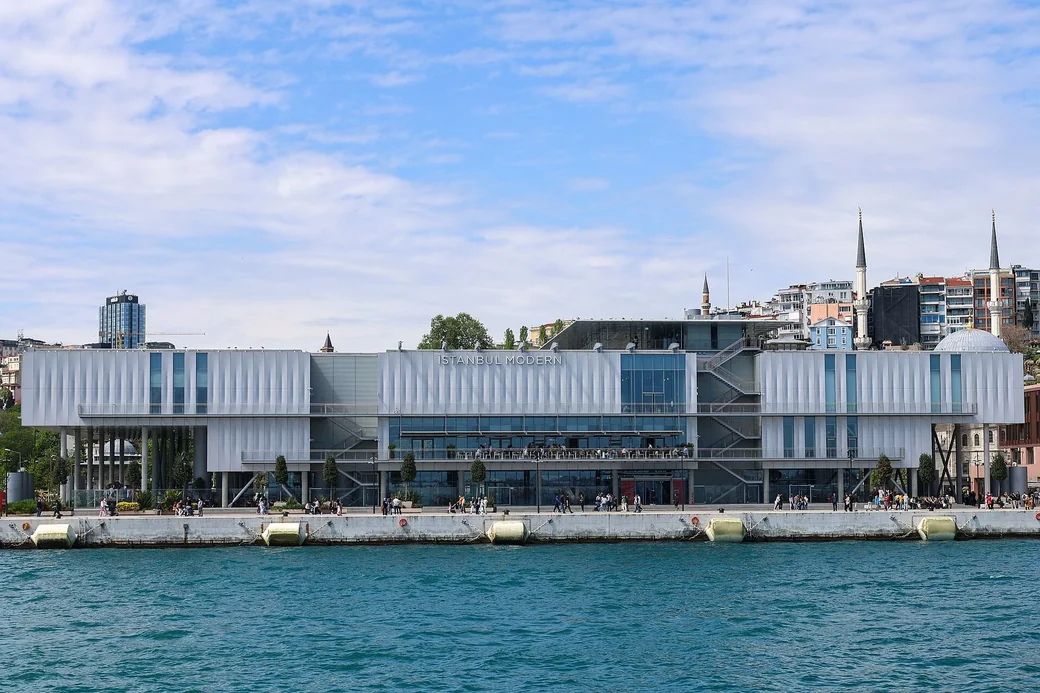
Istanbul Modern (İstanbul Modern Sanat Müzesi) is a museum of modern and contemporary art on the European shore of the Bosphorus, between Karaköy and Tophane, close to where the strait meets the Golden Horn. It was the country’s first museum devoted entirely to this field, and today it occupies a striking contemporary building right at the water’s edge. Works by artists from Türkiye and around the world share its galleries with changing exhibitions, making it one of Istanbul’s leading addresses for art and culture.
Istanbul Modern: Location, accommodation options and contact
Kiliç Ali Pasa Mahallesi, Tophane Iskele Caddesi No:1/1, 34433 Beyoglu, Istanbul
The place's location on the map and nearby accommodation and hotel options are shown by Stay22. Cookies are used. Your consent is remembered on every page; you can turn it off at any time in the cookie settings.
History of Istanbul Modern: from a Karaköy customs warehouse to a Bosphorus landmark
The idea of a permanent modern art museum in Istanbul grew out of the first Istanbul Biennial in 1987, when Nejat F. and Oya Eczacibasi saw how much appetite the city had for contemporary art. A former factory on the Golden Horn was tried first, then Antrepo No. 4, a customs warehouse designed by Sedad Hakki Eldem in the late 1950s, which hosted the 2003 Biennial. The museum opened there on 11 December 2004 after a conversion by Tabanlioglu Architects and welcomed more than seven million visitors in fourteen years. After a temporary home in the 1896 Union Française building in Beyoglu, it returned to its waterfront site in a new building on 4 May 2023.
Renzo Piano’s architecture: the fish-scale façade and the transparent ground floor
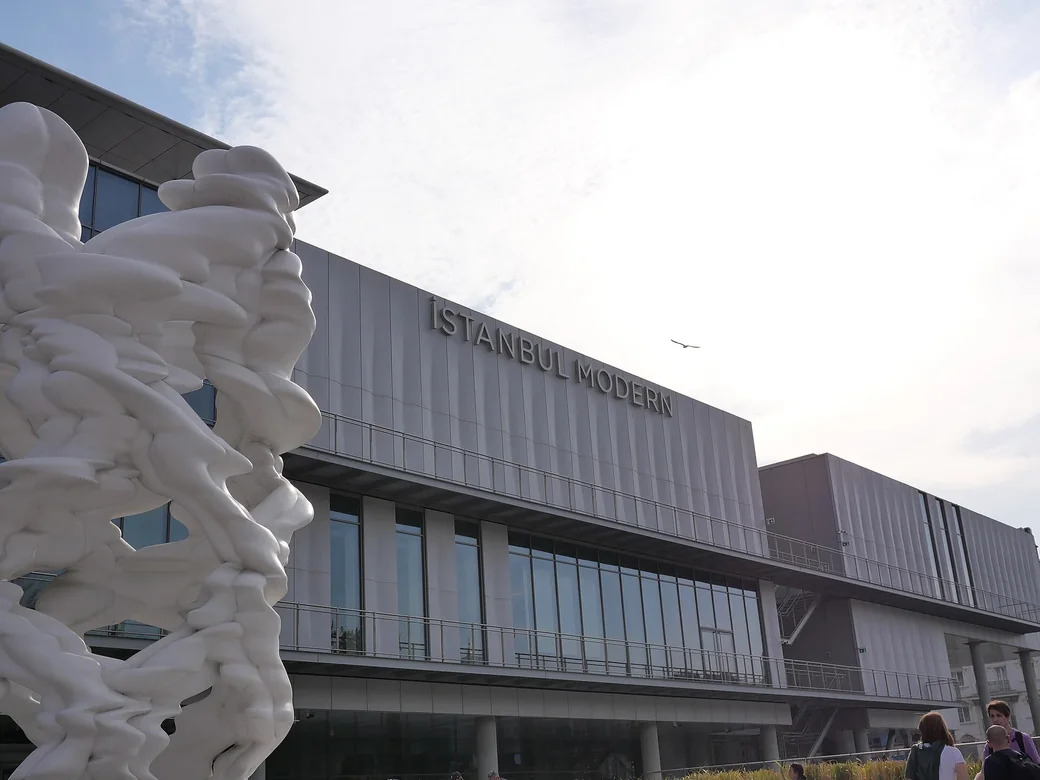
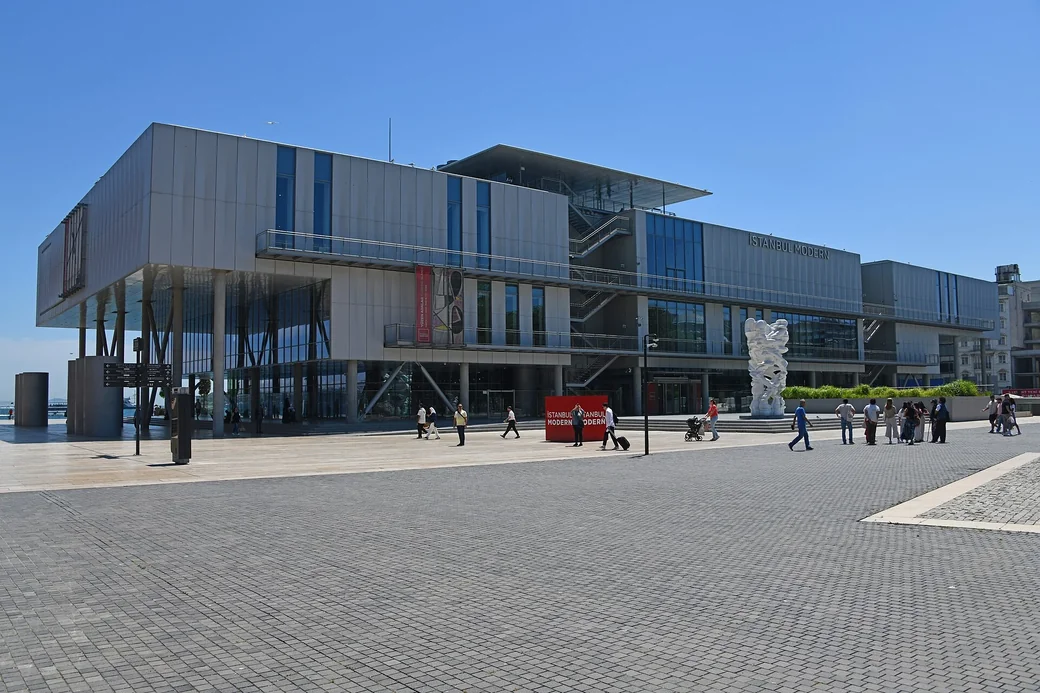
Designed by Renzo Piano Building Workshop with Arup and built by Yapi Merkezi, the museum is Piano’s first work in Istanbul. Its outline recalls ships passing between two continents and a sea creature that has just leapt ashore, while grey three-dimensional aluminium panels shimmer like fish scales as the light on the Bosphorus changes. The ground floor is deliberately transparent, so the promenade flows into Tophane Park, and its round columns soften the line between light and shadow. Five levels, three above ground and two below, rest on concrete columns braced with steel against earthquakes. Its silvery outline has made it one of the most recognisable modern buildings on the Istanbul waterfront.
Rooftop terrace and Bosphorus views: reflection pool, Galata Tower and the Princes’ Islands
From the second-floor foyer a glass pavilion leads up to the rooftop terrace, which seems to hover above a shallow reflection pool covering the entire roof. Sky, strait and skyline merge in the water, and the panorama takes in the Historic Peninsula, the Galata Tower, the Asian shore and the Princes’ Islands. At the foot of the building, a waterfront promenade that was long closed to the public now runs along the water. Go up on a clear day, ideally in the late afternoon, and finish at the terrace after the galleries so that the view becomes the reward.
Permanent installations: Olafur Eliasson’s Your Unexpected Journey and Richard Wentworth’s False Ceiling
Two works greet you before you reach a single gallery. Richard Wentworth’s False Ceiling (2005), made of hanging books, came across from the old building. On the central staircase, Olafur Eliasson’s three-part Your Unexpected Journey, made for this building, seems to float: its spheres are illusions, built from half-segments and mirrors whose reflections complete the shapes, and every level is a little more complex than the one below. Walk up slowly and look back from the landings, because the view changes with each step. Outside, Bettina Pousttchi’s red Vertical Highways V02, a 5.9-metre sculpture bent from highway guardrails, stands in front of the building, while Tony Cragg’s Runner stands on the side façade. The wide central staircase is the backbone of the building, linking the transparent ground floor, with its library, café, shop and workshop spaces, to the galleries above.
Collection highlights: modern and contemporary art from Fahrelnissa Zeid to Refik Anadol
The collection concentrates on art made since the mid-twentieth century and spans painting, sculpture, installation, photography, video and new media. Look for pioneers such as Fahrelnissa Zeid, Bedri Rahmi Eyüboglu, Abidin Dino and Burhan Dogançay, the ceramicist Füreya Koral and the opera singer and painter Semiha Berksoy, as well as photographers like Ara Güler and Yildiz Moran. Beside them hang international names including Anselm Kiefer, Georg Baselitz, Tracey Emin, William Kentridge, Bill Viola, Yoko Ono and Doris Salcedo. Refik Anadol’s Infinity Room: Bosphorus (2023) shows how data and light can turn the strait into an immersive artwork. A dedicated photography gallery gives the medium its own space within the museum.
Fun facts and firsts: a pioneering museum and a building that won awards worldwide
Before it was converted, its warehouse home was occasionally used as a film set. The new building was named Building of the Year in the cultural category of the ArchDaily awards and won the culture prize for completed buildings at the World Architecture Festival, and National Geographic listed it among its top cultural hot spots. Piano, who also co-designed the Centre Pompidou in Paris, imagined the shape as a flying vessel right on the water.
Cinema, library, shop and restaurant: the museum’s extra spaces worth your time
Beyond the galleries, the museum has a 156-seat auditorium used for film screenings and talks, and a library of art and architecture resources open to the public on the ground floor. The shop is unusually large and stocks work by local artists and designers, a good place for gifts that are not the usual souvenirs. There is a café on the ground floor, and Restoran Modern on the south façade serves Mediterranean and contemporary local cooking on a terrace facing the strait. Reserve ahead for evenings and sunset tables.
Tours, audio guides and workshops: getting more from your visit
Museum specialists lead exhibition tours for adults in the local language and in English. Groups can book on any day the museum is open, and individual visitors can join on weekends after reserving a place. Audio tours and augmented-reality content are available through QR codes beside the artworks, so bring headphones and a charged phone. Workshops and programmes for children, families, young people and adults run throughout the year, with special programmes for visitors with visual impairments and for deaf young people. Alongside temporary exhibitions, photography shows and film screenings, these programmes can turn a visit into a full cultural outing. Check the official website for the current schedule before you go.
Planning your visit: how long to stay, when to go and what to expect
Allow two to three hours; one hour is enough only for the collection galleries and the terrace. The galleries are often calmer on weekday mornings, and the museum stays open later on Friday evenings, which suits a visit after work. Collection and temporary exhibitions rotate, so check the programme on the official website. This is also why every visit can feel different. One ticket covers every exhibition. Online sales for the same day close in the late afternoon, entry stops thirty minutes before closing, and the museum is closed on Mondays, on 1 January and on the first day of the main religious holidays.
Best photo spots and photography rules at Istanbul Modern
Photography for personal, non-commercial use is welcome, but flash, tripods, selfie sticks and camera props are not allowed. The best frames: the façade and the sculptures from the waterfront promenade in soft light; the central staircase with Eliasson’s mirrored forms; the round columns and glass of the ground floor; and the rooftop reflection pool with the skyline mirrored in it. Photos may not be copied, distributed or shared beyond personal use without written permission from the museum and the artists, and advertising, fashion and commercial shoots are not permitted.
Museum etiquette: do’s and don’ts inside Istanbul Modern
Do leave umbrellas, large bags, backpacks and luggage in the cloakroom, and expect to be asked to take your backpack off inside the galleries. Do stay behind the warning lines and keep a respectful distance from the works. Don’t touch the artworks, sit on the gallery floor, or eat and drink in the exhibition spaces. Smoking and vaping are not allowed indoors or outdoors. Pets are not admitted, except guide dogs. Electric scooters, skateboards and folding bikes are not allowed; other scooters and folding bikes must be left in the cloakroom, which can fill up at busy times.
Istanbul Modern with kids: strollers, baby care room and family-friendly activities
Families will find a baby care room on the mezzanine floor and strollers to borrow for children aged six months to four years. Young children who are not in a stroller should be held by the hand in the galleries, for their own safety and that of the artworks. The museum runs workshops and programmes for children and families, and its website has a page of suggestions for planning a family visit. The audio and AR content can turn the galleries into a small game for older children.
Accessibility at Istanbul Modern: loan wheelchairs, descriptive tours and visitor-friendly services
A lift takes visitors up to the rooftop terrace. Loan wheelchairs are available: tell the staff when you buy your ticket. Portable stools are provided at the gallery entrances for anyone who needs to rest. Signs in the galleries warn visitors who are sensitive to light or who have epilepsy or migraine, and guide dogs are welcome. A descriptive exhibition tour for visually impaired visitors can be booked by email at least three days ahead, and the museum offers programmes for deaf young people and for children with special learning needs. Disabled visitors and their companion benefit from a concession with a disability ID card; see the ticket section.
Around Tophane and Karaköy: what to see within walking distance of Istanbul Modern
The museum sits in the middle of one of Istanbul’s best waterfront walks. Beside it runs the Galataport promenade with its cafés and views, and a few minutes away stand Sinan’s Kiliç Ali Pasha Mosque (Kılıç Ali Paşa Camii), the Nusretiye Mosque, the Tophane Fountain and Tophane-i Amire, the former Ottoman cannon foundry that now hosts exhibitions. Climb the lanes of Karaköy for galleries, bakeries and coffee, then continue uphill to the Galata Tower. Art lovers can add the Istanbul Painting and Sculpture Museum nearby or the Pera Museum in Tepebasi.
Legends and rumours around Istanbul Modern: Kiliç Ali Pasha, Cervantes and the chain across the Golden Horn
No legend is attached to the museum itself, but its neighbourhood is full of them. According to a rumour, the admiral Kiliç Ali Pasha asked the sultan for permission to build a mosque and was told in jest to build it on the sea, so he had the shore filled in and commissioned Sinan to raise the mosque next door. Another tale says the author of Don Quixote laboured on its construction, though this has never been proved. A third rumour says the mystical figure Hizir appeared at its opening and promised to pray there once a day. Karaköy has its own stories: according to one rumour its name comes from a Karaite Jewish community, and another says one end of the chain that closed the Golden Horn was fixed in the basement of the Yeralti Mosque (Yeraltı Camii). None of this is confirmed history.
Istanbul Modern: Visitor Tips
Buy your ticket online before you arrive, leave large bags and umbrellas in the cloakroom, and take the central staircase up to the second-floor galleries first so the collection and the terrace come while you are fresh. Photography without flash is welcome for personal use. Budget two to three hours, then continue with a stroll along the Galataport promenade and through the lanes of Tophane.
Istanbul Modern: Best Time to Visit
Weekday mornings for calmer galleries, Friday evening when the museum stays open late, and clear late afternoons for the rooftop terrace and the waterfront façade.
Istanbul Modern: Admission Fees
Adult – full admission
Full admission for visitors who do not live in Turkey; one ticket covers all current exhibitions.
TRY 1,000
Discounted – students and ages 65+
Reduced rate for students and visitors aged 65 and over; a valid ID or student card is required.
TRY 650
Group (more than 10 people)
Per-person rate for groups of more than ten visitors booking together.
TRY 650
Children up to 11 (free)
Free entry for children aged 11 and under; proof of age may be requested.
Free
Visitors with disabilities + companion (free)
Free for visitors with a disability and one companion; proof of eligibility is required.
Free
Quick Info
2h 30m
easy
Istanbul Modern: Getting There
The simplest route is the T1 tram (Kabataş–Bağcılar): get off at Tophane and walk about 250 metres towards the sea. From the M2 metro, get off at Sishane and walk downhill for roughly ten minutes, or ride to Taksim, take the F1 funicular down to Kabatas and change to the T1 tram.
Ferries from Kadiköy and Üsküdar call at the Karaköy and Kabatas piers. From Karaköy the museum is about 800 metres along the waterfront, a ten-minute walk, and from Kabatas it is around 1.4 kilometres. From Besiktas it is a pleasant stroll of fifteen to twenty minutes along the shore.
The museum has no car park of its own. If you drive, use the Galataport car park and leave through gate J, the exit closest to the entrance. A taxi can drop you in the Tophane area, a short walk from the door.
Nearby stops & parking
Closest stops: the Tophane tram stop (about 250 metres) and the Tophane bus stop (about 240 metres), both a few minutes’ walk away. The Karaköy ferry pier is about 800 metres away and the Kabatas pier about 1.4 kilometres. Sishane station on the M2 metro is a ten-minute downhill walk.
Parking: the museum has none. The nearest garage is the Galataport car park, and gate J is the exit closest to the museum. Taxis are easiest to find around Karaköy and Tophane, and at busy times walking the promenade is often quicker than driving.
Istanbul Modern: Dress Code & Etiquette
There is no dress code in the museum. Comfortable shoes are the best choice, because the galleries and the terrace mean a lot of standing and walking. Keep your voice low in the galleries, stay behind the warning lines, do not touch the works and do not sit on the floor. Smoking and vaping are not allowed anywhere on the premises.
If you plan to visit the neighbouring Kiliç Ali Pasha Mosque (Kılıç Ali Paşa Camii) afterwards, cover your shoulders and knees, bring a scarf for your hair if you are a woman, and take off your shoes at the entrance.