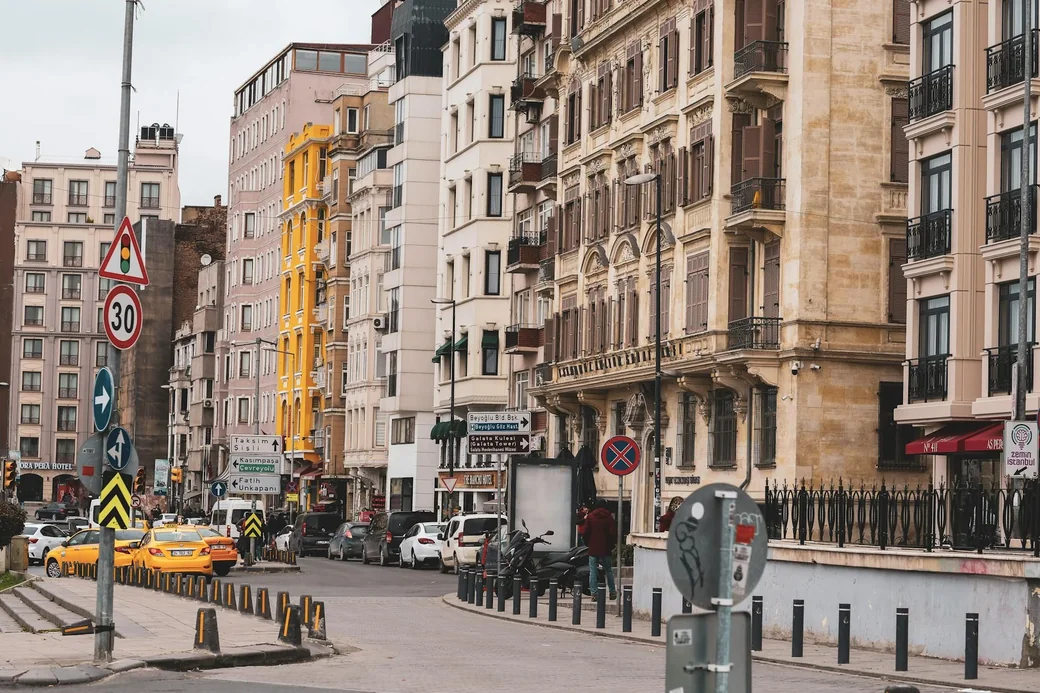
Istiklal Avenue is a long pedestrian street in the Beyoglu district of Istanbul, running from Taksim Square, the best-known square on the city's European side, down to Tünel. It is one of the most visited streets in the world and the liveliest promenade in the city centre. Shops, cafés, cultural venues and historic buildings line its entire length, and its blend of old-world elegance and modern city life makes it a natural starting point for exploring central Istanbul.
İstiklal Avenue & Taksim Square: Location, accommodation options and contact
İstiklal Caddesi, Beyoğlu, İstanbul – between Taksim Meydanı (34437) and Tünel Meydanı (34421)
The place's location on the map and nearby accommodation and hotel options are shown by Stay22. Cookies are used. Your consent is remembered on every page; you can turn it off at any time in the cookie settings.
İstiklal Avenue History: From Grand Avenue of Pera to Pedestrian Boulevard
Long before it became a pedestrian boulevard, İstiklal was the Grande Rue de Péra, called Cadde-i Kebir, the Grand Avenue, in Ottoman usage. The first Muslim settlement in the area dates to 1491, when a Mevlevi lodge (a convent of the whirling-dervish order inspired by Rumi) was founded near today's Tünel Square. Over the centuries diplomats, merchants and craftsmen from many communities built mansions, churches and shops along the ridge, and by the 19th century the street was famously multilingual and cosmopolitan. After the Republic was declared in 1923 it took the name İstiklal, meaning independence. Cars were banned in 1989, the tram returned in 1990, and the avenue now runs about 1.4 kilometres from Tünel to Taksim.
Taksim Square History and the Meaning Behind Its Name
Taksim means division or distribution, and the name is quite literal. In the 18th century Sultan Mahmud I had water brought from the north of the city to a stone reservoir here, the Maksem, where it was divided and sent on to other districts. The reservoir can still be seen at the edge of the square. The neighbourhood grew around this water point and, from the 20th century, around the Republic Monument. Five major roads meet here: Gümüşsuyu, Cumhuriyet, Tarlabaşı Boulevard, İstiklal and Sıraselviler. Its metro station is reported to be the busiest on the whole network, so almost every day in central Istanbul passes through Taksim at some point. Today the square is also a transport hub: the M2 metro and the F1 funicular from Kabatas on the Bosphorus shore arrive beneath it, and airport shuttle buses stop nearby.
Republic Monument in Taksim: Figures, Faces and Stories
The Republic Monument was made by the sculptor Pietro Canonica and unveiled on 8 August 1928. It stands about 11 metres high and has two faces. One side evokes the War of Independence, with Atatürk among his soldiers. The face turned toward İstiklal shows the new Republic: Atatürk with İsmet İnönü and Fevzi Çakmak, plus two foreign generals, Frunze and Voroshilov, placed there as thanks for the support given during the war. This detail stayed little known for decades, until a history magazine drew attention to it in 2002. Today it is the city's classic meeting point, and locals still say, “let's meet at the monument.”
Atatürk Cultural Center, Taksim Mosque and Republic Museum
Two large buildings now face each other across Taksim Square. The Atatürk Cultural Center, known as AKM, opened in 1969 as the Istanbul Palace of Culture for opera, ballet and theatre. After a fire in 1970 it was repaired and reopened under its present name in 1978, then closed for a long restoration and reopened on 29 October 2021. Opposite stands Taksim Mosque, started on 17 February 2017 and opened on 28 May 2021. Its design takes cues from 19th-century Beyoğlu architecture, and it includes an exhibition hall and a library. The Republic Museum, housed in the historic Maksem water reservoir on the square, displays items linked to the founding years, including clothes once worn by Atatürk.
Nostalgic Tram T2: Riding the Red Tram from Taksim to Tünel
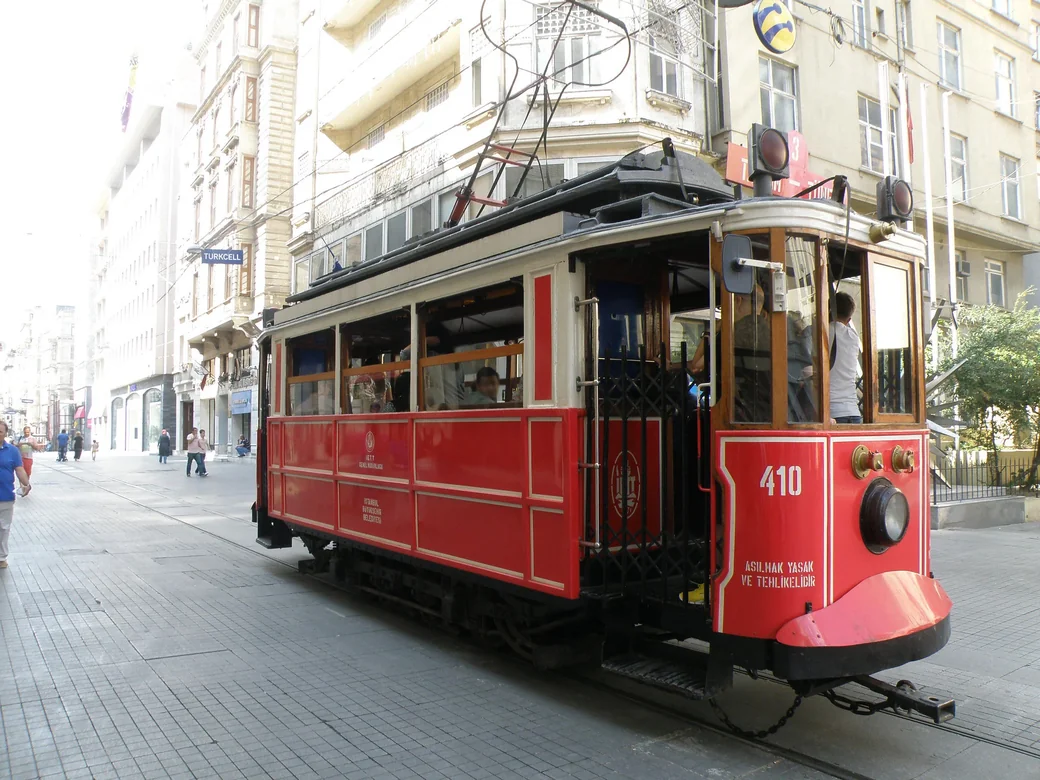
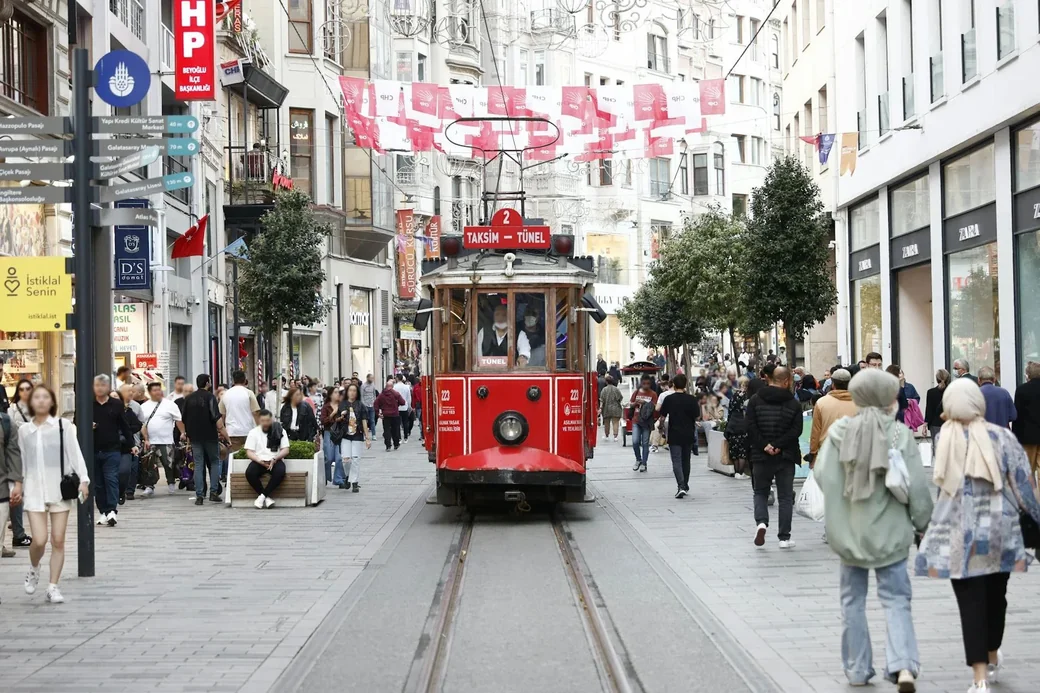
The red T2 tram is the symbol of the avenue. Istanbul's first horse-drawn tram ran in 1871, and electric trams reached İstiklal in 1914. They were withdrawn in the 1960s, and the line was revived on 29 December 1990, after the street was closed to traffic. Today it covers 1.64 kilometres with five stops: Taksim, Odakule, Galatasaray, Ağa Camii and Tünel. The ride takes roughly fifteen to twenty minutes, depending on the crowd, and the two directions pass each other at Galatasaray. A good plan is to ride down, then walk back up and look at the shops. The service can pause during works or special events, so check the current timetable. The tram is the only vehicle that runs along the pedestrian avenue in regular service, so its bell is a familiar sound all day.
Galatasaray Square and the High School at the Avenue's Midpoint
Galatasaray Square lies at roughly the middle of the avenue, and the monument to the 50th anniversary of the Republic, sculpted by Şadi Çalık in 1973, marks the halfway point. Behind the monumental gate stands Galatasaray High School, described as the oldest secondary school in the country; it grew out of the Galata Palace imperial school, with roots reaching back to the late 15th century. The famous football club Galatasaray was founded here in 1905 by the school's students. The gate is the most popular meeting spot after the monument at Taksim, and the square is also the junction for the fish market, the passages and the side streets leading to Çukurcuma.
Çiçek Pasajı, Fish Market and the Historic Passages of İstiklal
Çiçek Pasajı, the Flower Passage, was built as Cité de Pera by the banker Zografos on the site of the Naum Theatre, which burned down in 1870; it had 24 shops and 18 flats. Today its glass-roofed arcade is lined with taverns. Next to it, the Balık Pazarı fish market is crowded with fishmongers, pickle shops and small eateries, with the Üç Horan church on one side. Look also for Avrupa Pasajı with its antique shops, Halep Pasajı of 1885 with the Pera Cinema and a theatre, Suriye Pasajı, said to be the first building after the palace to receive electricity and gas, and the Atlas Pasajı cinema.
Churches and Mosques on İstiklal Avenue: History and Visiting Etiquette
The avenue is unusually rich in places of worship. The Church of St Anthony of Padua, the largest Catholic church in Istanbul, was designed by Giulio Mongeri in neo-Gothic style and built between 1906 and 1912. Not far away stands the Church of Santa Maria Draperis, and the Üç Horan church sits by the fish market. Ağa Camii, built in 1594 by Hüseyin Ağa, is one of the oldest mosques in Beyoğlu, and its name is also a tram stop. Ayia Triada church is just off Taksim Square, and synagogues stand in the surrounding streets. Enter quietly, dress modestly and do not photograph worshippers.
Historic Façades, Pera Museum, Markiz and Hacı Bekir
Look above the shopfronts: many façades along İstiklal still carry their original ornament. Narmanlı Han, built in 1831, became a home for artists, writers and publishers after 1933, and Tanpınar worked there from 1944 to 1951. Pera Museum, on Meşrutiyet Street a short walk from the avenue, occupies the former Bristol Hotel and shows Anatolian weights and measures and art. The Lebon patisserie, widely described as Istanbul's first, later gave way to Markiz, named after a chocolate brand, which was a writers' meeting place until about 1980. For lokum (Turkish delight, a soft starch-and-sugar confection), the Hacı Bekir house, founded in 1777, has had a branch on İstiklal since the 1960s.
Cinema and Theatre History on İstiklal: First Screenings and Old Halls
Film arrived in Istanbul on this street. The first public screening took place at the Sponek beer hall at the Galatasaray bend, near today's Avrupa Pasajı, and sources date it to either December 1896 or January 1897. The first permanent cinema, Pathé, opened in 1908 at nearby Tepebaşı. Cine Magic, which opened around 1920 on Sıraselviler near Taksim, was described as the city's first building made for cinema; it was demolished in 2012. Halep Pasajı still holds the Pera Cinema and a historic theatre, and the Atlas Pasajı cinema, together with the Istanbul Cinema Museum, keeps the tradition alive. Check the programmes: festival screenings and independent films are often shown here.
Tünel Square, the 1875 Underground Funicular and Galata Mevlevi Lodge
At the bottom of the avenue lies Tünel Square. The Tünel, opened on 17 January 1875 and designed by the engineer Gavand, is often called the world's second-oldest underground railway. Its two stations are only 573 metres apart and the ride takes about ninety seconds. The idea came from the crowds who climbed the steep Yüksek Kaldırım road every day. Beside the square, Galip Dede Street leads down to the Galata Mevlevi Lodge, founded in 1491 as the city's first Mevlevi lodge and now a museum. From here you can walk on to Galata Tower, Karaköy's cafés and the Golden Horn shore.
Shopping, Crowds and Visitor Numbers on İstiklal Avenue
İstiklal is one of the busiest shopping streets in Istanbul. Alongside the big brands you will find bookshops, record shops, souvenir stores, sweet shops and street food stalls. If you dislike crowds, come on a weekday morning, and keep Saturday evening for atmosphere. Shops usually open in the morning and close in the evening.
How to Walk İstiklal Avenue: Route, Timing, Accessibility and Nearby Sights
A relaxed plan: start at the Republic Monument in Taksim, walk down past the churches and passages to Galatasaray, then continue to Tünel and finish at Galata Tower or the Karaköy waterfront. Allow about three hours with stops. The pavement is paved and gently sloping, so wheelchairs and strollers manage well, though side passages often have steps, and the metro stations have lifts. Signs and menus are widely available in English, and guided walking tours run in several languages. Other places close by include Cihangir, Çukurcuma's antique shops, the Pera Museum, Galata Tower and the Galata Mevlevi Lodge.
Safety, Photo Spots and Do's and Don'ts at Taksim and İstiklal
Do: keep valuables in front pockets in the evening crowd, check the price before ordering, step aside when the tram rings its bell and use the side streets to escape the crush. Don't: stand on the rails for photographs, follow strangers inviting you to a bar, or accept a menu without prices. During major public events, the authorities may temporarily close some stations and streets. Good photo spots are the red tram with the avenue behind it, the Galatasaray gate, the glass roof of Çiçek Pasajı, the Republic Monument at dawn, and the view from Tünel down toward Galata Tower. Ask permission before photographing people.
Legends and Rumours of Taksim and İstiklal
Several stories are told here, none of them proven. According to one rumour, the name Beyoğlu comes from a Trebizond prince, Alexios Komnenos, who is said to have converted to Islam and built a mansion in Pera. According to another, it comes from Andrea Gritti, the envoy of Venice. By one account, the sculptor of the Republic Monument designed it as a pool after learning what Taksim means, but the last payment of his fee is said to have gone unpaid, so no water ever flowed. According to a story told by one writer, the two female reliefs on its sides were added later. Some also say the capped figure is a foreign ambassador, not a general; scholars disagree.
İstiklal Avenue & Taksim Square: Visitor Tips
Start at Taksim and walk downhill, so the slope works for you and the tram can carry you back up. Go early for photographs without crowds, and step into the side passages whenever the main street feels too busy. Keep phones and wallets secured in the evening crowd, and read menu prices before sitting down. Give yourself at least three hours if you want to stop in a passage, a café and a church.
İstiklal Avenue & Taksim Square: Best Time to Visit
Weekday mornings for a calm stroll; late afternoon and evening for the liveliest atmosphere. Spring and autumn are the most comfortable seasons.
İstiklal Avenue & Taksim Square: Admission Fees
Free admission
The pedestrian avenue and the square are public spaces, free to enjoy at any hour.
Free
Quick Info
3h
easy
İstiklal Avenue & Taksim Square: Getting There
The easiest way to reach the top of the avenue is the M2 metro (Yenikapı–Hacıosman line): Taksim station sits directly beneath the square, with exits close to the Republic Monument and to the start of İstiklal. If you are coming from the old city, take the T1 tram to Kabataş and change to the F1 funicular, which climbs to Taksim in about two and a half minutes.
To enter from the lower end, take the M2 to Şişhane, or ride the historic Tünel funicular up from Karaköy. Airport shuttle buses stop at Taksim, and an Istanbulkart works on all of these lines. The avenue itself is closed to traffic, so do not plan to drive onto it: take a taxi to the Taksim area or leave the car in a car park and continue on foot.
Nearby stops & parking
Taksim metro station and the F1 funicular are at the top of the avenue; Şişhane metro station and the Tünel funicular station are at the bottom. The nostalgic T2 tram stops at Taksim, Odakule, Galatasaray, Ağa Camii and Tünel. Taxis can drop off around Taksim Square and Tünel Square. Multi-storey car parks are found around Taksim, Sıraselviler and the Tarlabaşı Boulevard area, but traffic is heavy, so public transport is usually the better choice.
There is no dress code on the street itself. If you plan to enter a mosque or church along the way, cover your shoulders and knees, bring a scarf for covering the head in mosques, remove your shoes where asked, speak quietly and avoid visiting during services.