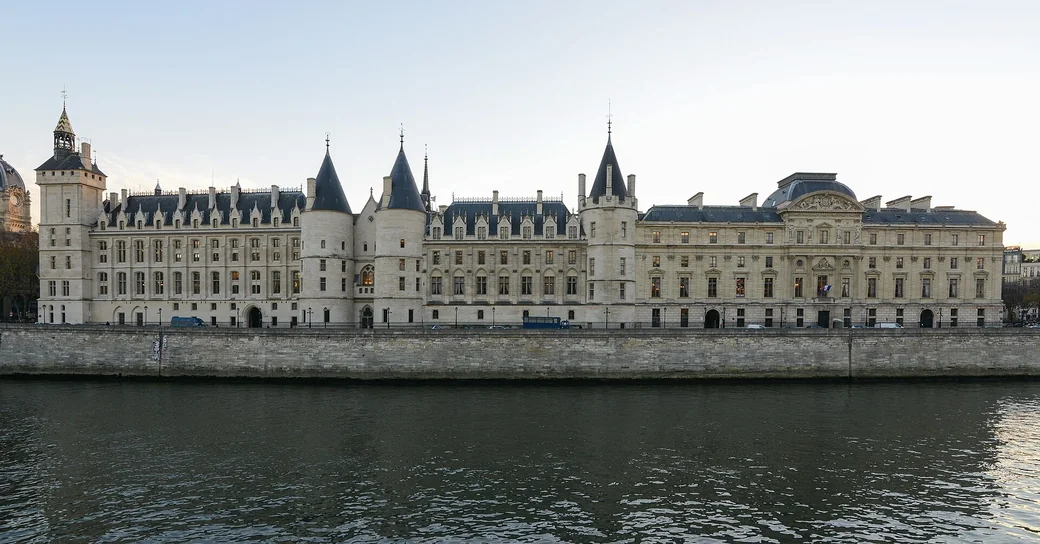
The Conciergerie is a medieval royal palace turned prison on the western tip of the Île de la Cité, in the very heart of Paris, on the banks of the Seine. Today a national monument and museum, it is known above all for its vast Gothic halls and for its role during the French Revolution, when some of the most famous prisoners of the Terror were held here. Its turreted riverside façade is one of the most recognisable sights along the Seine.
The Conciergerie: Location, accommodation options and contact
2 Boulevard du Palais, Île de la Cité, 75001 Paris, France
The place's location on the map and nearby accommodation and hotel options are shown by Stay22. Cookies are used. Your consent is remembered on every page; you can turn it off at any time in the cookie settings.
A Castellum, or Palatium, has stood on the Île de la Cité since the 4th century AD, covering roughly a hectare and once housing the Praetorian tribunal. For a time, two Roman emperors, Julian and Valentinian, even resided here — so the site's story begins long before the Kingdom of France, in the Roman Empire itself.
A 400-Year Palace for the Kings of France
From the 10th to the 14th century, the Palais de la Cité was the official residence and seat of power of the kings of France, built alongside the Sainte-Chapelle. When Charles V left for the Louvre in 1358, the building was entrusted to an officer called the "Concierge" and gradually turned into a prison. The rest of the palace became the home of the kingdom's courts of justice, a role the neighbouring Palais de Justice still carries on today.
Where Does the Name "Conciergerie" Come From?
The name comes from the title "Concierge", bestowed on a high-ranking royal officer responsible for keeping order, overseeing the police and registering prisoners. After the king left the palace, this officer effectively became its manager, and the building gradually came to be known by his title.
The Antechamber of the Guillotine: The Revolutionary Tribunal
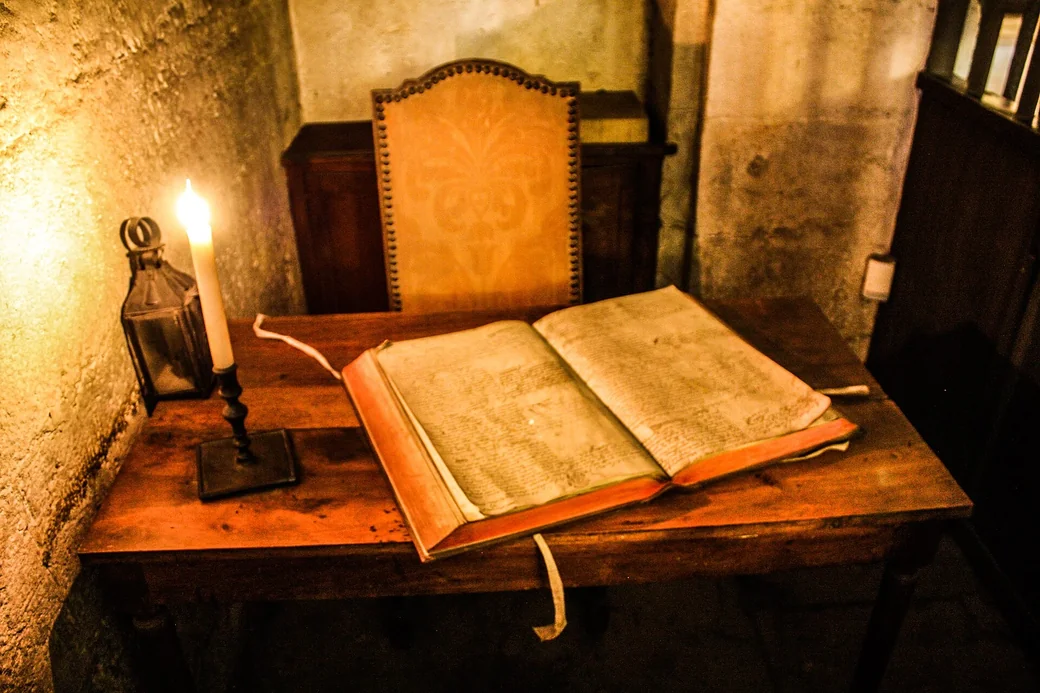
During the French Revolution, every session of the Revolutionary Tribunal was held here. At the height of the Terror, around 600 prisoners were held at once, and around 2,780 people in total were tried and sent to the guillotine. One room lists the names of over 4,000 people once held here — which is why contemporaries called it "the antechamber of the guillotine." Once sentenced, prisoners passed through the guichets (the gated wickets of the prison entrance) into the Cour de Mai, where horse-drawn carts waited to carry them across Paris to the scaffold.
Marie Antoinette's Final Two and a Half Months
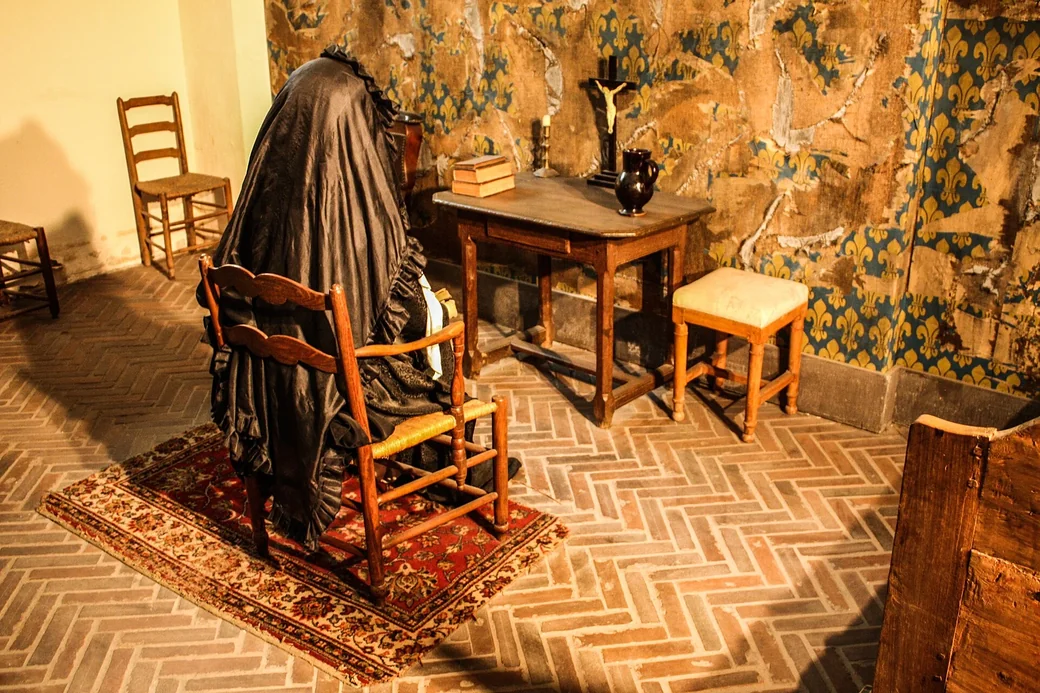
Queen Marie Antoinette was imprisoned here from August to October 1793, following the execution of her husband, Louis XVI. Her cell has been reconstructed for visitors, and in 1816, during the Restoration, a commemorative chapel was built on the site of her former cell. Like the other women held here, she took her daily walk in the Cour des Femmes, the prisoners' courtyard, whose original fountain — once used for washing laundry — still stands today.
The Revolution Devoured Its Own Children
Alongside Marie Antoinette, Charlotte Corday — who stabbed the revolutionary Marat to death — was also held here. One of history's great ironies: the architects of the Terror themselves, Danton and Robespierre, later shared the same cells before being sent to the guillotine, becoming victims of the very system they had built. Nearby, in the Chapelle des Girondins — once the king's private oratory — 21 Girondin deputies spent their last night together before being guillotined as a group on 31 October 1793, one of the Terror's largest single-day executions.
Europe's Largest Gothic Hall: Salle des Gens d'Armes
Built in 1302, this hall is considered one of the largest civic medieval Gothic halls in the world, with more than 60 columns, and at 1,785 square metres it holds the title of Europe's largest secular Gothic hall. In medieval times, thousands of royal guards could dine here at once. Just below, the medieval kitchens built under Jean II le Bon still have their four giant corner fireplaces, once large enough to prepare meals for the roughly 2,000 staff who served the royal household.
Home to Paris's Oldest Public Clock
The corner tower on the Quai de l'Horloge houses Paris's first public clock, installed in the 1370s. Still running today, it has been telling Parisians the time for more than 650 years — well worth a look from the outside before you go in. It stands beside two round twin towers, Tour de César and Tour d'Argent — the latter once housed the royal treasury, the former named for the Roman-era foundations beneath it — which together with Tour Bonbec make up the four medieval towers lining the riverside façade.
The Queen's Hidden Treasure: Catherine de Médicis's Legend
A striking anecdote tells that during the 16th-century Wars of Religion, Queen Catherine de Médicis, fearing her treasures would fall into enemy hands, entrusted them to an alchemist to be hidden deep within the Conciergerie. Whether entirely true or not, the story hints at just how many secrets this building has held over the centuries.
Damp Cells and the Tour Bonbec Torture Tower
Being so close to the Seine, the building flooded often, and the Conciergerie was known as an especially miserable prison. The oldest, round crenellated tower, the Tour Bonbec, was where prisoners were tortured — the name literally means "good beak", since confessions were extracted here by making prisoners "open their beaks." Conditions depended heavily on wealth: poorer prisoners, known as the "pailleux," slept on straw on the bare floor, while wealthier ones could pay for a furnished private cell called a "pistole."
Part of a UNESCO World Heritage Site Since 1991
The building served as a prison until the early 20th century, when it was opened to visitors as a historic monument; it has been a listed historic monument since 1862. The Conciergerie is part of the "Paris, Banks of the Seine" site, inscribed on the UNESCO World Heritage List in 1991. This 365-hectare heritage area also includes Notre-Dame, the Louvre, Sainte-Chapelle and the Eiffel Tower.
The Hidden Gem Overshadowed by Sainte-Chapelle
Most tourists head straight for the more famous Sainte-Chapelle next door and skip the Conciergerie altogether, which is why it's often considered one of Paris's most underrated historic sites by both locals and visitors — even though its architectural and historical value is every bit as significant.
How to Get There and How Long to Stay
The closest metro station is Cité (line 4); Châtelet (lines 1, 7, 11, 14) and Saint-Michel RER (lines B and C) are also within walking distance. Set aside 1 to 1.5 hours for the visit — it doesn't require a half-day itinerary.
Travel Back in Time with the HistoPad
The HistoPad tablet uses augmented reality to reconstruct the rooms as they looked in different eras, and it is available in several languages including French, English, German, Spanish, Italian, Japanese and Chinese. Pick it up as you enter so it can guide you from the very first hall.
Paris Museum Pass Holders Don't Need a Separate Ticket
Visitors carrying a valid Paris Museum Pass can enter the Conciergerie without buying a separate ticket. The pass covers dozens of museums and monuments across the city, so it can be worthwhile if you're planning to visit several sites during your stay.
Catch the Quietest Hour in the Great Hall
The quietest time to visit is first thing in the morning, when the Salle des Gens d'Armes is nearly empty and you can take in its forest of columns in silence. Tour groups tend to peak around the middle of the day, so an early start or a late-afternoon visit gives a much calmer experience.
Pair It With Sainte-Chapelle the Same Morning
The Conciergerie and Sainte-Chapelle are part of the same former palace complex and sit only about 50 metres apart on Boulevard du Palais. Starting at the Conciergerie at opening and moving on to Sainte-Chapelle around midday is the classic way to see both while avoiding the worst of the crowds.
The Conciergerie: Visitor Tips
Arrive early for the emptiest halls and pair your visit with neighbouring Sainte-Chapelle the same morning — the two sit about 50 metres apart. Pick up the HistoPad tablet at the start of your visit; it brings each room back to life in augmented reality. Photography is allowed in most rooms, and bags are checked at the entrance.
The Conciergerie: Best Time to Visit
First thing in the morning for the emptiest halls; late afternoon for warm light on the riverside towers seen from the Pont au Change.
The Conciergerie: Admission Fees
Adult
Entry to the former royal palace and revolutionary prison, including the exhibition and the augmented-reality HistoPad tablet.
Rate for visitors who are neither nationals nor residents of an EEA country. One ticket for both monuments; the Sainte-Chapelle visit requires a timed slot, while the Conciergerie can be visited on the same day at any time.
Rate for nationals or residents of an EEA country; proof of eligibility is required. One ticket for both monuments; the Sainte-Chapelle visit requires a timed slot, while the Conciergerie can be visited on the same day at any time.
€23
Under 18 (free)
Free for all visitors under 18, whatever their nationality. A valid ID showing date of birth may be requested.
Free
Ages 18–25 from the EEA (free)
Free for nationals or residents of an EEA country aged 18 to 25. ID (and proof of residence where relevant) is required.
Free
Visitors with disabilities + companion (free)
Free for visitors with a disability, plus one companion. Proof of disability status is required.
Free
First Sunday of the month (free)
Free for everyone on the first Sunday of the month, from November to March.
Free
Job seekers from the EEA (free)
Free for job seekers from the EU or EEA who show a job-seeker certificate less than six months old.
Free
Quick Info
1h 15m
easy
The Conciergerie: Getting There
The closest metro station is Cité on line 4, right on the Île de la Cité. Châtelet (lines 1, 7, 11, 14) and the Saint-Michel–Notre-Dame RER station (lines B and C) are both about a 10-minute walk away. Central Paris streets around the site are pedestrian-friendly, and it's an easy stroll from Notre-Dame or the Latin Quarter.
Nearby stops & parking
Cité metro station is literally across the street. There is no dedicated visitor parking on the island; the closest public car parks are Notre-Dame and Lutèce, a short walk away. Taxis can drop off along the Quai de l'Horloge, right beside the monument.
The Conciergerie: Dress Code & Etiquette
No specific dress code applies — the Conciergerie is a secular historical monument, not a religious site. Comfortable shoes are recommended for the uneven medieval stone floors and stairs, and bags are checked at the entrance as a standard security measure.