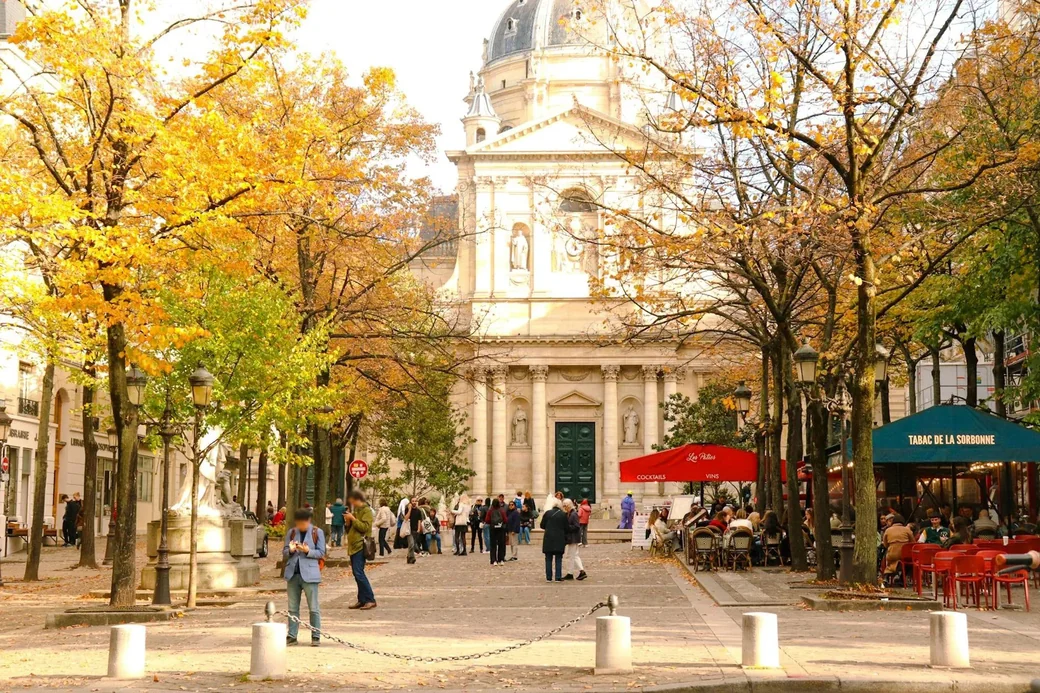
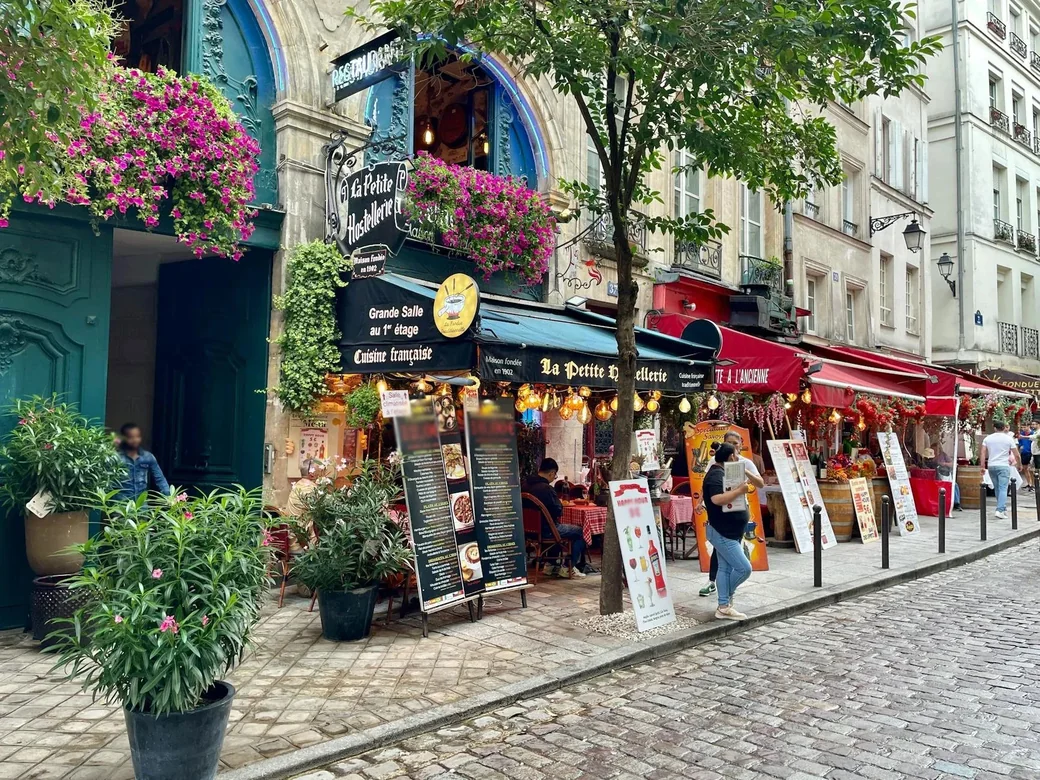
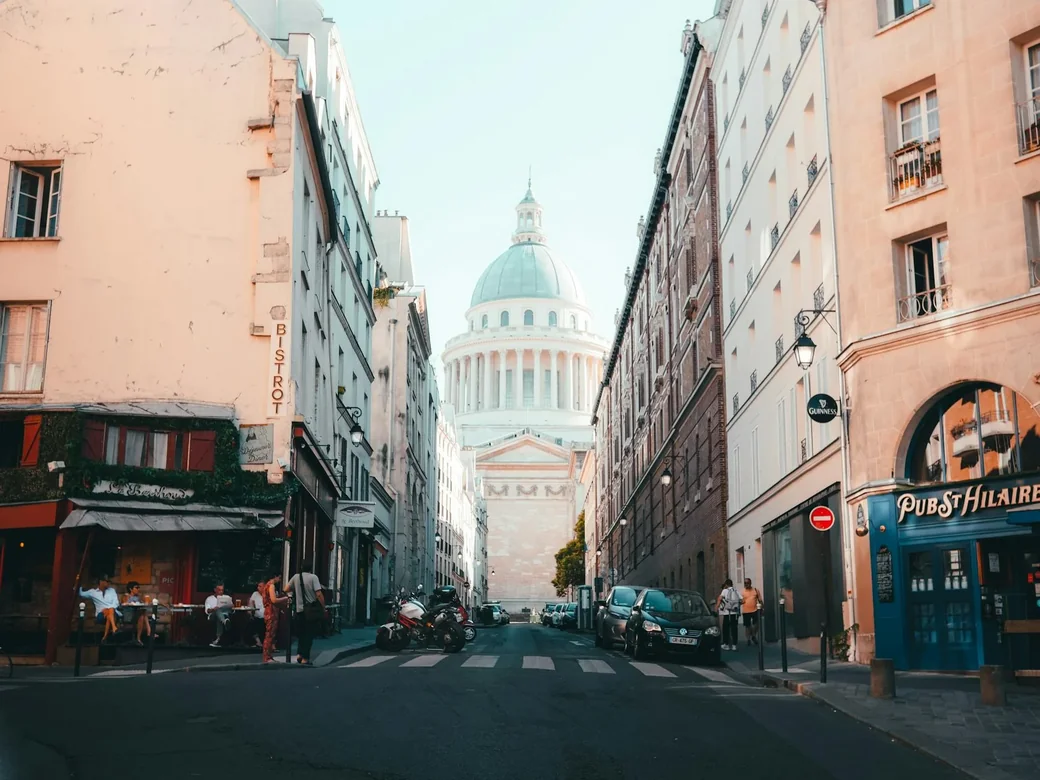
The Latin Quarter is a historic neighborhood on the Left Bank of the Seine, spread across the 5th and 6th arrondissements of Paris around the hill known as the Montagne Sainte-Geneviève. It is the city's traditional university district, and it still feels like one: narrow streets wind between old college buildings, small squares, churches and bookshops, and café terraces fill with students from morning to night. Crowned by the great dome of the Panthéon, it is one of the most atmospheric parts of Paris to explore on foot.
Latin Quarter: Location, accommodation options and contact
5th & 6th Arrondissement, Paris, France
The place's location on the map and nearby accommodation and hotel options are shown by Stay22. Cookies are used. Your consent is remembered on every page; you can turn it off at any time in the cookie settings.
Long before it appeared on any map as a tourist district, this hillside was simply where Paris did its thinking. When Pierre Abélard broke with the schools of Notre-Dame in the twelfth century and set up teaching on the Left Bank, he and the masters who followed lectured in Latin, the working language of every European scholar regardless of nationality — French, English, German, and Italian students argued philosophy in a tongue none of them had grown up speaking, and the district took its name from that common language. The habit outlasted the language itself. In 1257, Robert de Sorbon's small theological college gave the area a name, the Sorbonne, that would eventually stand for the whole university. Walk here today and the layering is still visible: narrow medieval lanes converge on a knot of grandes écoles (France's elite higher-education schools) and lycées that never really stopped teaching, so the 'quarter' is less a monument than a functioning campus without walls or gates. The Sorbonne's beginnings were humble in another sense too: Robert de Sorbon founded his college specifically to house and teach poor students of theology who could not otherwise have afforded to study.
The Panthéon: From Church to National Mausoleum
Jacques-Germain Soufflot's great domed building on top of the hill was commissioned as a church for Sainte-Geneviève, Paris's patron saint, and construction ran from 1764 to 1790 — spanning the years right up to the Revolution, which changed everything. Before the church was even consecrated for worship, revolutionary authorities repurposed it as a mausoleum for the nation's great men, and Voltaire's remains were moved there in 1791, followed by Rousseau's in 1794. For decades afterward, the building switched back and forth between church and civic monument as governments changed. The matter was finally settled in 1885, when Victor Hugo's state funeral drew immense crowds through the surrounding streets and the Panthéon was fixed permanently in its secular role. Today it continues to serve as the resting place where France honors figures it considers essential to the nation's history, and its dome remains one of the most recognizable silhouettes on the Left Bank skyline.
The Sorbonne and Its University Neighbors Today
The name 'Sorbonne' now covers more ground than the original medieval college. Several present-day institutions trace their lineage to it or share its historic buildings and courtyards, including Sorbonne University and Panthéon-Sorbonne University, and the surrounding streets host a remarkable concentration of other schools: Université Paris Cité, the elite École Normale Supérieure, the Collège de France (long known for free public lectures), and the historic secondary schools Lycée Henri-IV and Lycée Louis-le-Grand. Add research libraries such as the Bibliothèque Sainte-Geneviève, and you have one of the densest clusters of higher education anywhere in Europe, packed into a few walkable blocks. Most of these are working institutions rather than sights, so respect any signage restricting entry — but their presence is what gives the Latin Quarter its particular rhythm, with the ebb and flow of lectures, exam periods, and student life still visibly shaping the streets around you. All of them, in one way or another, descend from the medieval University of Paris, which grew out of the community of masters and students that first gathered on this hillside in the twelfth century.
Bookshops, Shakespeare and Company, and La Bohème
Small, independent bookshops remain one of the pleasures of walking these streets, and the most famous is Shakespeare and Company, the English-language shop near the river that has served generations of anglophone writers and readers passing through Paris. Its shelves, uneven floors, and reading nooks have made it a pilgrimage site for book lovers long before it appeared in any film. The neighborhood's romantic reputation for garret rooms, late-night conversation, and struggling artists is not purely a modern invention, either — it is the setting Puccini chose for La Bohème, whose young painters, poets, and their loves scrape by in a Left Bank world not unlike this one. Beyond the famous shop, smaller antiquarian and specialist booksellers are tucked along side streets near the Sorbonne, and browsing them, even without buying, is a good way to feel the district's long-standing identity as a place where reading and writing matter.
Rue Mouffetard: A Market Street with Character
Running downhill from Place de la Contrescarpe toward the church of Saint-Médard, rue Mouffetard is one of the oldest and most atmospheric market streets in Paris, its narrow, slightly winding course lined with cheese shops, bakeries, greengrocers, and small restaurants whose tables spill onto the pavement. It is busiest — and most fun to wander — in the late morning and around lunchtime, when shoppers and shopkeepers create a genuinely local rhythm rather than a staged one. Side alleys off the main street reveal quieter corners and older building facades, some dating back centuries, a reminder that this was a working-class market street long before it became a draw for visitors. Come hungry and let your nose guide you rather than following a rigid list; the pleasure here is grazing and browsing rather than ticking off a single must-see stop. Early evening brings a different, more convivial mood as café terraces fill and the street settles into its dinner rhythm.
Best Time to Visit and How to Avoid Crowds
Like much of central Paris, the Latin Quarter is busiest from late morning through the afternoon, especially near the main axis linking boulevard Saint-Michel to the river. Arriving soon after sunrise rewards you with empty, atmospheric streets and soft light for photographs, particularly around the smaller lanes near the Sorbonne before shops have opened their shutters. University term time, roughly autumn through late spring, adds a layer of genuine student bustle, especially at midday and around class changes, while the quieter summer months see fewer students but similar visitor numbers. Weekday visits generally feel calmer than weekends, when both Parisians and tourists treat the quarter as a destination for a leisurely stroll. If you want rue Mouffetard at its liveliest, aim for a Saturday morning; if you prefer it hushed, a weekday just after opening time works well. Either way, patience and an unhurried pace matter more here than precise timing.
Best Photo Spots in the Latin Quarter
Some of the most rewarding photographs in the Latin Quarter come from its verticality and its contrasts rather than a single marquee view. The steep, narrow lanes climbing the Montagne Sainte-Geneviève toward the Panthéon frame the dome nicely from several angles, especially rue Clovis and the streets just south of place du Panthéon. Small squares such as place de la Contrescarpe, with its trees and café awnings, offer a more intimate, lived-in scene. Rue Mouffetard's market stalls and colorful shopfronts make for good street photography, particularly in the softer light of morning. Near the river, the quays close to Notre-Dame give classic postcard views back across the water toward the cathedral and the Île de la Cité. Courtyards glimpsed through open gates along rue Saint-Jacques or near the Sorbonne can also yield quiet, unexpected compositions, though always be respectful about photographing where people live and study rather than treating every doorway as a backdrop.
How to Get to the Latin Quarter
Most visitors reach the Latin Quarter either by métro or on foot, and both work well. If you are already sightseeing around Notre-Dame or the Île de la Cité, simply crossing one of the bridges to the Left Bank drops you straight into the quarter's riverside edge near quai Saint-Michel, from which the district's narrow streets fan out and climb toward the Panthéon. Coming from elsewhere in Paris, the métro and RER network converges on the area from several directions, so it is rarely more than a short walk from any nearby station to your actual destination inside the quarter. Because the layout predates cars entirely, taxis and rideshares can only get you to the edge of the pedestrian-heavy core at best, and traffic on the surrounding boulevards can be slow at peak times. Budget a little extra time if arriving on foot from a distant part of the city, since the final approach involves a gentle but real climb up the hill.
A Walking Route Up the Montagne Sainte-Geneviève
A satisfying way to experience the Latin Quarter is as a single uphill walk rather than a list of separate stops. Start near the river around place Saint-Michel or the quays near Notre-Dame, then head inland and begin climbing gradually through the tangle of streets around rue de la Huchette and rue Saint-Séverin. Continue toward boulevard Saint-Michel and cut into the quieter lanes near the Sorbonne, where courtyards and older facades reward unhurried wandering. From there, keep climbing rue Soufflot, which points directly at the Panthéon's dome and makes for one of the district's most theatrical approaches on foot. Beyond the Panthéon, smaller streets lead toward rue Mouffetard for a well-earned pause among its food shops and cafés. The whole route covers only a modest distance, but the elevation change is real, so pace yourself, wear good shoes, and treat any detour down an inviting side street as part of the plan rather than a distraction from it. Keep an eye out, too, for half-open gates and passageways along the way: some lead into quiet courtyards where a small chapel sits tucked away from the street, a pocket of calm only a few steps from busy café terraces.
Café Culture and Student Life
Cafés here do more than serve coffee — they function as informal reading rooms, meeting points, and extensions of student life, much as they have for generations of writers and academics before today's students took over the same tables. Terraces along boulevard Saint-Michel and the smaller streets around the Sorbonne fill early with people studying, debating, or simply watching the crowd go by, and lingering over a single drink for an hour is entirely normal etiquette rather than an imposition. The atmosphere shifts through the day: quieter and more studious in the morning, busier at lunchtime near the universities, and more social in the evening as students and locals meet after classes or work. Because so many active schools sit within a few streets of each other, the quarter's café culture has a genuinely local, working rhythm rather than one staged purely for visitors — pull up a chair, take your time, and you become part of that rhythm rather than just an observer of it.
Accessibility and Mobility Notes
The Latin Quarter's charm — narrow medieval streets climbing a real hill — is also its main accessibility challenge. Many pavements are uneven, some stretches remain cobbled, and gradients around the Montagne Sainte-Geneviève can be steep enough to slow down wheelchair users, people with limited mobility, and anyone pushing a stroller or heavy luggage. Main thoroughfares such as boulevard Saint-Michel and boulevard Saint-Germain are flatter and better paved than the small lanes branching off them, so sticking to these where possible makes for easier going. Individual sites within the quarter, including the Panthéon, maintain their own accessibility arrangements, which can differ considerably from the street-level experience, so it is worth checking each site's specific provisions directly before visiting rather than assuming uniform access across the district. Service animals are generally welcome throughout the public streets. Traveling with an extra measure of patience, and allowing more time than a flat, modern neighborhood would require, makes the quarter far more manageable.
Visiting the Latin Quarter with Children
Families tend to enjoy the Latin Quarter as a place to wander rather than as a checklist of sights, and there is plenty here to hold a child's attention: narrow winding streets that feel like an adventure, the market stalls and food shops of rue Mouffetard, and the sheer scale of the Panthéon's dome towering over the rooftops. The Jardin des Plantes and its natural history museums lie just to the east, making an easy add-on for a longer family day. Pushchairs can manage the main boulevards without much trouble, but the smaller, hillier streets and any remaining cobblestones call for a bit more effort, so a carrier may suit very young children better on those stretches. Public benches and café terraces make it easy to pause for a rest, and because the quarter itself has no entrance fee, there is no pressure to rush between paid attractions — you can simply let curious children set the pace.
Do's and Don'ts in an Academic Neighborhood
Because the Latin Quarter is a living academic neighborhood and not an open-air museum, a little consideration goes a long way. Do treat the exteriors and public courtyards of university buildings as sights to admire, but don't wander into lecture halls, libraries, or restricted areas — most of the Sorbonne and its neighboring institutions are working spaces closed to casual visitors, particularly during term time. Do keep voices down around the Panthéon and inside any church you visit, both of which are treated with quiet respect by regular visitors and worshippers alike. Don't block narrow pavements for photographs, since many streets are barely wide enough for two people to pass, and residents use them daily. Do support small, independent bookshops and food stalls if you can, since they are part of what keeps the quarter authentic rather than purely touristic. And do remember this is a residential neighborhood as much as a historic one — ordinary courtesy toward people living and studying here is always appreciated.
Nearby Places Worth Combining
The Latin Quarter sits naturally alongside several other Left Bank highlights, making it easy to combine into a longer day. The Jardin du Luxembourg, with its formal gardens and Luxembourg Palace, lies just beyond the quarter's western edge and makes a pleasant, green counterpoint to the dense streets. To the north, crossing onto the Île de la Cité brings you to Notre-Dame and the medieval heart of the city, while the quays right along the riverbank near quai Saint-Michel and quai de Montebello form the quarter's own narrow riverside fringe — the one part of the Latin Quarter that actually falls within the UNESCO-listed 'Paris, Banks of the Seine' corridor running along the river between the Pont de Sully and the Pont d'Iéna. From there, the Île Saint-Louis and the wider riverside quays invite an easy extension of the walk in either direction, all without needing to plan around opening hours or tickets for the outdoor stretches.
Practical Wrap-Up: Free to Explore
There is no admission charge to enter or explore the Latin Quarter itself — it is a real, living part of Paris rather than a fenced attraction, so you are free to walk its streets, sit in its squares, and browse its shopfronts at no cost and at any hour. That said, individual sites within the district operate independently: stepping inside the Panthéon, visiting specific museums, or joining any guided tour comes with its own separate ticketing and schedule, set by each institution rather than by the neighborhood as a whole. Budget roughly half a day if you want to wander unhurriedly, longer if you plan to go inside the Panthéon or linger over a meal on rue Mouffetard. Comfortable shoes, a little flexibility in your route, and an appetite for narrow streets and bookshops will serve you better here than a tightly scheduled itinerary — this is a quarter best absorbed at a walking pace, one street at a time.
Latin Quarter: Visitor Tips
Wear comfortable, sturdy shoes — the streets around the Montagne Sainte-Geneviève are hilly and some are still cobbled. Bring a little cash for small stalls on rue Mouffetard, since not all accept cards. Give yourself time to wander without a fixed route; some of the quarter's best moments come from turning down an unplanned side street.
Latin Quarter: Best Time to Visit
Weekday mornings are quietest before tour groups arrive. Cafés and bookshops come alive in the evening. Many university buildings are closed to visitors during term time.
Latin Quarter: Admission Fees
Free admission
Free to enter and open to everyone; no ticket is needed.
Free
Quick Info
3h
easy
Latin Quarter: Getting There
The Latin Quarter is well served by the Paris métro and RER. Line 10 stops directly at Cluny–La Sorbonne and Maubert-Mutualité, right in the heart of the district, while line 4 reaches Saint-Michel and Odéon (also served by line 10), close to the riverside end of the quarter. RER B and C both call at Saint-Michel–Notre-Dame, a short walk from the same area, and RER B continues to Luxembourg, convenient for the western edge near the Jardin du Luxembourg. Lines 7 and 10 meet at Jussieu on the quarter's eastern side, and line 7 also serves Place Monge, near rue Mouffetard. Because the streets climb the Montagne Sainte-Geneviève and are frequently pedestrianized or very narrow, walking is by far the best way to get around once you arrive; the métro and RER bring you right to the edge of the quarter, and the rest becomes an enjoyable stroll.
Nearby stops & parking
Closest to the district's core: Cluny–La Sorbonne (line 10) and Maubert-Mutualité (line 10). Toward the river: Saint-Michel (line 4) and the RER B/C hub at Saint-Michel–Notre-Dame. Odéon (lines 4 and 10) sits at the quarter's northwestern edge. For the western side near the Jardin du Luxembourg, use Luxembourg (RER B). To the east, Jussieu (lines 7 and 10) and Place Monge (line 7) serve the area around rue Mouffetard and the Jardin des Plantes.
Latin Quarter: Dress Code & Etiquette
There is no dress code for wandering the Latin Quarter itself — come as you are. Comfortable, sturdy shoes are strongly recommended, since streets around the Montagne Sainte-Geneviève are hilly and sometimes cobbled. If you plan to step inside any of the neighborhood's churches, modest and respectful clothing — covered shoulders and no swimwear — is appreciated; the Panthéon, a civic monument, has no dress code but calls for the same quiet, respectful manner.