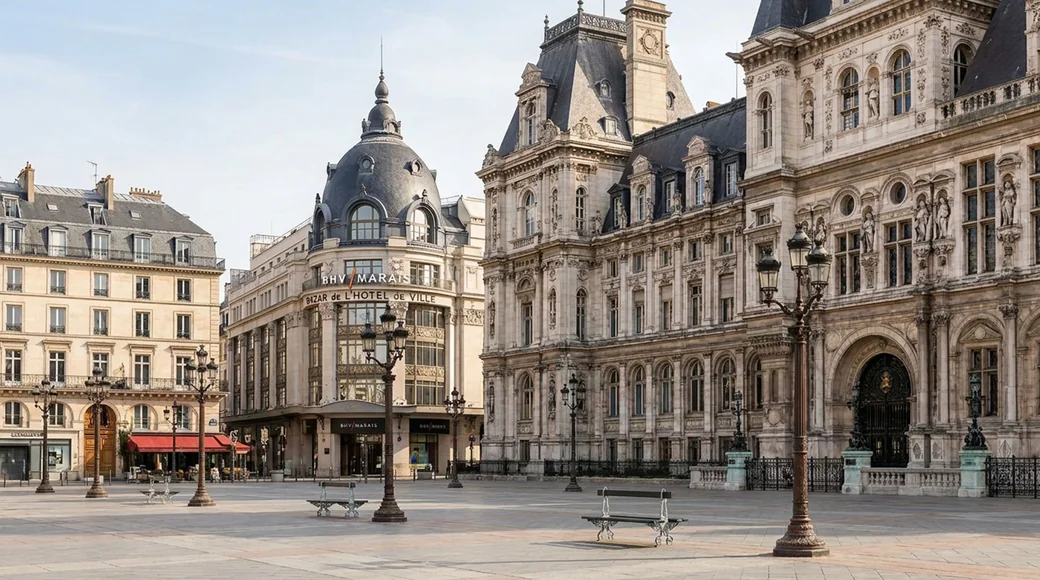
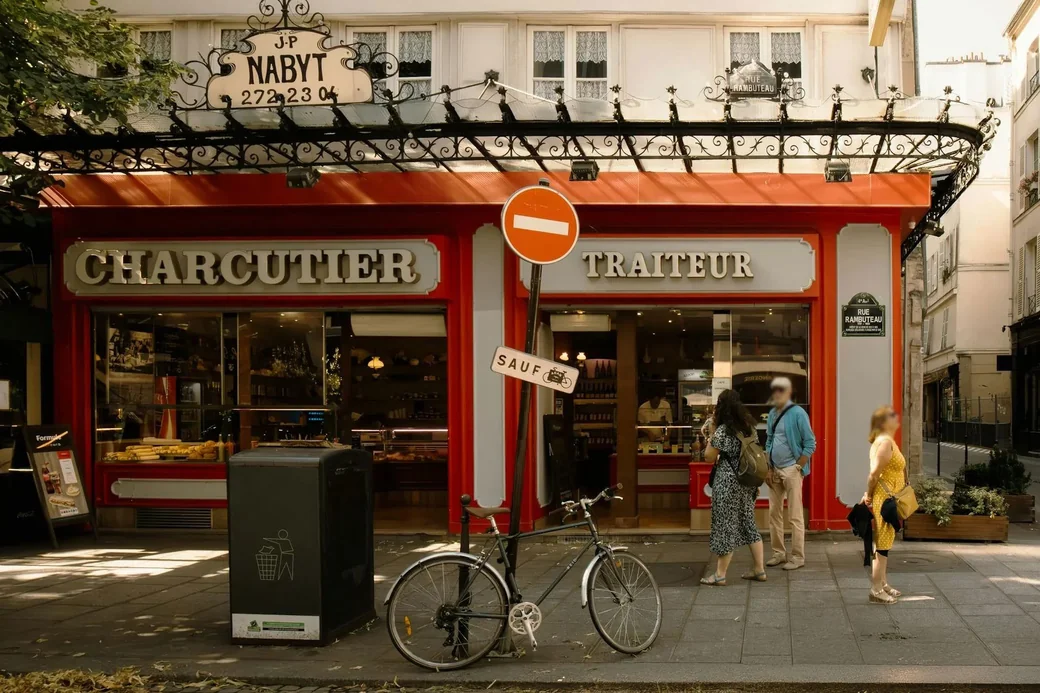
Le Marais is a historic district on the Right Bank of the Seine in central Paris, spread across parts of the 3rd and 4th arrondissements. Its narrow streets are lined with grand old mansions, hidden courtyards and elegant squares, yet it is anything but a museum piece: this is one of the liveliest corners of the city, where independent boutiques, art galleries, museums, bakeries and bars share the same few blocks. It is a neighborhood made for wandering on foot, with something new around almost every corner.
Le Marais: Location, accommodation options and contact
Le Marais, 3rd & 4th Arrondissement, 75003 / 75004 Paris, France
The place's location on the map and nearby accommodation and hotel options are shown by Stay22. Cookies are used. Your consent is remembered on every page; you can turn it off at any time in the cookie settings.
The name Le Marais literally means “the marsh,” a reminder that this part of the Right Bank was reclaimed wetland long before it became fashionable. The Knights Templar fortified the area around 1240, and by the seventeenth century it was Paris's most aristocratic address, anchored by Henri IV's Place Royale. The French Revolution changed everything: nobles fled, grand courtyards were subdivided into workshops and cheap housing, and by the mid-1900s the Marais had become a crowded, run-down working-class quarter. What saved it was a law, not luck. In 1964, Le Marais became one of France's first officially protected historic sectors, a status that stopped demolition crews in their tracks and financed restoration instead. That single decision is why so many seventeenth- and eighteenth-century buildings still stand today, giving the district its uniquely layered, lived-in atmosphere. Two earlier chapters are worth knowing as well. Even before the Templars arrived, medieval monks had begun draining the swampy ground, and the fortified keep the Order raised here was known as the Temple tower. Then, in the 1360s, the future King Charles V chose the area for his royal residence, the Hôtel Saint-Pol, drawing the court and the aristocracy into former marshland – the first step toward the streets of hôtels particuliers (grand private townhouses) that nobles and financiers would later build here.
Top Sights & Photo Spots
Le Marais rewards visitors who look up as much as those who look for a specific address. Place des Vosges is the essential stop: its arcaded galleries, symmetrical brick-and-stone façades, and central garden are equally rewarding for sightseeing and photography, especially in the soft light of early morning or late afternoon. The Musée Picasso, in the seventeenth-century Hôtel Salé, and the Musée Carnavalet, tracing the history of Paris inside the Hôtel Carnavalet, both reward an hour or two indoors. The Musée d'Art et d'Histoire du Judaïsme and the Art Nouveau Synagogue de la rue Pavée, designed by Hector Guimard in 1913, add another layer of history. Beyond the marquee sights, the real photographs come from wandering: pastel shopfronts, ivy-draped courtyards glimpsed through open carriage doors, and quiet side streets where the crowds thin out. Place des Vosges itself began life as Henri IV's Place Royale, built between 1605 and 1612 and renamed in 1800; it is the oldest planned square in Paris, and the rest of the Marais grew fashionable around it.
The Pletzl: Jewish Quarter
Rue des Rosiers and the streets around it make up the Pletzl (Yiddish for "little square"), the historic Jewish quarter of Paris. Eastern European Jewish immigrants began settling here from the late nineteenth century, building synagogues, schools, and shops that turned these few blocks into a genuine community. The Holocaust devastated the Pletzl; many residents were deported and never returned, and a memorial plaque on rue des Rosiers commemorates the schoolchildren taken during the war. In the postwar decades the community rebuilt, and today the street remains a living center of Jewish life in Paris, its bakeries, delis, and falafel counters serving specialties with roots across North Africa and Eastern Europe. Walking rue des Rosiers on a weekday afternoon, when the smell of fresh pastry drifts from doorways, is one of the most memorable small pleasures the Marais offers.
Marais by Night: LGBT Quarter
Since the 1980s, the blocks around rue des Archives and rue Vieille du Temple have grown into one of Europe's best-known gay villages, and the area remains a defining part of the Marais's identity. By day the streets look much like the rest of the neighborhood — cafés, bookshops, and clothing boutiques — but after dark, bars and clubs draw a lively, welcoming crowd that spills onto outdoor terraces on warmer evenings. The scene sits comfortably alongside the district's older, quieter corners, another example of how the Marais layers different communities and eras onto the same narrow streets rather than replacing one with another. Visitors looking for Paris's LGBT nightlife will find this pocket of the Marais the natural starting point, whatever night of the week they choose to explore it.
Best Time to Visit & Avoiding Crowds
The Marais's tangle of narrow streets means crowds concentrate fast, especially along rue des Francs-Bourgeois and rue Vieille du Temple on weekend afternoons, when Parisians treat the district as their own outdoor mall. Arriving on a weekday, and ideally before midday, is the simplest way to see the neighborhood at a human pace rather than shoulder to shoulder. If a weekend visit is unavoidable, aim for the first couple of hours after opening or the early evening, and use the quieter streets just one block back from the main shopping strips — the crowds thin out remarkably fast once you step off the busiest arteries. Spring and autumn bring mild, comfortable walking weather without the peak-summer heat that can make the shadeless, paved streets feel close and warm. Whatever the season, Place des Vosges' central garden offers a shaded, calmer pause when the surrounding streets feel busy.
Shopping in Le Marais
Shopping is one of the Marais's defining pleasures, and the range is wider than in most Paris neighborhoods: independent fashion designers and concept stores cluster along rue des Francs-Bourgeois and rue Vieille du Temple, while rue de Turenne and the surrounding side streets hide small art galleries, design studios, and specialty bookshops. Vintage and secondhand clothing is a particular strength here, with racks of curated pieces spanning decades tucked into shopfronts barely wider than a doorway. Unlike the grand department stores elsewhere in Paris, most Marais shops are small and independently run, which makes browsing feel more like discovery than transaction. Because so many storefronts are compact, don't expect to duck in and out quickly during busy afternoons — narrow aisles inside and narrow sidewalks outside mean shopping here rewards patience as much as curiosity. Pair a shopping afternoon with a stop at one of the small galleries scattered through the district for a break from clothes racks.
Food & Café Scene
Food in the Marais tells the story of the neighborhood as clearly as its architecture does. Rue des Rosiers is famous for its falafel counters, where lines form outside stalls serving generous, herb-heavy sandwiches rooted in Middle Eastern Jewish tradition, alongside kosher bakeries selling babka (a sweet, braided yeast cake) and other pastries. Elsewhere in the district, small wine bars pack in regulars for a glass and a plate of cheese or charcuterie, while a wave of relaxed cafés serves the kind of all-day brunch that has become a Parisian institution in its own right, especially on the streets around Musée Picasso. Bakeries selling classic French viennoiserie (croissants, pains au chocolat and other buttery breakfast pastries) sit within a few doors of Israeli, Lebanese, and North African spots, and it's entirely normal to see a pastry shop, a synagogue, and a cocktail bar sharing the same short block. Eating your way through the Marais, more than sightseeing, is often the best way to understand how its layered history still shapes daily life.
Getting to Le Marais
However you arrive in Paris, reaching the Marais is straightforward: it sits close to the geographic center of the city, wedged between the Seine and the northern boulevards, so it's rarely more than a short metro ride from wherever you're staying. If you're coming from Île de la Cité or the Latin Quarter, the walk across to Saint-Paul is pleasant and takes you past some of the oldest streets in Paris. Coming from Bastille, the eastern edge of the Marais is close enough to stroll to directly, making it easy to combine both in one outing. However you approach it, the metro or a short walk in from a neighboring district is the easiest and most relaxed way to arrive, and the tangle of narrow one-way streets and limited-traffic zones is best discovered on foot anyway.
A Walking Route Through Le Marais
A simple loop works well for a first visit. Start at the Saint-Paul metro station and head into rue des Rosiers, pausing at the falafel counters and kosher bakeries of the Pletzl. Continue east to Place des Vosges, and take a full turn around its arcaded galleries before cutting north toward the Musée Carnavalet and, a few streets further, the Musée Picasso in the Hôtel Salé. From there, rue des Francs-Bourgeois runs west through the heart of the shopping district, lined with concept stores and small galleries, before crossing rue Vieille du Temple, the spine of the Marais's LGBT quarter, with its cafés and bars. Continue toward rue des Archives and Rambuteau if you want to finish near the edge of Beaubourg. The whole route covers only a couple of kilometers, but narrow streets and frequent detours into courtyards or shopfronts make it easy to stretch into a half-day outing. While you circle Place des Vosges, look for the house at number 6, where Victor Hugo once lived; it is now a small museum dedicated to the writer and an easy stop to fold into the loop.
Accessibility & Family Notes
Le Marais is flat, which helps, but its cobblestones, narrow footpaths, and centuries-old thresholds mean it takes more care to navigate in a wheelchair or with a stroller than a modern boulevard would. Individual sights such as the Musée Carnavalet and Musée Picasso have their own step-free access and facilities, but the streets connecting them were never designed with modern accessibility in mind, so plan a slower pace and expect to problem-solve the occasional narrow doorway or curb. Service animals are welcome throughout the district. Families will generally find the neighborhood easy going: traffic is light on the smaller streets, the central garden at Place des Vosges gives children room to run around after a spell of window-shopping, and the casual food culture, from falafel to pastries, suits fussy eaters better than a formal restaurant would. The main practical challenge for parents is the same one wheelchair users face: pushing a stroller over cobblestones and narrow, sometimes crowded sidewalks takes patience, so budget extra time rather than rushing between stops.
Etiquette & Local Customs
A few small courtesies go a long way in the Marais. Many businesses around rue des Rosiers close for the Jewish Sabbath from Friday afternoon to Saturday evening, so treat closed shutters there on a Saturday as a sign of observance rather than an inconvenience. The inviting courtyards visible through open carriage doors along almost every street are private residential space, not public attractions — a respectful glance from the threshold is welcome, but walking in uninvited is not. Because sidewalks are often barely wide enough for two people, try not to block them entirely for a photo; step to one side or into a doorway gap so residents and other visitors can pass. As with anywhere in Paris, a simple “bonjour” when entering a shop and “merci, au revoir” on leaving is noticed and appreciated. And in the nightlife streets around rue Vieille du Temple, keep in mind that people actually live above the bars — voices carry easily on narrow residential streets late at night.
Nearby Places & Practical Wrap-Up
The Marais pairs naturally with several neighbors, so it rarely needs to be a whole day on its own. Just across the river, Île de la Cité and Île Saint-Louis make an easy add-on to the south, while Bastille, with its own market streets and canal-side paths, sits directly against the Marais's eastern edge. To the west, the Marais borders the Beaubourg quarter, an easy continuation on foot. There's no strong case for a single “best” season here: spring and autumn offer the most comfortable walking weather, summer brings long evenings that suit the LGBT nightlife scene, and winter's quieter streets can make the historic architecture easier to appreciate without crowds. Whatever the time of year, remember that the neighborhood itself has no gate, no opening hours, and no entrance fee — it's simply a living part of the city, free to wander at any hour. Individual museums inside it, like the Musée Picasso, do set their own admission policies, so check those separately before planning a visit around them.
Le Marais: Visitor Tips
Wear comfortable, flat shoes — the cobblestones and narrow, uneven sidewalks are hard on heels. Courtyards behind grand doorways often look inviting but are private residences, so peek respectfully rather than wandering in uninvited. Keep some cash handy, as some small boutiques and food stalls don't take cards.
Le Marais: Best Time to Visit
Visit Le Marais on weekday mornings for quiet streets. Evenings are lively. Many boutiques open Sundays, but Rue des Rosiers shops and restaurants often close Saturdays for Shabbat.
Le Marais: Admission Fees
Free admission
Free to enter and open to everyone; no ticket is needed.
Free
Quick Info
3h
easy
Le Marais: Getting There
Le Marais is best reached and explored on foot and by metro; there's no RER station directly serving the district. Line 1 stops at Saint-Paul, right in the heart of the neighborhood near rue des Rosiers and Place des Vosges, and at Hôtel de Ville on the western edge, which is also served by line 11 along with Rambuteau, near the Centre Pompidou side. Line 8 stops at Chemin Vert and Filles du Calvaire, convenient for the northern part of the Marais around Place des Vosges. Bastille, served by lines 1, 5, and 8, covers the eastern edge. Once you arrive, walking is the most rewarding way to experience the Marais: its narrow streets, many of them one-way or pedestrian, are made for strolling, and metro stations ring the whole district.
Nearby stops & parking
Saint-Paul (line 1) is the most central stop, a two-minute walk from rue des Rosiers and close to Place des Vosges. Hôtel de Ville (lines 1 and 11) anchors the southwestern edge near the Centre Pompidou side of the district. Rambuteau (line 11) sits just north of that, convenient for the western streets. Chemin Vert and Filles du Calvaire, both on line 8, serve the northern Marais near Place des Vosges' north side. Bastille (lines 1, 5, and 8) covers the eastern edge, handy if you're continuing toward the Bastille area afterward.
Le Marais: Dress Code & Etiquette
There's no dress code for wandering Le Marais itself — dress as you would for any Parisian stroll. Comfortable, sturdy shoes matter more than style, given the cobblestones and uneven pavements. If you plan to step inside the Synagogue de la rue Pavée or another active religious site in the neighborhood, modest clothing is appropriate, and a head covering may be requested or offered at the entrance, particularly for men.