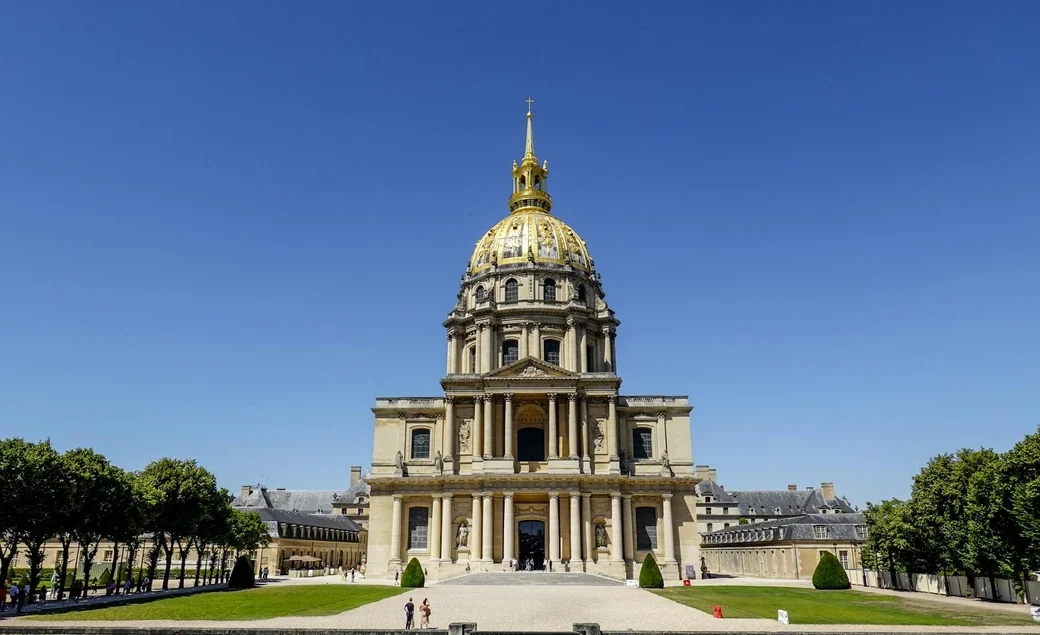
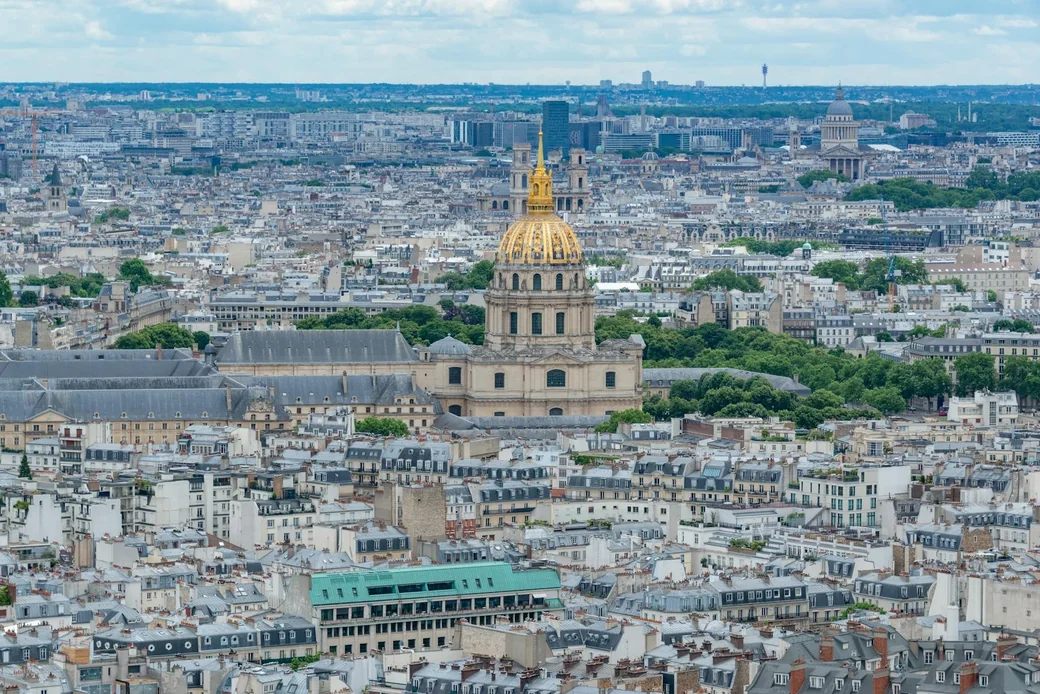
Les Invalides is a vast monumental complex on the Left Bank of the Seine, in the 7th arrondissement of Paris, and one of the city's most recognizable historic landmarks. Today it brings together a church, one of the world's great military museums and the tomb of Napoleon, all gathered beneath a gleaming golden dome that dominates this part of the city's skyline. Grand in scale and solemn in mood, it is one of the essential stops for anyone interested in French history.
Les Invalides: Location, accommodation options and contact
129 Rue de Grenelle, 75007 Paris, France (Dôme/tomb entrance: 2 Place Vauban)
The place's location on the map and nearby accommodation and hotel options are shown by Stay22. Cookies are used. Your consent is remembered on every page; you can turn it off at any time in the cookie settings.
Louis XIV ordered the construction of Les Invalides in 1670 to give wounded and elderly soldiers a hospital and a home, at a time when veterans without family support often had nowhere else to go. Architect Libéral Bruant completed the main complex by 1676, and it still functions in that original role today, if on a much smaller scale — a handful of elderly war veterans continue to live within its walls. Jules Hardouin-Mansart, better known for the Hall of Mirrors at Versailles, added the church and the gilded dome that now define the building's skyline, finishing the work in 1706. Few building projects anywhere have kept one purpose so consistently for over three and a half centuries. In its own day it ranked among the most ambitious building projects of France's classical age – as much a statement of royal power in stone as a charitable foundation.
Napoleon's Tomb Beneath the Dome
Napoleon Bonaparte died in exile on Saint Helena in 1821, but it wasn't until 1840 that his remains were brought back to France in a ceremony the French still call the Retour des Cendres (the "Return of the Ashes"). They were finally placed beneath the dome of Les Invalides in 1861, inside a sarcophagus carved from a single block of deep-red quartzite on a base of green granite. The tomb sits in an open, sunken crypt, so visitors look down on it from a circular gallery above, ringed by twelve colossal statues representing Victory and by relief panels celebrating his civil reforms and military campaigns. Napoleon's son and Marshal Ferdinand Foch are also buried within the complex, a short walk from the emperor himself. Foch earned his place here as the Marshal of France who served as supreme commander of the Allied armies during the First World War.
The Golden Dome and the Soldiers' Church
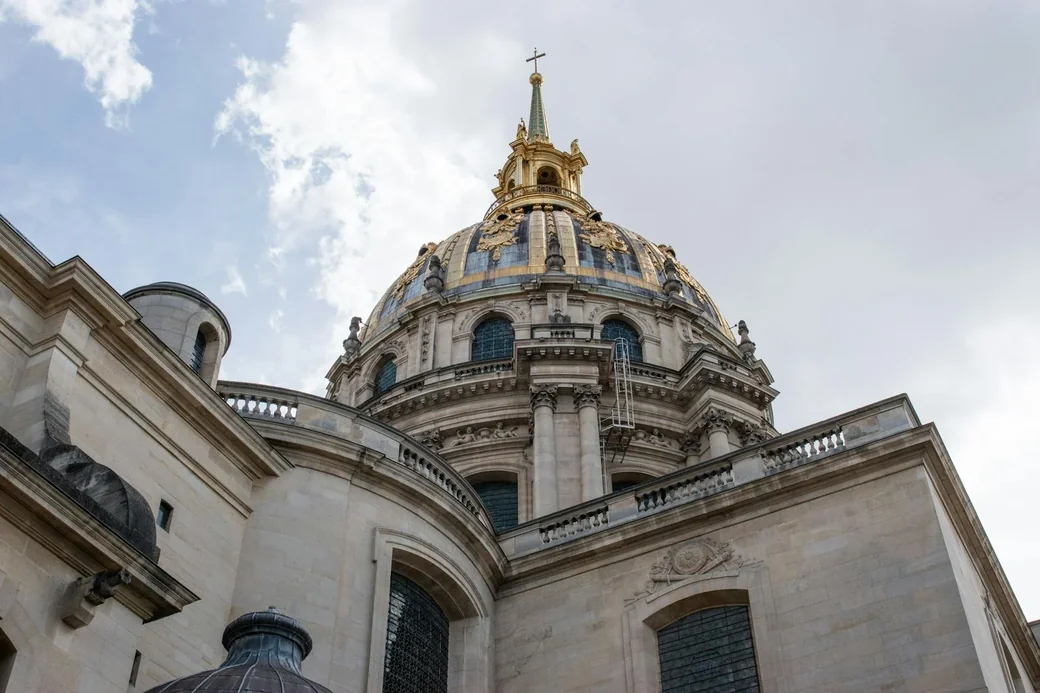
At 107 metres, the dome of Les Invalides is the tallest church roof in Paris, and its gold leaf surface — periodically re-gilded, using a substantial quantity of gold each time — catches the light across the Left Bank skyline. Beside it stands the Église Saint-Louis-des-Invalides, historically known as the soldiers' church, where flags captured by French forces still hang high along the nave. The two buildings share a single structure but were designed with two distinct purposes: one a place of worship for the veterans in residence, the other a monument to national military glory.
Inside the Musée de l'Armée
Wrapped around the dome and the church, the Musée de l'Armée ranks among the largest military history collections in the world, spanning medieval armour and Renaissance weaponry through Napoleonic uniforms and artillery to the trenches of the First World War and the campaigns of the Second. The dedicated Historial Charles de Gaulle galleries trace France's twentieth-century history in more depth. Give the museum real time if military history interests you at all — many visitors who come only for Napoleon's tomb end up spending far longer than planned once they're inside. The story actually begins even earlier than the medieval halls: the collections reach back to antiquity, so a full circuit traces the history of warfare from the ancient world to the twentieth century.
Which Entrance to Use
Les Invalides has two visitor entrances, and choosing the right one saves a walk. The main entrance, home to the ticket office, is at 129 Rue de Grenelle on the northern side facing the esplanade; it is the natural choice if you still need a ticket or are arriving early in the day. The second entrance, at 2 Place Vauban on the southern side, opens straight toward the Dôme and Napoleon's tomb and keeps a shorter daily schedule, which makes it handy for visitors who already hold a ticket and want to head directly to the tomb. The same ticket is valid at both, so you can enter on one side and leave by the other.
Metro, Bus and Parking Near Les Invalides
Three Métro/RER stations sit within easy walking distance: La Tour-Maubourg on line 8, Varenne on line 13, and Invalides itself, served by both lines plus RER C, which opens directly onto the esplanade in front of the building. Bus lines 28, 63, 69, 82, 83, 92 and 93 all stop nearby. Drivers will find limited paid parking on Rue de Constantine, though street parking in the surrounding government quarter is scarce; arriving by public transport or on foot is generally the more practical option.
Accessibility for Wheelchair and Reduced-Mobility Visitors
Visitors with motor disabilities are directed to the entrance at 129 Rue de Grenelle, which is set up to accommodate wheelchair access. Because the complex spans a former 17th-century hospital with courtyards, corridors and several museum wings added over different periods, accessibility can vary from one gallery to the next — it's worth calling ahead or checking the museum's accessibility page for the current state of lifts and ramps in the specific sections you plan to visit, particularly around the tomb's viewing gallery.
Best Time to Visit and How to Avoid Crowds
Arriving right at opening on a weekday is the surest way to see the tomb and the main galleries before tour groups build up. The museum also holds a monthly late opening on the first Friday evening, and that slot is noticeably calmer than any daytime visit. Weekends and French school holidays bring the heaviest visitor numbers, so if your schedule allows it, a Wednesday or Thursday morning is usually the quietest all-round option. Later in the afternoon, the low sun makes the gilded dome glow above the esplanade, so a visit that ends outside at that hour rounds off the day beautifully.
How Much Time to Set Aside
The Musée de l'Armée is genuinely vast, and visitors who try to see everything often end up spending three to four hours inside. If your priority is Napoleon's tomb and the dome itself, you can see the highlights in under an hour, but budget closer to two hours if you also want to walk through even a selection of the military history galleries. It's worth deciding before you go which sections matter most to you, since trying to cover the whole museum in a rushed hour tends to be unsatisfying.
What to Wear and Bring
There's no dress code, but the sheer size of the complex means comfortable shoes are the single most useful thing to bring. The galleries are indoors and climate-controlled, so heavy layers aren't necessary, though the courtyards and esplanade are exposed to the weather if you're photographing the dome from outside. Security screening at the entrance is similar to an airport checkpoint, so keep bags reasonably small.
Photography Tips and the Best Angles
The classic shot is the gilded dome seen from across the Esplanade des Invalides, especially in the low light of late afternoon when the gold leaf glows against the sky. From the Pont Alexandre III, a little further north, the dome lines up with the bridge's ornate lamp posts for a postcard-style composition. Inside, photography of Napoleon's tomb from the circular gallery works well handheld, without flash, since the space is naturally well lit from the dome's windows above.
Language Support and the Digital Guide
The museum offers a digital visitor guide with themed routes through its collections and through the Hôtel des Invalides itself, a convenient way to explore at your own pace. Gallery labels and signage are in French and English, so visitors who read either language can follow the displays comfortably. For commentary in other languages, a guided tour booked in advance is the most reliable choice, and staff at the entrance can point you toward the options available on the day.
Etiquette: What to Do and Avoid
The tomb of Napoleon is a solemn national monument as much as a museum exhibit, so a measure of quiet respect is appropriate around the circular gallery, and especially inside the adjoining Église Saint-Louis-des-Invalides, which remains a functioning church. Touching displayed weapons, armour or other artefacts is not permitted, and flash photography is generally discouraged near delicate historical objects. Large suitcases and bulky luggage will be refused at the security checkpoint, so it is best to leave them at your hotel.
Visiting with Children
The Musée de l'Armée's suits of armour, cannons and uniforms tend to fascinate children who enjoy history, and the sheer scale of the dome usually impresses younger visitors too. That said, Napoleon's tomb itself is a solemn, adult-toned space rather than an interactive one, so it's worth setting expectations beforehand — a quiet, respectful few minutes at the tomb, followed by more time in the livelier weapons and uniform galleries, tends to work well for a family visit.
The Esplanade and What's Nearby
The long lawn of the Esplanade des Invalides makes a pleasant spot to sit and take in the dome before or after a visit, and it leads directly to the Pont Alexandre III, one of the most ornate bridges in Paris, with the Grand Palais and Petit Palais visible on the far bank. The Musée Rodin, with its sculpture garden, is a short walk away on Rue de Varenne, making it an easy pairing for an afternoon that combines military history with art.
Les Invalides: Visitor Tips
One ticket covers the Musée de l'Armée, Napoleon's Tomb and the temporary exhibitions — buy it online to skip the ticket-office queue. Large bags and suitcases go through security screening, so travel light if you can.
Les Invalides: Best Time to Visit
Weekday mornings at opening are quietest. A late opening on the first Friday each month is another option. Afternoon light is ideal for photographing the gilded dome.
Les Invalides: Admission Fees
Adult
One ticket covers the Army Museum, Napoleon's Tomb beneath the Dome, the Dome church, the Museum of Relief Maps, the Museum of the Order of the Liberation and temporary exhibitions.
€17
Reduced rate
Reduced rate for large-family card holders, veterans and partner-card holders (such as the monthly Navigo pass); sold at the ticket desks.
€12
First Friday evening of the month
Reduced rate for the evening opening on the first Friday of each month.
€10
Under 18 (free)
Free for all visitors under 18, whatever their nationality. A valid ID showing date of birth may be requested.
Free
Ages 18–25 from the EEA (free)
Free for nationals or residents of an EEA country aged 18 to 25. ID (and proof of residence where relevant) is required.
Free
Combined ticket: Army Museum + Rodin Museum
One ticket for both museums; the two visits can be made on separate days within the validity period stated at purchase.
€26
Quick Info
2h
easy
Les Invalides: Getting There
Les Invalides sits between two major Métro stations: La Tour-Maubourg on line 8 and Varenne on line 13 are each a short walk from the main entrance, while the Invalides station itself, served by lines 8 and 13 plus RER C, opens directly onto the esplanade. Bus lines 28, 63, 69, 82, 83, 92 and 93 all stop nearby, and four Vélib' bike-share stations sit within a few minutes' walk. On foot, it's a pleasant 15-20 minute walk along the Seine from the Musée d'Orsay or across the Pont Alexandre III from the Grand Palais. Visitors arriving by car will find a handful of paid garages nearby, including one on Rue de Constantine, though the Métro and RER stations right by the esplanade make public transport the smoothest way in.
Nearby stops & parking
La Tour-Maubourg (line 8), Varenne (line 13) and Invalides (lines 8, 13 and RER C) all sit within a few minutes of the main entrance on Rue de Grenelle. Bus routes 28, 63, 69, 82, 83, 92 and 93 stop along the surrounding streets. Paid parking is available at Rue de Constantine, and four Vélib' bike-share docking stations serve the immediate area.
Les Invalides: Dress Code & Etiquette
There is no dress code — Les Invalides is a national museum and monument, not an active place of worship, though the Église Saint-Louis-des-Invalides asks for the same quiet respect as any church. Comfortable walking shoes matter more than anything else: the museum galleries and courtyards cover a lot of ground.