The Jardin du Luxembourg is a large public garden on the Left Bank of Paris, in the 6th arrondissement (district). Laid out around the Luxembourg Palace, it combines a formal French-style garden of terraces, flowerbeds and gravel walks with shadier, English-style areas planted with trees. It is one of the most cherished green spaces in the city, a favorite place for Parisians and visitors alike to stroll and unwind right in the middle of the city, and entry is free.
Luxembourg Garden: Location, accommodation options and contact
15 Rue de Vaugirard, 75006 Paris, France
The place's location on the map and nearby accommodation and hotel options are shown by Stay22. Cookies are used. Your consent is remembered on every page; you can turn it off at any time in the cookie settings.
A Queen's Garden: Marie de Médicis and the Roots of the Luxembourg
When Marie de Médicis lost her husband, Henri IV, she set about building something entirely her own: a garden and palace on the Left Bank that would remind her of home. Born in Florence into the powerful Medici family, she looked to the Boboli Gardens behind the Pitti Palace for inspiration, importing something of Tuscany's formal terraces and long garden vistas onto Parisian soil. Work began in 1612, and though the queen did not live to see every stage completed, her vision proved remarkably durable. Over the following centuries, the grounds were extended well beyond their original footprint, eventually reaching the roughly 23 hectares, about 57 acres, that visitors wander today. Few gardens in Paris carry such a direct, personal story behind their creation: a queen's homesickness, turned into one of the city's most enduring public spaces.
The Palace in the Garden: Home of the French Senate
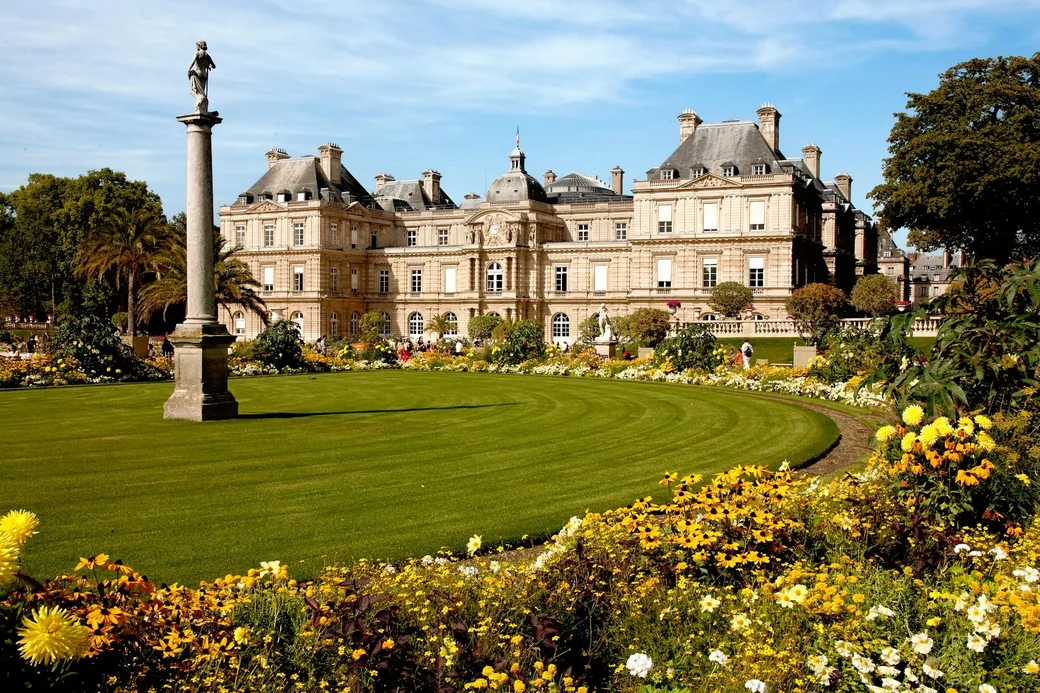
Wander the garden's central terraces and it's impossible to miss the honey-toned palace anchoring the whole composition: the Palais du Luxembourg, the residence Marie de Médicis commissioned alongside her garden. Its story took a dramatic turn after the French Revolution, when the building was declared a National Palace in 1791. Since 1879, under the Third Republic, it has housed the French Senate, the upper house of France's parliament, a role it continues to fulfill today. For garden visitors, the palace mostly serves as a magnificent backdrop, its formal facade visible across the parterres and the Grand Bassin. Because it remains an active seat of government, exploring its interior calls for a separate, dedicated visit rather than something to fold into a casual garden stroll, but simply knowing the history behind that stately building adds real depth to a walk through the grounds.
The Medici Fountain, the Grand Bassin, and the Queens of France
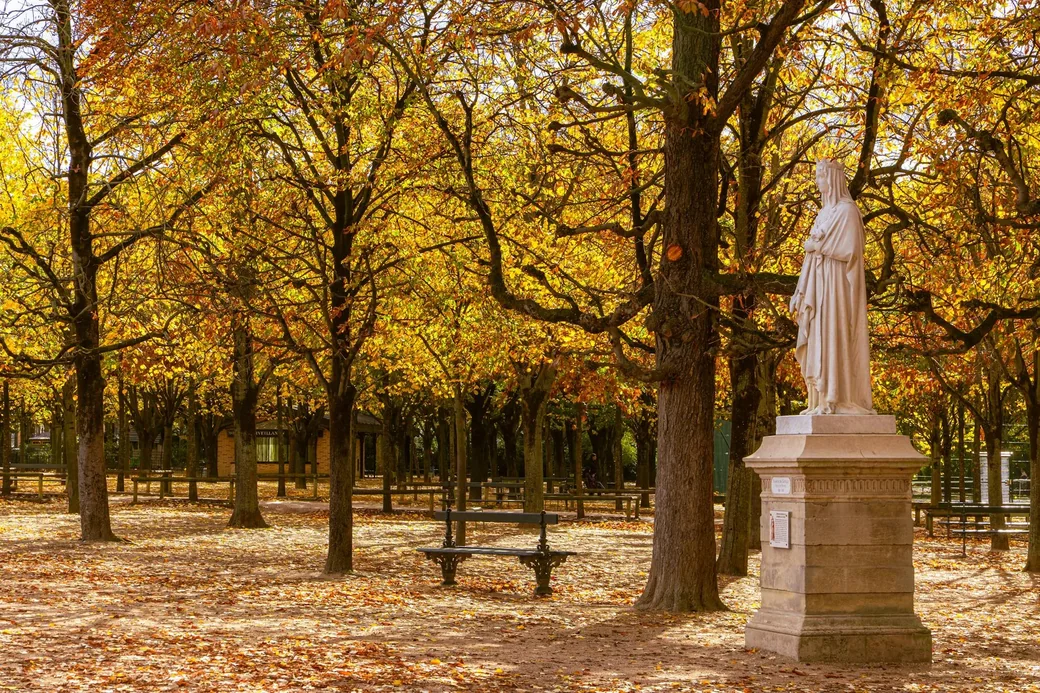
Three features capture the essence of a stroll through the Jardin du Luxembourg. Tucked into a cool, shaded corner near the palace, the Medici Fountain, built around 1630 and moved to its current site in the 1860s, feels almost secretive, its long reflecting pool framed by trees and crowned by a sculptural group from Auguste Ottin. Out in the open, the octagonal Grand Bassin is the garden's social heart, where small wooden sailboats, rented on the spot, drift across the water while children coax them along with long poles. And scattered across more than a hundred statues and monuments throughout the grounds is a particularly memorable series depicting historic Queens of France and other notable women, standing quietly among the trees as if keeping watch over everyone who passes.
A Hidden Orchard and the Luxembourg's Working Beehives
Away from the fountains and statues, a quieter corner of the Jardin du Luxembourg rewards visitors who wander off the main paths: an orchard of apple and pear trees, carefully tended within the grounds, and beside it, a working apiary known as the Rucher du Luxembourg. For generations, these hives have been used to introduce Parisians to the craft of beekeeping, part of the garden's surprisingly practical, almost agricultural side. It is a world away from the manicured parterres near the palace, and most first-time visitors walk right past it without realizing it's there. If you enjoy discovering the layers of a place beyond its headline attractions, take a slower loop through this part of the garden. It is a gentle reminder that behind the grand history and royal statues, the Jardin du Luxembourg has always also been a working, living green space.
When to Go: Quiet Mornings and Golden-Hour Light
Like most of Paris's best-loved green spaces, the Jardin du Luxembourg fills up as the day goes on, especially on sunny weekends when the chairs around the Grand Bassin become hard to find. Arriving soon after opening, particularly on a weekday, is the surest way to enjoy the garden at its most peaceful, with joggers and early risers as your main company and the gravel paths still quiet underfoot. Midday, especially in summer, brings the heaviest footfall, as visitors from the Latin Quarter and beyond pour in for lunch breaks and picnics near the lawns. If your schedule allows a second visit, come back in the late afternoon: the low sun filters beautifully through the chestnut trees, the crowds start to thin, and the whole garden takes on a softer, more golden character that rewards a slow, unhurried walk. On many days, especially in the warmer months, the garden's bandstand adds music to the scene with free open-air concerts.
Through the Seasons: Best Photo Spots Year-Round
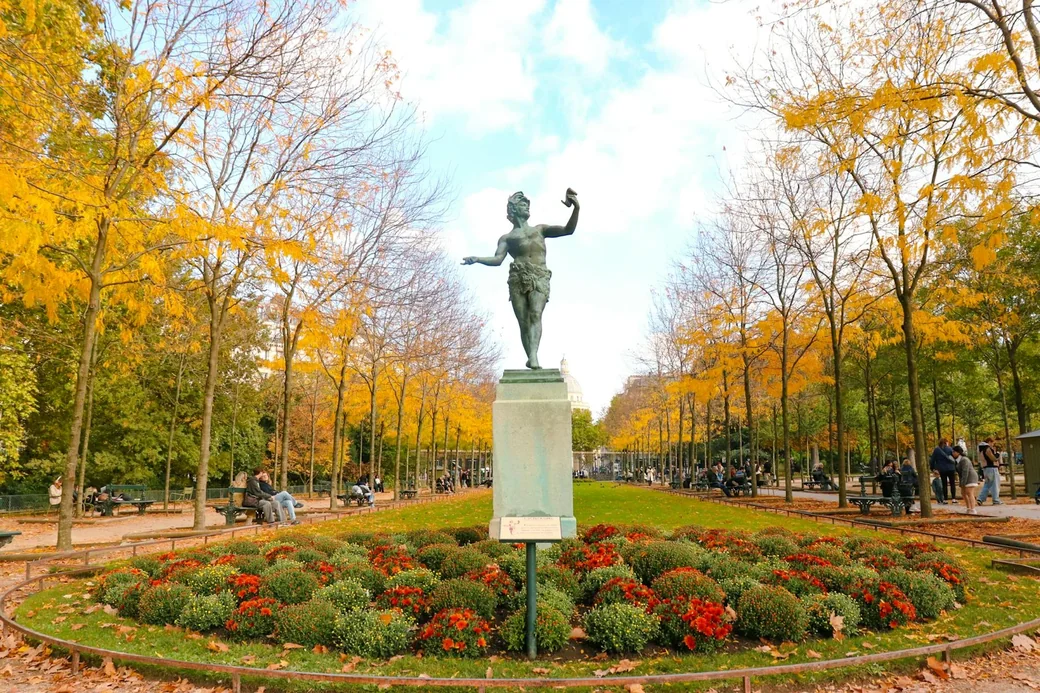
The Jardin du Luxembourg changes character with every season, which is part of why photographers keep returning. Spring brings blossoming trees and freshly planted flowerbeds around the parterres, while summer fills the lawns with green and the Grand Bassin with reflections of a bright sky. Autumn is arguably the most photogenic stretch, as the garden's chestnuts and plane trees turn shades of amber and gold across the gravel paths. Even winter has its charm, with bare branches framing the palace and noticeably thinner crowds. For photos, the view across the Grand Bassin toward the Palais du Luxembourg is the classic composition, while the tree-lined alley near the Medici Fountain offers a quieter, more intimate frame.
Family Fun: Carousel, Puppet Shows, and Toy Sailboats
Few Paris parks keep children as happily occupied as the Jardin du Luxembourg. At the Grand Bassin, kids have been pushing rented wooden sailboats across the water for generations, a simple pleasure that never seems to lose its charm. Nearby, a vintage carousel and a well-equipped playground give younger visitors plenty to climb, spin, and explore, while the marionette theatre puts on traditional puppet shows that delight children with slapstick humor that needs no translation. Because so much of this is spread across a relatively compact area near the western side of the garden, by rue Guynemer, families can easily move between activities without a long walk. Bring a little patience for queues at the sailboat rental, carousel, and playground on busy afternoons, but otherwise this corner of the garden is about as easy and rewarding a stop as family travel in Paris gets.
Garden Etiquette: Lawn Rules, Do's and Don'ts
The single most useful thing to know before settling in for a picnic is that most of the garden's lawns are intended for viewing rather than sitting; only a handful of designated areas allow visitors onto the grass, and each one is clearly marked, so a quick look for signage before spreading out a blanket saves any awkward surprises. Beyond that, the etiquette here is mostly common sense. Keep voices at a reasonable volume near the chess tables and reading chairs, where people often come specifically for quiet. Stay on the gravel paths rather than cutting across flowerbeds, avoid climbing on statues or fountain edges, and take any litter with you if bins are full. Given how many different generations and routines share this space every day, from toddlers at the playground to retirees at the chessboards, a little consideration goes a long way toward keeping the garden pleasant for everyone.
Getting There: The Easiest Routes into the Garden
For visitors arriving in Paris for the first time, the RER B is genuinely one of the more convenient lines in the city, running directly from Charles de Gaulle Airport through the center of Paris to the garden's own Luxembourg station. If you are already exploring the Left Bank, the garden is an easy addition to a walking day: it is roughly a fifteen to twenty minute stroll from Notre-Dame and the heart of the Latin Quarter, and just ten minutes or so from Saint-Germain-des-Prés. Many visitors simply stumble upon one of its many gates while wandering between the Panthéon, the bookshops around Boulevard Saint-Michel, and the cafés of Saint-Germain, which is part of what makes the garden feel less like a single destination and more like a natural pause built into a day of exploring this part of the city.
Accessibility and Mobility in the Garden
The Jardin du Luxembourg is, on the whole, a manageable place to navigate for visitors with limited mobility or those using a wheelchair or stroller. Most of the main paths are flat gravel or paved, wide enough for comfortable passing, and level with the surrounding streets at the main gates. The one caveat worth knowing is that gravel surfaces can become uneven or soften noticeably after rain, which may require a little extra care or assistance in wetter weather. Benches are placed generously throughout the grounds, making it easy to rest during a longer visit, and public restrooms are available near several of the main gates. Service animals are welcome throughout. As with any large public garden, conditions and facilities can change, so if accessibility is central to your plans, it is worth checking current details on the Senate's official website before you go.
A Parisian Ritual: How Locals Really Use the Garden
Beyond its monuments and manicured parterres, the Jardin du Luxembourg is, first and foremost, a working part of daily Parisian life. Every morning, a loop around the garden's perimeter path draws a steady stream of joggers, while small groups practice tai chi or stretch quietly on the grass before the rest of the city gets moving. By mid-morning, students from the nearby Sorbonne and other universities settle into the garden's iconic green metal chairs with books and laptops, and at the stone tables scattered near the main paths, a long-standing community of chess players gathers for matches that can run for hours. Sport has its place here too: the garden's tennis courts have long been a draw for local players. None of this is staged for visitors, which is exactly what makes it worth watching. Spend even fifteen minutes sitting quietly rather than walking straight through, and the garden reveals itself less as a tourist attraction and more as a shared living room for the whole neighborhood.
Nearby Highlights and a Final Word Before You Go
The Jardin du Luxembourg sits within easy reach of several other Left Bank highlights, making it simple to build a fuller day around it. The Panthéon, resting place of many of France's most celebrated figures, is a short walk to the southeast, while the church of Saint-Sulpice, known for its imposing towers and interior artwork, lies just north of the garden toward Saint-Germain-des-Prés. The winding streets of the Latin Quarter, with their bookshops, cinemas, and cafés, spread out just beyond the garden's eastern gates.
Luxembourg Garden: Visitor Tips
Bring coins for the toy sailboat rental at the Grand Bassin if you're visiting with children, and wear comfortable shoes since paths are gravel. Visit on a weekday morning for the quietest experience, and remember that a few lawns allow sitting while most are for viewing only, so look for the posted signs.
Luxembourg Garden: Best Time to Visit
Come early in the morning for a quiet garden and soft light, or return near golden hour for atmospheric photos.
Luxembourg Garden: Admission Fees
Free admission
Free to enter and open to everyone; no ticket is needed.
Free
Quick Info
1h 30m
easy
Luxembourg Garden: Getting There
The Jardin du Luxembourg is exceptionally well connected to the rest of Paris. RER B has its own station, Luxembourg, right beside the garden, making it perhaps the single easiest way to arrive from anywhere along that line, including from Charles de Gaulle Airport. Several métro stations lie within a short walk: Odéon, Mabillon, and Saint-Germain-des-Prés all sit a few minutes from the garden's gates. Numerous bus lines also serve the surrounding streets, including 21, 27, 38, 58, 82, 83, 84, 85, and 89. Driving into this dense, historic part of the Left Bank is rarely worthwhile: streets are narrow, one-way systems are common, and parking is scarce and expensive, so public transport or walking remains by far the most comfortable way to reach the garden.
Nearby stops & parking
The RER B station Luxembourg sits directly at the garden's edge, on Boulevard Saint-Michel. Métro Odéon (lines 4 and 10) and Saint-Germain-des-Prés (line 4) are both roughly 5-8 minutes' walk from the northern gates, while Mabillon (line 10) is a similar distance to the west. Bus lines 21, 27, 38, 58, 82, 83, 84, 85, and 89 stop at various points around the garden's perimeter.
Luxembourg Garden: Dress Code & Etiquette
There is no formal dress code; ordinary, comfortable clothing is fine for a garden stroll. Wear comfortable walking shoes, since most paths are flat gravel that can turn uneven or soft after rain. One quirk worth knowing: many of the garden's lawns are for viewing only, while a few designated areas allow sitting or picnicking on the grass, so look for the posted signs before settling down.