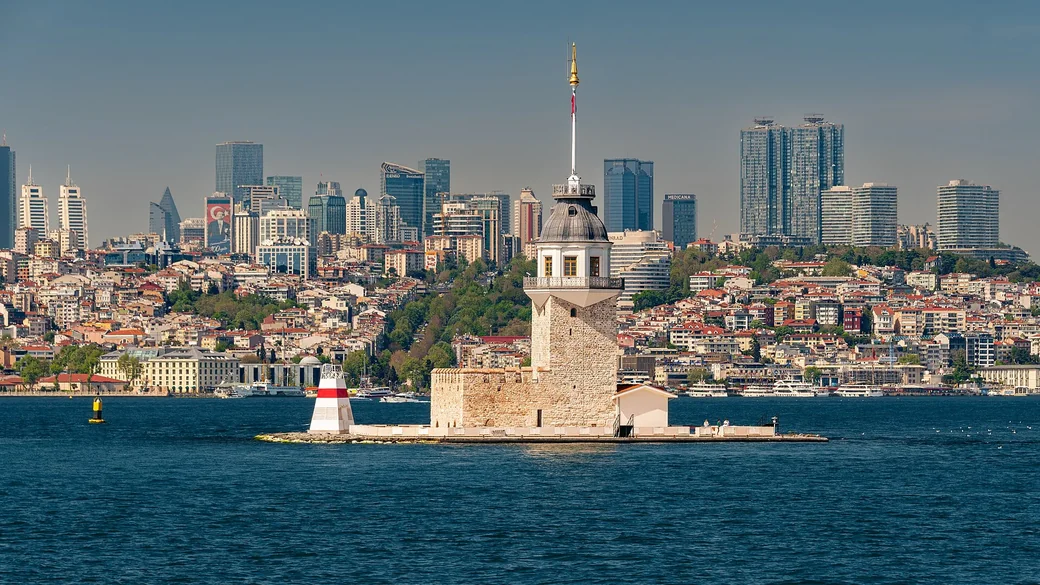
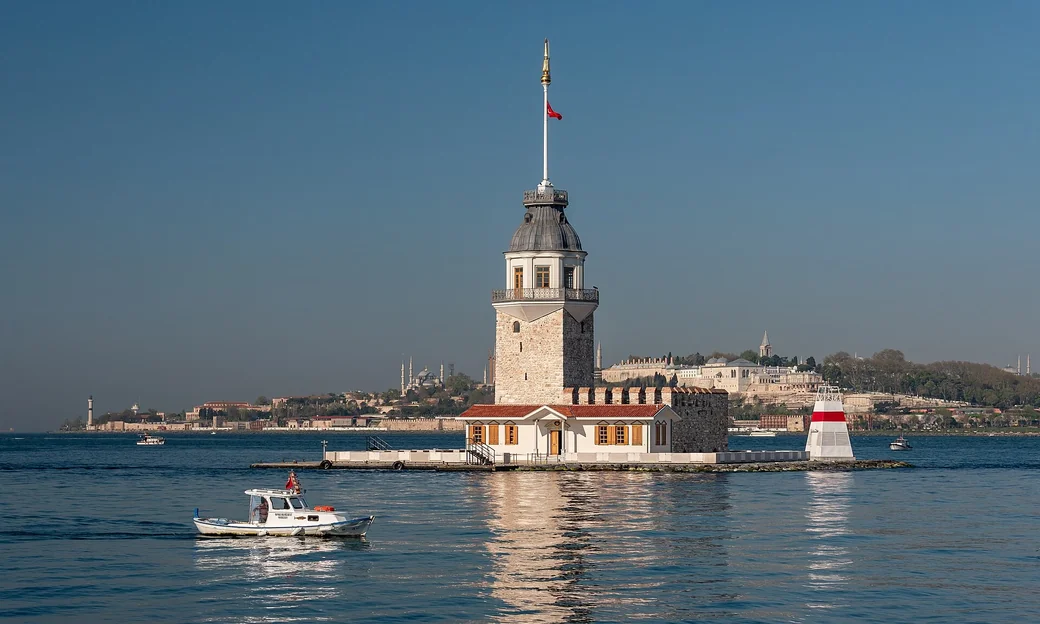
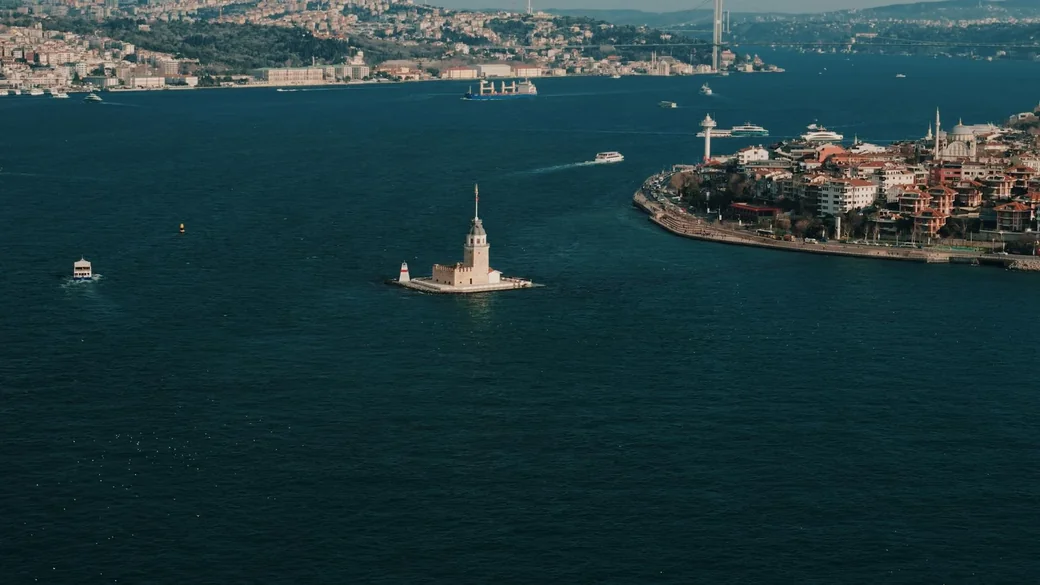
Maiden's Tower (Kız Kulesi) is a small historic tower standing on a rocky islet just off Üsküdar, on the Asian side of Istanbul, at the point where the Bosphorus opens into the Sea of Marmara. Rising alone from the sea, its slender silhouette is one of the best-known images of the city. Today the tower is a monument museum, and its unusual setting in the middle of the water makes a visit feel quite unlike any other sight in Istanbul.
Maiden's Tower: Location, accommodation options and contact
Salacak Mah., Harem Sahil Yolu Cd., Üsküdar, Istanbul (islet 200 m offshore; boats depart from Salacak Pier, Harem Sahil Yolu Cd. No: 26/1)
The place's location on the map and nearby accommodation and hotel options are shown by Stay22. Cookies are used. Your consent is remembered on every page; you can turn it off at any time in the cookie settings.
Maiden's Tower (Kız Kulesi): its strategic position between the Bosphorus, the Marmara and the Golden Horn
The rock that carries the tower lies about 200 metres from the Salacak shore. From here it overlooks the strait to the north, the Marmara to the south and the entrance of the Golden Horn to the west, which is exactly why every power that held the city wanted a post on it and why, for centuries, it was used to watch and control sea traffic. The tower and its exhibition are managed today by the Ministry of Culture and Tourism. You can only get there by boat, which is part of the charm: the short crossing frames the Old City skyline long before you step ashore.
Ancient and Byzantine history of Maiden's Tower: customs post and sea chain
Historians suggest that a customs or toll station may have stood on this rock as early as the fifth century BC. According to some accounts the Athenian general Alcibiades probably set one up around 408 BC, after the naval victory at Cyzicus, to tax ships coming down from the Black Sea. In antiquity the rock was known as Arkla, meaning little castle, and as Damalis. In Byzantine times a tower of the Komnenos era stood here, and an iron chain was stretched from it to a tower at Mangana on the Constantinople side to close the strait and collect dues. A defence wall once linked the islet to the shore, and traces of it can still be made out under the water. During the siege of 1453 the Venetian Gabriele Trevisano commanded the garrison.
Ottoman Maiden's Tower: fortress, mehter band, cannon salutes and lighthouse
After the conquest of 1453, Mehmed II had a fortress rebuilt on the islet and a garrison stayed on duty. The court also gave the tower a ceremonial role: a mehter band (the traditional Ottoman military band) played here every evening and before dawn, and cannons fired to mark an enthronement, a royal birth or circumcision at Topkapı Palace, the fleet's departure in spring and the religious holidays. Evliya Çelebi describes a commander and about one hundred guards. An earthquake in 1509 damaged the older wooden tower, which was rebuilt. In 1719 Sultan Ahmed III ordered a lamp to be kept burning at night, fed with olive oil, to guide ships. The wooden structure later burned, and Grand Vizier Damat (title for a sultan's son-in-law) İbrahim Pasha had a masonry lighthouse built in its place.
A prison, a quarantine hospital and a cyanide store: the later life of the tower
In the eighteenth century the tower sometimes doubled as a prison for statesmen who had fallen from favour. Beşir Ağa, the chief of the harem eunuchs, was jailed here in 1752 before his execution, and in 1755 Grand Vizier Hekimoğlu Ali Pasha was held here before being sent into exile. Most of the present building dates from the reign of Mahmud II in 1832–33, when it served as a quarantine hospital during a cholera epidemic, and patients were isolated here again during the plague of 1836–37. A medallion with Mahmud II's imperial cipher above the entrance records the date. The tower passed to the lighthouse administration in 1857 and to the port authority in 1945. Museum notes also report that cyanide was stored here for a while, and that in 1992 poets used the tower for a time as their own "Poetry Republic".
How the 2021–2023 restoration changed Maiden's Tower
Before the latest works, the tower had been restored in 1995–2000, reinforced with steel bands after the 1999 earthquake and leased to a private operator as a restaurant. In 2020 it passed to the culture ministry, and a new restoration began in 2021 under a scientific board that included Feridun Çılı, Zeynep Ahunbay and the architect Han Tümertekin. The team used documents from the late eighteenth century to bring back the look of Mahmud II's time, removing roof additions, a steel structure in the fortress and heavy reinforced concrete. The enclosed courtyard was opened, a Fatih-era gate came to light, hollow stretches of wall found by ground radar were injected with grout, and piles were driven around the islet as an earthquake precaution. The tower reopened in May 2023 as a monument museum.
The legend of the king's daughter and the snake behind the name Maiden's Tower
According to the best-known legend, a soothsayer foretold that the daughter of a ruler would die of a snakebite on her eighteenth birthday. Some tellings name a Byzantine emperor as her father, others a sultan. To cheat fate, he had her shut away in a tower in the middle of the sea. On her eighteenth birthday he sailed over with a basket of fruit as a gift, in other versions grapes or flowers, and a snake had hidden inside it. It bit the girl, and the prophecy came true. This is a legend, not a documented event, but it is the story most often given for the name Maiden's Tower, "Kız Kulesi" in the local language.
Battal Gazi and the tower: a tale told by Evliya Çelebi
Another story, recorded by the seventeenth-century traveller Evliya Çelebi, says that the folk hero Battal Gazi waited seven years opposite Constantinople because he had fallen in love with the daughter of the lord of Üsküdar. According to the tale, when Battal left to campaign in Damascus, the ruler had a fortress built in the sea and hid his daughter there, calling it "Pirgos Tiskuris", the Maiden's Tower. On his return Battal crossed by boat, stormed the tower and carried off the girl and the treasure. Evliya places the tale in the days of Harun al-Rashid, but historians note that Battal Gazi died around 740, so this belongs to folklore and not to chronology.
Damalis and the Athenian general: the old name of the rock
A third account, again told as legend, explains the ancient name Damalis. According to this story, when the Athenian general Chares settled in Üsküdar his wife Damalis died there, and he had a tomb built for her, either on this rock or on the hill where the Ayazma (holy spring) Mosque now stands. A statue of a cow, since damalis means a young cow, is said to have been set on a column in the fourth century BC, and the headland came to be called Damalis Point. Sources disagree about where the monument actually stood, so treat this as a local tradition that preserves an old place-name rather than as a proven site.
Other stories and Maiden's Tower in popular culture
Several smaller rumours circle the tower. According to one, drinking water reached the island through a channel laid along the seabed from the shore. Another, attributed to Evliya Çelebi, speaks of a holy man who lived in the tower in the days of Sultan Bayezid and sat on the surface of the sea. Neither is documented, and both should be read as folklore. In modern times the tower appeared on the reverse of the 10-lira banknote from 1966 to 1981, and it features in the 1999 James Bond film The World Is Not Enough. It has also become shorthand for Istanbul itself on postcards and travel posters.
What to see inside Maiden's Tower: museum rooms, courtyard and terrace
After landing, you walk into the restored courtyard, now open to the sky, and follow the route into the museum rooms, where displays tell the story of the rock from antiquity to the quarantine years and present the main legends. Look at the crenellated walls and the narrow stone stairs, then climb to the upper levels and the terrace for a 360-degree panorama: the Old City skyline and the entrance of the Golden Horn, the Marmara on one side, the Bosphorus on the other and the domes of Üsküdar behind you. Audio guides are offered in many languages, so ask at the entrance for yours. A small café serves visitors on the islet, and fuller meals are easier to find on the shore.
How to get to Maiden's Tower by boat from Salacak or Karaköy
Boats to the tower leave from two piers. Salacak Pier on the Asian shore offers the more frequent crossings, while Karaköy Pier on the European side has fewer departures with long gaps between them, so check the timetable before you set out. On the Asian side, reach Üsküdar by Marmaray, the M5 metro or a ferry and walk south along the waterfront to Salacak, about fifteen minutes. On the European side, ride the T1 tram to Karaköy and walk to the pier in front of the Ziraat Bank building. Crossings depend on sea conditions, so a stormy day can mean delays or cancellations. Note the time of your return boat when you land, and keep your transfer ticket handy.
Best time to visit Maiden's Tower: seasons, time of day and avoiding crowds
Weekday mornings, soon after opening, are the calmest time on the island, while weekends, public holidays and midday in high season bring queues for the boats. Spring and autumn give clear light and gentler seas, summer brings longer opening hours and warm evenings, and winter is quiet but windy. Late afternoon is the best moment for photographs, when the sun lowers over the Old City. After dark the tower is lit, and a light and laser show has been staged in the evenings, although programmes can change. Allow about two hours for the whole visit, including both crossings, and check the ticket-office closing time before you plan a late trip.
Best photo spots for Maiden's Tower in Istanbul
The classic picture is taken from the Salacak promenade, where the tower sits alone on the water with the Old City skyline behind it, especially soft at sunset. The Üsküdar waterfront gives a wider frame with ferries passing through. From the European side, the Karaköy and Galataport promenades show the tower small and graceful against the Asian shore. For a high panorama of the southern Bosphorus, try Çamlıca Hill. Once on the island, shoot from the terrace toward the Old City at golden hour and use the stone walls and doorways for framing. Keep a lens cloth ready, since sea spray and wind are common.
Accessibility, children and audio guides at Maiden's Tower
Reaching the tower means boarding a boat and then climbing stone steps, so independent wheelchair access is limited; contact the museum before you go to ask about assistance. Visitors under eighteen must come with a parent or guardian, and families should keep children close to the parapets and on the stairs, which can be slippery in wet weather. Audio guides are offered in many languages, including all the languages of this site, and the museum can be reached by email or phone, with contact details listed on this page. Anyone who cannot manage stairs can still enjoy the setting from the Salacak shore, where the view of the tower is open to everyone.
Do's, don'ts, dress and nearby places to combine with Maiden's Tower
Do arrive at the pier a little early, carry a photo ID if you use a museum card, and bring a windbreaker and flat shoes. Don't lean over the parapets, climb on the walls, drop litter or feed the gulls, and keep your voice low in the exhibition rooms. There is no dress code, since this is a museum rather than a place of worship. Combine the visit with Üsküdar: the Mihrimah Sultan and Şemsi Pasha mosques, both by Sinan, the Salacak waterfront, the cultural centre Nevmekan Sahil, Kuzguncuk and Beylerbeyi Palace. Across the water, Galata Tower and the Karaköy quarter make a good second stop.
Maiden's Tower: Visitor Tips
Take an early boat on a weekday, bring a windproof layer for the open terrace, and check the boat timetable before you leave the shore, because crossings follow set departures. Photograph the tower from the Salacak promenade at sunset, then go up for the Old City skyline in the last hour of daylight. Keep to the marked stairs and parapets, and allow around two hours including both boat crossings.
Maiden's Tower: Best Time to Visit
Weekday mornings for fewer crowds; golden hour for the best light; spring and autumn for calm seas and clear skies
Maiden's Tower: Admission Fees
Adult and ages 8–18 – international visitors
Standard rate for international visitors aged 8 and over. Museum Pass Istanbul is accepted. The boat transfer to the islet is paid separately.
€27
Children up to 7 (free)
Free entry for children aged 7 and under; proof of age may be requested.
Free
Quick Info
2h
easy
Maiden's Tower: Getting There
Maiden's Tower can only be reached by boat. Official shuttles leave from two piers: Salacak Pier on the Asian shore (Harem Sahil Yolu Caddesi No: 26/1, Üsküdar) and Karaköy Pier on the European side, in front of the Ziraat Bank building. From Üsküdar, take Marmaray or the M5 metro to Üsküdar station and walk about fifteen minutes south along the waterfront to Salacak, or ride one of the city buses that stop at the Kız Kulesi stop. From the European side, the T1 tram to Karaköy leaves you a short walk from the pier, which is the easiest option if you are staying in Sultanahmet, Beyoğlu or Galata. By car, aim for the Salacak coast road, but parking is limited, so public transport is the better choice. Timetables can change with weather and season, so check the official museum page on the day of your visit.
Nearby stops & parking
Closest public transport: Üsküdar station (Marmaray and M5 metro) and the Üsküdar ferry piers, about fifteen minutes on foot from Salacak; city buses call at the Kız Kulesi stop on the coast road. On the European side, the Karaköy tram stop and the Karaköy and Galataport waterfront are a short walk from the Karaköy boat pier. Taxis can drop you right at Salacak Pier. Street parking along the Salacak shore is scarce and fills quickly at weekends, so avoid driving if you can; the paid car parks in central Üsküdar and Karaköy are the fallback.
Maiden's Tower: Dress Code & Etiquette
Maiden's Tower is a museum, not a place of worship, so there is no formal dress code. Wear flat, non-slip shoes for the boat deck and the old stone stairs, and bring a windproof jacket because the open terrace is exposed even on sunny days. Speak quietly in the exhibition rooms and keep to the marked routes on the walls and parapets.