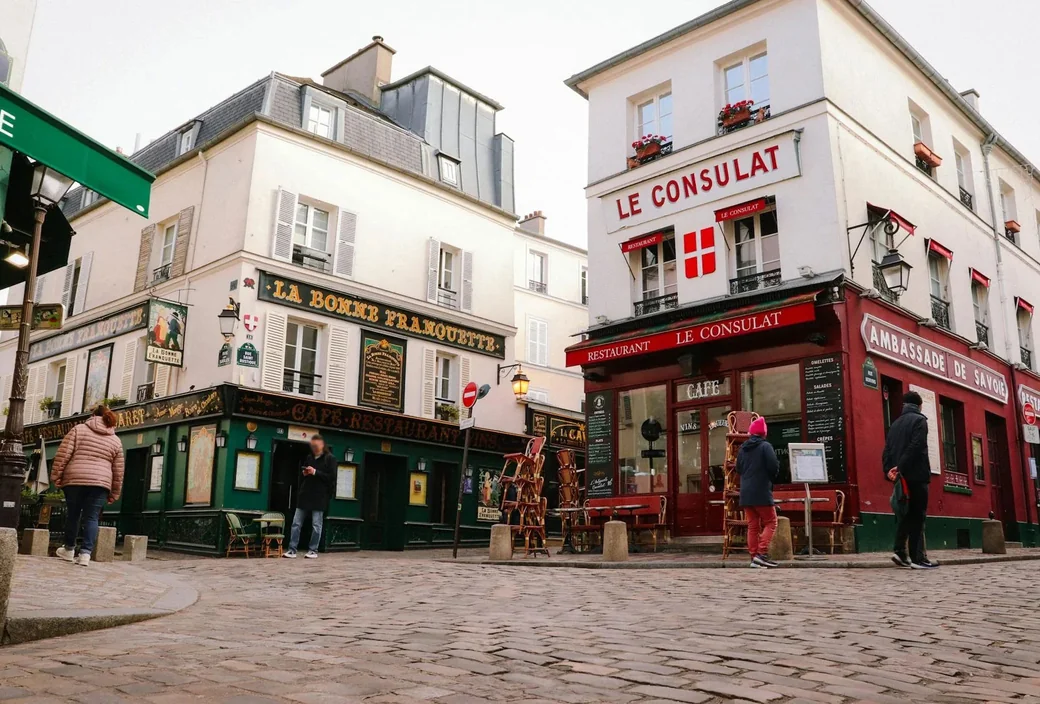
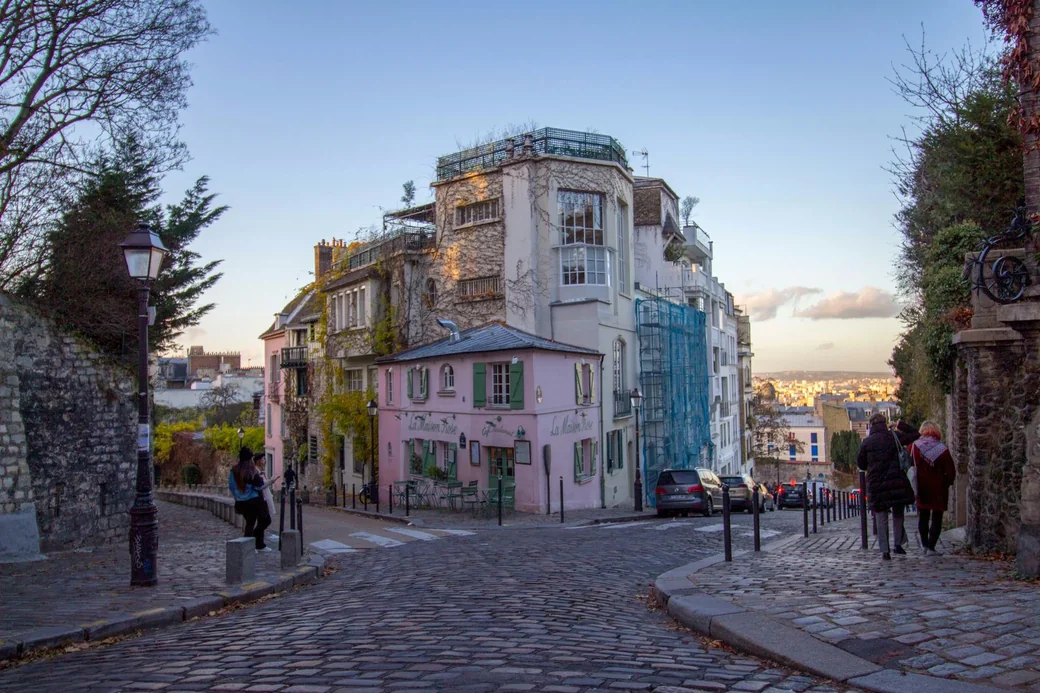
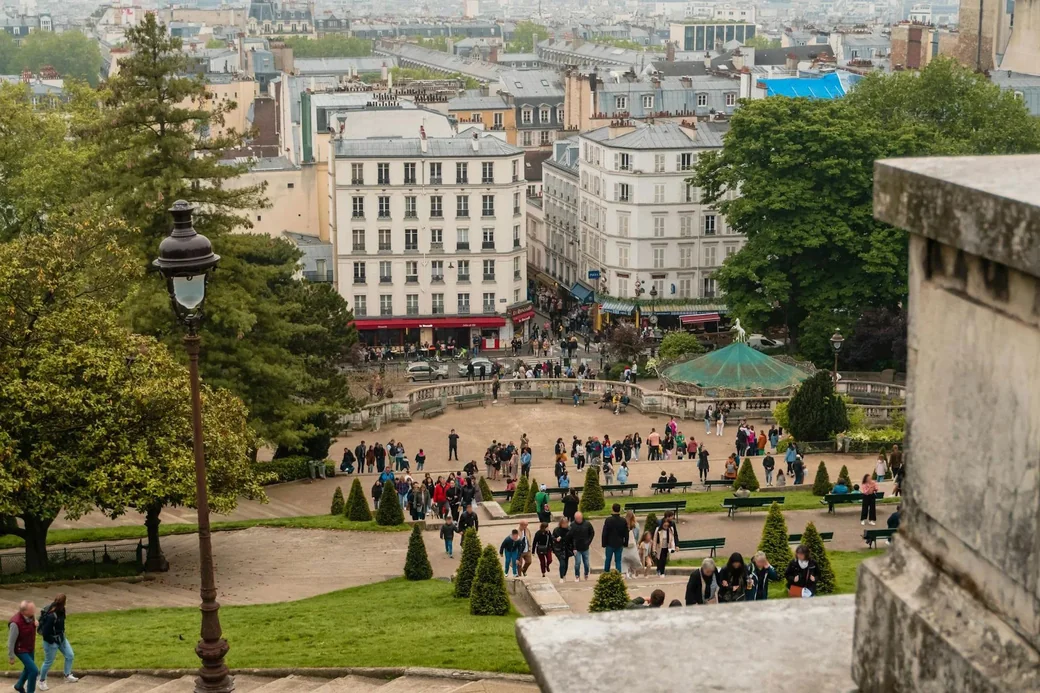
Montmartre is a hilltop neighborhood in the 18th arrondissement (district) in the north of Paris, known to Parisians simply as “la Butte” (the hill). It is one of the city's most atmospheric districts, a tangle of steep cobbled lanes, stairways, small squares and cafés. Its best-known landmark is the Sacré-Cœur Basilica, and its name is inseparable from the history of art in Paris, which makes it one of the city's best-loved places to explore on foot.
Montmartre: Location, accommodation options and contact
Montmartre, 18th arrondissement, 75018 Paris, France
The place's location on the map and nearby accommodation and hotel options are shown by Stay22. Cookies are used. Your consent is remembered on every page; you can turn it off at any time in the cookie settings.
Long before it became part of Paris, Montmartre was an independent village perched on its own hill north of the city, only formally annexed into Paris in 1860. Even today, the steep, winding streets and pockets of greenery hint at that semi-rural past rather than the grid of a planned capital. The hill's modern fame comes from the decades around 1900, when cheap rents and a freewheeling atmosphere drew an extraordinary concentration of artists. Pablo Picasso, Pierre-Auguste Renoir, Henri de Toulouse-Lautrec, Vincent van Gogh, and Maurice Utrillo all worked or lived here during this Belle Époque period, sketching cabarets, dance halls, and each other. The legendary studio building known as Le Bateau-Lavoir sheltered a shifting community of struggling painters and poets between roughly 1904 and 1909; it was within its cramped, ramshackle rooms that Picasso painted Les Demoiselles d'Avignon, a work now regarded as a turning point toward modern art. Decades earlier, in 1871, the same hillside had been at the center of the Paris Commune uprising. Walking Montmartre's lanes today, past plaques and small museums, is a walk through more than a century of Parisian upheaval and creativity.
Sacré-Cœur Basilica: A National Vow in Stone
Crowning the summit of Montmartre, the Sacré-Cœur Basilica is one of the most recognizable silhouettes in Paris, its white travertine domes visible from much of the city. It was conceived as a national vow, a votive church proposed after France's defeat in the 1870-71 Franco-Prussian War, intended as an act of penance and hope for national renewal. Construction broke ground in 1875 on a design by architect Paul Abadie, chosen ahead of 77 rival proposals for his free interpretation of Romano-Byzantine tradition. The basilica was substantially complete by 1914, but the First World War delayed its formal consecration until 1919. Inside, the nave is open to visitors, and its scale and mosaics are worth lingering over regardless of faith. At its highest point, the basilica itself rises to about 83 meters. Climbing to the dome is a different experience altogether: a narrow, separately ticketed staircase leads up past the bells to an open gallery with one of the widest panoramas over Paris.
Place du Tertre and Its Street Artists
Just steps behind the basilica, the Place du Tertre has been Montmartre's artistic heart since the nineteenth century, when painters gathered here to work, trade canvases, and argue about art over cheap wine. That tradition is still visible today: the small, plane-tree-shaded square is crowded with working artists at their easels, offering portraits, caricatures, and quick sketches to passersby, alongside cafés and restaurants that spill onto the cobblestones. It is one of the liveliest, most photographed corners of the neighborhood, and also one of the busiest, so patience is useful at peak hours. If you would like a portrait done, agree on the style and scope before the artist begins, since timing and approach can vary considerably between them. Beyond the professional easels, the surrounding streets host small galleries and studios that keep alive Montmartre's identity as a working artists' quarter rather than only a historical memory. Even if you do not commission anything, it is worth a slow lap of the square simply to watch the artists at work, a living echo of the bohemian scene that once drew Picasso and his contemporaries to these same few blocks.
The Moulin Rouge at the Foot of the Hill
At the foot of the Montmartre hill, where the Butte meets the busier streets of Pigalle along Boulevard de Clichy, the red windmill of the Moulin Rouge has marked the entrance to the neighborhood's nightlife since the cabaret first opened in 1889. It is remembered as the birthplace of the modern can-can, the high-kicking dance that scandalized and delighted audiences in equal measure and later became a symbol of Parisian nightlife around the world. Toulouse-Lautrec, who lived nearby, captured the venue's dancers and performers in some of his most famous posters and paintings, cementing the Moulin Rouge's place in art history as well as entertainment history. The cabaret still operates today, its illuminated windmill sails a familiar backdrop for photographs after dark, especially for visitors making their way between Montmartre's hilltop sights and the Pigalle metro area. Even without attending a show, the exterior and surrounding boulevard are worth a stop on any walk between the Butte and the city below, particularly in the evening when the neon lights up the street.
The Clos Montmartre Vineyard
Tucked between houses on the northern slope of the Butte, the Clos Montmartre is a small working vineyard that feels like an improbable secret in the middle of a major city. It produces only a small batch of wine each year, a curiosity rather than a serious commercial operation, but it is a charming reminder that Montmartre was farmland and vineyards long before it was annexed into Paris in 1860. The grapes are harvested each autumn during the lively Fête des Vendanges (the Montmartre grape-harvest festival), one of the few moments the enclosed vineyard opens up more visibly to neighborhood life. At other times of year, visitors can still glimpse the neat rows of vines through the fence along Rue des Saules, a quiet, almost rural corner just a short walk from the crowds of Place du Tertre. It is not a stop that needs much time, but it is an easy and rewarding detour for anyone curious about the hill's agricultural past, and a nice contrast to the basilica and cabaret history that usually dominate a first visit.
The Funicular and the 222 Steps of Rue Foyatier
Montmartre's steepest challenge is simply getting up it, and the neighborhood offers two classic ways to do so. The most storied route is the Rue Foyatier staircase, a straight run of 222 steps climbing directly toward the basilica, flanked by old-fashioned lamp posts and offering views back over the rooftops as you go, a favorite spot for photographs, if a demanding one for the legs. For a step-free alternative, the Montmartre Funicular runs alongside the staircase, carrying passengers from the base of the hill to just below the basilica's forecourt in a couple of minutes, using the same ticket as the regular metro and bus network. It is an easy, practical choice for anyone visiting with young children, limited mobility, luggage, or simply tired feet after a day of walking. Many visitors climb the steps on the way up when they are fresh and take the funicular back down, or reverse the order depending on energy levels; either way, it is worth building a few minutes of rest into the plan, since the elevation gain is real even by the standards of a hilly city like Paris.
Montmartre Cemetery: A Quiet Resting Place
On the northern edge of the neighborhood, the Cimetière de Montmartre is a quieter, greener side of the Butte, one of the large historic cemeteries that Paris built outside its old city walls in the nineteenth century. Shaded by mature trees and crossed by winding paths, it holds the graves of numerous painters, writers, composers, and performers who once lived in or around Montmartre, making it something of a companion piece to the neighborhood's artistic history above ground. It is a peaceful place to walk, particularly in contrast to the crowds around Sacré-Cœur and Place du Tertre. Many visitors treat it less as a checklist of graves to find and more as a calm, atmospheric detour, a chance to slow down among ivy-covered monuments and old stone chapels before climbing back up toward the hill's busier attractions. Comfortable shoes are useful here too, since the paths are uneven in places.
When to Go to Beat the Crowds
Montmartre's hilltop sights, especially the Sacré-Cœur forecourt and Place du Tertre, are among the busiest in Paris from mid-morning through late afternoon, when tour groups, day-trippers, and street vendors all converge on the same few narrow streets. Arriving early, ideally in the first hours of the morning, gives a very different experience: soft light on the basilica's domes, empty steps for photographs, and a chance to watch the square's artists set up for the day before the crowds arrive. Sunset is the other favorite window, when the low light flatters both the basilica and the view over the rooftops of Paris, though the steps do fill up as more people arrive for the same reason. Weekday visits are generally calmer than weekends, and rainy or overcast days, while less photogenic, often mean noticeably thinner crowds around the main square. Whatever time you choose, remember that the streets here are narrow and often only wide enough for foot traffic, so even a modest crowd can feel more intense than the same number of people would elsewhere in the city.
Where to Get the Best Views and Photos
The single best-known viewpoint in Montmartre is the terrace and staircase directly below the Sacré-Cœur Basilica, in Square Louise-Michel, where tiered steps look out over a wide stretch of Paris rooftops toward the horizon, a classic shot, especially at sunrise or sunset. Part of the reason the views reach so far is height: Montmartre is the highest natural point in Paris, rising to about 130 meters above sea level, with the hill itself standing roughly 100 meters above the Seine. For a different angle, the basilica's dome climb rewards visitors with an even higher, wider panorama, taking in landmarks across the city on a clear day. Away from the main terrace, the quieter streets just west of the basilica, around Rue Saint-Rustique and the lanes near Place du Tertre, offer picturesque cobblestone corners, ivy-draped walls, and small cafés that feel far removed from the crowds a few minutes away. The Clos Montmartre vineyard on Rue des Saules and the windmills tucked among the surrounding streets add a rural, almost village-like backdrop uncommon elsewhere in central Paris. For photographers, early morning light tends to be the softest and least crowded option, while the golden hour before sunset brings warmer tones to the basilica's pale stone.
How to Get to Montmartre
Because Montmartre sits on its own hill, reaching it usually means combining the metro with a short walk or the funicular rather than arriving at a single, obvious station. From central Paris, metro lines 2, 4, 12, and 13 all pass close to the base of the Butte, with Anvers (line 2) and Abbesses (line 12) the two most commonly used stops for visitors heading up to the basilica. From Anvers, it is a walk of a few minutes to the bottom of the Rue Foyatier steps and the lower funicular station; from Abbesses, the walk is shorter but still involves some uphill stretches, since the station itself sits partway up the hill. City bus line 40 is worth knowing about too, since its route runs up onto the hilltop itself rather than stopping at the base, making it a useful option for visitors who would rather skip the climb altogether; several other bus routes also serve the wider neighborhood. Taxis and ride-shares can drop passengers near the top, though the narrowest streets around Place du Tertre are pedestrian-only.
A Suggested Walking Route Up the Butte
A satisfying way to see Montmartre is to start at the bottom and let the hill do the storytelling as you climb. Begin near Anvers metro station and walk up to the base of the Rue Foyatier steps, pausing to look back over the rooftops as you climb toward the basilica, or take the funicular if you would rather save your energy. At the top, spend time on the terrace of Square Louise-Michel before continuing behind the basilica to Place du Tertre, where street artists work the square and small streets fan out in every direction. From there, wander northwest along quieter lanes toward the Clos Montmartre vineyard on Rue des Saules and the nearby windmills, before looping past the Montmartre Cemetery if time and energy allow. Finish by heading back downhill toward Boulevard de Clichy and Pigalle, where the Moulin Rouge marks the transition back into the busier streets of central Paris. The whole loop can be done in a couple of unhurried hours, longer with café stops, gallery browsing, or a portrait sitting in the main square.
Accessibility and Mobility on the Hill
Montmartre is a genuinely hilly neighborhood, and that is worth planning around rather than ignoring. Many of its most photogenic streets are cobblestoned, narrow, and sloped, and the direct route to the basilica involves either the 222 steps of Rue Foyatier or an equivalent climb on nearby streets. The Montmartre Funicular is the most useful accessibility tool on the hill: it runs on the same ticket as the metro and covers the steepest stretch in about ninety seconds, making it a practical option for visitors using wheelchairs or mobility aids, families with strollers, or anyone who simply prefers not to climb. That said, the funicular addresses only one section of the neighborhood; the surrounding streets, including much of Place du Tertre and the lanes around it, remain uneven and sloped, with few dedicated accessible restrooms. Sacré-Cœur's nave itself is reasonably level once inside, though the approach and forecourt involve stairs. Visitors with mobility concerns are generally better served planning a shorter, more targeted route around the basilica and square rather than attempting the full loop of the hill on foot.
Montmartre Do's and Don'ts
A few simple habits go a long way toward a smooth visit. Do take time to watch the street artists at Place du Tertre work, and if you would like a portrait, agree on the approach and scope before they start rather than after. Do keep bags zipped and phones out of back pockets, particularly on the crowded steps below the basilica and around the square, since this stretch of Montmartre is a well-known spot for pickpockets and for scams involving strangers offering free friendship bracelets or petitions to sign, both of which are typically a setup to pressure you for money; a polite but firm no and continuing to walk is usually enough. Do not block the narrow streets and staircases for long photo sessions, since many of these lanes are barely wide enough for two people to pass. And do not expect the same pace as a shopping street elsewhere in Paris; Montmartre's charm is largely about wandering slowly, so building in unhurried time, rather than treating it as a quick checklist stop, tends to make for a much better visit.
What's Nearby: Pigalle and Beyond
Montmartre sits within easy walking distance of several other well-known corners of Paris, making it easy to combine with a wider day out. At the foot of the hill, the Pigalle district blends into the neighborhood's nightlife streets, anchored by the Moulin Rouge and a mix of cabarets, bars, and shops along Boulevard de Clichy. The Sacré-Cœur Basilica itself, at the summit, is generally treated as Montmartre's central landmark rather than a separate destination, though it is substantial enough to merit its own unhurried visit. To the east, the streets toward Château Rouge and the Goutte d'Or reveal a more everyday, multicultural side of the 18th arrondissement, a useful contrast to the tourist-oriented lanes higher up the hill. Travelers with more time can continue north from Montmartre toward quieter residential streets that see far fewer visitors, or head back down toward central Paris via the metro lines that converge at the base of the Butte. However you combine it, Montmartre works well as either the highlight of a half-day itinerary or a scenic add-on to a visit focused on Pigalle or the wider 18th arrondissement.
Montmartre: Visitor Tips
Wear comfortable, sturdy shoes, Montmartre's streets are steep, cobbled, and full of stairs. Take the funicular if you would rather save your legs for wandering the lanes at the top, and keep a hand on your bag around Place du Tertre and the basilica steps, where pickpockets and street scams are a known issue.
Montmartre: Best Time to Visit
Early morning or around sunset, for soft light on the basilica's domes and thinner crowds; the busiest hours run from mid-morning to late afternoon.
Montmartre: Admission Fees
Free admission
Free to enter and open to everyone; no ticket is needed.
Free
Quick Info
3h
moderate
Montmartre: Getting There
Montmartre sits on its own hill, so getting there usually means combining the metro with some walking or a short funicular ride. Metro lines 2, 4, 12, and 13 all serve stations around the base of the Butte, with the exact station depending on which side of the hill you are approaching from; Anvers and Abbesses on the south and west sides are the most popular starting points. Bus line 40 (along with several other routes serving the wider area) runs over the top of the hill, and from the foot of the hill near Anvers the Montmartre Funicular carries passengers the rest of the way to near the basilica on the regular Paris public-transport ticket. Because the hill is genuinely steep, comfortable shoes make a real difference, and travelers with limited mobility will find the funicular far easier than the Rue Foyatier's 222 steps.
Nearby stops & parking
The most convenient metro stops are Abbesses (line 12), tucked partway up the hill on its western side, and Anvers (line 2), at the foot of the Butte near the funicular's lower station. Blanche (line 2) and Pigalle (lines 2 and 12) serve the Moulin Rouge and nightlife end of the neighborhood, while Château Rouge, Jules Joffrin (line 12), and Lamarck-Caulaincourt (line 12) offer quieter approaches from the north. The Montmartre Funicular's two stations bookend the steepest stretch of the climb, near Rue Foyatier at the bottom and just below the basilica's forecourt at the top.
Montmartre: Dress Code & Etiquette
There is no dress code for wandering Montmartre itself, but comfortable, sturdy shoes are strongly recommended given the steep streets, staircases, and uneven cobblestones. Because Sacré-Cœur is an active church rather than a museum, modest dress, covered shoulders and knees, is customary when stepping inside the basilica, and hats are typically removed.