Notre-Dame de Paris is the Catholic cathedral of Paris and the seat of its archbishop, standing on the Île de la Cité, the island in the Seine where the city was born. Built in the Middle Ages, it is one of the best-known Gothic churches in the world and has long been regarded as a symbol of both Paris and France. Still a living place of worship, it is also one of the city's best-loved sights, a place where faith, history and architecture meet.
Notre-Dame Cathedral: Location, accommodation options and contact
6 Parvis Notre-Dame - Place Jean-Paul II, 75004 Paris, France
The place's location on the map and nearby accommodation and hotel options are shown by Stay22. Cookies are used. Your consent is remembered on every page; you can turn it off at any time in the cookie settings.
Welcome to Notre-Dame Cathedral: A Gothic Icon Reborn
Few buildings anywhere carry the symbolic weight of Notre-Dame. For more than 850 years it has stood at the center of French life, witnessing royal ceremonies, national celebrations and centuries of everyday prayer, and before 2019 it welcomed around 12 million visitors a year, making it one of the most visited and most photographed monuments on earth. Its return after the fire has added a new chapter to that story: many visitors today are struck by the cleaned, pale stone and the bright light of the restored interior. Celebrated worldwide as a symbol of resilience and French craftsmanship, this rebirth is well worth experiencing in person, whatever brings you here.
Rose Windows and Flying Buttresses: The Architecture of Notre-Dame
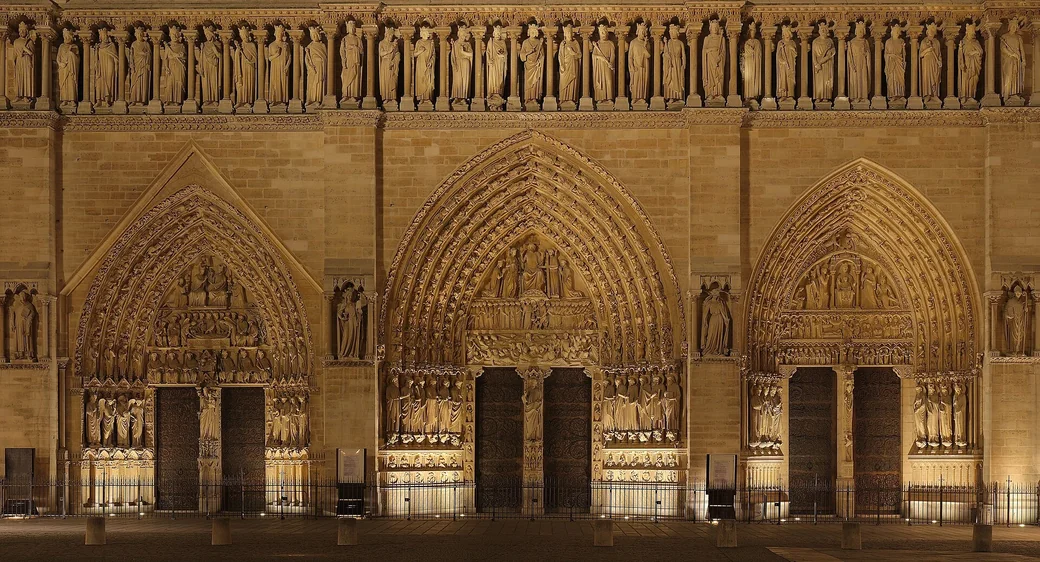
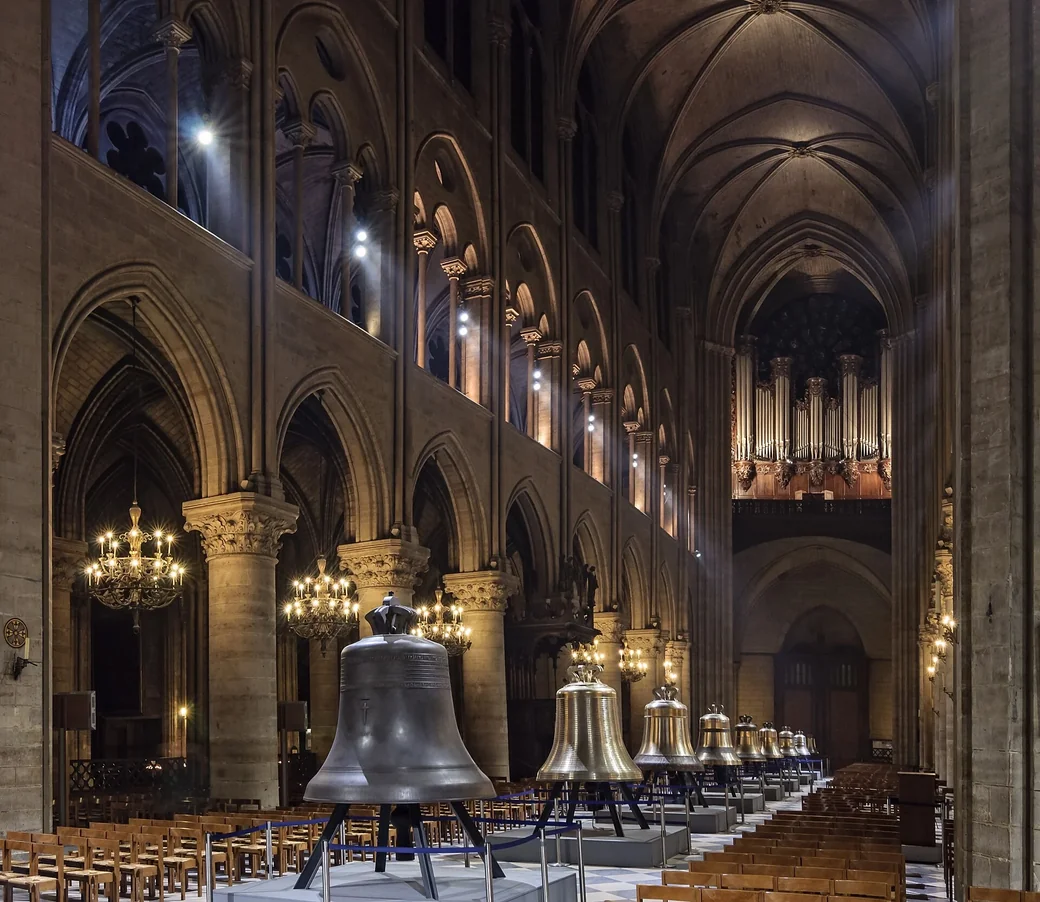
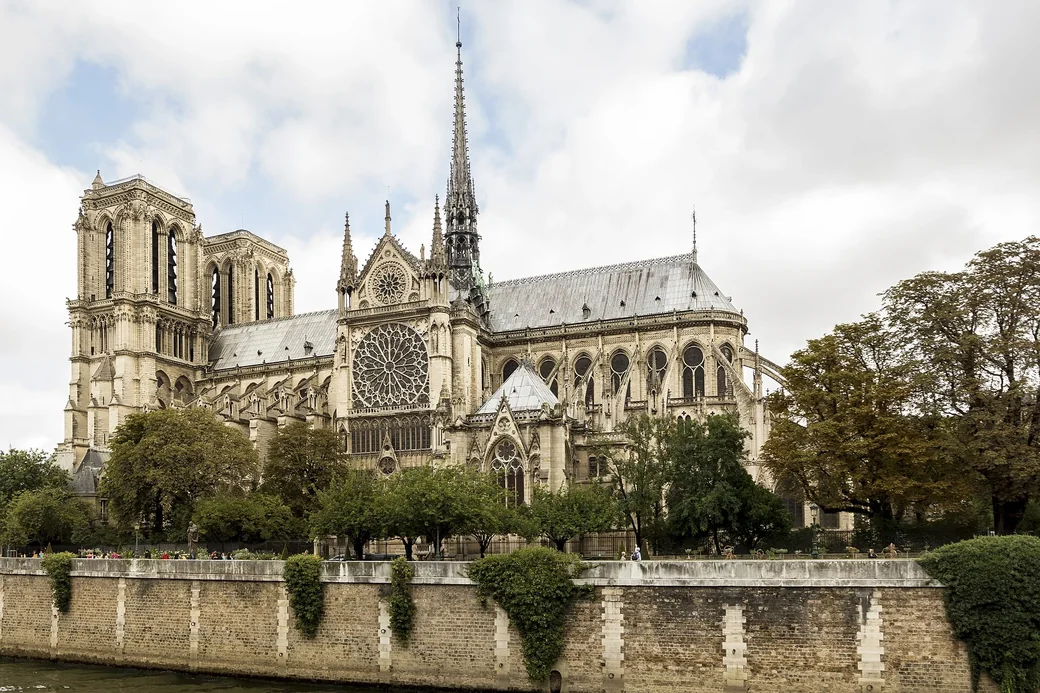
Notre-Dame is considered one of the defining achievements of French Gothic architecture, and its structure is as remarkable as its history. The building's flying buttresses, among the first used at this scale, allowed the walls to rise higher and thinner than ever before, opening space for enormous stained-glass windows. Three rose windows, on the west, north and south facades, remain the cathedral's most breathtaking feature, their intricate tracery filling the nave with colored light on a sunny day. Twin towers frame the western entrance, while the slender central spire, rebuilt after the 2019 fire using traditional techniques, once again rises above the Paris skyline. Elaborate sculpture across the facades was originally designed to teach biblical stories to a largely illiterate population. Inside, ribbed vaults channel the weight of the stone ceiling down onto slender piers, giving the nave its sense of soaring height.
From 1163 to Today: The History of Notre-Dame Cathedral
Construction of Notre-Dame began in 1163 and continued for close to two centuries, finishing around 1345. Over the following centuries the cathedral witnessed extraordinary moments in French history, including Napoleon Bonaparte's coronation as emperor in 1804. By the early 19th century the building had fallen into disrepair, and it was Victor Hugo's 1831 novel that drew public attention back to its plight, helping spark a major restoration led by architect Eugène Viollet-le-Duc. Notre-Dame later hosted a service of thanksgiving in 1944 to mark the Liberation of Paris. Then, on 15 April 2019, fire destroyed the roof and spire, though the structure and rose windows largely survived, and a painstaking international restoration brought the cathedral back to public life in December 2024. Since 1991, the cathedral has also been part of the UNESCO World Heritage Site "Paris, Banks of the Seine", which covers the riverbanks between the Pont de Sully and the Pont d'Iéna together with the Île de la Cité and the Île Saint-Louis.
Visiting the Nave and Attending Mass
The main nave of Notre-Dame is the heart of the visit and welcomes everyone, believers or not. Daily Mass and other services take place throughout the week; worshippers attending a service use a separate entrance and are asked to arrive a little early. The Crown of Thorns is presented for veneration on set days, including the first Friday of each month, and the cathedral publishes the current schedule on its official website. A timed reservation can be made online a few days ahead to shorten the wait; without one you can still join the walk-in line, which moves fastest early in the morning and in the quieter winter months.
Climbing the Bell Towers of Notre-Dame
A visit to the Bell Towers is separate from the nave visit and requires its own timed ticket, which must be booked online in advance. The towers reopened on 20 September 2025 with a new route: it begins at the foot of the south tower, climbs a 178-step double-helix staircase in solid oak through the belfry, passes close to the great Emmanuel bell and the famous gargoyles and chimeras, and crosses a walkway to the north tower, with sweeping views over the rooftops of Paris along the way. In total the climb covers 424 steps on narrow spiral stairs, so it suits visitors who are comfortable with stairs.
The Treasury and the Crown of Thorns
The Treasury of Notre-Dame, visited with a separate ticket, holds centuries of liturgical silverwork, reliquaries and embroidered vestments still used for major celebrations. The cathedral's most venerated relic, the Crown of Thorns brought to Paris by Saint Louis in 1239, rests in a new reliquary designed by Sylvain Dubuisson in the axial chapel at the eastern end of the cathedral, where it was installed when Notre-Dame reopened in December 2024. It is presented for veneration on set days, including the first Friday of each month, alongside a fragment of the True Cross and a Holy Nail. Allow around 30 to 45 minutes to see the Treasury at a relaxed pace.
How Long to Spend at Notre-Dame Cathedral
A visit to the nave alone can be done in as little as 30 to 45 minutes, enough time to take in the rose windows, the altar and the general atmosphere of the space. Adding the Treasury brings a typical visit closer to an hour and a quarter, while climbing the Bell Towers adds significantly more, often an hour and a half or more once queuing and the climb itself are factored in. Because the towers and the Treasury are separate, ticketed experiences, it's worth deciding in advance which combination suits your schedule rather than trying to fit everything into a single rushed visit.
Accessibility at Notre-Dame Cathedral
The main nave of Notre-Dame is on a single level and is generally accessible to visitors using wheelchairs, with a dedicated access point typically available instead of the general queue, so it's worth asking on arrival or checking ahead for current arrangements. The Bell Towers, by contrast, are not wheelchair accessible at all, since the 424-step climb has no lift or ramp of any kind and involves narrow spiral stairs unsuitable for mobility aids. Service and guide animals are welcome throughout the cathedral, as is standard practice at major heritage and religious sites.
Language Support and Visitor Information at Notre-Dame
Visitor information at Notre-Dame is reliably available in French and English, both on-site through information panels and via the cathedral's official website. A companion smartphone app also offers additional background for those who want more context on the building's history and architecture as they walk through it. While materials in other languages may be available depending on the season and any temporary exhibitions, French and English are the two you can count on finding consistently. Staff and volunteers on-site can usually help with basic questions in several languages, particularly during busier tourist periods, even where printed materials are more limited.
Address and How to Find Notre-Dame Cathedral
Notre-Dame Cathedral stands at 6 Parvis Notre-Dame - Place Jean-Paul II, on the Île de la Cité in the heart of Paris. Its island setting means the cathedral is visible from several directions along the Seine, and it's easy to find simply by searching for it on Google Maps or any navigation app, which will route you to the square directly in front of its western facade. Because the island sits between the Right and Left Banks, Notre-Dame makes a natural stop on a longer riverside walk, whether you're coming from the Louvre to the north or the Latin Quarter to the south.
Getting to Notre-Dame by Metro, RER and Bus
Public transport makes Notre-Dame easy to reach from anywhere in Paris. The metro station Cité, on Line 4, sits directly on the island, just a short walk from the cathedral, while Saint-Michel, also on Line 4, and Hôtel de Ville, on Lines 1 and 11, are only a few minutes further on foot. If you're coming from the airport or the suburbs, the RER stop Saint-Michel-Notre-Dame, served by both RER B and RER C, is usually the most convenient option. Several bus routes, including lines 21, 38, 47, 85 and 96, also stop within easy walking distance of the cathedral's square.
Parking and the Closest Stops Near Notre-Dame
If you're driving, there's an underground public car park right on the Île de la Cité, close to the cathedral itself, with further options in the Maubert and Lagrange area on the nearby Left Bank. Traffic and street parking on the island are limited, so most visitors find it far easier to arrive by public transport or on foot. For those using the metro or RER, Cité on Line 4 sits directly on the island, Saint-Michel-Notre-Dame on the RER B and C is just across the river, and several bus lines stop within a short walk of the square in front of the cathedral.
Dress Code, Security and Etiquette at Notre-Dame
Because Notre-Dame remains an active place of worship, its dress code is genuinely enforced, not just a suggestion: shoulders and knees must be covered, sleeveless tops and short shorts or skirts aren't permitted, and footwear is required at all times. Hats and caps are customarily removed inside, while religious head coverings are fine. All visitors pass through airport-style security screening at the entrance, and large bags, glass bottles, knives and scissors aren't allowed inside. Photography is welcome throughout the nave, but flash, tripods and selfie sticks are not, and quiet, respectful behavior is expected at all times, especially near the altar or during a service.
Nearby Attractions and Planning a Smooth Visit
Notre-Dame's island setting puts several major sights within easy reach. Sainte-Chapelle, just a short walk away, holds some of the most spectacular stained glass in Paris, while La Conciergerie, the former royal palace and prison, sits nearby too. Across the river, the Latin Quarter offers the Sorbonne, countless bookshops and cafés, including the famous Shakespeare and Company, while Île Saint-Louis next door is known for its charming streets and Berthillon ice cream. The Musée de Cluny and the Panthéon are both a short walk further into the Left Bank. To make the most of your visit, book the Bell Towers ticket well in advance if you want to climb them, and consider combining Notre-Dame with Sainte-Chapelle on the same day.
Notre-Dame Cathedral: Visitor Tips
Come as early in the day as you can, especially on weekdays, to enjoy the nave before tour groups and school trips arrive. If you'd rather skip any wait at the door, book the timed-entry reservation online a few days ahead, though the queue-in line usually moves fast even without one. Once inside, look up: the three rose windows and the soaring stone vault reward a slow, quiet look more than a quick walk-through. The Crown of Thorns relic is presented for veneration on set days, including the first Friday of each month, so check the cathedral's official website for the current schedule before you plan around it. Photography is welcome, but leave the flash, tripod and selfie stick behind, and keep your voice low throughout.
Notre-Dame Cathedral: Best Time to Visit
Early on a weekday morning, right when the nave opens.
Notre-Dame Cathedral: Admission Fees
Cathedral – free admission
Entering the cathedral nave is free for everyone; a free time-slot reservation is optional and shortens waiting.
Free
Bell towers – adult
Climb of 424 steps to the gargoyles and a panoramic view of Paris; online booking is mandatory.
€16
Bell towers – under 18 (free)
Free for visitors under 18; online booking is still required.
Free
Treasury
Sacred objects and relics, including the Crown of Thorns; tickets are sold on site only.
€12
Treasury – Reduced rate
Reduced rate for visitors under 18, students and job seekers, with proof; free for children under 5.
€6
Bell towers – Ages 18–25 from the EEA (free)
Free for nationals or residents of an EEA country aged 18 to 25. ID (and proof of residence where relevant) is required.
Free
Bell towers – First Sunday of the month (free)
Free for everyone on the first Sunday of the month, from November to March.
Free
Quick Info
1h
easy
Notre-Dame Cathedral: Getting There
Notre-Dame sits right on the Île de la Cité, making it an easy walk from almost anywhere in central Paris. By metro, Cité on Line 4 puts you directly on the island, while Saint-Michel, also on Line 4, and Hôtel de Ville on Lines 1 and 11 are only a few minutes further on foot. The RER stop Saint-Michel-Notre-Dame, served by both RER B and RER C, is especially convenient if you're arriving from the airport or a Paris suburb. Several bus lines also stop within a short walk of the cathedral's square.
Nearby stops & parking
The RER B and RER C both stop at Saint-Michel-Notre-Dame, just across the river from the cathedral. On the metro, Cité on Line 4 is the closest station, right on the island itself, with Hôtel de Ville (Lines 1 and 11) and Châtelet (Lines 7, 11 and 14) a short walk further away. Bus lines including 21, 38, 47, 85 and 96 all stop nearby. Drivers will find an underground car park on the Île de la Cité itself, with further options in the Maubert and Lagrange area on the Left Bank.
Notre-Dame Cathedral: Dress Code & Etiquette
As an active cathedral, Notre-Dame enforces a real dress code at the entrance: shoulders and knees must be covered, and sleeveless tops or short shorts and skirts aren't permitted. Footwear is required at all times. Hats and caps are customarily removed inside, while religious head coverings are fine. Expect airport-style security screening at the door, and keep both your outfit and your voice appropriately modest, especially near the altar or during a service.