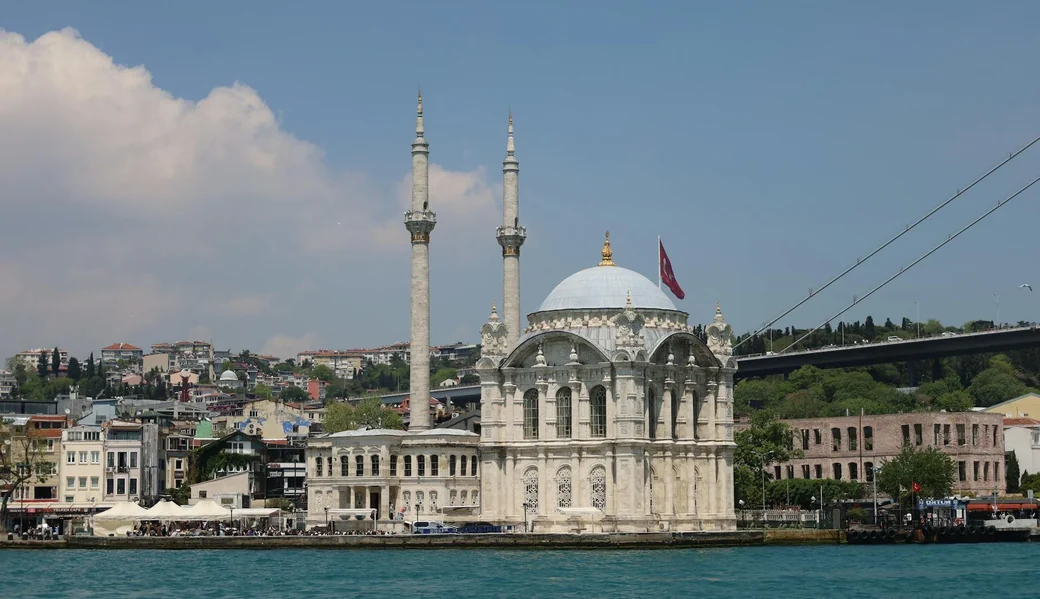
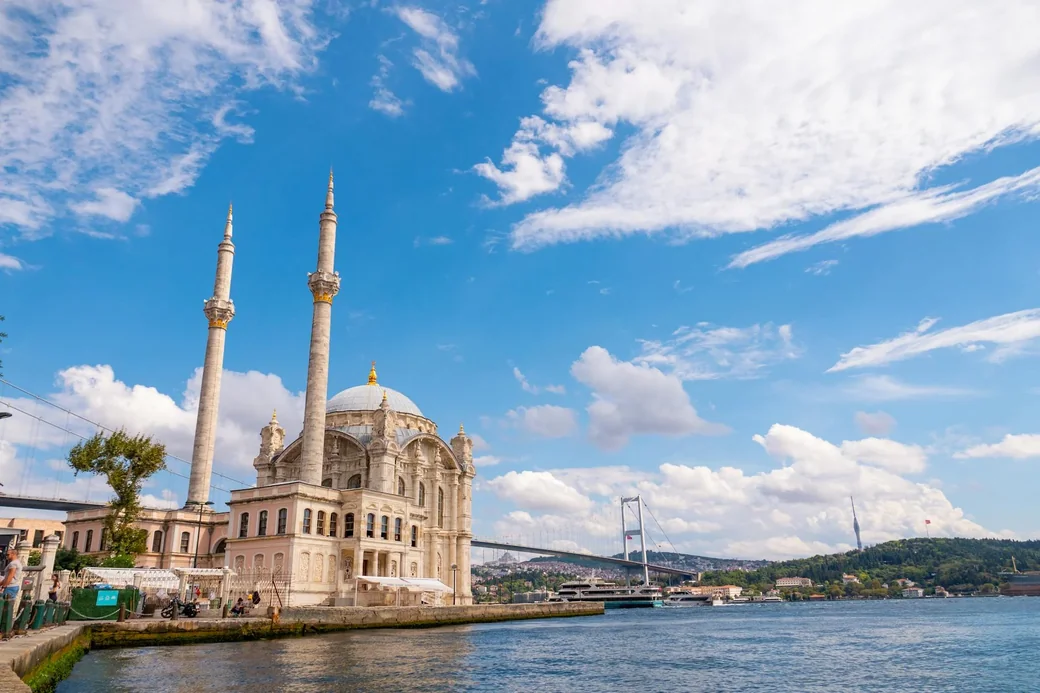
Ortaköy Mosque, officially the Büyük Mecidiye Mosque (Büyük Mecidiye Camii), is an Ottoman imperial mosque at the water's edge in Ortaköy, a neighbourhood of Besiktas on the European shore of the Bosphorus. Set right on the shoreline, it is one of the city's best-loved sights. The pier square in front of it, with its cafés, street food and open views across the strait, makes the area a favourite place for a seaside stroll.
Ortaköy Mosque and Square: Location, accommodation options and contact
Mecidiye Neighbourhood, Mecidiye Köprüsü Street No:1, 34347 Besiktas, Istanbul
The place's location on the map and nearby accommodation and hotel options are shown by Stay22. Cookies are used. Your consent is remembered on every page; you can turn it off at any time in the cookie settings.
Ortaköy Mosque and Square: The Bosphorus' Most Photographed View
The mosque rises at the northern end of the pier square, right beside the water. Behind it stretch the steel cables of the bridge that links two continents, and the meeting of delicate stone with that huge span has become one of Istanbul's most photographed postcard views. The mosque is small compared with the great imperial mosques, yet its setting and decoration leave a far bigger impression. It also appears in films such as Fatih Akin's Im Juli. You can see the mosque in half an hour to an hour and add one or two hours for the square and the waterfront. Entry is free.
Ortaköy Mosque History: From a Small Prayer Hall in 1721 to the Friday Procession of 1854
A small prayer hall built in 1721 by Mahmud Agha, son-in-law of Grand Vizier Ibrahim Pasha, once stood on this spot; it was later renewed as the Mehmed Kethüda Mosque and eventually burned. When the government moved from Topkapi Palace (Topkapı Sarayı) to Çiragan Palace (Çırağan Sarayı), the sultan needed a new mosque on the Bosphorus for the Friday procession. The decision was taken in 1848, work began in early 1849, the building was finished on 26 December 1854, and three days later, on Friday 29 December 1854, it opened with a procession attended by Sultan Abdülmecid. The inscription over the entrance also gives 1854. Sultan Abdülaziz is said to have come here for Friday prayers too. According to some sources, this first prayer hall was damaged in the Patrona Halil uprising of 1731.
Who Built Ortaköy Mosque? The Architect Debate, Twin Minarets and Pile Foundations
Two accounts exist of who designed the mosque. Common sources credit the Balyan family, usually Nigogos Balyan, but a study of the 1848 survey registers in the Ottoman Archive concludes from the seals that the design belongs to Seyyid Abdülhalim Efendi, head of the building office, with the foremen Artin and Istefan running the work. The first plan had one minaret; when Sultan Abdülmecid asked for two, like the Beylerbeyi Mosque across the water, the estimated cost nearly doubled. The ground was reclaimed land at the mouth of the Ortaköy stream: the stream was diverted and 2,501 piles were driven into the foundations. The same documents show the east wing of the lodge was built as a school.
Ortaköy Mosque Architecture: Baroque and Empire Stonework and Slender Minarets
The exterior is one of the finest examples of the eclectic style of 19th-century Istanbul: baroque and rococo curves blend with empire and neoclassical details. Carved and relief stonework, surfaces that swell and recede, and half-embedded false columns are the mosque's signature. The building stands about two metres above the quay it rests on. The two-storey imperial lodge in front of the entrance, laid out in a U shape, is kept plain, and the two slender minarets rise from inside it. Look for the volute brackets under the balconies and the gilded acanthus leaves. The minarets were fluted when first built and became plain-shafted after the 1909 repair.
Inside Ortaköy Mosque: Painted Domes, Marble Mihrab and Light off the Water
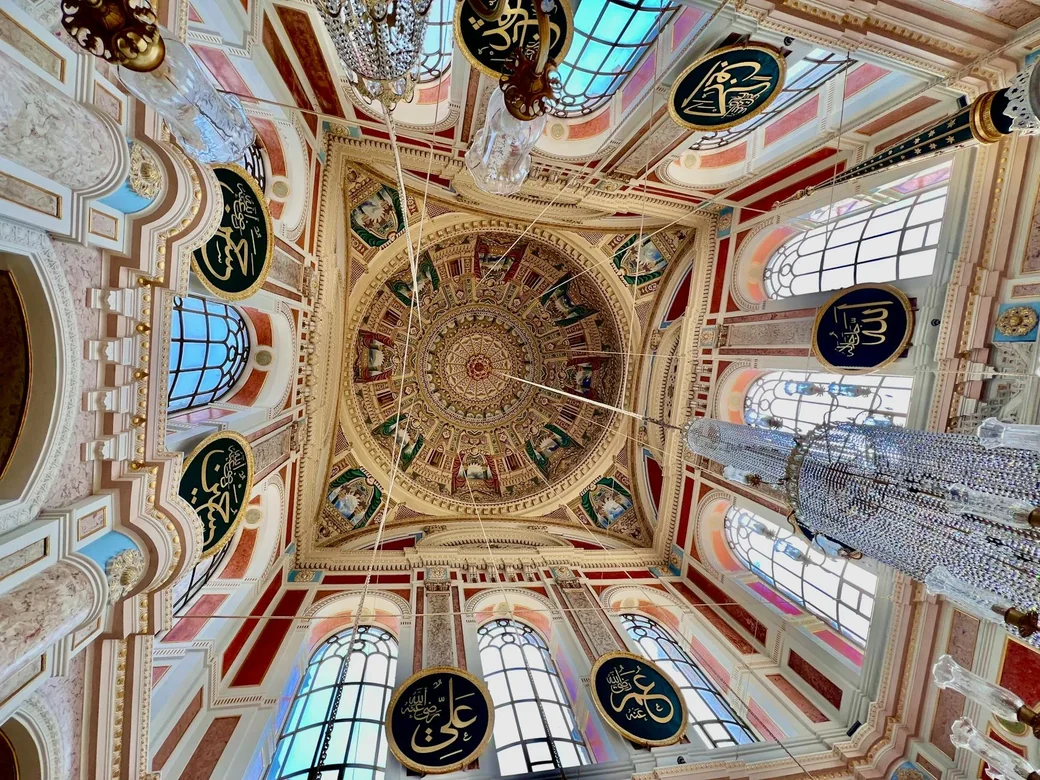
The prayer hall is a square of about 12.25 metres a side, covered by a single dome carried on pendentives. The present reinforced-concrete double-shell dome was rebuilt in the 1960s and measures about 13.85 metres across. Two rows of large windows bring in light reflected off the Bosphorus and make the modest space feel airy. The marble mihrab (prayer niche facing Mecca) is in the empire style, the minbar (pulpit) is decorated with pink stone, and the walls are covered in pink plaster imitating stone with red-and-white veining. The painted landscapes and architectural scenes in the dome and pendentives stand out. The panels of the four caliphs and the declaration of faith above the minbar are by Sultan Abdülmecid; the other panels are by Ali Haydar Bey.
Ortaköy Mosque Restorations: Earthquake, Fire and the 2014 Reopening
Soft ground and a delicate structure meant the building needed repair many times. It was repaired in 1862 and 1866; after heavy damage in the 1894 earthquake the Ministry of Foundations repaired it again in 1909, and the fluted minarets were rebuilt plain. In the 1960s cracks led to strengthened foundations and a new dome, and the mosque reopened for worship in 1969. It was restored again after a fire in 1984, and after a major programme of work between 2011 and 2014 it reopened on 6 June 2014. Although much of the original fabric has been replaced over time, the mosque is still counted among the finest architectural works on the Bosphorus.
Ortaköy Square History: A Neighbourhood Where Mosque, Church and Synagogue Are Neighbours
The name Ortaköy means “middle village”: the district lies between Besiktas and Kuruçesme. In Byzantine times the area is said to have been known as Ayios Fokas. For centuries Muslim, Christian and Jewish communities lived here as neighbours, and a mosque, a church and a synagogue still stand a few streets apart. The present building of the Ayios Fokas Church dates from 1856; the traceable history of the Etz Ahayim Synagogue goes back to the early 18th century, and it was rebuilt after fires. The baroque marble fountain on the square was built in 1723 by Damat Ibrahim Pasha. The architect Bruno Taut also lived in a house on the hillside above the district during his years in exile. Old photographs show that the pier once stood a little north of the mosque rather than where it is today; when a new pier was built south of the mosque in 1909 the old one was removed, and the present pier was rebuilt and opened in 2002. According to Evliya Çelebi, the largest non-Muslim community of the district in the 17th century was the Jewish one. Today the square around the pier is the lively heart of the district.
The Bosphorus Bridge and Ortaköy: The European Foot of the 15 July Martyrs Bridge
The structure right behind the mosque is the Bosphorus Bridge, the first bridge built across the strait, now officially called the 15 July Martyrs Bridge. Its European foot is in Ortaköy and its Asian foot in Beylerbeyi. It is 1,560 metres long, with a main span of 1,074 metres between the towers, and the towers are 165 metres high. The bridge opened in October 1973 and was renamed in 2016. An information panel on its history stands under the bridge on Muallim Naci Avenue. In the evening lights, the contrast between the modern steel of the bridge and the 19th-century stone of the mosque is the real appeal of the Ortaköy postcard.
What to Eat in Ortaköy: Kumpir, Waffles and Waterfront Tea Gardens
The square's best-known treat is kumpir: a large oven-baked potato mashed with butter and cheese and filled with salad, olives, corn, sausage and other toppings. The street running along the left as you face the mosque is lined with almost identical kumpir stalls, and the sellers call out loudly for customers; ask clearly about the toppings and the price before you order. Waffle counters, simit (sesame bread ring), chestnut and corn sellers and the waterfront tea gardens are pleasant alternatives. Taking your kumpir to the benches by the pier and eating it facing the sea, with the gulls for company, is the classic Ortaköy ritual.
Ortaköy Crafts Market and Shopping in the Back Streets
At weekends, especially on Sundays, the square and the streets around it turn into a handicrafts market: stalls line up with jewellery, hats, bags, textiles, second-hand books and souvenirs. Small shops and workshops that stay open all year are also worth a stroll in the back streets. The further you move from the square, the thinner the crowd and the more visible the daily life of the district. When buying souvenirs, it helps to tell handmade items from mass-produced magnets, to ask the price before you buy, and to watch your belongings in the crowd. Going before midday lets you browse comfortably before it gets busy.
Ortaköy Mosque Opening Hours, Entry and Visitor Etiquette
The mosque is open to visitors during the day, but it closes to sightseeing during the five daily prayers, usually for about half an hour. Friday midday is the busiest time for worship, and during Ramadan and religious holidays crowds grow both inside and on the square. Entry is free. You go in from the side facing the square and leave your shoes on the racks; because the interior is small, you may wait a few minutes at busy times. Strollers are usually not allowed inside. Hours can change, so check the current prayer times before you go and be respectful to worshippers. On accessibility, sources disagree: one reports a ramp at the side entrance, another says there are a few steps at the door; the cobblestones of the square can also be hard going for wheelchair users and people with limited mobility.
Ortaköy Mosque Photo Spots and the Best Time to Visit
The classic shot frames the mosque and the bridge together from beside the low chains in front of the mosque. The part of the pier to the left of the mosque is another favourite spot. For a different view, take to the water: on the short Bosphorus cruises that leave from the pier, the mosque appears from the sea beneath the bridge cables. At sunset the sky changes colour behind the bridge, and when the evening lights come on, reflections are added. The square is emptiest early in the morning, when a wide-angle lens gives an almost crowd-free frame. Spring and autumn are the most comfortable seasons; summer weekends and Ramadan evenings are very crowded, and winter winds can be sharp.
How to Get to Ortaköy Mosque: Bus, Tram, Ferry and Walking
The easiest route is via Kabatas: take the T1 tram, or the F1 funicular from Taksim, down to Kabatas, then board a bus towards Ortaköy and get off at the Ortaköy stop. Buses in the same direction also leave from Besiktas Square. If you like the water, Sehir Hatlari (Şehir Hatları) ferries call at Ortaköy Pier from the Eminönü, Üsküdar and Kadiköy directions. Walking from Besiktas along Çiragan Avenue (Çırağan Caddesi) is a pleasant alternative, passing in front of Çiragan Palace (Çırağan Sarayı). Driving is hard because of traffic and parking. Line numbers can change, so check the IETT and Sehir Hatlari apps before you go.
Things to See Near Ortaköy: Çiragan, Feriye, the Hamam and Yildiz Park
You can turn Ortaköy into a half-day route. The Esma Sultan Mansion next to the mosque is now used as an events venue. The Hüsrev Kethüda Hamam, attributed to the architect Sinan, is known as the first building put up in Ortaköy. Towards Kuruçesme, the Defterdar Ibrahim Pasha Mosque (Defterdar İbrahim Paşa Camii) of 1661 looks out to sea above its boathouses. You can see the Etz Ahayim Synagogue and the Ayios Fokas Church from the outside. Çiragan Palace (Çırağan Sarayı), the Feriye Palaces and Yildiz Park (Yıldız Parkı) lie towards Besiktas, and Dolmabahçe Palace is close to Kabatas. The walk along Çiragan Avenue (Çırağan Caddesi) passes beneath old poplars.
Legends and Stories About Ortaköy Mosque
None of the following is documented fact; all of it is legend. According to legend, because of its closeness to Yildiz Palace (Yıldız Sarayı) the district lived off palace leftovers, which is why people said “no smoke rises over Ortaköy.” According to legend, Sultan Abdülmecid decorated the walls himself with gilded calligraphy; the records show only that some panels and the declaration of faith are his. According to legend, the mosque was converted from an old church, although the earlier building was also a mosque. According to legend, Doña Gracia and Joseph Nasi lived in the district and set up a printing press. According to legend, Leonardo da Vinci proposed a bridge over the Bosphorus to Bayezid II. Around Feriye, disputed accounts also circulate about the death of Sultan Abdülaziz in 1876.
Ortaköy Mosque and Square: Visitor Tips
Enter the mosque outside prayer times, leave your shoes on the rack and bring your own scarf. At the kumpir stalls ask for the toppings and the price before you order. For the bridge shot, stand on the pier edge in front of the mosque; for an empty square, come in the morning. Avoid Friday midday and summer weekend evenings.
Ortaköy Mosque and Square: Best Time to Visit
From late afternoon through sunset; early weekday mornings for a quiet photo. Spring and autumn are the most comfortable seasons.
Ortaköy Mosque and Square: Admission Fees
Free admission
The mosque and the waterfront square are free to visit; modest dress and respect for prayer times are appreciated.
Free
Quick Info
2h
easy
Ortaköy Mosque and Square: Getting There
The easiest route is via Kabatas. Take the T1 tram, or the F1 funicular from Taksim, down to Kabatas, then board a bus towards Ortaköy and get off at the Ortaköy stop. Buses also leave from Besiktas Square in the same direction. If you prefer the water, Sehir Hatlari (Şehir Hatları) ferries call at Ortaköy Pier from the Eminönü, Üsküdar and Kadiköy directions, while the Bosphorus line runs only a limited timetable. You can also walk from Besiktas along Çiragan Avenue (Çırağan Caddesi). Line numbers and timetables change, so check the IETT and Sehir Hatlari apps before you set off.
Nearby stops & parking
The nearest bus stop is Ortaköy, about a three-minute walk from the square. The ferry pier lies just south of the mosque, and the sea-bus service running between Bebek and Galataport also calls at Ortaköy. If you come by taxi, ask to be dropped near the pier because of the traffic on Çiragan Avenue (Çırağan Caddesi). Parking around the square can be difficult, especially at weekends and in the evening; if you drive, it is easier to park near Kabatas or Besiktas and continue by public transport.
Ortaköy Mosque and Square: Dress Code & Etiquette
The mosque is an active place of worship. Cover your shoulders and knees, women should cover their hair, and shoes come off. Speak quietly inside, do not walk in front of people praying, do not use flash and avoid photographing worshippers.