The Palace of Versailles is the former royal residence of the kings of France, located in the town of Versailles just southwest of Paris. Surrounded by vast formal gardens and a wider estate of smaller palaces, it ranks among the largest and most famous palace complexes in the world. Its sumptuous interiors, landscaped grounds and the story of court life that unfolded within its walls make it a symbol of French royal splendour and one of the classic day trips from the capital.
Palace of Versailles: Location, accommodation options and contact
Place d'Armes, 78000 Versailles, France
The place's location on the map and nearby accommodation and hotel options are shown by Stay22. Cookies are used. Your consent is remembered on every page; you can turn it off at any time in the cookie settings.
Versailles began humbly, as a modest hunting lodge built in the 1620s for Louis XIII on the edge of a forest southwest of Paris. It was his son, Louis XIV, who saw the site's potential for something far grander. Starting in the 1660s, the Sun King launched a series of building campaigns that steadily swallowed up the old lodge inside an ever-expanding palace, and in 1682 he made the momentous decision to move the entire royal court and the machinery of French government to Versailles. For more than a century afterward, decisions that shaped Europe were made within these walls, and Versailles became a physical expression of absolute monarchy: a stage where etiquette, art, and architecture combined to project the king's authority to nobles, ambassadors, and rivals alike. Walking through the State Apartments today, it is worth remembering that every gilded ceiling and painted allegory was designed with that political purpose in mind, not decoration for its own sake. That transformation took place on a site that was hardly promising, as the original lodge stood on marshy ground at the edge of the forest, and each phase had its own master. Louis Le Vau led the early campaigns, wrapping the old hunting lodge in a new stone envelope, while Jules Hardouin-Mansart, chief architect in the later decades of the reign, added the palace's most spectacular elements, including the long north and south wings and the Hall of Mirrors.
The Hall of Mirrors and a Treaty That Ended a War
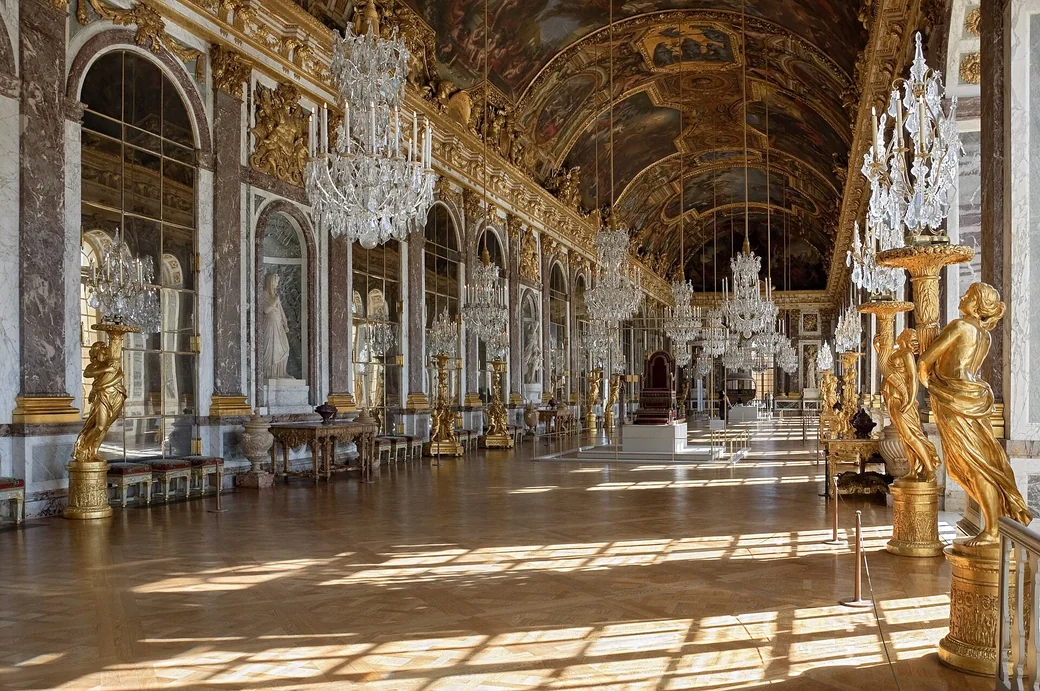
The Hall of Mirrors, or Galerie des Glaces, is the single most famous room at Versailles, a soaring 73-metre gallery where seventeen mirrored arches face seventeen windows overlooking the gardens, multiplying light across gilded stucco and painted ceilings. Built under Jules Hardouin-Mansart's direction and completed in the 1680s, it was designed as a stage for court ceremony, where ambassadors would be received amid a dazzling display of the kingdom's wealth and craftsmanship. Its history extends well beyond the age of Louis XIV: it was here, on 28 June 1919, that representatives signed the Treaty of Versailles, formally ending the First World War and reshaping the map of Europe. Standing in the gallery today, visitors are looking at both an artistic masterpiece and a site of profound twentieth-century history. The room can become extremely crowded at midday, so visiting close to opening time or later in the afternoon makes it much easier to appreciate the scale and detail of the space.
The Gardens and the Musical Fountains Shows
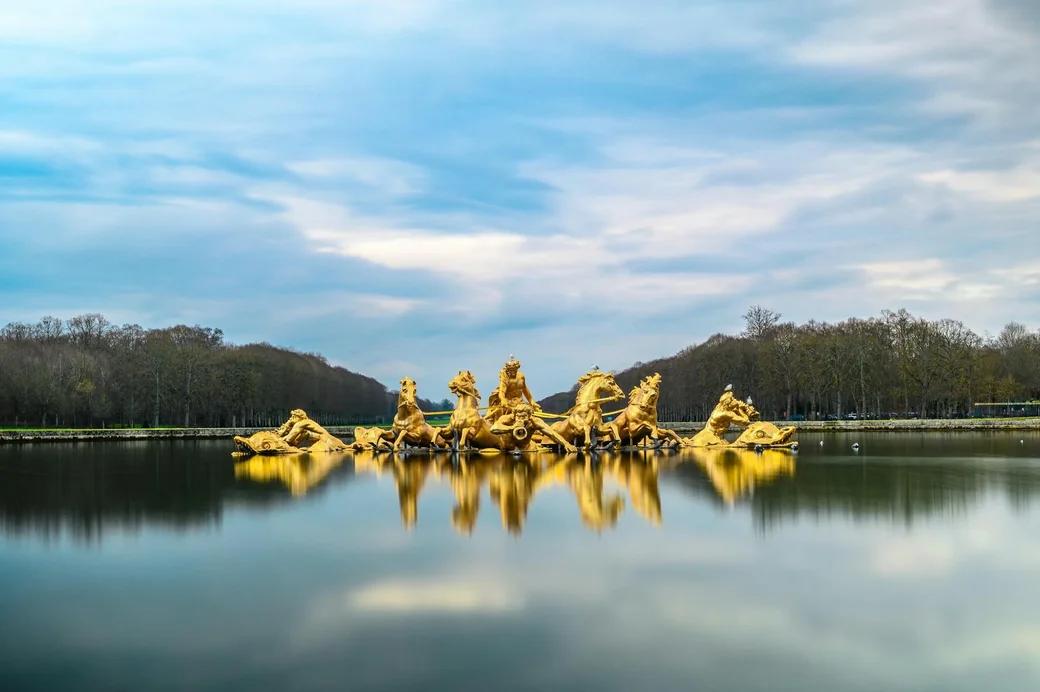
André Le Nôtre's gardens are as central to Versailles as the palace itself, a vast composition of clipped parterres, statue-lined paths, ornamental basins, and long green perspectives stretching toward the horizon. Exploring them on foot, by bike, or by the little train takes real time, since the grounds cover an enormous area that includes groves, the Grand Canal, and countless fountains. The gardens are at their most theatrical during the seasonal Musical Fountains Shows and Musical Gardens events, when the fountains are set in motion to Baroque and classical music, recreating something of the spectacle Louis XIV once staged for his court. Because the fountains do not run continuously outside these scheduled shows, checking the calendar in advance is worthwhile if seeing them in full flow matters to your visit. Even without the fountains playing, a walk through the gardens, especially toward the Grand Canal or the groves away from the main terrace, offers some of the calmest and most rewarding moments of a visit to Versailles. Across a park that spreads over hundreds of hectares, Le Nôtre imposed strict geometric order on the land, a statement that even nature was expected to bow to the king's design.
The Estate of Trianon and Marie-Antoinette's Hamlet
Away from the main palace, at the far end of the gardens, lies the Estate of Trianon, a quieter and more intimate world within Versailles. The Grand Trianon, a low pink-marble pavilion, was built as a private retreat where Louis XIV could escape the formality of court life, while the smaller Petit Trianon later became strongly associated with Marie-Antoinette, who used it as a personal refuge. Close by, she had a rustic hamlet built, the Hameau de la Reine, a picturesque cluster of thatched cottages, a working farm, and a mill designed to resemble a simple Normandy village. It was a place where the queen and her circle could step outside the rigid etiquette of the main court and play, in a highly curated way, at rural life. Because the Estate of Trianon is a considerable walk from the main chateau, visiting it usually requires a separate stretch of the day, and it is worth building extra time into your schedule if you want to see both the palace and Trianon without rushing.
Best Time to Visit and How to Avoid the Crowds
Versailles is one of the most visited sites in France, and crowd levels make a real difference to how enjoyable a visit feels. Arriving right when the gates open, or booking a timed slot for later in the afternoon, tends to produce the shortest queues and the calmest experience inside the State Apartments. Tuesdays are worth avoiding if possible, since the Louvre is closed that day and a share of its visitors head to Versailles instead. The quieter months from late autumn to early spring bring a more intimate atmosphere, while weekends, school holidays and summer Musical Fountains Show days draw the biggest crowds; on those days, an early slot and a little patience go a long way.
Where to Get the Best Photos at Versailles
Versailles offers no shortage of memorable photo opportunities, both inside the palace and across its grounds. Inside, the Hall of Mirrors is the obvious highlight, though its popularity means it is easiest to photograph without crowds early in the day. Outside, the garden facade of the palace, viewed from the Parterre d'Eau with its reflecting pools, gives one of the most recognisable views of the estate, especially in the soft light of early morning or early evening. Climbing partway up the garden's central axis and looking back toward the palace offers a classic symmetrical composition, while the Grand Canal provides a long, calm stretch of water that works well for wide landscape shots. The groves scattered through the gardens, quieter and often overlooked, can yield more atmospheric images away from the main crowds. At the Estate of Trianon, the rustic charm of the Hameau de la Reine, with its thatched cottages and small farm animals, offers a completely different visual character from the formal grandeur of the main chateau.
How to Get to Versailles from Paris
The most direct way to reach the Palace of Versailles from central Paris is the RER C (Paris's regional express rail) line, which runs straight to Versailles Château – Rive Gauche station, only about a ten-minute walk from the Palace gates, making it the option most visitors choose. Since January 2025, a single Métro-Train-RER ticket has been valid across the whole Île-de-France rail network, so the ticket you use in central Paris covers the trip to Versailles as well. Two other stations offer useful alternatives depending on where you start: Versailles Rive Droite, served by Transilien (suburban trains of the Île-de-France region) trains from Gare Saint-Lazare, is around a 17-minute walk from the Palace, while Versailles Chantiers, reached from Gare Montparnasse, is about 18 minutes on foot. Driving is also possible, with parking close to the estate, but traffic and full car parks are common at weekends and in the peak summer months, so allow extra time or choose the train for a more predictable journey.
A Suggested Full-Day Strategy
Because Versailles combines a grand palace, sprawling gardens, and a separate estate, a full day is the most comfortable way to see it all without rushing. A practical approach is to start with the Palace itself in the morning, right at opening, when the State Apartments and Hall of Mirrors are at their calmest. From there, spend the middle part of the day exploring the gardens, ideally timing your walk to coincide with a Musical Fountains Show if one is scheduled, before pausing for lunch at one of the cafes or picnic areas within the grounds. In the afternoon, make your way to the Estate of Trianon, which sits a fair distance from the main chateau; renting a bike, taking the little train, or using the boat on the Grand Canal can make this stretch much easier on tired legs. Visitors with less time can prioritise the Palace and Gardens alone and treat the Estate of Trianon as a reason to return, since trying to see everything in only a few hours often means rushing through rooms and gardens that reward a slower pace.
Hidden Treasures: the Royal Chapel and the Royal Opera
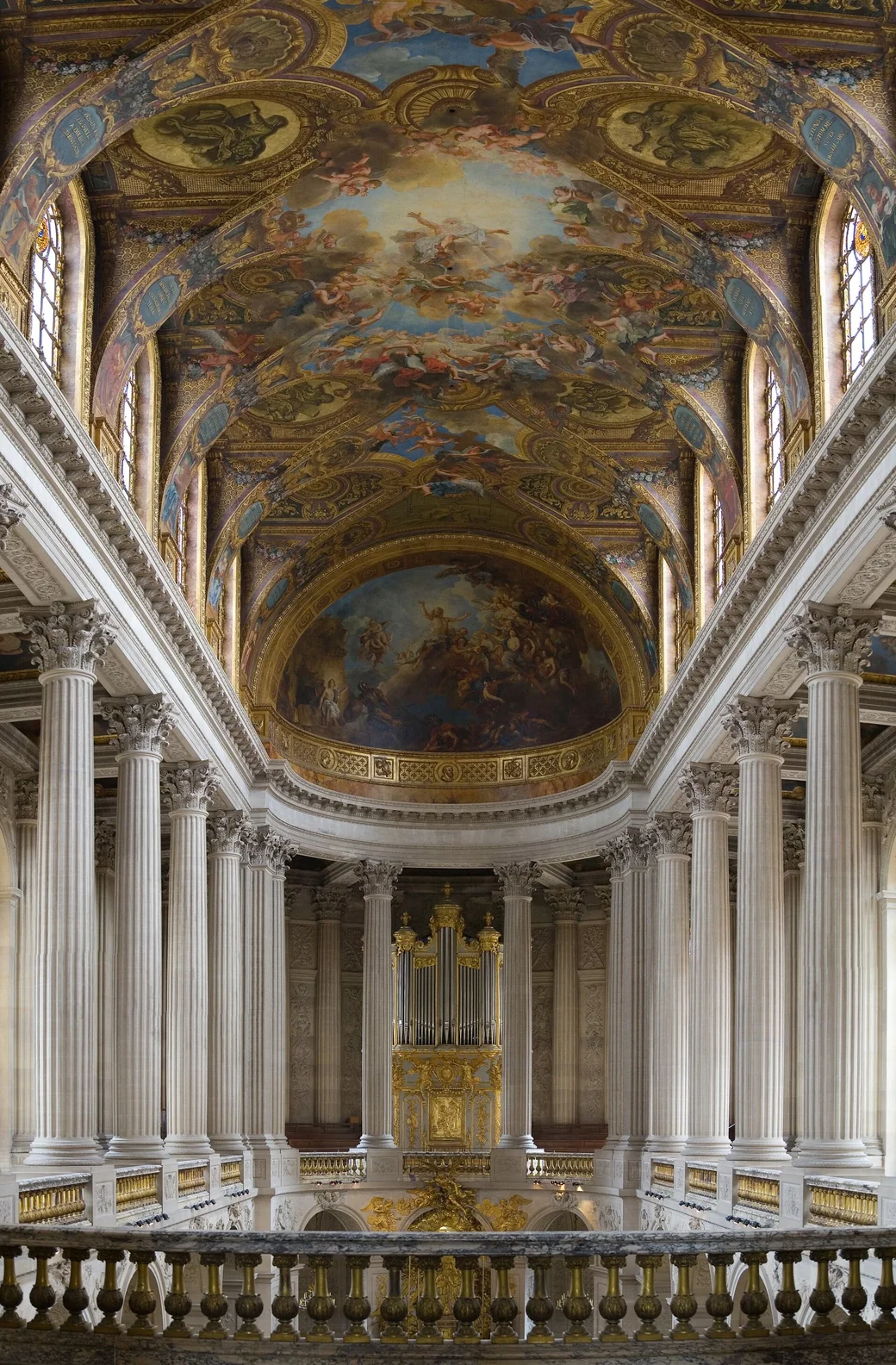
Two of the palace's most beautiful spaces are easy to overlook. The Royal Chapel, completed in 1710 to designs by Jules Hardouin-Mansart and finished by his brother-in-law Robert de Cotte, was the last great building project of Louis XIV's reign: a soaring white-and-gold interior where the king heard mass each morning from the royal gallery, while the court gathered below. Its painted vaults and luminous stone make it one of the finest examples of French Baroque religious architecture, and it can be admired from the State Apartments' upper vestibule.
At the far end of the north wing lies the Royal Opera, designed by Ange-Jacques Gabriel and inaugurated in 1770 for the wedding celebrations of the future Louis XVI and Marie-Antoinette. Built largely of wood painted to imitate marble, it was engineered for superb acoustics and could be converted from a theatre into a ballroom. It still hosts concerts and operas today, and seeing it, during a performance or on a guided tour, is one of the most magical ways to imagine court life at Versailles.
Booking Tickets and Timed Entry
Because Versailles limits the number of visitors admitted to the Palace at any given time, tickets are sold with a specific entry slot, and booking online in advance is strongly recommended, particularly for the busy spring and summer months. Buying ahead not only secures your preferred time but usually means bypassing the ticket queues at the gates, leaving only the security check before entry. It is worth deciding beforehand which parts of the estate you want to see, since separate options exist for the Palace alone, the Estate of Trianon alone, or a combined pass that also includes the Gardens. On Musical Fountains Show days the Gardens have their own ticketing, so a quick look at the official Château de Versailles website for the current options and time slots will help you choose.
Accessibility and Mobility at Versailles
Versailles is a very large site, and visitors with mobility considerations should plan accordingly. The main State Apartments are largely step-free and accessible by wheelchair, and accessible restrooms and assistance services are available on site. The gardens are mostly flat, but paths are often gravelled, and some sections can be uneven or difficult in a wheelchair or with limited mobility, particularly further from the main terraces. The Estate of Trianon lies a considerable distance from the Palace, and reaching it comfortably may require the little train or another form of transport rather than walking the full distance. Audio guides are available to support the visit, though not every gallery or feature offers full accessibility. Because services can change, it is worth checking the official website before your visit and, where possible, contacting the venue directly to confirm the specific arrangements you need.
Visiting Versailles with Children
Versailles can be a rewarding destination for families, though the scale of the estate means it helps to plan with children's stamina in mind. The gardens offer plenty of open space to explore, and younger visitors often enjoy the Grand Canal, the groves, and especially the rustic charm of Marie-Antoinette's Hamlet at the Estate of Trianon, where small farm animals and thatched cottages tend to capture children's imaginations more readily than gilded state rooms. The Musical Fountains Shows, when scheduled, can also be an engaging way to introduce children to the site's history through spectacle rather than long explanations. Because so much of the visit involves walking, and because the palace interiors can be crowded and require patience, pacing the day with breaks, snacks, and time in the gardens between indoor sections tends to work better than trying to see everything in one continuous stretch. Renting a bike or considering the little train can also help tired legs cover the distance to the Estate of Trianon more easily.
Do's and Don'ts for Your Visit
A few simple habits go a long way toward making a visit to Versailles smoother. Do book your entry time in advance where possible, arrive a little before your slot, and bring water and comfortable shoes, since the site involves a great deal of walking both indoors and out. Do respect the roped-off areas and furnishings inside the State Apartments, which are original or carefully restored historic pieces rather than replicas that can be touched. Don't expect to see the entire estate, Palace, Gardens, and Trianon included, in only a couple of hours; trying to rush everything tends to produce a frustrating, exhausting visit rather than an enjoyable one. Don't rely solely on the main terrace fountains being active outside scheduled show times, since much of the water feature display is seasonal and tied to specific event days. Finally, don't forget that weather can change quickly given how much of the visit takes place outdoors, so checking the forecast and packing accordingly, including sun protection or rain gear as needed, is a simple step that makes a real difference.
Exploring the Town of Versailles
The town of Versailles grew up around the palace and offers a pleasant, quieter contrast once you step outside the estate gates. Its streets are lined with cafes, bistros, and shops, making it a comfortable place to stop for a meal before or after visiting the Palace, especially if you would rather avoid the busier food options directly on the grounds. The Notre-Dame district and the covered Marché Notre-Dame market are worth a wander for a taste of everyday local life alongside the grand history next door. History enthusiasts may also want to seek out other sites connected to the town's royal past, since Versailles as a settlement developed almost entirely in the palace's shadow over the seventeenth and eighteenth centuries. Because the town's train stations, including Versailles Rive Droite and Versailles Chantiers, sit within easy walking distance of these streets, it is simple to combine an exploration of the town with your journey to or from the Palace without needing extra transport.
Practical Essentials and UNESCO Status
The Palace and Park of Versailles was inscribed as a UNESCO World Heritage Site in 1979, recognised as an outstanding example of royal architecture and garden design that influenced palaces and courts across Europe for generations. The Versailles inscription is a World Heritage Site in its own right, separate from the UNESCO listing that covers the banks of the Seine in central Paris. For visitors, that historical weight comes with practical scale: this is one of the largest and most visited monuments in France, and comfortable footwear, a flexible schedule and realistic expectations about crowds will do more for your visit than almost anything else. Plan for at least half a day, and ideally a full day, if you want to experience the Palace, the Gardens and the Estate of Trianon without feeling rushed. Whatever combination you choose to prioritise, a quick look at the official Château de Versailles website before you go will help you make the most of your time here.
Palace of Versailles: Visitor Tips
Book a timed-entry ticket online in advance to skip the worst of the queue, and decide beforehand whether you want to see the Palace alone or the Palace, Gardens and Estate of Trianon together. Wear comfortable shoes, since the estate is vast and much of it is seen on foot; the little train, rental bikes or the rowing boats on the Grand Canal are pleasant ways to rest tired legs.
Palace of Versailles: Best Time to Visit
Visit at opening or book a weekday afternoon slot for shorter queues. Tuesdays are often busier. In spring and summer, the gardens are especially beautiful during Musical Fountains Shows.
Palace of Versailles: Admission Fees
Passport (whole estate) – low season
Applies to visits from November to March. Access to the whole estate: the palace with a timed entry, the Trianon estate, temporary exhibitions and the gardens.
€25
Passport (whole estate) – low season – EEA nationals/residents
Rate for nationals or residents of an EEA country; proof of eligibility is required. Applies to visits from November to March. Access to the whole estate: the palace with a timed entry, the Trianon estate, temporary exhibitions and the gardens.
€22
Passport (whole estate) – high season
Applies to visits from April to October. Access to the whole estate: the palace with a timed entry, the Trianon estate, temporary exhibitions and the gardens.
€35
Passport (whole estate) – high season – EEA nationals/residents
Rate for nationals or residents of an EEA country; proof of eligibility is required. Applies to visits from April to October. Access to the whole estate: the palace with a timed entry, the Trianon estate, temporary exhibitions and the gardens.
€32
Late-admission Passport – low season
Applies to visits from November to March. Discounted Passport for entering the palace later in the afternoon; the earliest entry time depends on the season.
€18
Late-admission Passport – low season – EEA nationals/residents
Rate for nationals or residents of an EEA country; proof of eligibility is required. Applies to visits from November to March. Discounted Passport for entering the palace later in the afternoon; the earliest entry time depends on the season.
€15
Late-admission Passport – high season
Applies to visits from April to October. Discounted Passport for entering the palace later in the afternoon; the earliest entry time depends on the season.
€28
Late-admission Passport – high season – EEA nationals/residents
Rate for nationals or residents of an EEA country; proof of eligibility is required. Applies to visits from April to October. Discounted Passport for entering the palace later in the afternoon; the earliest entry time depends on the season.
€25
Trianon estate only
Grand Trianon, Petit Trianon, the Queen's Hamlet and the Trianon gardens; valid all year round, without a palace visit.
€15
Trianon estate only – EEA nationals/residents
Rate for nationals or residents of an EEA country; proof of eligibility is required. Grand Trianon, Petit Trianon, the Queen's Hamlet and the Trianon gardens; valid all year round, without a palace visit.
€12
Musical Gardens / Fountains Show (high season)
Garden access with music and fountain displays on show days, April to October; the palace is not included.
€15
Musical Gardens / Fountains Show (high season) – EEA nationals/residents
Rate for nationals or residents of an EEA country; proof of eligibility is required. Garden access with music and fountain displays on show days, April to October; the palace is not included.
€12
Musical Gardens/Fountains + Trianon (high season)
Combined ticket for the Musical Gardens or Fountains Show and the Trianon estate, for visitors who skip the palace.
€20
Musical Gardens/Fountains + Trianon (high season) – EEA nationals/residents
Rate for nationals or residents of an EEA country; proof of eligibility is required. Combined ticket for the Musical Gardens or Fountains Show and the Trianon estate, for visitors who skip the palace.
€17
Gardens in low season (free)
In the low season (November to March) the gardens and park are free for everyone; the palace and Trianon require a ticket.
Free
Passport (whole estate) – Large families / holiday vouchers
Special on-site rate for holders of a large-family card or visitors paying with French holiday vouchers; sold at the ticket desks only.
€13
Trianon estate only – Large families / holiday vouchers
Special on-site rate for holders of a large-family card or visitors paying with French holiday vouchers; sold at the ticket desks only.
€8
Under 18 (free)
Free for all visitors under 18, whatever their nationality. A valid ID showing date of birth may be requested.
Free
Ages 18–25 from the EEA (free)
Free for nationals or residents of an EEA country aged 18 to 25. ID (and proof of residence where relevant) is required.
Free
Quick Info
4h
moderate
Palace of Versailles: Getting There
The easiest way to reach the Palace of Versailles from central Paris is the RER C (Paris's regional express rail), which runs directly to Versailles Château – Rive Gauche station, about a 10-minute walk from the Palace gates. Trains run frequently throughout the day, and since January 2025 a single Métro-Train-RER ticket has been valid across the whole Île-de-France rail network, so the same ticket you use in the city takes you all the way to Versailles. Two alternative stations also serve the town: Versailles Rive Droite, reached by Transilien (suburban trains of the Île-de-France region) trains from Gare Saint-Lazare, is roughly a 17-minute walk from the Palace, while Versailles Chantiers, served by Transilien trains from Gare Montparnasse, is about 18 minutes on foot. Driving is possible, with parking near the estate, but traffic is heavy on weekends and in the busy summer season, so the train is generally the more reliable option.
Nearby stops & parking
Versailles Château - Rive Gauche (RER C (Paris's regional express rail)) is the closest station, about 10 minutes on foot from the Palace's main gates. Versailles Rive Droite (Transilien (suburban trains of the Île-de-France region) from Gare Saint-Lazare) is around 17 minutes away, and Versailles Chantiers (Transilien from Gare Montparnasse) is about 18 minutes away, both a little farther but useful alternatives depending on where you start your journey in Paris.
Palace of Versailles: Dress Code & Etiquette
There is no strict dress code at the Palace of Versailles, but comfortable, sturdy walking shoes are essential given the sheer size of the palace and gardens. Much of the visit takes place outdoors in the gardens and at the Estate of Trianon, so dressing in layers and checking the weather beforehand is strongly recommended, especially on the gravelled and sometimes uneven garden paths.