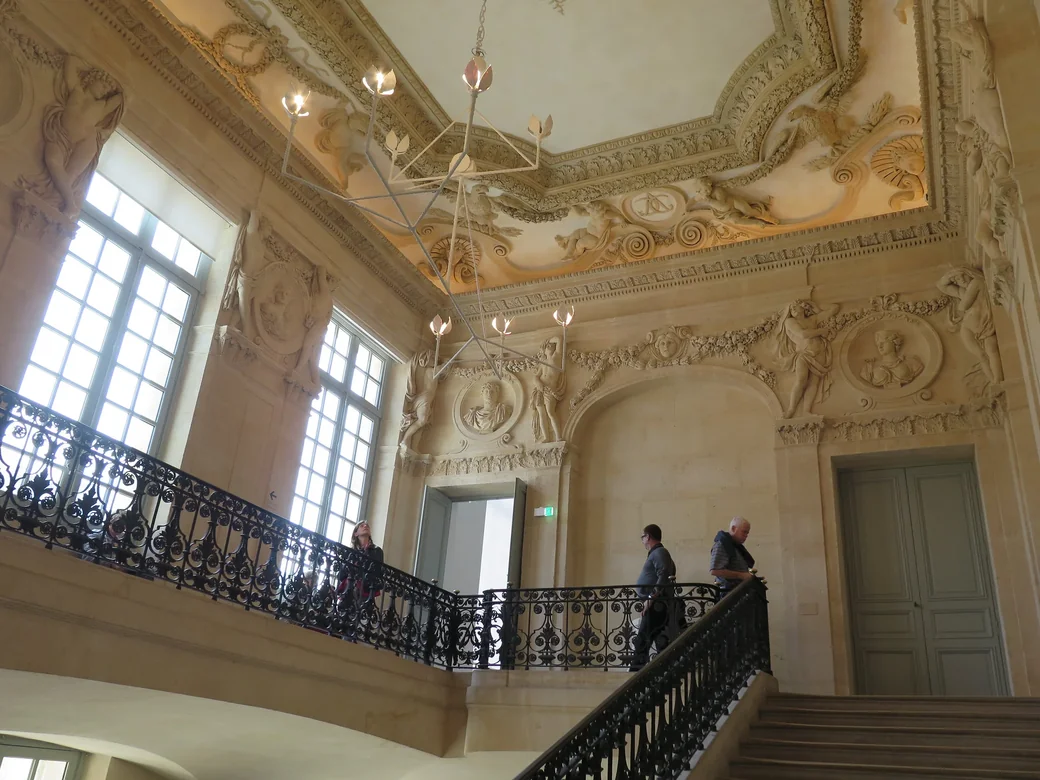
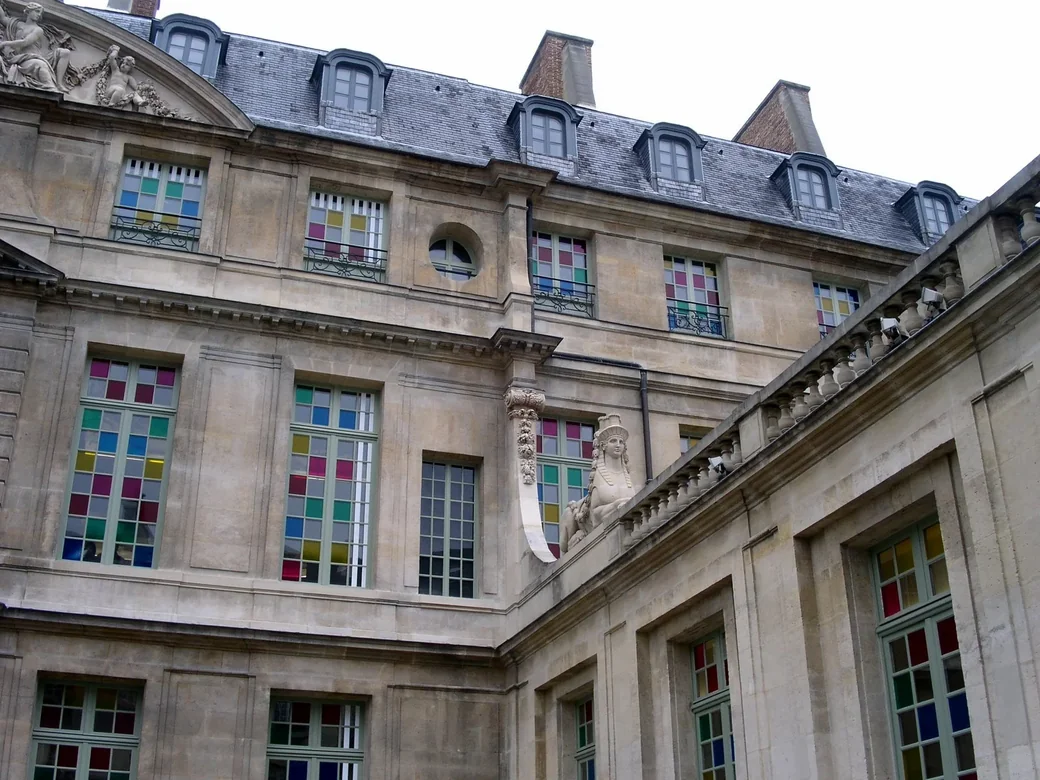
The Musée national Picasso-Paris is France's national museum dedicated to Pablo Picasso, located in the Marais district of Paris's 3rd arrondissement (district). It is housed in the Hôtel Salé, a stately 17th-century private mansion in the heart of the old quarter. The museum stands out as one of the most important places in the world to discover Picasso: its collection follows the Spanish-born artist through every stage of his long career, making it an essential stop for anyone drawn to modern art.
Picasso Museum (Paris): Location, accommodation options and contact
5 Rue de Thorigny, 75003 Paris, France
The place's location on the map and nearby accommodation and hotel options are shown by Stay22. Cookies are used. Your consent is remembered on every page; you can turn it off at any time in the cookie settings.
From Salt-Tax Mansion to Picasso Museum: The Hôtel Salé's History
The building housing the collection was never built with art in mind. Pierre Aubert de Fontenay, who grew rich collecting France's deeply unpopular salt tax, commissioned this mansion in 1656, and Parisians nicknamed it the Hôtel Salé — the 'salted mansion' — as a pointed joke about the source of his fortune. Architect Jean Boullier gave it a dramatic stone staircase and a richly decorated courtyard that still greet visitors today. The City of Paris bought and restored the building in the 1960s specifically to eventually house a museum, though it would be another two decades before Picasso's collection gave that plan its purpose. Completed in 1659, the mansion passed through a long succession of owners and institutional uses over the following three centuries before that purchase, yet Boullier's staircase and courtyard façade have come down to us largely intact.
How a Tax Debt Created the World's Largest Picasso Collection
The museum exists because of an unusual French legal mechanism called dation en paiement, which lets heirs pay inheritance tax using artwork instead of cash. When Pablo Picasso died in 1973, his estate owed enormous taxes, and because he had rarely sold pieces he considered personally significant, the resulting donation to the French state was remarkable: roughly 5,000 works spanning his entire career. A second dation from his wife Jacqueline's estate added further depth. The result is not a greatest-hits selection bought on the open market, but the artist's own working collection, complete with the sketchbooks and personal experiments a commercial gallery would rarely have acquired. The gift spanned every medium Picasso worked in — paintings, sculptures, ceramics, drawings, prints and sketchbooks — forming a working archive of his entire creative life. The museum opened to the public in 1985 and has kept growing ever since through further gifts and acquisitions.
Picasso's Own Art Collection, on Display Alongside His Work
Picasso was also a serious collector of other artists' work, and a selection of these pieces hangs within the museum alongside his own. Paintings and drawings by Cézanne, Matisse, Braque, Miró and Degas all passed through his personal collection, but the standout is Henri Rousseau's Portrait of a Woman, which Picasso bought for a few francs in 1908 and kept until the end of his life. Seeing what Picasso himself chose to live with adds an unusual layer to a single-artist museum, revealing which of his contemporaries and predecessors he considered worth studying firsthand.
The 2014 Renovation and the Museum's Modern Layout
The Hôtel Salé closed for renovation in 2009 and did not reopen until 2014, a five-year project that roughly doubled the available exhibition space by opening up new galleries in the attic and basement levels. The result is a visit that alternates between grand 17th-century salons with their original stone details and contemporary white-walled galleries built for modern lighting and display standards. The route through the museum is largely chronological, following Picasso's career from his early academic training in Spain through Cubism, his ceramics period in Vallauris, and his prolific final decades.
Along the way, the collection reveals process as much as finished masterpieces: sketchbooks show ideas evolving across dozens of pages, ceramics from his Vallauris workshop sit alongside monumental bronze sculptures, and academic studies from his teenage years in Spain hang not far from the loosely painted canvases of his final decade — a fitting journey for an artist whose work never stopped changing shape.
Booking Ahead and Getting Through the Entrance
Booking a timed-entry slot online before you go is strongly recommended, particularly for weekends, school holidays and popular temporary exhibitions, which can be fully booked well in advance; a reserved slot also gives you priority access at the door. Plan to arrive a few minutes before your time, and allow a comfortable margin before closing, since the one-directional route through the collection takes longer than many visitors expect. Suitcases are not allowed and bags go through a security check at the entrance, so travelling light speeds things up.
Métro, Bus and Parking Near the Museum
Three Métro line 8 stations sit within easy walking distance: Saint-Sébastien-Froissart, Chemin Vert and Filles du Calvaire are all 5 to 8 minutes on foot, while Saint-Paul on line 1 offers a slightly longer alternative through the Marais' narrow streets. Bus lines 20, 29, 65, 69, 75 and 96 all stop within a few minutes of the entrance. Driving into the Marais is best avoided — street parking is scarce and largely reserved for residents, and the nearest public garages still require a short walk to the museum itself.
Accessibility for Wheelchair Users and Visitors with Reduced Mobility
The museum is accessible to visitors with reduced mobility throughout, with the exception of one historic room that cannot be adapted, and lifts serve the gallery levels. Guide dogs and assistance dogs are welcome, and wheelchairs and folding seat-canes can be borrowed at the information desk. The terrace and the sales counter inside the museum are accessible; the separate bookshop at 4 rue de Thorigny is not, because of a high step at its door. Lifts are occasionally taken out of service for maintenance, so if a fully step-free route is essential it is worth checking the museum's website on the day.
Best Time to Visit and How to Avoid Crowds
Weekday mornings shortly after opening, especially Tuesday through Thursday, tend to be the calmest time to see the permanent collection without dense crowds. Weekends and school holidays bring noticeably more visitors, so a weekday visit pays off if you want space in front of the major works. Popular temporary exhibitions draw their own crowds regardless of the day, so booking an early time slot is worth doing whenever a special exhibition is on. Late in the afternoon, as the tour groups thin out, the upper floors often become pleasantly quiet again.
How Much Time to Set Aside
Most visitors spend one and a half to two hours moving through the permanent collection at a comfortable pace, longer if a temporary exhibition is also open. Because the museum's route is largely one-directional, it's difficult to do a quick highlights-only visit, so it's worth budgeting real time rather than trying to fit it into a rushed half hour between other Marais stops.
What to Wear and Bring
There's no dress code, but the building's stone staircases and some historic, slightly uneven flooring make comfortable flat shoes the most useful thing to wear. Large bags, backpacks and suitcases typically need to be checked at the entrance, so travelling light makes the visit smoother, especially since storage space can be limited during busy periods.
Photography Rules and Tips
Photography without flash is generally permitted throughout the permanent collection, though flash and photography are often restricted in ticketed temporary exhibitions to protect works on paper and other light-sensitive pieces — it's worth checking signage as you enter each gallery. The courtyard facade of the Hôtel Salé itself, visible from just inside the entrance gates, is one of the most photogenic spots and doesn't require a ticket to view from the street.
Language Support and the Audio Guide
Audio guides can be rented on site, in several languages for adults and in English and French for children. Wall text in the galleries is generally provided in French and English. Language options for temporary exhibitions can differ from the permanent collection, so ask at the information desk if you are relying on a particular one.
Etiquette: What to Do and Avoid
As with most fine art museums, touching the artworks, sculptures or display cases is not permitted, and flash photography is generally discouraged even where photography itself is allowed, to protect fragile pigments and works on paper. Large bags are checked at the entrance rather than carried through the galleries. Because the collection spans intimate personal sketchbooks as well as major paintings, keeping voices relatively low helps preserve the atmosphere for other visitors studying the smaller, more detailed pieces.
Visiting with Children
The museum's mix of sculpture, ceramics and boldly colourful later paintings tends to hold children's attention better than a purely academic collection might, and family-oriented trails or activity booklets are often available at the information desk during school holidays. That said, the one-directional route and the density of works in some rooms can make a very young child's visit tiring, so pacing the visit around a child's attention span, rather than trying to see everything, tends to work best.
The Marais and What's Nearby
The museum sits in the heart of the Marais, one of Paris's best-preserved historic districts, and several other sights are within easy walking distance. Place des Vosges, the city's oldest planned square, is about 7-8 minutes away on foot, while the Centre Pompidou and its modern art collection is roughly 10-12 minutes in the other direction. The Musée Carnavalet, dedicated to the history of Paris itself, and the boutique-lined streets of Rue des Francs-Bourgeois and Rue Vieille du Temple make it easy to build a full afternoon around the museum without needing to travel far.
Picasso Museum (Paris): Visitor Tips
Book a timed-entry ticket online in advance, especially for weekends and temporary exhibitions, which can sell out. The route is largely one-directional, so it's hard to skip sections once inside.
Picasso Museum (Paris): Best Time to Visit
Weekday mornings just after opening are quietest, especially Tuesday to Thursday, when the mansion's grand salons can be enjoyed calmly. On weekends and during big exhibitions, book an early slot.
Picasso Museum (Paris): Admission Fees
Adult
Single ticket for the permanent collection and the temporary exhibitions.
€16
Reduced rate
Reduced rate for eligible visitors; proof of eligibility is required.
€12
Family rate
Family rate for one or two adults accompanying a child.
€12
First Wednesday evening of the month
Reduced rate for the evening opening on the first Wednesday of each month.
€12
Under 18 (free)
Free for all visitors under 18, whatever their nationality. A valid ID showing date of birth may be requested.
Free
Ages 18–25 from the EEA (free)
Free for nationals or residents of an EEA country aged 18 to 25. ID (and proof of residence where relevant) is required.
Free
Visitors with disabilities + companion (free)
Free for visitors with a disability, plus one companion. Proof of disability status is required.
Free
First Sunday of the month (free)
Free for everyone on the first Sunday of every month, all year round.
Free
Quick Info
1h 45m
easy
Picasso Museum (Paris): Getting There
The museum sits in the Marais, a short walk from several Métro line 8 stations: Saint-Sébastien-Froissart, Chemin Vert and Filles du Calvaire are all within 5-8 minutes on foot, while Saint-Paul on line 1 is a slightly longer walk through the neighbourhood's narrow streets. Bus lines 20, 29, 65, 69, 75 and 96 all stop within a few minutes of the entrance. On foot, it's roughly a 10-12 minute walk from the Centre Pompidou or 7-8 minutes from Place des Vosges, both pleasant routes through the Marais. Driving is not recommended: street parking in the district is scarce and largely reserved for residents, and the nearest public garages require a short walk regardless.
Nearby stops & parking
Saint-Sébastien-Froissart, Chemin Vert and Filles du Calvaire (all line 8) are the closest Métro stations, each 5-8 minutes on foot; Saint-Paul (line 1) is a further alternative. Bus routes 20, 29, 65, 69, 75 and 96 stop nearby. Public parking is limited in the immediate area; the closest paid garages are a short walk away on the district's main avenues.
Picasso Museum (Paris): Dress Code & Etiquette
There is no dress code. The museum is a converted private mansion with stone staircases and some uneven historic flooring, so comfortable, flat shoes are more useful than any particular outfit.