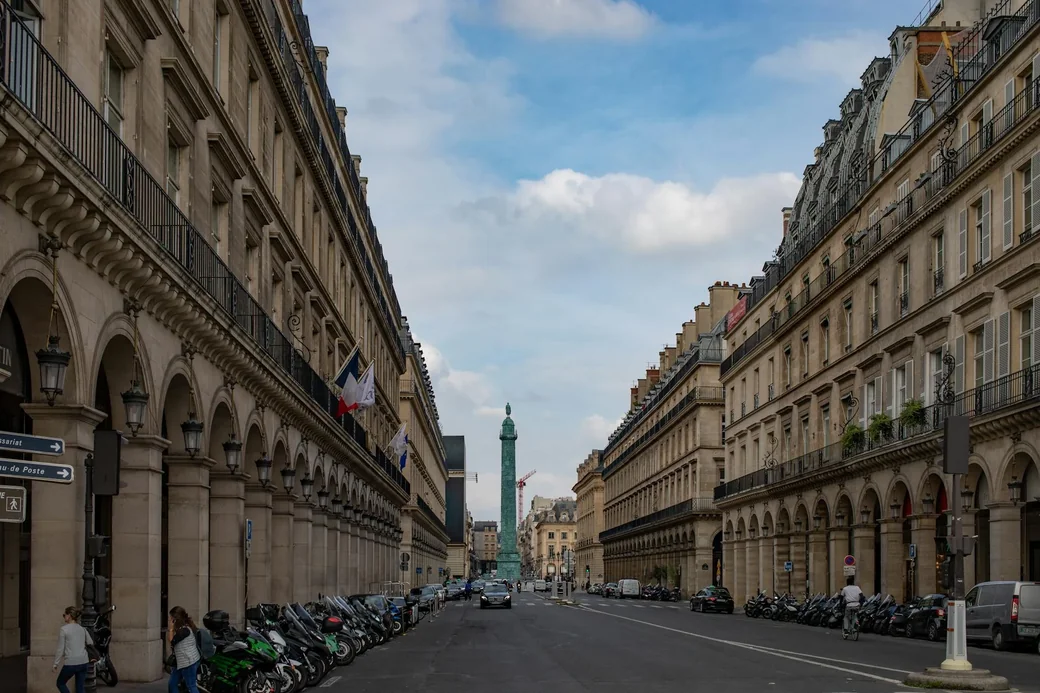
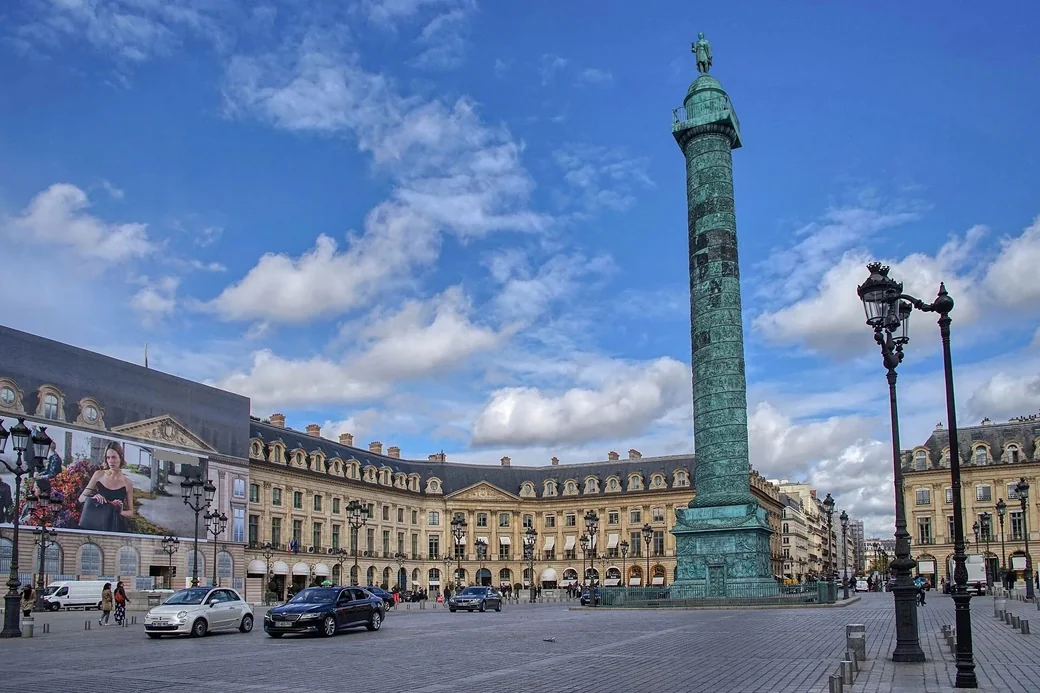
Place Vendôme is a historic octagonal square in Paris's 1st arrondissement (district), set between the Tuileries Garden and the Opéra district. A ring of matching stone façades surrounds it, with a tall bronze column rising at its centre. Today it is also one of the most prestigious addresses in the world, synonymous with luxury hotels and fine jewellery, and a natural stop for anyone exploring the historic heart of the city on foot.
Place Vendôme: Location, accommodation options and contact
Place Vendôme, 75001 Paris, France
The place's location on the map and nearby accommodation and hotel options are shown by Stay22. Cookies are used. Your consent is remembered on every page; you can turn it off at any time in the cookie settings.
Place Vendôme owes its existence to Louis XIV, who wanted a grand square that would celebrate his military victories and rival the elegance of Place des Vosges and Place des Victoires elsewhere in Paris. Work began in 1698 under the direction of Jules Hardouin-Mansart, the king's chief architect, who had already built the dome of the Invalides and the Hall of Mirrors at Versailles. Rather than construct full buildings himself, Mansart designed only the stone façades, with arcaded ground floors, tall pilasters, and pedimented pavilions at the corners, and sold the plots behind them to wealthy financiers, who built their own townhouses to match. This clever arrangement let the crown control the square's appearance without paying for every building inside it. Construction continued for more than two decades, and the square was essentially finished by 1720, its uniform stone ring already admired as one of the most elegant pieces of urban design in Europe. The square's name has followed the politics of each era. It was first called Place des Conquêtes (Square of Conquests), then Place Louis-le-Grand (Louis the Great Square), when a bronze equestrian statue of Louis XIV stood at its centre, before taking the name Place Vendôme after the townhouse of the Duc de Vendôme that had once occupied the site.
The Vendôme Column: Bronze Cast From Cannons
At the center of Place Vendôme rises a column that has nothing to do with its original royal purpose. In 1805, Napoleon Bonaparte defeated the combined armies of Austria and Russia at the Battle of Austerlitz, and the following year he ordered a monument built to celebrate the victory. Constructed between 1806 and 1810, the Vendôme Column was cast in bronze melted down from roughly 1,200 cannons captured from the defeated armies. Its design directly echoes Rome's ancient Trajan Column: a continuous spiral of bas-relief panels winds up the shaft, depicting scenes from the 1805 campaign in remarkable detail, while a statue originally crowned the top. Standing over 40 meters tall, the column instantly became the dominant feature of the square, turning a monument to royal glory into one celebrating imperial conquest, and it remains the focal point every visitor looks for first. The column also took the place of an earlier monument: revolutionaries had pulled down Louis XIV's equestrian statue in 1792, and Napoleon claimed the empty pedestal for his own victory memorial. The statue that first crowned the column depicted Napoleon himself.
Toppled and Rebuilt: The Column's Turbulent Past
The Vendôme Column has not always stood undisturbed. During the uprising known as the Paris Commune in the spring of 1871, the column was condemned as a hated symbol of militarism and imperial pride. On 16 May 1871, it was formally pulled down by decree, an act closely associated with the painter Gustave Courbet, who served on the Commune's arts commission at the time and was later held financially responsible for its destruction. The toppling left the square without its centerpiece for several years. Once order was restored, French authorities decided to rebuild rather than leave the pedestal empty, and the column was recast and re-erected in 1875, topped once again with a copy of the original statue. The episode is one of the most dramatic in the square's three-century history, a reminder that even the grandest Parisian monuments have not always survived political upheaval unscathed.
An Octagon in Disguise: Mansart's Uniform Façades
From street level, Place Vendôme looks almost square, but its corners are subtly cut at an angle, giving the whole space the visual effect of an octagon rather than a plain rectangle. This was Jules Hardouin-Mansart's signature touch, achieved simply by chamfering the four corners of the plaza. Every façade around the square follows the same design: rows of arches at ground level, tall pilasters rising through the upper floors, and pediments marking the center and corners of each side, all built from pale, uniform stone. The effect is one of remarkable harmony, with no single building drawing attention away from the whole ensemble or the column at its center. Architectural historians consider it one of the finest examples of French classical urban planning, an approach later echoed in squares across Europe, and it still frames the shopfronts, hotel entrance, and government offices around it with the same quiet elegance it had in the eighteenth century.
The Ritz and the World's Finest Jewelers
Few addresses in the world say luxury quite like Place Vendôme. The legendary Ritz Paris, opened on the square in 1898, has hosted royalty, writers, and film stars for well over a century and remains one of the most famous hotel addresses on earth. Beneath Mansart's arcades, the rest of the square is given over almost entirely to the biggest names in fine jewelry: Chaumet, Boucheron, Van Cleef & Arpels, and Cartier all keep flagship boutiques here, alongside historic names like the shirtmaker Charvet. Together they have made Place Vendôme synonymous with the French jewelry and haute couture trade for well over a hundred years, and window displays along the square are often as elaborate as small museum exhibits. Even visitors with no plans to shop find it worth a slow walk around the arcades simply to see the craftsmanship on display, and a coffee at a nearby café is a pleasant way to take in the atmosphere without ever stepping inside a boutique.
The Ministry of Justice at Nos. 11 and 13
Not everything on Place Vendôme is about glamour. Nos. 11 and 13, on the square's western side, have served as the seat of the French Ministry of Justice, known as the Chancellerie, continuously since 1718, making it one of the longest-serving government buildings anywhere in Paris. Behind the same uniform Mansart façade as its glamorous neighbors, the ministry quietly handles the administration of the French justice system and has done so through empires, republics, and world wars. The building is not open to casual visitors, but its presence adds an unexpected layer of institutional history to a square better known for jewelry and hotels, and its discreet entrance is worth noticing as you walk past. The mix of state power, royal history, and private luxury within a few hundred meters of each other is part of what makes Place Vendôme such a distinctive stop on a walk through central Paris.
How to Reach Place Vendôme by Metro and On Foot
Reaching Place Vendôme is straightforward from almost anywhere in central Paris. The closest metro station is Tuileries on Line 1, only a few minutes' walk to the south, making it an easy add-on to a visit to the Tuileries Garden or the Louvre. Opéra, on Lines 3, 7, and 8, and Madeleine, on Lines 8, 12, and 14, both sit a short walk to the north and work well if you are coming from other parts of the city on those lines. Several bus routes run along nearby Rue de Rivoli and around the Opéra Garnier, and travelers arriving by RER A (Paris's regional express rail) can connect through Auber or Châtelet-Les Halles before finishing the trip on foot. Because the square itself is pedestrian-friendly with only limited local traffic, walking the last stretch from any of these stations is usually faster and more pleasant than trying to arrive by car.
Pairing Your Visit With the Tuileries and Opéra Garnier
Place Vendôme's location makes it easy to fold into a longer walk through some of the most celebrated parts of Paris. The Tuileries Garden lies just a few minutes south, offering a shaded, tree-lined contrast to the square's formal stone architecture and a natural link toward the Louvre and the Seine. To the north, the Rue de la Paix leads directly to the Opéra Garnier, Charles Garnier's opulent nineteenth-century opera house, while the Rue Saint-Honoré and Rue du Faubourg Saint-Honoré, both lined with high-end boutiques, run close by for those who enjoy window shopping. Place de la Concorde, one of the largest and most historic squares in Paris, is also within easy walking distance to the southwest. Because Place Vendôme itself takes only about half an hour to appreciate fully, most visitors treat it as one stop among several rather than a destination on its own, weaving it into a half-day stroll through the 1st arrondissement (district).
Best Time to Visit and Where to Get the Best Photos
Place Vendôme rewards visitors who choose their moment carefully. Early morning, before the boutiques open and delivery traffic picks up, the square is at its quietest, with soft light raking across the stone façades and the bronze column. Early evening brings a different mood, as shop windows and street lamps illuminate the arcades just as the sky turns blue, a classic hour for photography. Weekday visits tend to be calmer than weekends, when both tourists and shoppers fill the square. For photographs, the center of the plaza gives an unobstructed view straight up the column, while the corners, thanks to Mansart's angled design, offer symmetrical framing of two façades at once. Standing back near the entrance from Rue de la Paix also captures the column with the Ritz or the ministry building in the same frame, a composition many visitors come away with as their signature shot of the square.
Accessibility and Etiquette on the Square
Place Vendôme is one of the more accessible historic sites in central Paris. The square is entirely flat, paved with smooth cobblestones and stone, and completely step-free, so wheelchair users, visitors with strollers, and anyone with limited mobility can explore it without difficulty. A little courtesy goes a long way here: because the buildings around the square include a working government ministry, a five-star hotel, and some of the world's most exclusive boutiques, it is best to keep noise down near entrances, avoid blocking doorways while taking photographs, and ask before photographing boutique staff or hotel guests directly. Visiting outside the busiest midday hours also makes it easier to enjoy the architecture calmly and take unobstructed photos without large crowds crossing your frame.
Place Vendôme: Visitor Tips
Allow about 30 minutes to admire the column and architecture, and combine your visit with a stroll through the nearby Tuileries Garden.
Place Vendôme: Best Time to Visit
Visit early morning or evening on a weekday, when the square is quiet and soft light highlights the bronze column, stone façades and illuminated boutique windows.
Place Vendôme: Admission Fees
Free admission
Free to enter and open to everyone; no ticket is needed.
Free
Quick Info
30m
easy
Place Vendôme: Getting There
Place Vendôme sits in the heart of the 1st arrondissement (district), an easy walk from the Tuileries Garden, the Louvre, and the Opéra district, and it fits naturally into a longer stroll through central Paris. Taxis and ride-hailing cars can drop passengers directly on the square or on the surrounding streets, though traffic is limited to slow, mostly one-way local access, and short-term parking in the area is scarce and expensive, so most visitors arrive on foot or by public transport rather than by car. Paris's Vélib' bike-share network has docking stations within a few minutes' walk, offering another easy way to combine a visit with other nearby sights such as the Madeleine or the Palais-Royal.
Nearby stops & parking
The closest metro station is Tuileries on Line 1, just a few minutes' walk south of the square. Opéra, served by Lines 3, 7, and 8, and Madeleine, served by Lines 8, 12, and 14, are both within a short walk to the north, and either makes a convenient approach if you are coming from elsewhere on those lines. Several bus routes also stop nearby along Rue de Rivoli and around the Opéra Garnier, and RER A (Paris's regional express rail) trains stop at the Auber and Châtelet-Les Halles hubs a little further away for travelers connecting from outside central Paris.
Place Vendôme: Dress Code & Etiquette
There is no dress code or religious etiquette to observe at Place Vendôme, since it is simply an open public square rather than a place of worship. That said, the surrounding streets are lined with some of the most exclusive jewelry houses and hotels in the world, so a smart-casual look feels most at home if you plan to browse the boutique windows or step into the Ritz. Photographers should be considerate of security staff and other pedestrians: tripods and professional shoots on the square generally require prior authorization, and it is polite to avoid lingering directly in front of boutique entrances or hotel doors when taking pictures.