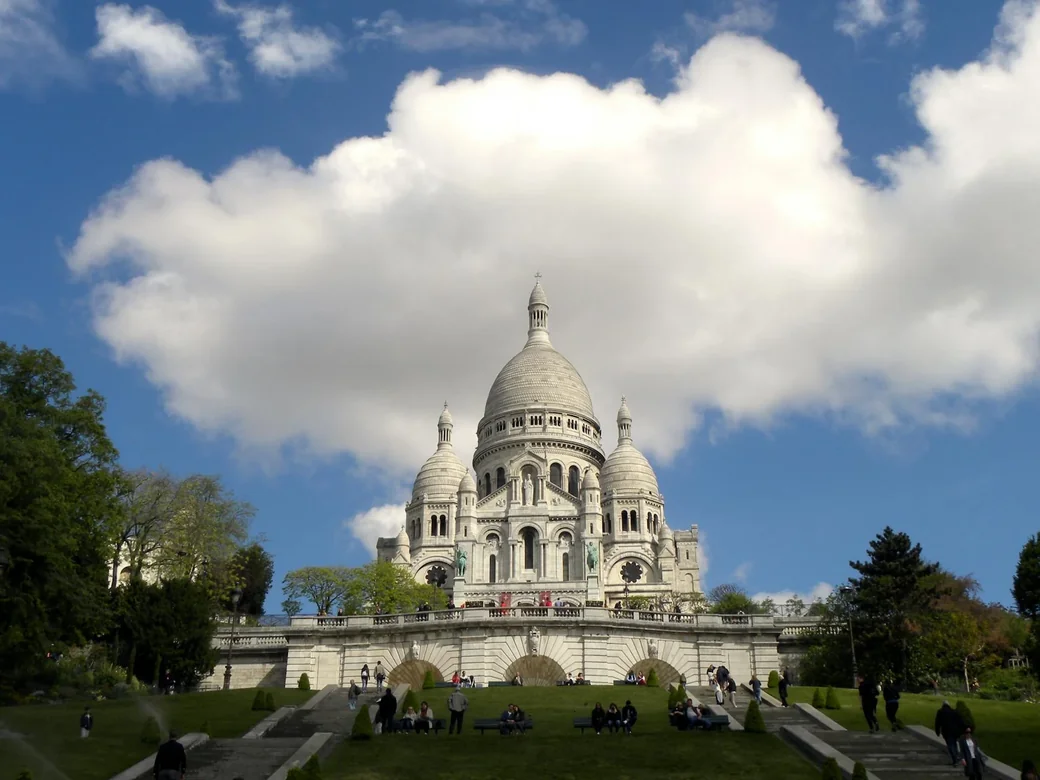
Sacré-Cœur Basilica (Basilique du Sacré-Cœur) is a Roman Catholic basilica dedicated to the Sacred Heart of Jesus, standing at the very top of the Montmartre hill in the 18th arrondissement (city district) of Paris. Its cluster of white domes is one of the most recognisable shapes on the Paris skyline, and the wide flights of steps leading up to it are a favourite gathering spot for visitors. At once a working church and one of the city's most visited landmarks, it is an essential stop on any walk through Montmartre.
Sacré-Cœur Basilica: Location, accommodation options and contact
35 Rue du Chevalier de la Barre, 75018 Paris, France
The place's location on the map and nearby accommodation and hotel options are shown by Stay22. Cookies are used. Your consent is remembered on every page; you can turn it off at any time in the cookie settings.
The 1870 Defeat That Gave Birth to the Sacré-Cœur Basilica
After France's defeat by Prussia in 1870 and the upheaval of the Paris Commune that followed, two Catholic laymen, Alexandre Legentil and Hubert Rohault de Fleury, promoted a "national vow" (Vœu national) to build a church dedicated to the Sacred Heart as a sign of the country's spiritual renewal. The National Assembly declared the project of public utility on 24 July 1873, and construction was financed through a nationwide public subscription, with donations arriving from every corner of France.
One Architect Started It, Five Finished It: The Builders of Sacré-Cœur
Architect Paul Abadie, who had restored the Saint-Front Cathedral in Périgueux, won the design competition against 77 or 78 rival projects. He laid the cornerstone on 16 June 1875, but died in 1884 before construction was finished. Four more architects carried the project forward in succession — Honoré Daumet, Jean-Charles Laisné, Henri-Pierre Rauline, and Lucien Magne — with Jean-Louis Hulot completing the final details. The interior opened for worship in 1891, though the basilica wasn't consecrated until 16 October 1919, delayed by the First World War. Abadie drew his Romano-Byzantine design from Hagia Sophia in Istanbul and St Mark's Basilica (Basilica di San Marco) in Venice, and the main building work continued from 1875 until 1914.
The Engineering Secret Beneath Sacré-Cœur: 83 Concrete Wells
Montmartre's hill is riddled with old gypsum quarries, so the ground beneath the planned basilica was far too unstable to build on directly. Engineers sank 83 wells roughly 30 to 33 metres deep and filled them with concrete to create a stable foundation — by far the most expensive and time-consuming phase of the entire project, longer even than raising the walls above ground. The result is almost poetic: if the hill itself ever eroded away, the basilica would remain standing, suspended on its own forest of concrete pillars.
Who Actually Owns Sacré-Cœur? The City of Paris, Not the Church
A law passed on 13 April 1908, under Georges Clemenceau's government, made Sacré-Cœur the property of the City of Paris, while the building remains dedicated to Catholic worship. The Church therefore holds the use of the basilica rather than its ownership, and since 1995 a community of Benedictine sisters has looked after its spiritual and material life at the request of the Archbishop of Paris. It is one of the more surprising facts for visitors who assume such a major church must belong to a diocese. In 2022 the basilica was also classified as a historic monument, yet above all it remains a living sanctuary where uninterrupted prayer has continued day and night since 1885.
The Story Behind Sacré-Cœur's Street Address
The basilica's address, 35 rue du Chevalier de la Barre, honours François-Jean de la Barre, a young nobleman executed in 1766 for blasphemy, whose case became a lasting symbol of freedom of conscience in France. In 1905 a bronze statue of him by Armand Bloch was inaugurated in front of the basilica, and in 1907 the street was renamed after him. The statue was moved to the nearby Square Nadar in 1926 and melted down for its metal in 1941, during the Second World War; a new statue was unveiled in Square Nadar in 2001 and still stands there today, just a few steps from the funicular's upper station.
The Hidden Names Carved Into Sacré-Cœur's Columns
Construction was financed entirely by donations, organised through a Stone Subscription that let families sponsor a single stone, a column, or even an entire chapel, with the donor's full name, initials, or family crest engraved directly into the surface. Estimates of the number of donors and the total sum raised vary widely between sources, so treat any single precise figure with caution — but millions of people across France contributed over the decades. Their names are still visible on the columns and walls today, and spotting them is a rewarding detail to look for during a visit.
Is Saint Denis Really Buried at Montmartre? The Truth Behind the Hill's Name
Montmartre is traditionally read as the "mount of martyrs", a name linked to Saint Denis, the first bishop of Paris, who, according to legend, picked up his own head after his martyrdom and walked away carrying it. Tradition holds that his walk ended at the site of today's Basilica of Saint-Denis, north of Paris, where he is venerated rather than on the hill itself. Montmartre has another, less-known claim to fame: in 1534 Ignatius of Loyola and his companions took the vows that led to the founding of the Jesuit order in a chapel on the slopes of the hill. The hill itself rises to about 130 metres, making it the highest natural point in Paris.
Why Sacré-Cœur Never Turns Grey: The Self-Cleaning Stone Secret
Unlike most old buildings in Paris, Sacré-Cœur's façade never darkens with age or pollution. The reason lies in the specific stone used: travertine quarried at Château-Landon, near Souppes-sur-Loing. This particular limestone is unusually hard and fine-grained, and when rainwater hits it, it releases calcite that effectively bleaches and cleans the surface — meaning the basilica genuinely gets whiter, not dirtier, every time it rains, which is why it still gleams today exactly as it did when it was completed over a century ago.
Christ in Majesty: Inside One of the World's Largest Mosaics
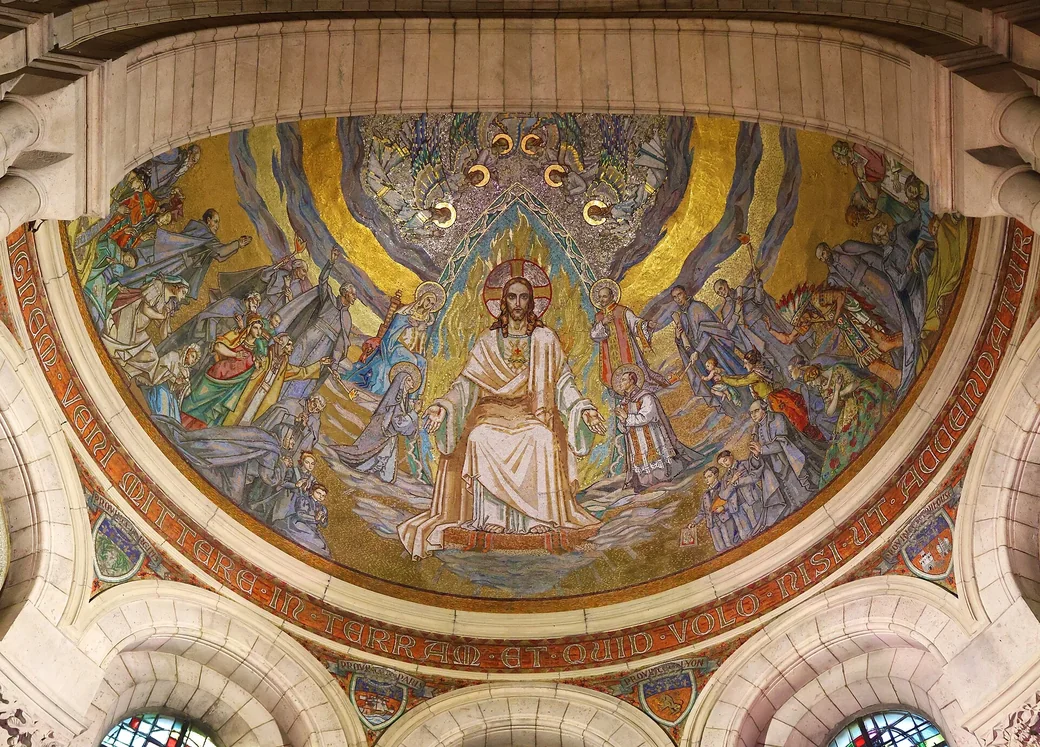
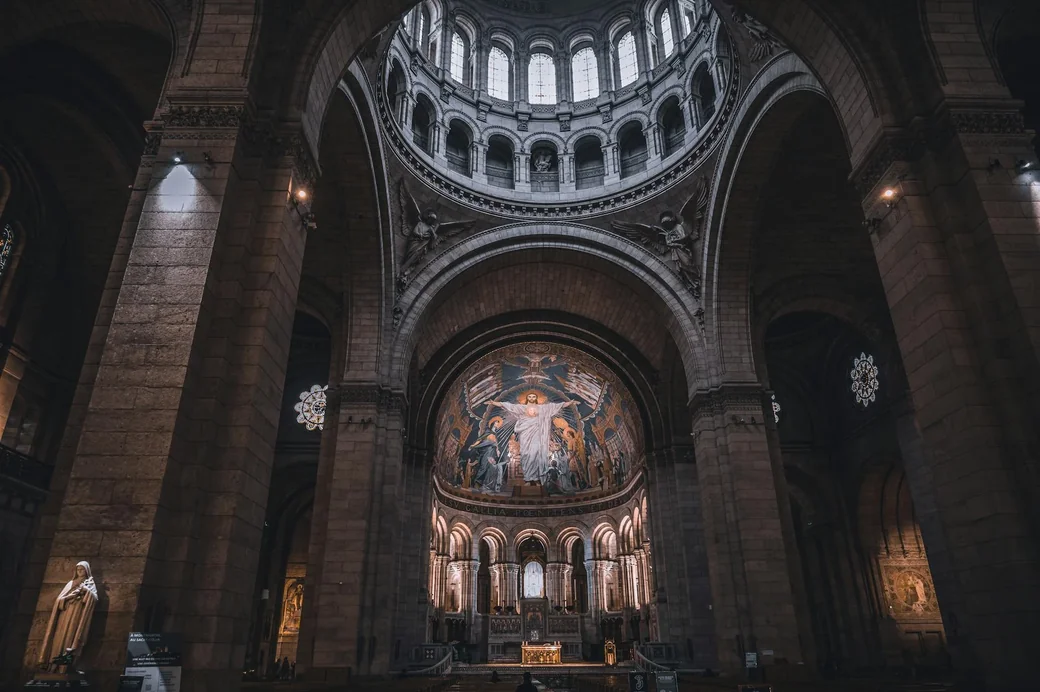
Covering roughly 475 square metres of the apse vault, the mosaic of Christ in Majesty ranks among the largest in the world. Created from cartoons by Luc-Olivier Merson and Marcel Magne, it was inaugurated in 1923. Christ stands at the centre with arms wide open and a golden Sacred Heart on his chest, surrounded by the Virgin Mary, the Archangel Michael and Joan of Arc, together with figures from the history of devotion to the Sacred Heart. Standing beneath it and letting your eyes follow the gold tesserae (small mosaic tiles) up into the vault is one of the most memorable moments of any visit.
La Savoyarde: The Story Behind France's Largest Bell
Weighing about 18.8 tonnes with a diameter of roughly three metres, La Savoyarde is the largest swinging bell in France. Cast in 1891 by the Paccard foundry in Annecy-le-Vieux and offered by the dioceses of Savoy, it was hauled up to Montmartre in October 1895 on a wagon drawn by a team of 28 horses. Its official name is Françoise-Marguerite du Sacré-Cœur, and its deep voice rings out over Paris on the great feast days of the Church year.
The Night 13 Bombs Fell Beside Sacré-Cœur and Shattered Every Window
On the night of 20-21 April 1944, thirteen bombs struck the street beside the basilica. The walls held firm, but every stained-glass window was blown out — and, according to the sanctuary's own account, the congregation kneeling in perpetual adoration (uninterrupted prayer before the consecrated host) inside never once left their prayers. The stained glass visible now was installed after the war; the originals from before 1944 are gone for good.
The Two Bronze Riders Guarding Sacré-Cœur's Facade
Look up at the facade before heading inside and you will spot two equestrian bronze statues flanking the entrance: Joan of Arc on one side and Saint Louis (King Louis IX) on the other, both sculpted by Hippolyte Lefèbvre. The pairing is deliberate — both are canonised French figures associated with military leadership and national identity, fitting for a monument born out of national defeat.
The Historic Organ Hiding Inside Sacré-Cœur
Sacré-Cœur houses a grand organ built in 1898 by Aristide Cavaillé-Coll, the most celebrated organ builder of 19th-century France, originally for the private château of Baron Albert de l'Espée, a passionate music lover. After the baron's death the instrument spent years in storage before being installed in the basilica, where it was inaugurated on 16 October 1919 by Charles-Marie Widor, Marcel Dupré and Abel Decaux. With four keyboards and dozens of stops, it was classified a historic monument in 1981, and its full voice is best heard during Mass or at an organ recital.
Climbing Sacré-Cœur's Dome: Nearly 300 Steps to a Sweeping View of Paris
Sacré-Cœur's central dome rises to 83 metres, and the walkway around its top opens onto a full 360-degree panorama of Paris. The dome is reached through an exterior entrance on the left side of the basilica, followed by a spiral staircase of nearly 300 steps. There is no lift, and the passages near the top are narrow, so comfortable shoes and a steady pace make the climb far more enjoyable. The reward is one of the finest panoramas in Paris: from roughly 200 metres above sea level, the view sweeps across the rooftops to landmarks such as the Eiffel Tower, and on a clear day it stretches for around 30 kilometres. Because access can be adjusted for weather or maintenance, it is worth checking the official website before your visit.
Getting to Sacré-Cœur: Metro, the 'Funicular,' and Accessibility Notes
The closest metro stations are Anvers (line 2) and Abbesses (line 12), with Pigalle, Lamarck-Caulaincourt, Barbès-Rochechouart and Château Rouge as alternatives. From the foot of the hill, the Montmartre funicular climbs to the basilica in about a minute and a half and is part of the Paris public transport network. Despite its name, today's funicular is in fact two independent inclined lifts rebuilt in 1990–91; the line first opened in 1900 with a water-counterweight system and ran electrically from 1935. Visitors with reduced mobility can use a step-free entrance with a lift at the rear of the basilica, at 35 rue du Chevalier de la Barre, while the dome is reached only by stairs.
Sacré-Cœur Basilica: Visitor Tips
The dome climb has nearly 300 narrow steps and no lift, so wear comfortable shoes. Inside the basilica, shoulders and knees should be covered and photography is not permitted in the nave. Arriving early in the morning gives you the calmest visit.
Sacré-Cœur Basilica: Best Time to Visit
Early morning, before the day's visitors arrive, for a peaceful basilica and calm steps, or sunset for golden light on the white stone and a lively atmosphere on the hilltop.
Sacré-Cœur Basilica: Admission Fees
Basilica – free admission
Entering the basilica is free for everyone; visitors are asked to dress modestly and keep silence.
Free
Dome – adult (16 and over)
Climb of nearly 300 steps with no lift, ending in a 360° panoramic view over Paris.
€8
Dome – child (up to 15)
Reduced rate for children up to age 15.
€5
Quick Info
1h 30m
moderate
Sacré-Cœur Basilica: Getting There
Take Metro line 2 to Anvers, then walk up rue de Steinkerque and either climb the steps or ride the Montmartre funicular, which is part of the Paris public transport network. Metro line 12 to Abbesses drops you deeper into Montmartre's streets. Alternatively use Pigalle (lines 2/12), Lamarck-Caulaincourt (line 12), Barbès-Rochechouart (lines 2/4) or Château Rouge (line 4). The Montmartrobus (line 40) loops around the top of the hill, and the final approach to the basilica is a pleasant climb on foot, by the stairs or along sloping village streets.
Nearby stops & parking
Closest stops: Anvers (M2) and Abbesses (M12), both roughly 400–500 m from the basilica steps. The funicular's lower station sits at Place Suzanne-Valadon, at the foot of the gardens below the basilica, and its upper station is right beside the forecourt. The Montmartrobus (line 40) stops close to the basilica. By car, drop-off and taxi access is easiest via rue du Cardinal Guibert on the north side, and a public car park is available near Anvers.
Sacré-Cœur Basilica: Dress Code & Etiquette
Shoulders and knees must be covered to enter the nave; this is enforced. Photography is prohibited inside the church, and professional filming or photo shoots require prior written permission from the sanctuary. Silence is expected throughout, since the basilica is a working place of prayer, not a museum.