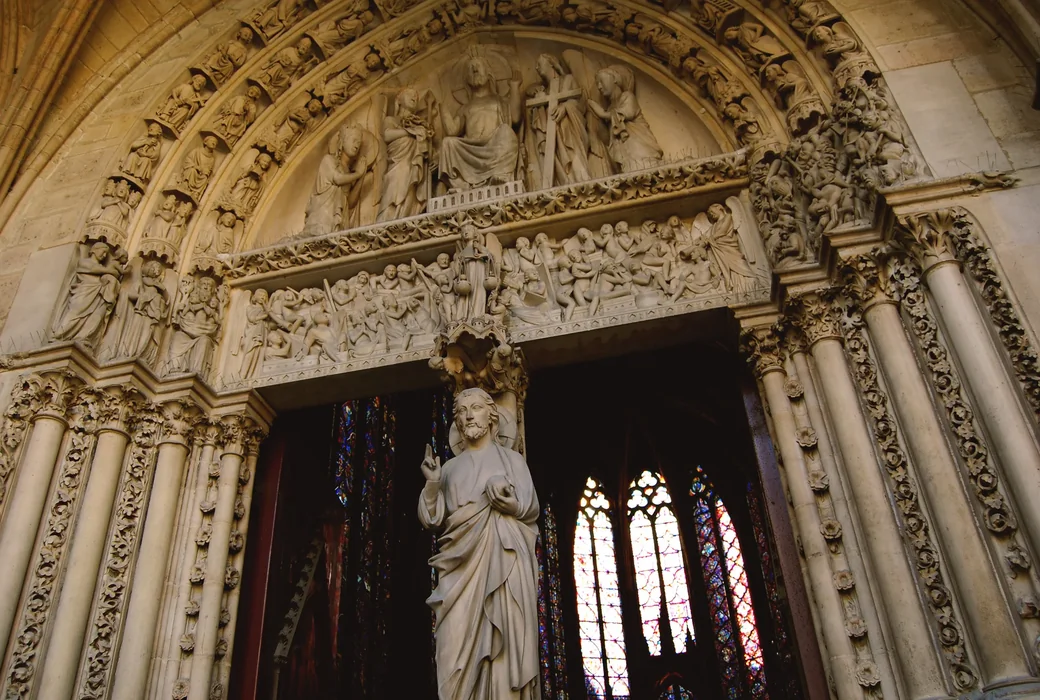
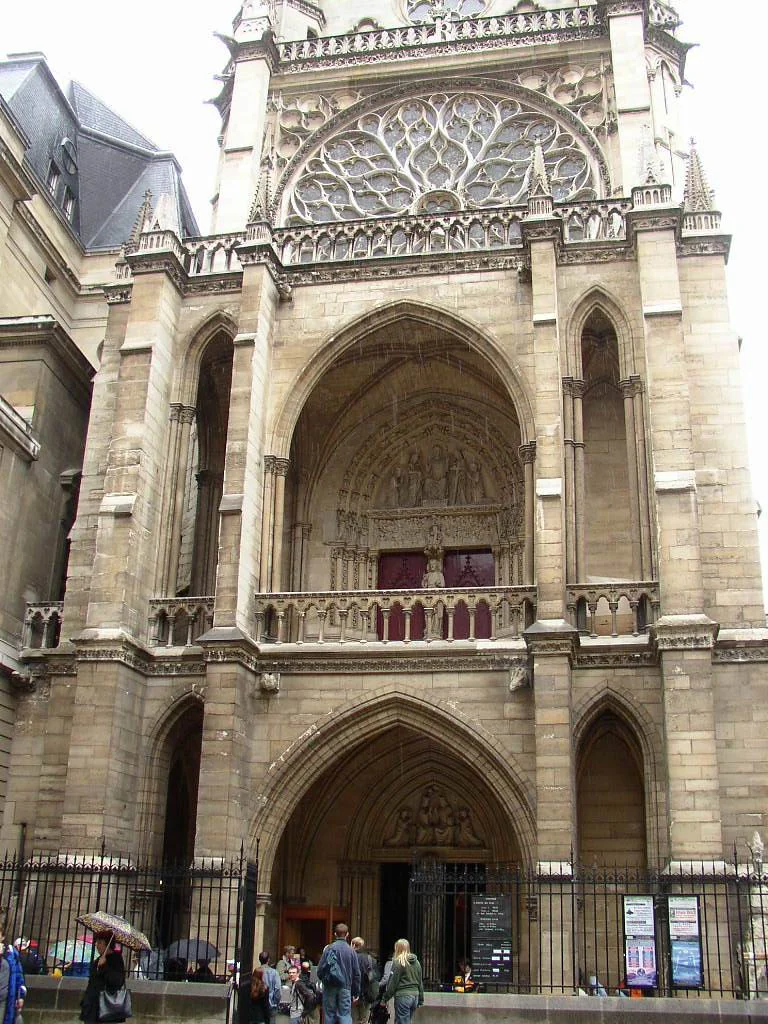
Sainte-Chapelle is a medieval royal chapel on the Île de la Cité, the island in the middle of the Seine in central Paris. Regarded as one of the masterpieces of French Gothic architecture, it is celebrated above all for its towering stained-glass windows, which flood the interior with coloured light and make it one of the most breathtaking spaces in the city. Today it is a historic monument open to visitors and one of the unmissable sights in the old heart of Paris.
Sainte-Chapelle: Location, accommodation options and contact
8 Boulevard du Palais, 75001 Paris, France
The place's location on the map and nearby accommodation and hotel options are shown by Stay22. Cookies are used. Your consent is remembered on every page; you can turn it off at any time in the cookie settings.
King Louis IX built Sainte-Chapelle at remarkable speed, raising the entire structure between 1242 and 1248 within the grounds of the royal residence on the Île de la Cité. The chapel was consecrated on 26 April 1248 and served a single overriding purpose: to shelter the relics of Christ's Passion that Louis had acquired from Constantinople, most famously the Crown of Thorns. Housing such an extraordinary relic inside the royal palace was also a deliberate statement of prestige, casting Paris and the French crown as a new spiritual center of Christendom. The relics were originally displayed on a raised platform at the east end of the upper chapel, visible to the king and his court during private devotions. Although the relics were later moved elsewhere and much of the original reliquary furniture was lost during the Revolution, the chapel purpose-built to hold them still stands essentially intact, one of the few royal buildings from Louis IX's Paris to survive to the present day. According to contemporary accounts, the king paid more for the Crown of Thorns than the entire chapel cost to build.
The Unsolved Mystery of Sainte-Chapelle's Architect
Despite the chapel's fame, no surviving medieval document names the person who designed it. For much of the 19th century, during the building's careful restoration, historians credited the royal master mason Pierre de Montreuil, who is documented working on other Parisian projects of the period. That attribution has since been questioned, and many historians today lean instead toward Jean de Chelles or Thomas de Cormont, both master masons active on major church projects in northern France around the same decades, or toward an unrecorded master possibly trained in the Amiens workshop tradition. Without contracts, signed drawings, or an inscription naming a designer, the debate cannot be settled definitively, and the chapel is sometimes described simply as the work of the finest masons available to the French crown in the 1240s. The uncertainty has become part of the building's appeal: visitors admire a masterpiece of engineering and design whose creative genius remains, eight centuries later, anonymous.
1,113 Scenes: One of the World's Great Stained-Glass Cycles
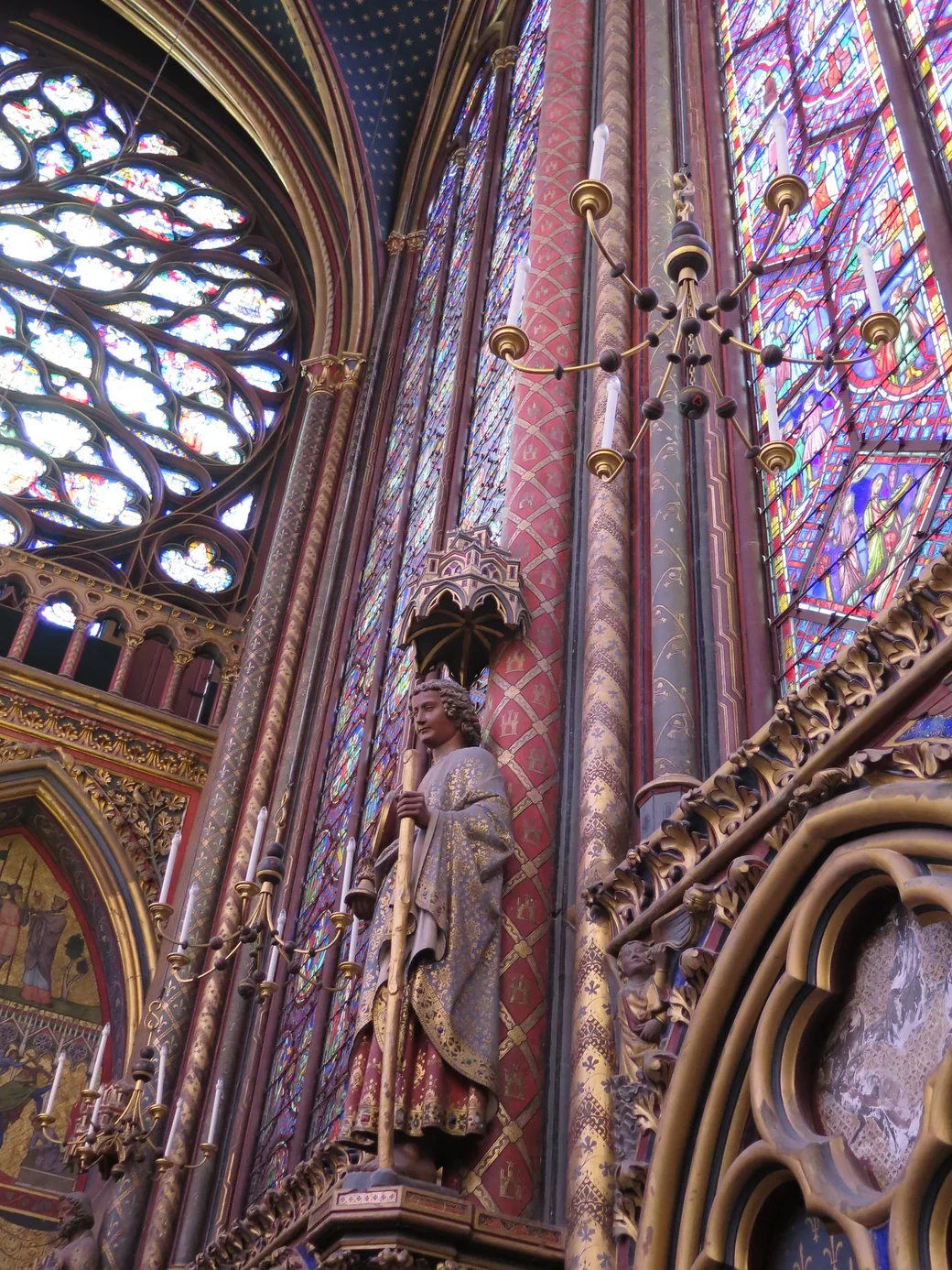
The upper chapel's fifteen windows form one of the oldest and most extensive stained-glass programs to survive from the Middle Ages, comprising roughly 1,113 individually painted scenes across more than 600 square meters of glass. Read from bottom to top and generally left to right, the windows unfold the biblical narrative in sequence, beginning with Genesis and ending with the story of the relics' arrival in Paris, with scenes from Exodus, the story of Esther and the Passion of Christ along the way; the Apocalypse is told separately in the rose window above the entrance. The glass is a masterclass in Rayonnant (“radiant”) Gothic design, in which the stone structure is pared down to the thinnest possible ribs and mullions so that color and light, rather than solid wall, define the interior. Roughly two-thirds of the glass is original 13th-century work, painstakingly conserved through several restoration campaigns, making a visit here one of the closest experiences available anywhere to seeing medieval Paris through medieval eyes. Taken as a whole, the windows read almost like an illuminated manuscript enlarged to the scale of a building, and the chapel is regarded as one of the finest surviving examples of the Rayonnant style in Europe.
Two Chapels in One: Servants' Hall and Royal Sanctuary
Sainte-Chapelle is really two chapels stacked one above the other, each built for a different rank of medieval society. The lower chapel, with its low vaulted ceiling painted deep blue and scattered with gold fleur-de-lis, was used by palace staff, guards, and household servants for their own daily worship. A narrow turret staircase connects it to the upper chapel, the king's private place of prayer, where the ceiling soars far higher and stained-glass windows take over almost the entire wall surface. This vertical arrangement was not just practical but symbolic, keeping the sovereign's devotions physically and visually elevated above the rest of the court. Most visitors move quickly through the atmospheric but modest lower level before climbing to the upper chapel, where the full impact of the building unfolds; taking a moment in the lower chapel first helps make the transition into the radiant upper space even more striking.
Inside the Historic Palais de la Cité
Sainte-Chapelle stands within the walls of the Palais de la Cité, the former royal and judicial heart of medieval Paris, sharing its grounds with the Conciergerie and the present-day Palais de Justice. The Île de la Cité itself, the small island at the very center of Paris where the city began, is included within the UNESCO World Heritage Site "Paris, Banks of the Seine," recognizing the exceptional concentration of historic architecture along the river. Because the chapel sits inside an active judicial complex, its entrance and security arrangements are shared with the surrounding buildings, and the approach to the ticket office passes through the same courtyard used for centuries by the palace's occupants. Exploring the complex gives a sense of how tightly layered Parisian history can be: Roman and medieval origins beneath royal Gothic architecture, a revolutionary-era prison next door, and a functioning courthouse still in use today, all within a few hundred meters of each other.
Best Time to Visit and How to Beat the Crowds
Sainte-Chapelle is compact, and its narrow staircases and small upper chapel fill up quickly, so timing matters more here than at many larger Paris sights. The calmest moments are generally right at opening or in the final hour before closing, when tour groups have thinned out. A clear, sunny morning is especially rewarding, since direct light passing through the east-facing windows makes the glass glow far more vividly than on an overcast day. Booking a timed entry slot online well ahead is strongly recommended, particularly for weekends, school holidays and the summer months, and arriving a little before your slot leaves time for the security screening shared with the Palais de Justice. A visit taking in both chapels usually lasts about an hour, but it is worth leaving extra time simply to stand still beneath windows that have inspired visitors for nearly eight centuries.
Combine Your Visit with the Conciergerie
Sainte-Chapelle and the neighbouring Conciergerie, once part of the medieval royal palace and later a revolutionary prison, are managed together by the Centre des Monuments Nationaux (the French state agency that runs national monuments) and combine easily into a single outing. Pairing the two makes practical sense, since they stand only steps apart within the same historic complex and together tell the fuller story of the Palais de la Cité, from royal residence and chapel to prison and courthouse. Many visitors begin with the stained glass of the chapel and then continue to the Conciergerie's vaulted Gothic Salle des Gens d'Armes, one of the largest surviving medieval halls in Europe. The official Centre des Monuments Nationaux website lists the current combined-visit options.
Reaching Sainte-Chapelle by Metro and RER
The easiest way to reach Sainte-Chapelle is on foot once you are anywhere near the Seine, since the Île de la Cité sits right in the geographic heart of Paris. The nearest metro station is Cité on Line 4, located directly on the island just a couple of minutes' walk from the entrance. Travelers arriving by RER (Paris's regional express rail network) can use Saint-Michel–Notre-Dame, served by both RER B and RER C, a short stroll across a bridge from the Left Bank. Châtelet, one of the busiest interchange stations in the city with Métro Lines 1, 4, 7, 11, and 14 plus RER A, B, and D, is also within an easy ten-minute walk and useful for onward connections. Given how central and walkable the area is, many visitors simply combine a stop here with a stroll along the Seine or a visit to nearby Notre-Dame.
What Else to See on Île de la Cité and Beyond
The chapel's location puts an unusual concentration of major sights within a few minutes' walk. Notre-Dame Cathedral sits at the eastern end of the same small island, while the Conciergerie and Palais de Justice share the chapel's own courtyard to the west. Crossing to the western tip of the island brings you to Pont Neuf, the oldest standing bridge in Paris, with views along the Seine in both directions, and just across the river on the Left Bank lies the Latin Quarter, with its narrow medieval streets, bookshops, and cafés around the Sorbonne. Because the island is so small and largely pedestrian-friendly, it is easy to see several of these landmarks in a single unhurried morning or afternoon before continuing on to other parts of central Paris.
Accessibility at Sainte-Chapelle
Sainte-Chapelle has made real efforts to open a medieval building to visitors with reduced mobility. A ramp at the entrance gives step-free access to the lower chapel, and an elevator, used with the help of staff, takes visitors up to the upper chapel so that the famous windows can be enjoyed without climbing the narrow spiral staircase. Wheelchairs can also be borrowed on site, and service and guide dogs are welcome throughout the building. Contacting the monument before your visit is a good way to arrange assistance with the elevator and plan the smoothest route through the two levels.
Capturing the Stained Glass on Camera
Photography is generally allowed inside Sainte-Chapelle, and the upper chapel rewards a little patience with a camera or phone. The best light typically falls in the morning on a clear day, when direct sun angles through the east and south-facing windows and saturates the glass with color; overcast days produce softer, more muted tones that some photographers prefer for detail shots of individual panels. Tripods and flash are not appropriate in the space, both out of respect for other visitors and because flash adds nothing to glass that is already lit from behind by daylight. Stepping back toward the center of the room and shooting upward captures the full sweep of the vaulted ceiling and windows together, while a longer lens or the zoom on a phone camera helps pick out individual scenes high in the tracery that are easy to miss with the naked eye.
Visiting Respectfully: Security and Conduct
Because Sainte-Chapelle sits inside the Palais de la Cité alongside the Palais de Justice, every visitor passes through airport-style security screening before entering the complex, so it helps to arrive with only small bags and allow a few extra minutes for this step. Once inside, remember that the chapel remains consecrated ground as well as a major heritage site: speaking quietly, silencing phones, and avoiding loud conversation are appreciated throughout, and especially in the upper chapel, where many visitors want a quiet moment to take in the windows. Eating and drinking are not permitted inside, and large bags, suitcases, and certain other items may be restricted or require checking before entry. A calm, unhurried pace suits the building far better than rushing through, and it also happens to be the best way to notice details in the glass and stonework that a quick visit would miss.
Sainte-Chapelle: Visitor Tips
Reserve a timed slot online before you go for the smoothest entry. Bring only small bags, since security screening applies to the whole Palais de la Cité complex. The neighbouring Conciergerie makes a natural pairing on the same outing; allow about an hour for the chapel itself.
Sainte-Chapelle: Best Time to Visit
Visit at opening or in the last hour before closing for a calmer chapel, ideally on a sunny morning when the glass glows. Book a timed slot online early, especially in summer and holiday periods.
Sainte-Chapelle: Admission Fees
Adult – non-EEA visitors
Rate for visitors who are neither nationals nor residents of an EEA country. Timed-entry ticket for the Gothic royal chapel with its stained-glass windows.
€22
Adult – EEA nationals/residents
Rate for nationals or residents of an EEA country; proof of eligibility is required. Timed-entry ticket for the Gothic royal chapel with its stained-glass windows.
Rate for visitors who are neither nationals nor residents of an EEA country. One ticket for both monuments; the Sainte-Chapelle visit requires a timed slot, while the Conciergerie can be visited on the same day at any time.
Rate for nationals or residents of an EEA country; proof of eligibility is required. One ticket for both monuments; the Sainte-Chapelle visit requires a timed slot, while the Conciergerie can be visited on the same day at any time.
€23
Under 18 (free)
Free for all visitors under 18, whatever their nationality. A valid ID showing date of birth may be requested.
Free
Ages 18–25 from the EEA (free)
Free for nationals or residents of an EEA country aged 18 to 25. ID (and proof of residence where relevant) is required.
Free
Visitors with disabilities + companion (free)
Free for visitors with a disability, plus one companion. Proof of disability status is required.
Free
First Sunday of the month (free)
Free for everyone on the first Sunday of the month, from November to March.
Free
Job seekers from the EEA (free)
Free for job seekers from the EU or EEA who show a job-seeker certificate less than six months old.
Free
Quick Info
1h
easy
Sainte-Chapelle: Getting There
Sainte-Chapelle sits in the heart of the Île de la Cité, easily reached on foot from almost anywhere in central Paris. The closest metro station, Cité (Line 4), is right on the island, just a short walk away. Saint-Michel–Notre-Dame, served by RER B (Paris's regional express rail network) and RER C, is a few minutes further on foot across the river, and Châtelet, one of the city's largest interchange stations, is also within easy walking distance for visitors coming from the Right Bank.
Nearby stops & parking
Cité (Métro Line 4) is the nearest station, directly on the Île de la Cité. Saint-Michel–Notre-Dame (RER B and RER C, Paris's regional express rail network) sits just across the Seine on the Left Bank, about a five-minute walk away, and Châtelet–Les Halles (Métro Lines 1, 4, 7, 11, 14 and RER A, B, D) is roughly ten minutes on foot, making it a convenient hub for onward travel across the city.
Sainte-Chapelle: Dress Code & Etiquette
Sainte-Chapelle remains consecrated ground and part of a working historic monument, so while there is no strictly enforced dress code as at an active parish church, modest, respectful clothing is appreciated, with covered shoulders and knees a sensible default. Visitors are asked to keep voices low, silence phones, and move quietly through the upper chapel, since the space is still treated as a place of reflection as well as a major heritage site.