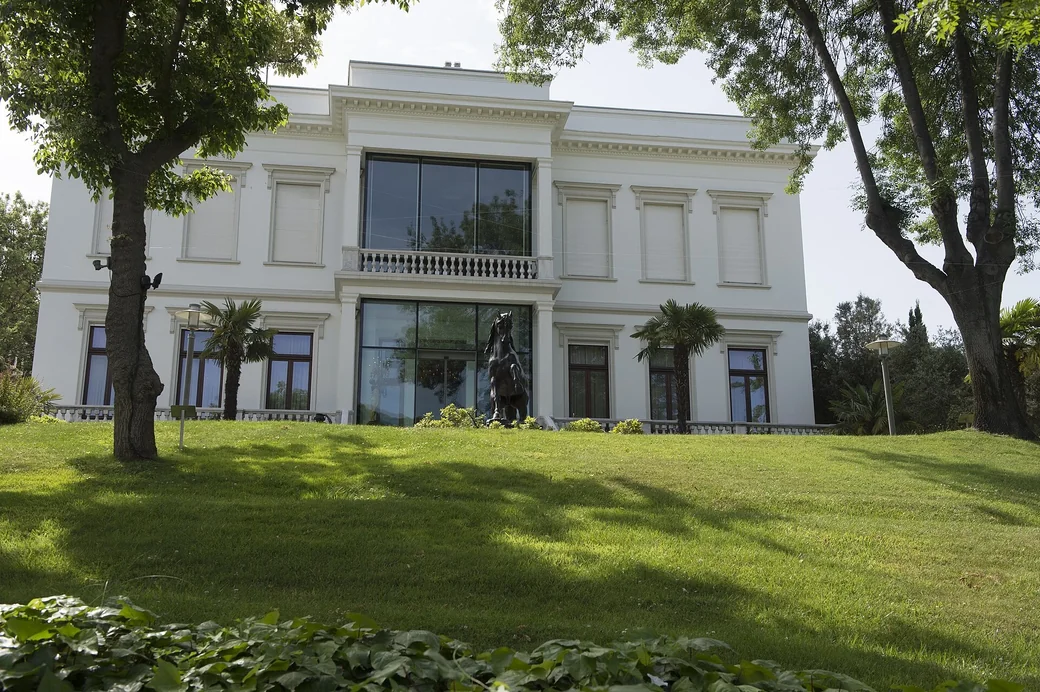
The Sakip Sabanci Museum (Sakıp Sabancı Müzesi) is an art museum in Emirgan, on the European shore of the Bosphorus in Istanbul's Sariyer district. It is housed in a historic mansion known as Atli Kösk (Atlı Köşk), the Equestrian Villa, which looks out over the water from its garden. Known for its Ottoman calligraphy, its paintings and its major international exhibitions, the museum is one of the most elegant cultural addresses on the Bosphorus.
Sakip Sabanci Museum: Location, accommodation options and contact
Sakip Sabanci Caddesi No: 42, Emirgan, 34467 Sariyer, Istanbul
The place's location on the map and nearby accommodation and hotel options are shown by Stay22. Cookies are used. Your consent is remembered on every page; you can turn it off at any time in the cookie settings.
The Story of the Sakip Sabanci Museum: Atli Kösk Through the Years
In the 1840s a waterside mansion stood where the villa is today. In 1925 Prince Mehmed Ali Hasan had it pulled down and commissioned the architect Edoardo De Nari to build a new one, finished in 1927 and used for many years as a summer residence by various members of the Khedival family (the dynasty of Egypt's viceroys). In 1951 Haci Ömer Sabanci bought the villa together with some of its valuable furnishings and objects. After his death, Sakip Sabanci and his family moved in permanently. The house and its collection were handed to Sabanci University in 1998, opened as a museum in 2002 and enlarged with new galleries in 2005. What you walk through today is both a family home and an art museum. The villa has since undergone a comprehensive restoration; after nine months of work it reopened with a new room created from furnishings that had been kept in storage.
Why Is It Called Atli Kösk? The Bronze Horse Statues in the Garden
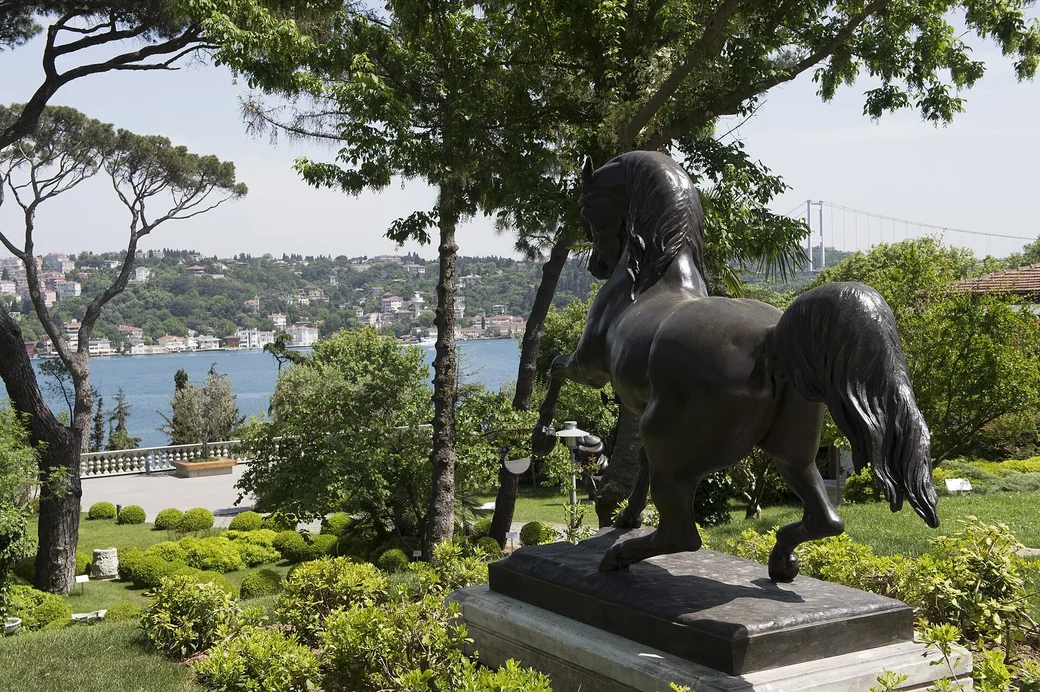
The statue that gave the villa its name is a bronze horse dated 1864. Made by the sculptor Louis Doumas, it was bought at an auction held at the Marble Mansion of Mahmud Muhtar Pasha in Moda and placed in the garden, after which locals began to call the house Atli Kösk (Atlı Köşk). The museum dates this horse in front of the villa to 1956, although other sources give earlier years. The second horse, at the entrance and facing the street, is a cast of one of the four horses standing before St Mark's Basilica in Venice, which were carried off from the Hippodrome of Constantinople during the Fourth Crusade in 1204. The two statues in the garden therefore reach back to two very different chapters of Istanbul's history. The museum adds that the cast at the entrance was ordered from abroad and set up in 1955, and that over time both horses became identified with the villa.
Atli Kösk Legends: A Horse, a Deer and Vehbi Koç at the Auction
Legend has it that when the horse statue came up for auction, Vehbi Koç, knowing Haci Ömer Sabanci wanted it, kept raising the bid to test his rival; in the end the horse went to Sabanci. The deer statue sold next was bought by Koç, and according to the story it now stands in front of the Divan Hotel. Sakip Sabanci tells the tale in his memoirs and says the episode caused friction between the two industrialists. Another account holds that, since Haci Ömer had spent his youth riding a donkey, the horse was a symbol of wealth in his eyes. Two versions also circulate about the second horse at the entrance: by one, a business partner who sold them machinery gave a copy as a gift, by the other, Haci Ömer took a mould of a statue he admired at a businessman's home abroad and had it cast. It is also said that the villa briefly served as an embassy, though no official source confirming this has been found.
The Calligraphy Collection: Ottoman Book Arts from the 14th to the 20th Century
The Arts of the Book and Calligraphy Collection is one of the museum's most distinctive sections. On the upper floor, it runs from the late fourteenth century to the twentieth and includes handwritten Qur'ans, prayer books, single-sheet works by illuminators and calligraphers, diplomatic documents bearing the sultan's tughra (calligraphic imperial monogram), and elegant writing tools made of silver, coral and ivory. Masters such as Sheikh Hamdullah, Hafiz Osman, Sekerzade Mehmed and Necmeddin Okyay are represented, and QR codes on the labels let you browse whole manuscripts digitally. A video installation by Kutlug Ataman links the collection to contemporary art. Sakip Sabanci built up the collection over many years. Calligraphy is sensitive to light, so the display changes from time to time; check the museum's website before you go to see which parts are on view. Selections from the collection have also been shown in Madrid and Seville. If you are new to calligraphy, a guided tour makes the stories behind the panels and the different scripts much easier to follow.
The Painting Collection: From Osman Hamdi Bey to Fikret Mualla
The painting collection brings together early examples of painting made in Istanbul in the last years of the Ottoman Empire and after. It holds works by Osman Hamdi Bey, Seker Ahmed Pasha, Süleyman Seyyid, Ibrahim Çalli and Fikret Mualla, along with paintings by Fausto Zonaro and Ivan Aivazovsky, who worked in Istanbul in the late Ottoman period. Some sources say the collection includes more than three hundred and twenty paintings and sculptures, though that figure may be out of date. The painting and calligraphy collections are shown as separate permanent collection displays. Seeing the Bosphorus of the past in the city views is a good chance to compare it with the real water outside the window.
The Family Rooms and Decorative Arts: Walking Through the Sabanci Home
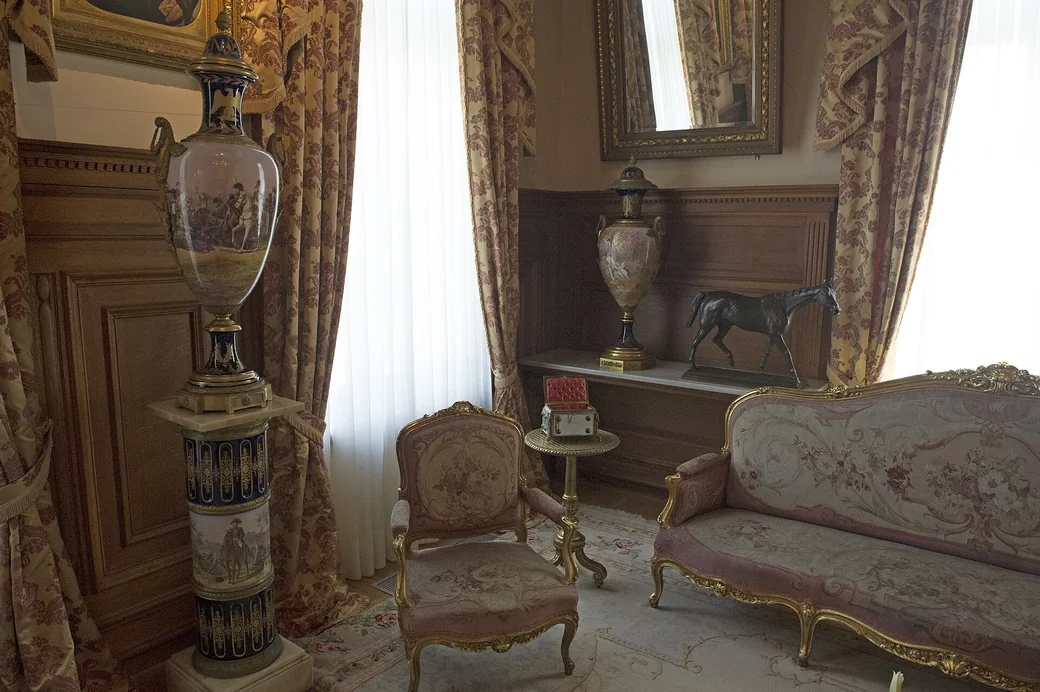
The Family Rooms on the lower floor carry traces of a household's daily life, with furniture, chandeliers and decorative objects reflecting the Western-leaning taste of the Ottoman elite in the nineteenth century. Several of these rooms, which hold decorative arts of the eighteenth and nineteenth centuries, are kept as the Sabanci family lived in them; Haci Ömer Sabanci collected the chandeliers, vases, figurines and oil paintings with care. The rooms also show photographs of Sakip Sabanci with statesmen, along with his decorations and personal belongings. The museum has research-oriented collections too, such as the Abidin Dino Archive and the Emirgan Archive. Lingering here before the galleries is a good way to grasp the spirit of the museum. The reception salons on the lower floor, known as the Pink Room and the Blue Room, and the grand Dining Room once welcomed diplomats and cultural figures as well as the family; gilded mirrors, silk-upholstered armchairs, vases bearing the Napoleonic crest and tapestry sets complete the picture. Ai Weiwei's two-part porcelain installation Column (2006-2007), made in Jingdezhen, also stands on this floor.
Picasso in Istanbul and the Museum's Firsts: Record-Breaking Exhibitions
Open from 24 November 2005 to 26 March 2006, Picasso in Istanbul was, in the museum's own words, the first comprehensive exhibition devoted to a world-famous artist in the country. It showed 135 works: 51 oil paintings, 47 drawings, 13 ceramics, 12 sculptures, 8 engravings, 2 lithographs and 2 tapestries. About 254,000 people saw it, a record for its time, with 10,000 visitors in the first four days, and the show was covered by the Financial Times and the New York Times. According to Hürriyet, the idea for a Picasso show first came from Sakip Sabanci himself. The museum has also taken selections of its Ottoman calligraphy collection to Madrid and Seville, introducing it abroad.
Temporary Exhibitions, Concerts and the Digital Archive: What's On
Through large international temporary exhibitions, the museum brings many internationally known artists to Istanbul. Alongside the shows it runs concerts, conferences, seminars and learning programmes for both children and adults, and its conservation and research units are part of daily work. If you cannot visit, or want to prepare first, the digitalSSM archive database and the Google Arts & Culture page are there for you, and some past exhibitions have also been presented online. The programme changes often, so the best way to see which temporary exhibitions are open is to check the Exhibitions and Events section of the official website before you go. The museum also runs a membership programme that gives year-round privileged access to exhibitions and events.
A Bosphorus Garden with Sculptures, Stonework and 115 Plant Varieties
The official presentation of the garden describes it as one of the loveliest spots on the Bosphorus, with 115 plant varieties. Alongside sculptures, fountains and columns there are contemporary art installations, and archaeological and stone pieces from the Roman, Byzantine and Ottoman periods are also shown outdoors. The horse statues in front of the villa are the most photographed figures in the garden. It offers a quiet place to sit and watch the Bosphorus, perfect for resting after a dense round of galleries. If the weather is fine, give the garden plenty of unhurried time. Anish Kapoor's granite sculpture Double, which joined the collection after his solo exhibition at the museum in 2013-2014, also stands in the garden and plays with light and void.
The Museum Restaurant, Shop and Places to Take a Break
MSA's Restaurant serves menus inspired by cuisines from around the world with a view of the Bosphorus; the dishes are prepared and served by MSA's chef and students. The museum shop sells design products and gifts inspired by the collections and exhibitions, and purchases are said to support the exhibition and education programmes. Visitor reviews often praise the terrace and the view. The restaurant's hours may not match the museum's exactly, so if you are planning a meal, ask the museum before you go. The restaurant and the garden are the best places to catch your breath in the middle of the visit.
How Long Does the Sakip Sabanci Museum Take? A Suggested Route
We suggest allowing two to three hours for the Sakip Sabanci Museum (Sakıp Sabancı Müzesi). Begin with the Family Rooms and the collection halls, move on to the temporary exhibition galleries, then head out to rest in the restaurant or the garden. If you want a guided tour, book the one-hour adult tours in advance; groups are limited to twenty-five people. Ticket sales and last entry stop shortly before closing, so do not arrive late in the afternoon. If you are visiting with children, keep the garden for the end, so they have somewhere to run once the galleries start to tire them. Even two hours is enough for a quick visit. Combined with the garden, the restaurant and the shop, the visit easily becomes an unhurried half-day outing that blends art, history and Bosphorus views.
Best Time to Visit, Avoiding Crowds and Photo Spots
Arriving on a weekday morning as the museum opens gives the calmest experience; Tuesdays and weekend afternoons get noticeably busier. In spring, when the tulip season begins in Emirgan Park, the whole area comes alive, so leave early to avoid traffic and parking trouble. The best photo spots are the horse statue at the entrance facing the street, the bronze horse in the garden, the garden terraces looking over the Bosphorus and the villa's facade. Photography rules inside can vary by exhibition, so make a habit of asking the staff before you shoot. For the best daylight, choose the early part of the afternoon. The museum is closed on the first day of each of the two major religious festivals (Ramazan Bayramı and Kurban Bayramı) and on 1 January, so plan around those days.
Accessibility, Visiting with Family and Guided Tours
According to the museum's official page, visitors can reach the exhibition spaces by wheelchair using the passageways and the lift, and restrooms designed for disabled visitors are available. If you have specific needs for the garden or the historic parts of the villa, it helps to ask the museum staff before your visit. Guided tours are arranged for adults and for students; the adult tours last one hour with groups of at most twenty-five, and you can email the museum's learning department for details. There are also workshops and learning programmes for children. Ask in advance which languages the guided tours are offered in; the museum's official website is published in two languages.
Dos and Don'ts at the Sakip Sabanci Museum
Do: remember that an online ticket is valid only for the day it was bought for, and carry ID in case your ticket requires it. Keep your voice low in the galleries, look at the objects and display cases from a distance, and follow the staff's directions. Don't: touch the objects, walls or display cases, use flash, or climb on or lean against the statues in the garden. Since photography rules can differ by exhibition, always ask before shooting, especially in the temporary shows. Put your rubbish in the bins provided in the garden.
What's Nearby: Emirgan Park, Rumeli Hisari and More
Emirgan Park, right next to the museum, is a large park of about 47 hectares; the grounds are known as the place where Khedive Ismail Pasha lived in exile, and the park is famous for its tulip festival in spring. Inside stand the Yellow, Pink and White pavilions that Khedive Ismail Pasha had built in the 1870s. In the square of Emirgan you can have tea in the shade of the plane trees and see the historic Hamid-i Evvel Mosque. Towards Sariyer lies the Sadberk Hanim Museum (Sadberk Hanım Müzesi), and to the south Rumeli Hisari (Rumeli Hisarı), with Anadolu Hisari (Anadolu Hisarı) facing it across the Bosphorus. Visiting the museum in the morning and the park in the afternoon is an easy way to turn one day into a Bosphorus route of art and nature. Emirgan itself is one of the oldest settlements on the Bosphorus, which adds a sense of history to any stroll through the neighbourhood.
Sakip Sabanci Museum: Visitor Tips
Start with the Family Rooms and the collection halls, move on to the temporary exhibition galleries, and save the garden and terrace for last. Ticket sales stop thirty minutes before closing, so avoid arriving late in the day. Ask the staff about photography rules for the exhibition you are seeing; as in most museums, flash and touching the objects are not allowed. Allow two to three hours and you will still have time for the garden and the restaurant. Online tickets are valid only for the day you buy them for.
Sakip Sabanci Museum: Best Time to Visit
Weekday mornings right after opening; spring, when the tulips bloom in nearby Emirgan Park. Tuesdays and weekends are busier, and the museum is closed on Mondays.
Sakip Sabanci Museum: Admission Fees
Adult
Standard adult admission to the museum's mansion and galleries.
TRY 450
Discounted – teachers, ages 65+, students over 18
Reduced rate for teachers, visitors aged 65 and over and students over 18; ID is required.
TRY 330
Student (over 14)
Student rate for visitors over 14; the student card is checked when the ticket is issued.
TRY 225
Free Tuesdays
Admission is free on Tuesdays during opening hours.
Free
Children up to 12 (free)
Free entry for children aged 12 and under; proof of age may be requested.
Free
Visitors with disabilities + companion (free)
Free for visitors with a disability and one companion; proof of eligibility is required.
Free
Quick Info
2h 30m
easy
Sakip Sabanci Museum: Getting There
The museum stands on the European shore of the Bosphorus, on Sakip Sabanci Caddesi in Emirgan. By public transport, take the IETT (Istanbul public transport) buses that run along the coast road from the Kabatas and Besiktas direction and get off at the Çinaralti stop; other lines also serve Emirgan. If you prefer the metro, there are connections such as ring services from Levent along the Baltalimani road and shuttle links between Rumeli Hisarüstü and the Istinye or Haciosman metro area. Routes change from time to time, so check the current line information in the Istanbul public transport app before you set out.
If you would rather arrive by water, tour boats and private boats that call at Emirgan can be an option, though sailings vary with the season and demand. Drivers follow the Bosphorus coast road to Emirgan. The museum's own car park is small and fills up fast, so it is easier to arrive close to opening time or to take a taxi.
Nearby stops & parking
The nearest bus stop is Çinaralti in the centre of Emirgan, on the same street as the museum. The visitor car park has limited space. If it is full, try the parking areas along the coast road and around Emirgan Park, but be aware that the area gets very crowded on weekends and in spring. Taxis can drop you at the main entrance, and you can order a ride with a taxi app for the return trip. Small private boats sometimes run between Emirgan and Kanlica on the opposite shore, depending on demand; they are not a regular service.
Sakip Sabanci Museum: Dress Code & Etiquette
There is no strict dress code at the museum. Comfortable walking shoes are the best choice for the galleries and the garden, and soles that grip are useful on the wooden and marble floors of a historic mansion. The wind off the Bosphorus can feel cool, so bring a light jacket. Keep your voice down in the galleries, do not touch objects or display cases, and follow the staff's instructions. If you plan to step into a nearby place of worship such as the Emirgan Mosque, wear clothes that cover your shoulders and knees.