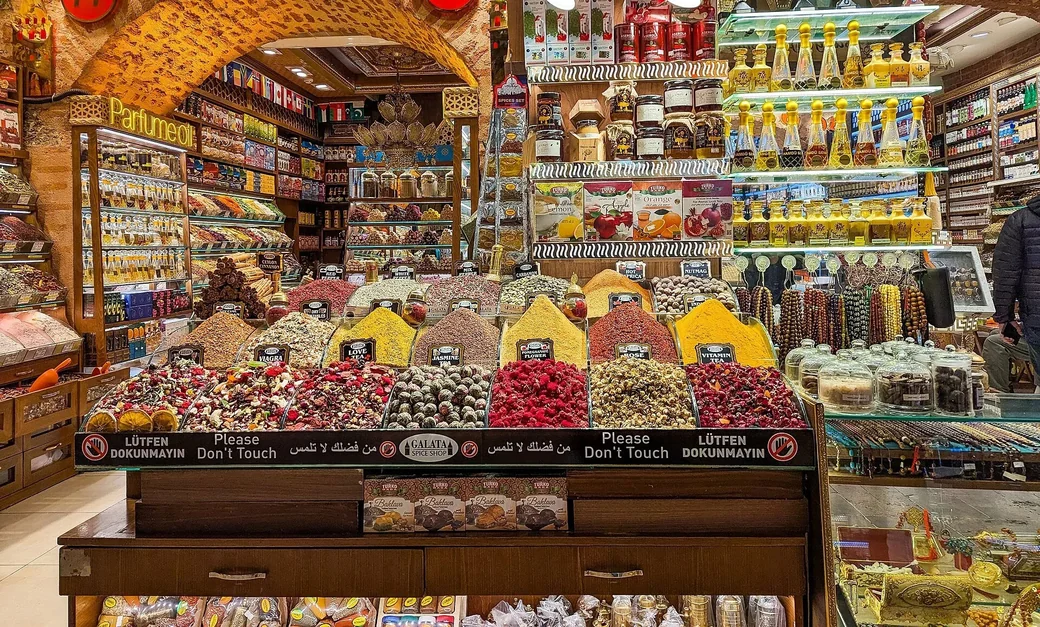
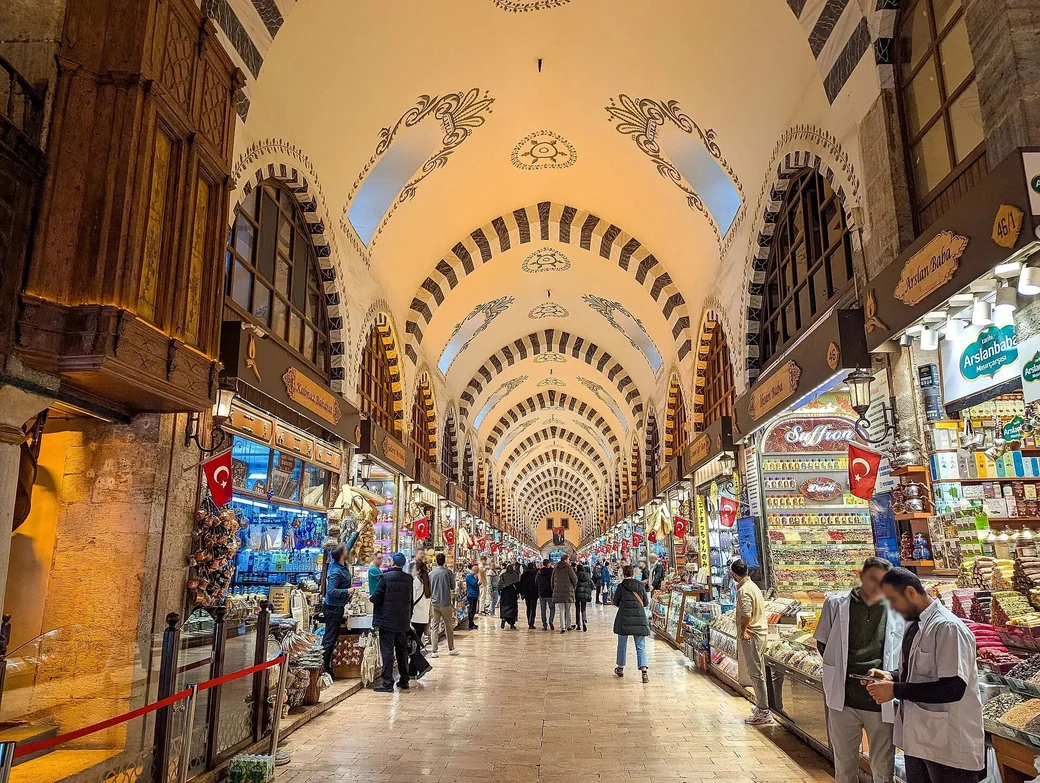
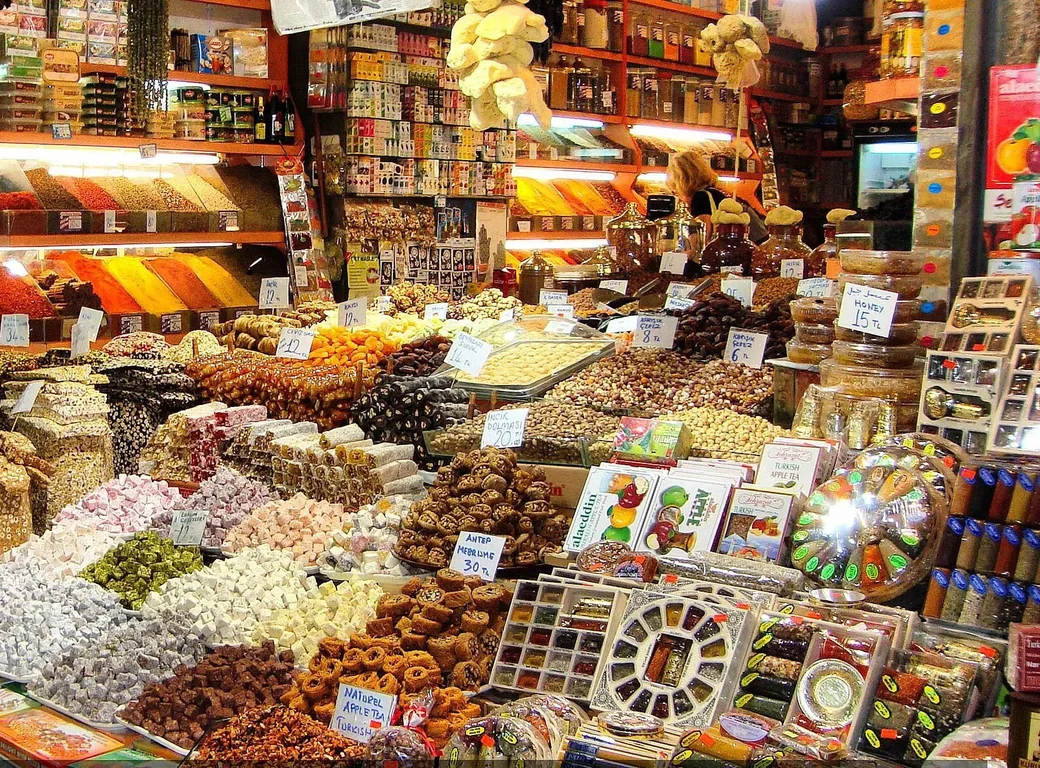
The Spice Bazaar (Mısır Çarşısı), often called the Egyptian Bazaar, is a historic covered market in Eminonu (Eminönü), on the Golden Horn waterfront in Istanbul's old city. Its vaulted corridors are lined with shops selling spices, teas, Turkish delight, dried fruit and nuts, and the air is rich with their aromas. It is one of the city's most atmospheric places to browse, taste and pick up edible souvenirs to take home.
Spice Bazaar (Egyptian Bazaar): Location, accommodation options and contact
Rüstem Paşa Mahallesi, Erzak Ambarı Sokağı No:92, Eminönü, 34116 Fatih/Istanbul, Türkiye
The place's location on the map and nearby accommodation and hotel options are shown by Stay22. Cookies are used. Your consent is remembered on every page; you can turn it off at any time in the cookie settings.
Spice Bazaar history: built around 1660 as the New Mosque's income market
The Spice Bazaar is the arasta of the New Mosque complex, which Hatice Turhan Sultan, mother of Sultan Mehmed IV, ordered to be completed around 1660. In other words, it is an endowment market whose shop rents paid for the mosque's expenses. According to the sources it opened with a ceremony in 1663–1664. The chief court architect Kâzım Ağa is named as the man who started it and Mustafa Ağa as the one who finished it, but accounts differ, so it is safest to say "according to the sources". In the seventeenth century it was called the New Bazaar and the Valide Bazaar; the name Egyptian Bazaar took hold after the middle of the eighteenth century.
The 66-year story of the New Mosque and its legends: from Safiye Sultan to Hatice Turhan Sultan
To understand the bazaar you need the story of its neighbour, the New Mosque. Its foundations were laid in 1597 on the orders of Safiye Sultan, wife of Murad III. The homes of the Jewish community in the area were expropriated and the residents moved to Hasköy; some accounts say the owners were paid double. After Mehmed III died and Safiye Sultan lost her influence, construction stood unfinished for decades until Hatice Turhan Sultan restarted it in 1661. The mosque was completed in the mid-1660s (1663 or 1665, depending on the source) and, taking about 66 years, is remembered as the longest mosque construction in Ottoman history. According to legend, Safiye Sultan, who was of Venetian origin, wanted a mosque right on the water's edge, and according to legend it was the first mosque built on Istanbul's shoreline. According to legend, Köprülü Mehmed Pasha persuaded Hatice Turhan Sultan by saying that finishing the half-built mosque was better than starting a new one. According to the sources, the mosque was damaged in the Great Fire of Istanbul on 24 July 1660. Some sources also credit it with 66 domes, a number often mentioned as a coincidence alongside the 66 years of construction.
Why is it called the Egyptian Bazaar? Origins and legends
Several explanations circulate for the name Egyptian Bazaar. The part based on official sources is this: most of the spices and medicinal raw materials sold in the shops came by way of Egypt, and from the middle of the eighteenth century the market was called by that name. According to legend, the building was paid for with taxes collected in Egypt, especially Cairo. According to another legend, the market was named after the Egyptian caravans that brought goods from India and the Far East to Istanbul. According to legend, a spice market named Makron Envalos stood on the same site in Byzantine times; this story is not regarded as established fact. Foreign travellers consistently referred to the building as the Egyptian Bazaar in their travel books. The word çarşı itself, according to the Fatih district governorate's page, comes from Persian: cahar (four) and su (side, street), so it literally means "four streets". Whatever their basis, these tales reflect the identity the bazaar has carried for centuries.
Architecture: the L-shaped plan, six gates and the Prayer Square
The Spice Bazaar is an arasta in classical Ottoman style, built in alternating courses of stone and brick on an L-shaped plan, with the east-west arm the longer one. It is described as a "double bazaar" because it joins two markets into one. Where the two arms meet stands the Prayer Square, covered by a cross vault whose arches rest on piers rather than walls. The kiosk in this space was used for calls to prayer and announcements, and it is said that an official would call out to the merchants here and pray for a prosperous day. There are six gates, four large and two small, and the arcaded upper floors above the main entrances once served as courtrooms. The Haseki Gate is one of them. Each shop has a high window, and skylights above the corridor bring in daylight. According to the Fatih district governorate, the original plan had 88 vaulted bays and cells inside and 18 shops outside along Tahmis Street. Over time the gates have been known by names such as the New Mosque (Yeni Cami) Gate, the Tahmis/Hasırcılar Gate, the Tahtakale/Ketenciler Gate, the Flower Market Gate, the Garden Gate and the Haseki Gate. In a late-seventeenth-century engraving the bazaar and the New Mosque appear inside an outer wall facing the sea; that wall was taken down in the second half of the nineteenth century, and only the tower on which the mosque's imperial pavilion (Hünkâr Kasrı) stands survives.
Herbalists, the "natural pharmacy" and the lantern-and-egg shop signs
When the bazaar was first built it was reserved for herbalists and cotton merchants; herbalists used forty-nine of roughly one hundred shops. It worked as a kind of "natural pharmacy": prescriptions made from herb mixtures were hung in front of the shops and offered to customers. Some shops carried a fire tower, a small boat, an ostrich egg, scissors, a tassel or a lantern under the eaves. According to the Fatih district governorate's page on the bazaar, the idea was that a customer unhappy with a purchase could say "from the shop with the lantern" or "the one with the egg", so the signs worked as a form of consumer protection. Some shops still sell herbal mixtures today.
Fires, restorations and a changing market: from 1691 to today
The bazaar came close to destruction more than once. A fire in 1688 damaged the wooden shops in the streets outside it, and in January 1691 another fire burned almost the entire market, sparing only a few shops with iron doors. Some sources also mention a large fire in 1940. In 1864 the makeshift shops between the New Mosque and the bazaar were removed and later returned, and in 1941 a road cut between the two, separating the mosque from the market. The Istanbul Municipality carried out a major restoration between 1940 and 1943, in which the back rooms of the shops were merged with their fronts and the original layout largely disappeared. According to one source, the General Directorate of Foundations undertook another restoration between 2013 and 2018. Over the years the range of goods has grown well beyond spices, and today the shops also offer delicacies, gifts and souvenirs of every kind.
What to buy at the Spice Bazaar: spices, tea, Turkish delight and more
For cooking, the standouts are sumac, chili flakes, Urfa pepper (isot), dried mint, cumin and good saffron. In the tea department, Rize tea, linden and apple tea are popular, and Turkish coffee is an easy addition. Turkish delight comes in flavours such as rose, pistachio, pomegranate, citrus and hazelnut, and baklava travels well when vacuum-packed. Dried figs and other dried fruit, nuts, grape molasses, fruit leather and olive-oil soap also make good gifts. Buying spices in amounts you can use within about three months is the easiest way to keep them fresh. Dried thyme is another fragrant favourite that is light to carry home.
Smart shopping tips: taste first, beware of cheap saffron, and bargain
Shopkeepers often offer tastings, so choose Turkish delight and tea by tasting, and prefer lokum (Turkish delight) freshly cut from the block over ready-made boxes. Real saffron consists of deep red threads with yellowish tips and is sold in sealed packs; an unusually cheap offer calls for caution. Say that you will carry your purchases home and ask for vacuum packing. Prices are marked, but bargaining is common for larger purchases; do it with a smile and without hurrying. Visiting a few shops to compare is a good habit, and according to some guides, shops on Hasırcılar Street just outside the bazaar offer the same products on better terms. Stay away from dubious "power mixes".
Spice Bazaar best time to visit, crowds and how long to stay
The best moments are weekday mornings soon after the bazaar opens and the late afternoon, when the corridors are calmer; the middle of the day, especially at weekends, is the busiest. Winter days are quieter, and because the hall is covered you can visit in rain or cold. The bazaar is reported to be closed on religious holidays and on 29 October, Republic Day; arrangements can also change during Ramadan and on other public holidays, so check current information before you go. A quick circuit takes 30 to 60 minutes; allow about two hours if you add the surrounding streets and the Rüstem Pasha Mosque.
How to get to the Spice Bazaar: tram, Marmaray, ferry and on foot
The easiest way is the T1 tram: get off at Eminönü and walk two minutes towards the New Mosque. With Marmaray, get off at Sirkeci and either change to the tram or walk about ten minutes. Ferries from Kadıköy, Üsküdar and Beşiktaş dock at the Eminönü piers. You can walk over the Galata Bridge from Karaköy, or come down Mahmutpaşa hill from the Grand Bazaar. Driving is not recommended, since traffic is heavy and parking is limited. Because the bazaar has six gates, say which gate you mean when meeting friends or taking a taxi; the New Mosque Gate is a good reference.
Photo spots and ways to avoid the crowds
The quietest shots come in the first hours after opening, when the arched corridors, vaults and pyramids of spices look emptier. The cross vault of the Prayer Square and the skylights above the corridor make fine architectural frames. Ask before photographing people or shopkeepers; most are happy to pose when asked politely. At busy times, walk the outside loop (Hasırcılar–Rüstem Pasha–Balkapanı) first and enter the bazaar last. Cafés on the upper floors of the hans around the bazaar may offer calmer views over the market square.
Nearby stops: the New Mosque, Rüstem Pasha Mosque, Hasırcılar and the Eminönü waterfront
When you step out, the New Mosque is right beside you, and the Rüstem Pasha Mosque, a work of Sinan with an interior covered in İznik tiles, is a short walk away. Just outside the Hasırcılar Gate, the queue at Kurukahveci Mehmet Efendi, in business since 1871, is easy to spot. The Flower Market and Tahmis Street are worth a stroll, and the Eminönü waterfront offers fish-sandwich stalls and the view of the Galata Bridge. The Grand Bazaar is about ten minutes' walk away; it is much larger and sells mostly jewellery, carpets and textiles, while the Spice Bazaar is focused on food.
Do's and don'ts: etiquette and dress
Do greet the shopkeepers, accept tastings politely, compare prices in several shops, carry your bag in front of you, and check the contents of a package before you take it. Don't buy under pressure, don't give in to "only for this moment" urgency, don't photograph people without permission, and don't stand for long in the narrow corridor and block the way. For the bazaar itself, comfortable shoes are enough. If you visit the neighbouring mosques, shoulders and knees should be covered, women should cover their hair, shoes must be removed, and visits should avoid prayer times.
Accessibility, visiting with children, guides and languages
The main L-shaped corridor is flat and wide, so the bazaar is considered partly accessible for wheelchairs and strollers; however, movement becomes difficult at busy times, and the stone paving in some surrounding streets can be uneven. One traveller guide reports security checks at the entrances. With its colourful stalls and tasting offers it appeals to visitors of all ages, but keep children close in the crowds. Food and culture tours starting at the bazaar and private guides work in various languages. Tourist-oriented shops often speak more than one language, but the options vary by tour and by shop.
Safety and facilities: pickpockets, restrooms and cafés
Pickpocketing and street theft are common in the busiest tourist areas of any big city, and the crowded corridors of the bazaar call for care. Keep your wallet and phone in a front pocket and carry a backpack in front of you. There are public restrooms in and around the bazaar and plenty of cafés and restaurants; for a hot drink you can stop at Kurukahveci Mehmet Efendi or one of the tea houses nearby. The covered hall can be visited in rain and cold.
Spice Bazaar (Egyptian Bazaar): Visitor Tips
Walk the surrounding streets first to compare quality and prices before you buy. Taste Turkish delight and tea before choosing, and ask for vacuum packing for anything you take home. Be cautious about saffron offered at a suspiciously low price. Early morning is the easiest time to photograph the arched corridors without crowds. The bazaar has several gates, so name the gate when arranging a meeting point, for example the New Mosque gate. In crowds, carry your bag in front of you.
Spice Bazaar (Egyptian Bazaar): Best Time to Visit
Weekday mornings soon after opening or the late afternoon are calmest, and work best at weekends too. Winter is quieter, and the covered hall works in any weather.
Spice Bazaar (Egyptian Bazaar): Admission Fees
Free admission
Wandering through the bazaar's aisles is free; you only pay for the spices and sweets you choose.
Free
Quick Info
1h
easy
Spice Bazaar (Egyptian Bazaar): Getting There
The Spice Bazaar sits right beside Eminönü Square, which makes it one of the easiest places in Istanbul to reach. The simplest route is the T1 Bağcılar–Kabataş tram: get off at the Eminönü stop and walk about two minutes towards the New Mosque. If you arrive by Marmaray, get off at Sirkeci; from there you can change to the tram or walk for roughly ten minutes.
From the Asian side, ferries from Kadıköy, Üsküdar and Beşiktaş dock at the Eminönü piers, a few minutes' walk from the bazaar. Many city buses also serve Eminönü. If you start from Karaköy, you can simply walk across the Galata Bridge, and from the Grand Bazaar the downhill walk along Mahmutpaşa takes about ten minutes.
Driving is not recommended because traffic is heavy and parking is limited. If you do come by car, look for car parks around Sirkeci or Eminönü. When you use a taxi or ride-hailing app, do not just say "Mısır Çarşısı"; name the gate on the New Mosque side, because the bazaar has more than one entrance.
Nearby stops & parking
The closest stop is Eminönü on the T1 tram line, about two minutes on foot from the bazaar. The Eminönü ferry piers (Kadıköy, Üsküdar and Beşiktaş services) and the bus platforms are also very close. For Marmaray passengers the nearest station is Sirkeci, with a short walk to the Eminönü waterfront. For parking, check the car parks around Sirkeci and Eminönü; spaces can be hard to find at weekends and around midday. Taxis and ride-hailing cars usually drop passengers around Eminönü Square, and the New Mosque side is a good meeting point. Parking in Eminönü and Sirkeci is limited and changes through the day and week, so check current availability before driving.
Inside the bazaar, comfortable clothes are enough, and comfortable shoes matter because you will be walking on stone floors among crowds. Greeting shopkeepers, accepting tasting offers politely and bargaining with a smile are all part of the etiquette. Ask permission before photographing people or stalls. If you plan to visit the neighbouring New Mosque or the Rüstem Pasha Mosque, cover your shoulders and knees, women should cover their hair, remove your shoes and keep quiet, and avoid visiting during the call to prayer and prayer times.