The Süleymaniye Mosque (Süleymaniye Camii) is the grand imperial mosque that the celebrated architect Mimar Sinan created for Sultan Suleiman the Magnificent in the sixteenth century. It crowns the Third Hill of Istanbul's old city, high above the Golden Horn, and stands at the centre of a historic complex built around it. With its broad central dome and slender minarets, it shapes one of the most recognisable skylines in the world, and it remains a working mosque that also welcomes visitors.
Süleymaniye Mosque: Location, accommodation options and contact
Prof. Sıddık Sami Onar Street No:1, Süleymaniye, Fatih, Istanbul 34116
The place's location on the map and nearby accommodation and hotel options are shown by Stay22. Cookies are used. Your consent is remembered on every page; you can turn it off at any time in the cookie settings.
Süleymaniye Mosque history: Suleiman's answer to Hagia Sophia
Suleiman the Magnificent first asked Mimar Sinan for a mosque in memory of his son, Prince Mehmed, which became the Şehzade Mosque. The result impressed the sultan so much that he requested a second, grander building in his own name. The chosen site was the grounds of the Old Palace, which had to be cleared. The foundation inscription gives 1550 as the start and 1557 as the opening, although planning began earlier and some buildings of the complex were finished later, with the last expenses recorded in 1559. Sinan described the opening day himself: he handed the key to the sultan, who asked him to open the door, and he did so with the words Ya Fettah. Sinan's own account places the opening on Friday, 15 October 1557.
Dome and architecture of the Süleymaniye: Sinan's lesson in light
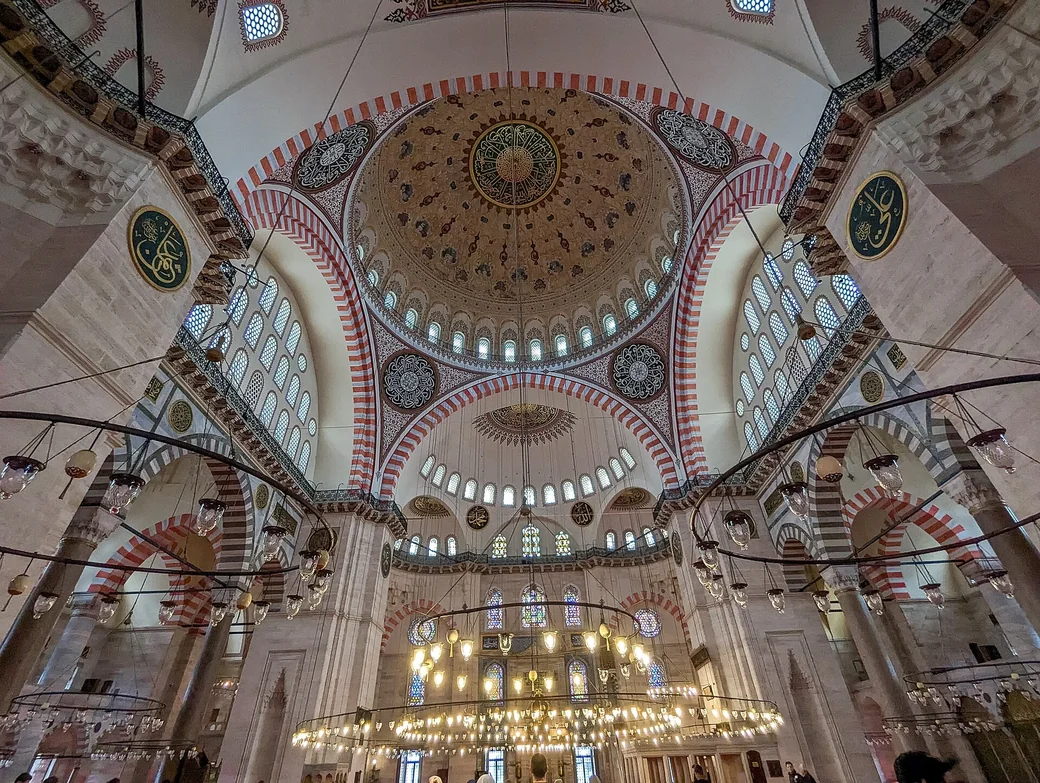
The central dome reaches 53 metres and measures roughly 27 metres across, supported by four great piers and two half-domes in a scheme inherited from Hagia Sophia and the Bayezid II Mosque. Sinan's genius lay in making that old plan feel weightless. He buried the heavy buttresses inside the walls, joined them with galleries and filled the spaces between with windows, so that light pours in from every side. The prayer hall is almost square, around 58 by 57 metres, and the dome's diameter is half its height. Sinan compared the windows around the dome to the wings of the angel Gabriel.
Four minarets and ten balconies: what they symbolise
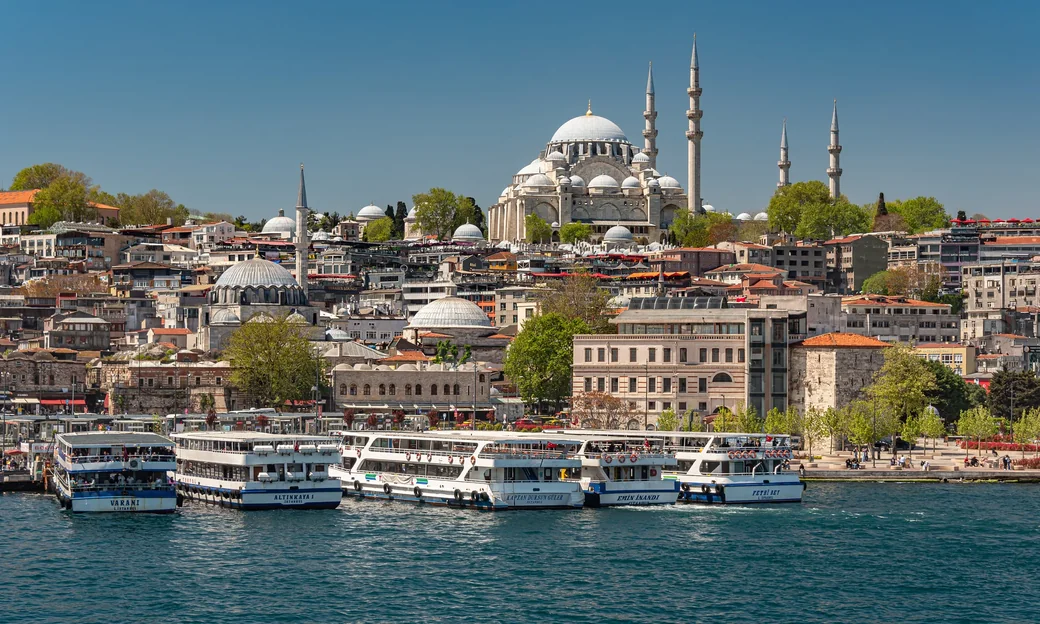
Four minarets stand at the corners of the courtyard, which in Ottoman practice was reserved for mosques founded by a sultan. The two taller ones, beside the prayer hall, have three balconies and rise to about 76 metres including their lead caps. The two shorter ones, at the far corners of the courtyard, have two balconies each and reach roughly 56 metres. Together they carry ten balconies. Tradition reads this as a message: four minarets for the fourth sultan after the conquest of the city, and ten balconies for the tenth Ottoman ruler. The graded heights also make the whole mass seem to climb toward the dome.
Courtyard, fountain and portal of the Süleymaniye Mosque
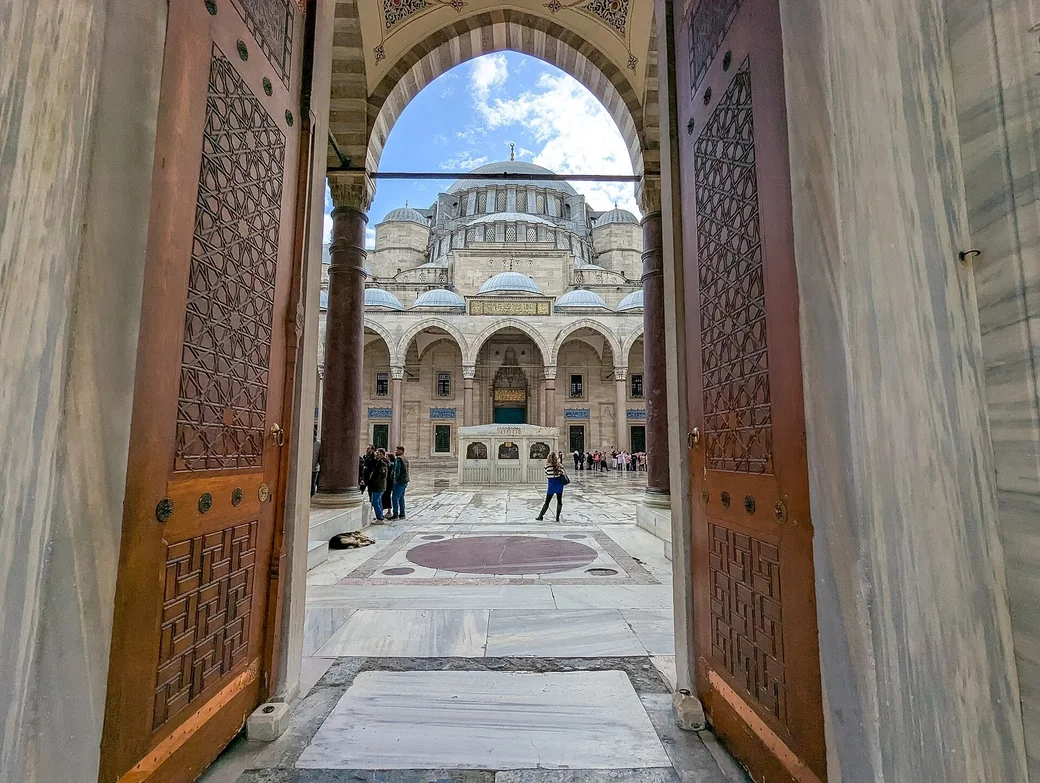
The courtyard measures about 47 by 57 metres and is surrounded by a peristyle of marble, granite and porphyry columns crowned with stalactite-like muqarnas capitals. The central fountain is decorative; water once sprayed down from its ceiling, which early visitors found unusual, and the real ablution taps sit outside under the wide eaves of the side galleries. The portal of the prayer hall bears a foundation inscription composed by the Sheikh ul-Islam Ebussuud Efendi and written in thuluth script by Hasan Çelebi. Its doors are carved from walnut, ebony and olive wood and inlaid with ivory and mother-of-pearl. According to the records, the main door is the work of the master joiner Ahmed.
Inside the prayer hall: calligraphy, stained glass and Iznik tiles
Sinan kept the interior restrained on purpose. The endowment deed states that showy gold and jewelled ornament was avoided, and calligraphy takes the place of lavish decoration. Iznik tiles are used only around the mihrab (the prayer niche showing the direction of Mecca), and the most elaborate stained-glass windows are found on the qibla wall beside it, traditionally attributed to Sarhoş İbrahim. The painted dome you see today dates from the nineteenth-century repairs of the Fossati brothers; traces of the original scheme, mostly red with an early experiment in blue, were found during cleaning. The simple marble minbar (the pulpit) and the sultan's loge on eight granite and marble columns complete the picture.
Firsts and records of the Süleymaniye Mosque
The Süleymaniye is the largest Ottoman-era mosque in Istanbul. Its tile lunettes were the first in which Iznik potters used the bright tomato-red under the glaze, and the panels beside the entrance of Suleiman's tomb are the earliest known tiles with emerald green. The tomb's fourteen-metre dome is the first major double-shelled dome in Sinan's work, and the water taps tucked under the gallery eaves were a practical innovation. Sinan called the Şehzade Mosque his apprentice work, this mosque his journeyman work and the Selimiye in Edirne his masterpiece, although most visitors would happily call it perfect already.
Tombs of Suleiman, Hürrem Sultan and Mimar Sinan
Behind the qibla wall lies the walled cemetery. Suleiman's octagonal tomb, begun after his death during the Szigetvár campaign in 1566 and finished by 1568, stands inside a portico of twenty-four columns; its double-shelled dome covers Iznik tiles and a band of Quranic verses, and beside the sultan rest his daughter Mihrimah and the later sultans Suleiman II and Ahmed II. Hürrem Sultan's smaller octagonal tomb, dated 1558, has a sixteen-sided tiled interior. Outside the complex wall, at a street corner, Sinan's own simple tomb sits under a light dome on six columns, fronted by a marble drinking fountain. Scholars compare the design of Suleiman's tomb with the Dome of the Rock in Jerusalem, and the thuluth inscription in Sinan's tomb is by Nakkaş Sai.
The Süleymaniye complex today: madrasas, hammam, library, museum
The külliye once included four madrasas, a medical school, a hospital, a public kitchen, a caravanserai, a hammam, a primary school and rows of shops, many built on terraced substructures because of the slope. The shop row below the madrasas, known as the Tiryaki Çarşısı, was famous for its coffeehouses. Today the hospital building has been restored, the old Sıra Dükkânlar shops east of the mosque serve as the Istanbul Design Museum, and the hammam, built in 1557, still stands. The Süleymaniye Manuscript Library, among the world's great collections, works as a research library rather than a sightseeing stop.
Fires, earthquakes and restorations of the Süleymaniye
The mosque was damaged in the great fire of 1660 and repaired under Mehmed IV. Part of the dome collapsed in the earthquake of 1766, and later repairs covered much of Sinan's decoration. Major work followed in the middle of the nineteenth century. During the First World War the courtyard served as an ammunition store and a fire broke out. A full restoration was completed in 1956, the prayer hall was conserved between 1961 and 1967, and the most thorough campaign ran from 2007 to 2010, removing cement mortars and strengthening the cracked dome. UNESCO documents cite the work as good practice within the World Heritage property. That property, the Historic Areas of Istanbul, was inscribed on the World Heritage List in 1985, and the Süleymaniye quarter around the mosque forms one of its protected zones.
How the Süleymaniye was built: the archive story
Thanks to the research of the historian Ömer Lütfi Barkan, the accounts of the construction survive in remarkable detail. Some 3,523 master craftsmen from eight trades worked on the site, supported by thousands of labourers; the daily average was around 1,674 people, and on one day in July 1555 more than three thousand were at work. Paid labourers, recruits from the sultan's household troops and enslaved workers all took part, and about half of the labour force was Christian and half Muslim. Daily wages ranged from one to twelve akçe. The first site manager's books are lost, so the earliest years are known only indirectly. The mosque itself employed 277 people under its endowment.
Süleymaniye legends I: the dream, the jewel minaret and the hookah
According to a popular tale, Suleiman dreamt that the Prophet showed him where the mihrab and minbar should stand; he took Sinan to the hill without a word, and Sinan answered that he had been two steps behind him in the dream. Another story, attributed to Evliya Çelebi, who wrote long afterwards, says the Safavid shah Tahmasp sent a casket of jewels while building was slow; the offended sultan gave it to Sinan, who is said to have set the gems in the mortar of a minaret, the so-called Jewel Minaret. No document confirms either story. A third tale shows Sinan puffing an unlit hookah to test the acoustics. According to a widely told tradition, Justinian cried "Solomon, I have surpassed you" on completing Hagia Sophia; that Suleiman's mosque answers this boast is an interpretation, not a documented statement.
Süleymaniye legends II: ostrich eggs, soot room and the four columns
According to tradition, Sinan hung ostrich eggs in the lamp bowls to keep spiders and scorpions away, and he built a chamber above the main entrance to collect lamp soot, which was supposedly used to make ink. Vakıflar specialists do mention the soot room, but the ink and the eggs remain unproven traditions. Another story says the four huge interior columns were carried from Baalbek, Alexandria and various places in Istanbul; contemporary accounts only prove that columns were reused from several sites. Finally, the claim that the mosque never cracked in a hundred earthquakes is a myth: the dome partly collapsed in 1766.
Visiting the Süleymaniye: prayer times, etiquette and rules
The Süleymaniye is an active mosque, so the main hall is closed to sightseeing during the five daily prayers, and Friday around noon is the busiest and least suitable time. Visiting windows can differ from one source to another, so check the day's prayer schedule and ask at the gate. Remove your shoes, speak softly, avoid flash and keep food and drink outside. Cover shoulders and knees, and bring a scarf if you are a woman. Dress and behaviour matter more here than at a museum, so follow staff instructions at once.
How to get to the Süleymaniye Mosque and what to see nearby
The easiest approach is the M2 metro to Vezneciler, followed by a short walk uphill. Tram riders can use Beyazıt-Kapalıçarşı or Laleli-Üniversite, and from Eminönü it is a ten to fifteen minute climb. Combine the visit with Beyazıt Square and Istanbul University next door, the Grand Bazaar a short walk away, the Spice Bazaar and ferries at Eminönü, and Sinan's earlier Şehzade Mosque. In the lanes below the mosque, the old market street offers small restaurants, and the neighbourhood's best-known dish is its slow-cooked white bean stew. Streets are steep and cobbled, so wear shoes with good grip.
Best time, photo spots and Ramadan lights at the Süleymaniye
Weekday mornings are the calmest hours, and the light falls from the side onto the courtyard walls, ideal for photographs. Late afternoon and sunset repay the climb with the best view of the city: walk to the northern garden wall for the Golden Horn, Galata and the Bosphorus together. Photographs inside should be taken without flash and without disturbing worshippers. In winter the lit silhouette is striking, and during Ramadan a mahya, a text of lamps strung between the minarets, is hung each year, a tradition that once included a moving mahya with boats and a bridge. Friday noon is best avoided. For the classic view of the mosque itself, look back at it from the ferries, the bridges or the opposite shore of the Golden Horn, where its silhouette rises above the old city.
Süleymaniye Mosque: Visitor Tips
Arrive on a weekday morning, when the courtyard is almost empty and the light falls across the walls from the side. Check the prayer schedule before you go, because the main hall is reserved for worshippers during prayers and the hours around Friday noon are the busiest of the week. Carry a scarf and cover shoulders and knees; you will take your shoes off at the door, so wear socks you do not mind showing. Walk to the garden wall on the Golden Horn side for the panorama over the water, Galata and the Bosphorus, and return near sunset if you can, when the skyline turns gold. Do not skip the tombs behind the prayer hall and the small tomb of Sinan just outside the wall. Silence, no flash and no food inside are the unwritten rules everyone follows. The approach to the mosque is steep and cobbled and some parts have steps, so visitors with reduced mobility should ask the staff at the gate which entrance is easiest. If you plan to bathe in the historic hammam, reserve ahead, because it works by appointment.
Süleymaniye Mosque: Best Time to Visit
Weekday mornings for quiet and soft side light; late afternoon and sunset for the Golden Horn panorama. Avoid prayer times and Friday noon.
Süleymaniye Mosque: Admission Fees
Free admission
Entering the mosque and its terrace is free; modest dress is expected and visits pause during prayer times.
Free
Quick Info
1h
easy
Süleymaniye Mosque: Getting There
The simplest route is the M2 metro line to Vezneciler station; from there the mosque is a short, signposted walk uphill of roughly five to ten minutes. If you travel by the T1 tram, get off at Beyazıt-Kapalıçarşı or Laleli-Üniversite and walk up through the university quarter. From the Eminönü ferry piers and tram stop it takes about ten to fifteen minutes on foot, with a steady climb at the end. Several city bus lines pass close to the Süleymaniye quarter, and a taxi can drop you at the main courtyard gate, although the narrow streets around the hill are often congested. The area is best explored on foot, so wear comfortable shoes, and allow extra time if you plan to continue to the Grand Bazaar or the Spice Bazaar afterwards.
Nearby stops & parking
The closest metro station is Vezneciler on the M2 line, about five to ten minutes away on foot. Haliç metro station near Unkapanı is a slightly longer walk of roughly ten minutes. The nearest tram stops are Beyazıt-Kapalıçarşı, Laleli-Üniversite and Eminönü, and the Eminönü ferry piers are also within walking distance. Taxis can stop at the street gates, but there is no large car park next to the mosque, so public transport is recommended. Paid car parks exist in the surrounding historic district, yet driving into the narrow, steep lanes is rarely worth the trouble.
Süleymaniye Mosque: Dress Code & Etiquette
Süleymaniye is an active place of worship, so modest clothing is expected from every visitor. Shoulders and knees should be covered; men should avoid shorts and sleeveless tops, and women are advised to bring a scarf for the head. Scarves are sometimes lent at the entrance, but you should not rely on it. Shoes are taken off before the prayer hall, so socks are a good idea. Speak quietly, switch off the phone sound, do not use flash, do not eat or drink inside, and never walk in front of people who are praying. During prayers the main hall is closed to sightseeing, and a polite request from the staff should always be followed.
Guide / Language
en
tr
de
fr
es
it
pt
ar
zh
ja
ko
Süleymaniye Mosque: Amenities & Facilities
Golden Horn panorama terrace
Ablution taps
Tombs of Suleiman and Hürrem Sultan
Courtyard with central fountain
Külliye buildings: madrasas, hammam, design museum