The Sultan Ahmed Mosque (Sultanahmet Camii), known around the world as the Blue Mosque, is the imperial mosque of Sultan Ahmed I and one of the most famous landmarks of Istanbul. It stands in Sultanahmet Square, in the historic heart of the old city. Its graceful domes and minarets crown the skyline, and its richly decorated interior makes it one of the most admired religious buildings in the world. It remains a working mosque that also opens its doors to visitors, so a visit here is both a sightseeing highlight and a glimpse of living faith.
Blue Mosque (Sultan Ahmed Mosque): Location, accommodation options and contact
Sultanahmet Square (At Meydanı) No:7, 34122 Sultanahmet, Fatih, Istanbul, Türkiye
The place's location on the map and nearby accommodation and hotel options are shown by Stay22. Cookies are used. Your consent is remembered on every page; you can turn it off at any time in the cookie settings.
Why Sultan Ahmed I Built the Blue Mosque in Sultanahmet
Work began in 1609 under Sultan Ahmed I, who had come to the throne as a teenager. After the Peace of Zsitvatorok in 1606 damaged Ottoman prestige, he wanted a monument that would win divine favour and rival Hagia Sophia. The site on the old Byzantine Great Palace had to be cleared of several viziers’ palaces, including that of Sokollu Mehmed Pasha. It was the first imperial mosque in more than forty years and was paid for from the treasury rather than from war booty. The opening ceremony took place on 9 June 1617, although the inscription on the gate gives 1616; the building was not quite finished, and the last accounts were signed by Ahmed’s successor, Mustafa I. The southern side of the mosque still rests on the foundations and vaults of the Byzantine Great Palace.
Blue Mosque Architecture: Dome, Piers and 260 Windows
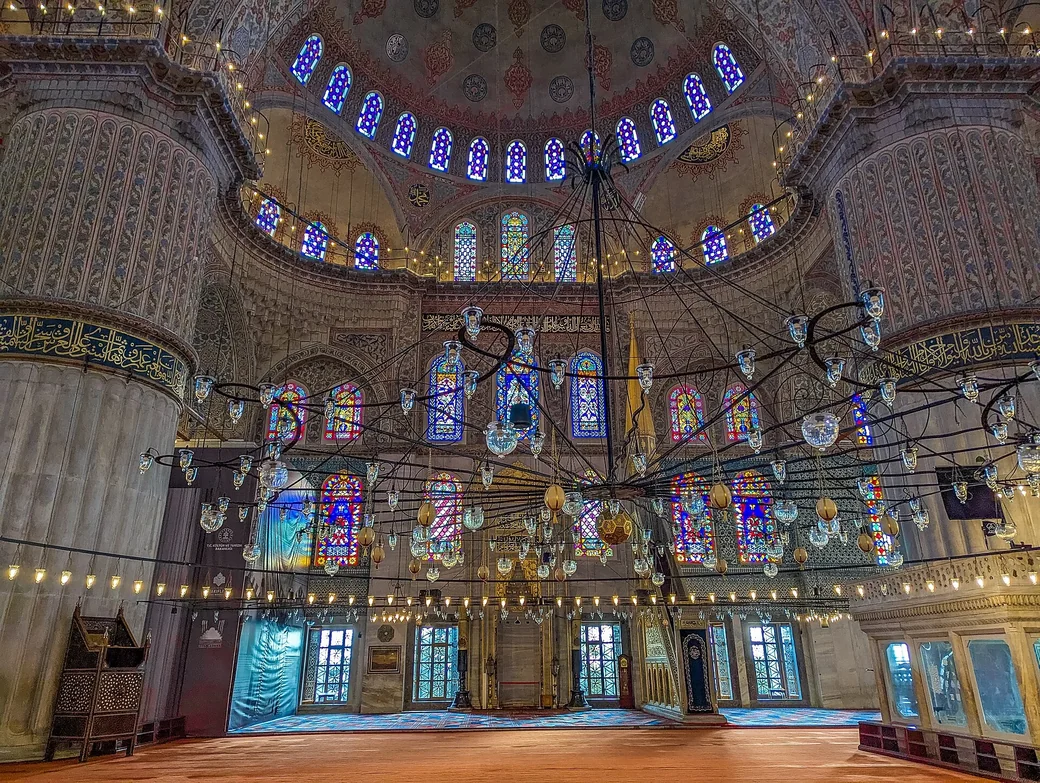
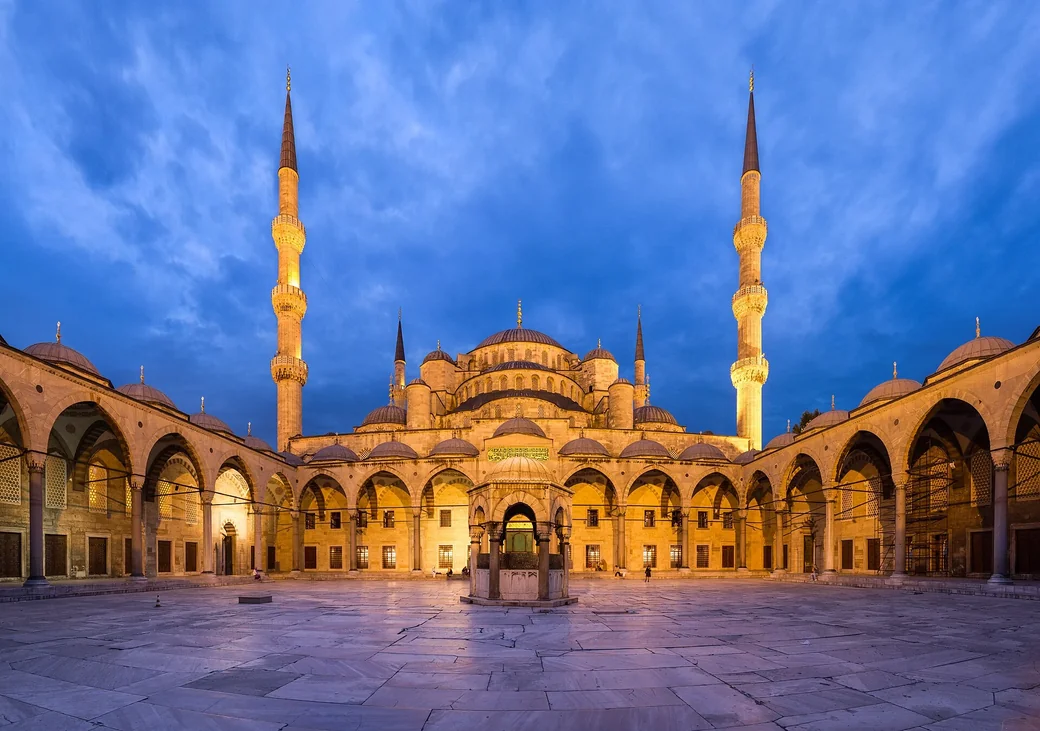
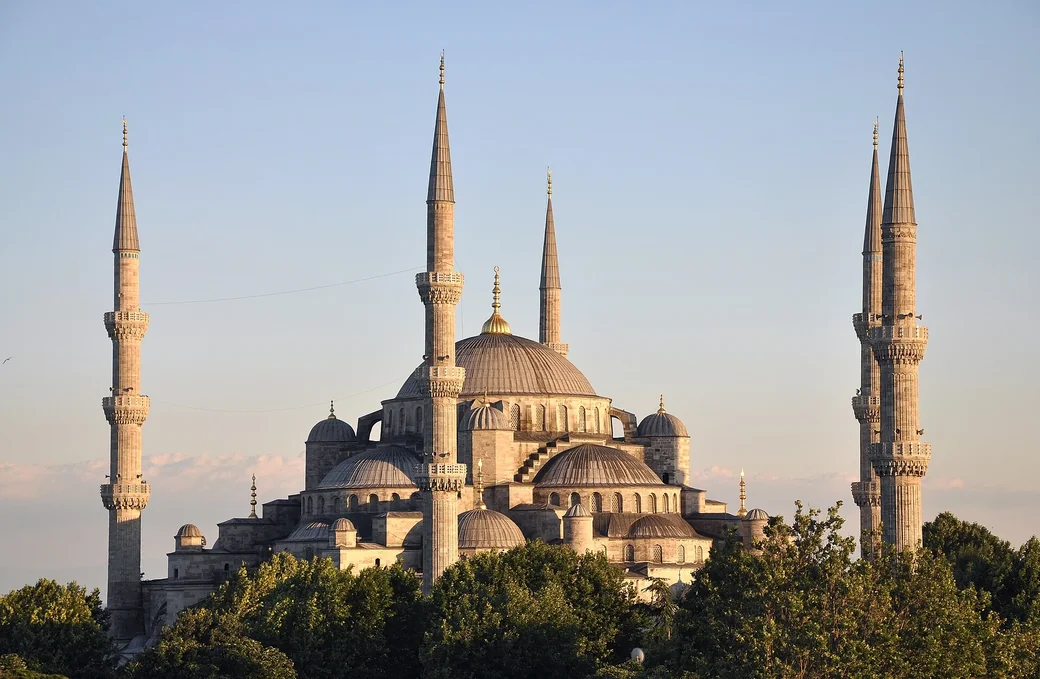
A central dome 43 metres high and 23.5 metres wide is carried by four piers about five metres thick and by four semi-domes. The prayer hall measures roughly 64 by 72 metres. Architect Sedefkâr Mehmed Ağa, a pupil of Sinan, placed around 260 windows so skilfully that the dome seems to float, and the count is higher than at the Süleymaniye. Twelve kinds of marble clothe the walls and columns, and the mosque can hold about 12,000 worshippers at once. The courtyard, roofed by 26 columns and 30 small domes, is entered through three gates. The royal gallery stands in the southeast corner on ten marble columns and has its own mihrab (the prayer niche showing the direction of Mecca) and a mother-of-pearl inlaid door. The architect’s nickname Sedefkâr means mother-of-pearl master, and the inlaid walnut throne he made for Ahmed I can be seen in Topkapı Palace.
İznik Tiles, Blue Paintwork and Calligraphy Inside the Blue Mosque
More than 20,000 İznik tiles, with a figure of 21,043 often quoted, cover the lower walls. They came from İznik and Kütahya workshops in blue, green and white, with tulip and floral designs. Blue painted decoration on the domes and semi-domes gave the mosque its nickname abroad. The inscriptions were written by the calligrapher Seyyid Kasım Gubari of Diyarbakır. Look for the marble mihrab with its stalactite carving and the richly decorated minbar (the pulpit) beside it.
Why the Blue Mosque Has Six Minarets: Facts and Legends
Four minarets with three balconies stand at the corners of the prayer hall and two with two balconies flank the courtyard, making sixteen balconies in all. At the time, six minarets existed only at the Haram in Mecca. According to legend, the sultan asked for altın (gold) minarets, the architect heard altı (six) and built six. According to another legend, scholars protested that this rivalled Mecca, so a seventh minaret was added there. Neither story is documented history. Another rumour ties the six minarets to Ahmed being the sixth sultan after the conquest and the sixteen balconies to his being the sixteenth sultan; as he is usually counted as the fourteenth, such number tales cannot be taken as fact. According to one rumour, six was chosen so as not to exceed the seven balconies of the mosque in Mecca. Another version says the architect travelled to Mecca and, on his return two years later, told the sultan that there were now seven.
Legends of the Blue Mosque: First Pickaxe, Gate Chain and Ostrich Eggs
According to tradition, the sultan struck the first pickaxe himself and carried earth in the skirt of his robe, a scene recorded by Evliya Çelebi; the pickaxe is said to be kept in Topkapı Palace. According to legend, an iron chain above the courtyard gate forced even the sultan to bow his head when he rode in. Rumour says ostrich eggs hung from the lamps to keep spiders away, that a fragment of the Black Stone lies near the mihrab, and that the design reworks an unbuilt Sinan project. None of this is proven. According to another tale, the building belongs to a chain of rivalry in which Hagia Sophia was said to outdo Solomon’s Temple and the Süleymaniye to outdo Hagia Sophia, while this mosque was built to rival Hagia Sophia in turn. In the same account, as he carried the earth the sultan prayed that it be accepted as the humble service of his servant Ahmed, and the grand vizier, the scholars, the janissaries (the Ottoman elite infantry corps) and the cavalry then joined in.
Sultanahmet Complex: Ahmed I Tomb, Carpet Museum and Arasta Bazaar
The mosque was the heart of a külliye (a mosque complex with schools, a hospital and other charitable buildings) with a madrasa, school, hospital, kitchen and bazaar, though some parts have not survived. The tomb of Ahmed I, built in 1617–1619 and finished under Osman II, stands on the northeast side and holds 36 sarcophagi, among them Kösem Sultan, Osman II and Murad IV. The royal pavilion, damaged by fire in 1912, now houses the Vakıflar Carpet and Kilim Museum. The arasta (a row of shops attached to a mosque, whose rents support it) bazaar, completed in 1617, includes the Great Palace Mosaic Museum. The zigzag painted decoration inside the tomb is said to recall the covers of the Kaaba. Ahmed I himself died in 1617, the year the mosque opened, at the age of only 27.
Blue Mosque Highlights: UNESCO Listing, Restoration and Papal Visit
The mosque belongs to the Historic Areas of Istanbul, inscribed by UNESCO in 1985. Its royal pavilion was the first of its kind in Ottoman architecture, and the building is regarded as the last great mosque of the classical period. A major restoration by the General Directorate of Foundations ran from 2018 to 2023: three minarets were taken down and rebuilt stone by stone, the domes were re-leaded and the painted decoration renewed. Pope Benedict XVI visited on 30 November 2006. It was reportedly the second papal visit to a Muslim place of worship. The restoration closed the mosque to visitors and worshippers for only five months; it reopened on 21 April 2023, the first day of Ramadan Bayram, after Friday prayer, in a ceremony. Work included a tall scaffold that reached dome level for conservation work. The mosque also gave its name to the Sultanahmet district. The 2018–2023 campaign was the most extensive restoration in the building's history.
Blue Mosque Prayer Breaks and Friday Services: How to Plan Your Visit
The mosque receives visitors every day, but it is an active place of worship, so it closes to sightseers around each of the five daily prayers and for longer around the Friday midday prayer. Visiting arrangements change with the season and on religious holidays, including Ramadan, so check the prayer-time board in the courtyard and the official information before you go. Plan your day so that you arrive well before a prayer break rather than during it, and allow about 30 to 45 minutes inside.
Best Time to Visit the Blue Mosque and How to Avoid the Crowds
Go on a weekday morning, soon after the mosque opens to visitors, when the tour groups have not yet arrived and the light on the tiles is soft. Spring (April–May) and autumn (September–October) are comfortable seasons, and the courtyard is lovely in tulip time. Avoid Friday midday, public holidays and the stretch just before each prayer break, when visitors pile up outside. Summer is the busiest season and winter is calmer. Early hours also leave room to enjoy the courtyard and the exterior calmly, which is good for photographs.
How to Get to the Blue Mosque: T1 Tram, Metro Links and Driving
Take the T1 Bağcılar–Kabataş tram to the Sultanahmet stop and walk across the square. The tram connects with the metro lines and Marmaray, so travellers from either side of the Bosphorus can reach it easily, and Gülhane and Çemberlitaş are the neighbouring stops. Driving is possible via the coastal road (Kennedy Avenue) and the Çatladıkapı entrance, but the mosque has no car park and parking in Sultanahmet is very limited, so a tram ride or a taxi to the square is wiser.
Visiting the Blue Mosque: Entrance, Shoes, Security and How Long to Stay
Visitors use an entrance separate from the worshippers, so follow the signs and the staff. Shoes come off before the carpet; you may carry them in a bag or leave them on the shelves. Strollers are not allowed inside, and security staff may ask you to follow their instructions. A relaxed visit to the prayer hall takes 30 to 45 minutes, and you should allow another half hour for the courtyard and the square. Bring only a small bag.
Blue Mosque Dress Code and Etiquette: Do’s and Don’ts
Do cover your shoulders and knees, take off your shoes, speak softly and respect the line between visitor and prayer areas. Women should cover their hair. If your clothes are unsuitable, borrow garments from the loaner cabin and return them to the same cabin. Don’t smoke in the garden, don’t wear shorts or sleeveless tops, don’t photograph worshippers and don’t step into areas reserved for prayer. Follow the instructions of security staff and of officials carrying a mosque identity card.
Photography Tips for the Blue Mosque: Best Viewpoints and Rules
The classic view takes in the mosque and Hagia Sophia together from Sultanahmet Park between the two monuments, while the Hippodrome side shows the domes cascading downward. Inside, photography is welcome outside prayer times, but use no flash and never photograph people praying or washing. Morning light brings out the blue of the tiles, and in spring tulips frame the courtyard. A wide-angle lens helps in the prayer hall, while a tripod is rarely practical in a crowd.
Blue Mosque Accessibility, Families and Guides
A wheelchair ramp is reported at the northwest entrance near the Hippodrome. To protect the carpet, visitors transfer, with help from the staff, into a wheelchair provided by the mosque, and the paving around the square is cobbled. Strollers cannot enter the prayer hall, so carry small children or use a baby carrier. Guided visits and audio guides are offered by outside operators, with English audio guides available.
Places Near the Blue Mosque in Istanbul: Hagia Sophia, Hippodrome and More
Hagia Sophia stands directly opposite, across the square. The Hippodrome beside the mosque still holds the Obelisk of Theodosius and the Serpent Column. The Basilica Cistern, Topkapı Palace and the Grand Bazaar are all within a short walk. Behind the mosque, the arasta bazaar and the Great Palace Mosaic Museum reveal what lay beneath the Byzantine palace. A half day in Sultanahmet easily covers several of these sights.
Blue Mosque (Sultan Ahmed Mosque): Visitor Tips
Plan your visit around the five daily prayers: the mosque closes to visitors for a while around each prayer, and Fridays call for extra planning. Arrive soon after the mosque opens to visitors to keep the queue short, wear shoes that slip off easily and carry a light scarf. Use the visitor entrance, keep your voice low and take photos without flash. A relaxed visit takes 30 to 45 minutes. Combine it with Hagia Sophia, the Hippodrome and the Basilica Cistern, all within a few minutes’ walk.
Blue Mosque (Sultan Ahmed Mosque): Best Time to Visit
Weekday mornings soon after the mosque opens to visitors; spring (April–May) and autumn (September–October). Visits fit between prayer times; Friday midday belongs to worshippers.
Blue Mosque (Sultan Ahmed Mosque): Admission Fees
Free admission
Entry is free for all visitors; modest dress is expected and visits pause during prayer times.
Free
Quick Info
45m
easy
Blue Mosque (Sultan Ahmed Mosque): Getting There
The simplest way to reach the Blue Mosque is the T1 Bağcılar–Kabataş tram. Get off at the Sultanahmet stop and walk the short distance across the square to the mosque. The T1 line can be reached by transfer from the metro lines and from Marmaray, so visitors from both the European and the Asian side can connect easily. From Eminönü or Karaköy the journey takes only a few minutes. Driving is possible along the coastal road (Kennedy Avenue) and through the Çatladıkapı entrance, but the mosque has no car park and the streets around Sultanahmet Square are narrow and busy, so a tram ride or a taxi to the edge of the square is far more practical.
Nearby stops & parking
The closest stop is Sultanahmet on the T1 tram line, a few minutes’ walk from the visitor entrance. The neighbouring stops of Gülhane and Çemberlitaş are also within walking distance. The mosque itself has no car park, and only a few small private car parks with very limited capacity operate in the neighbourhood. Taxis can drop passengers at the edge of Sultanahmet Square, from where it is a short walk over cobbled pavement to the mosque.
Blue Mosque (Sultan Ahmed Mosque): Dress Code & Etiquette
As an active place of worship, the mosque asks visitors to cover shoulders and knees, both inside the building and in the courtyard. Women are expected to cover their hair with a scarf. Visitors without suitable clothing can borrow garments from the loaner clothing cabin and must return them to the same cabin. Shoes are taken off before the carpeted area. Keep your voice low, do not smoke in the garden, respect the barrier that separates visitors from worshippers and never photograph people while they pray.
Guide / Language
en
Blue Mosque (Sultan Ahmed Mosque): Amenities & Facilities